- English
- French
- German
- Portuguese
- Spanish
- Russian
- Japanese
- Korean
- Arabic
- Greek
- German
- Turkish
- Italian
- Danish
- Romanian
- Indonesian
- Czech
- Afrikaans
- Swedish
- Polish
- Basque
- Catalan
- Esperanto
- Hindi
- Lao
- Albanian
- Amharic
- Armenian
- Azerbaijani
- Belarusian
- Bengali
- Bosnian
- Bulgarian
- Cebuano
- Chichewa
- Corsican
- Croatian
- Dutch
- Estonian
- Filipino
- Finnish
- Frisian
- Galician
- Georgian
- Gujarati
- Haitian
- Hausa
- Hawaiian
- Hebrew
- Hmong
- Hungarian
- Icelandic
- Igbo
- Javanese
- Kannada
- Kazakh
- Khmer
- Kurdish
- Kyrgyz
- Latin
- Latvian
- Lithuanian
- Luxembou..
- Macedonian
- Malagasy
- Malay
- Malayalam
- Maltese
- Maori
- Marathi
- Mongolian
- Burmese
- Nepali
- Norwegian
- Pashto
- Persian
- Punjabi
- Serbian
- Sesotho
- Sinhala
- Slovak
- Slovenian
- Somali
- Samoan
- Scots Gaelic
- Shona
- Sindhi
- Sundanese
- Swahili
- Tajik
- Tamil
- Telugu
- Thai
- Ukrainian
- Urdu
- Uzbek
- Vietnamese
- Welsh
- Xhosa
- Yiddish
- Yoruba
- Zulu
Are Grade 5 Titanium Brake Bicycle Bolts M5 safe for road bikes daily?
Yes — grade 5 titanium brake bicycle bolts M5 are safe for daily road bike use. Made from Ti-6Al-4V alloy, these bolts deliver a tensile strength of 950 MPa and a yield strength of 880 MPa, far exceeding what typical braking loads demand. They resist rust in rain, salt, and sweat without any coating degradation. At roughly 1.7g per bolt — about 40% lighter than steel equivalents — they shed real grams from your braking system without sacrificing structural integrity. When installed correctly with proper torque and anti-galling compound, they perform reliably across thousands of miles.
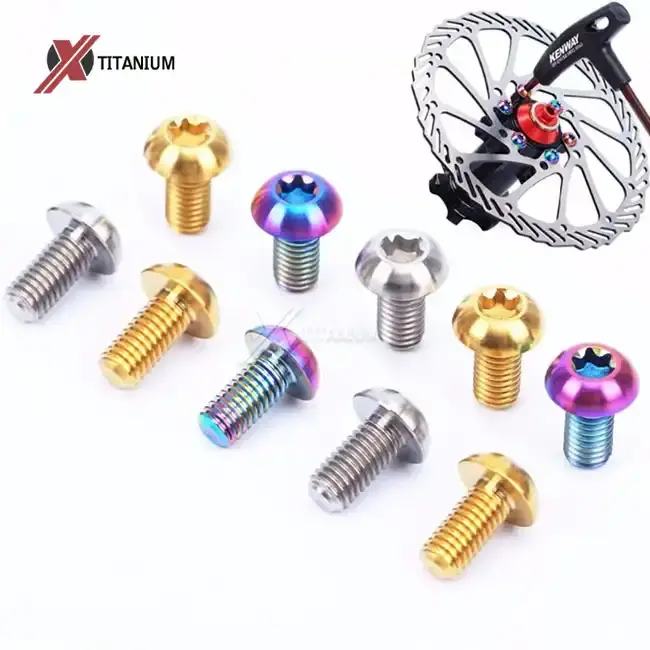
Understanding Grade 5 Titanium M5 Brake Bolts for Bicycles
What Is Ti-6Al-4V and Why Does It Matter?
Titanium metal Ti-6Al-4V is made up of 90% titanium, 6% aluminum, and 4% vanadium. When you put these two things together, they make an inactive oxide layer on the bolt's surface. This layer protects the bolt from acidic sweat, road salt, and water. This resistance to corrosion directly means longer service life and fewer replacements for brake system fasteners, which are parts that are constantly vibrating and going through thermal cycling.
M5 Thread Specifications Explained
When you see the number M5, it means that the thread is 5 mm wide and has a pitch of 0.8 mm. Lengths vary from 10mm to 50mm to accommodate different ways of mounting calipers. When you roll threads instead of cutting them, you keep the alloy's grain structure, which makes them much more resistant to fatigue when they are repeatedly slowed down. According to ISO standards, thread fit must be within a 6g tolerance. This makes sure that metal caliper bolts fit perfectly.
Typical Applications on Road Bikes
These bolts can be found on a disk brake road bike in three main places. At rotor mounts, they deal with both temperature cycles and shear forces at the same time. At brake post mounts, they can handle quick shock loads when stopping hard. When it comes to hydraulic line clamps on the handlebars, titanium's chemical inertness is very useful because stainless steel bolts in that spot usually break after just one season of being exposed to sweat.
Comparing Grade 5 Titanium Brake Bolts with Other Materials
Titanium vs. Stainless Steel
Each stainless steel M5 brake bolt weighs about 3 grams and has a tensile strength of 700 to 800 MPa, based on the grade. Grade 5 titanium is very strong (950 MPa) and very light (around 1.2–1.4g per bolt for M5x10 rotor bolts) . A full disk brake groupset has six rotor bolts per wheel and four caliper bolts. This can cut the weight by 25–30 grams. That difference can be seen and felt by road cyclists who are careful about their weight and competitive builds. Grade 5 titanium brake bicycle bolts M5 are the SKU where this strength-to-weight advantage is most measurable.
Titanium vs. Aluminum Bolts
For safety-critical jobs, aluminum rivets don't work because they are lighter than steel ones. Their tensile strength is usually less than 300 MPa, which means they can't be used to fix brake calipers, where quick deceleration forces put a lot of stress on the material. A lot of skilled mechanics think that aluminum brake bolts are dangerous. In some configurations, Grade 5 titanium is about the same weight as aluminum but has three times the structural strength.
Long-Term Cost Comparison
Titanium screws cost more up front than steel ones. Titanium, on the other hand, doesn't rust, stop, or need to be replaced often because its surface wears down. Over the course of three years of maintenance, titanium often has a lower total cost of ownership. This is especially true for brands that sell brake upgrade kits, where the durability of the bolts directly affects the reputation of the product and encourages customers to buy it again.
Installation and Maintenance Best Practices for M5 Titanium Brake Bolts
Torque Specifications and Anti-Galling Compounds
Torques greater than 10 Nm can be applied to the bolts themselves. But the parts they hold in place, like rotors, calipers, and lever clamps, usually only allow 5–7 Nm of installation torque. Always follow the torque settings that came with the caliper or rotor. Importantly, titanium galls when it comes into contact with aluminum when the threads are dry. Before installation, you should use a copper-based anti-seize paste or a titanium preparation compound on all of the threads. This step must be taken.
Threadlocker and Vibration Resistance
When brakes are used, they constantly vibrate. Even nuts that are properly torqued can slowly back out if they don't have extra retention. When used on clean threads, a medium-strength threadlocker on caliper mount bolts keeps them from coming loose without making removal harder in the future. You could also use spring screws, but threadlocker is usually better for disk brake jobs that need a steady holding force for safety reasons.
Inspection and Cleaning Routine
Check the brake bolts every 500–800 km of road riding or after any wet or muddy event. Inspect the bolt head and caliper face for movement or gaps at the seating surface. Before re-torquing, clean the threads with isopropyl alcohol. Titanium doesn't need rust protection the way steel does, because its oxide layer self-heals. Any bolt showing thread distortion or signs of over-torquing should be replaced before the next ride. Grade 5 titanium brake bicycle bolts M5 are the SKU where this inspection routine matters most.
Procurement Guide for Grade 5 Titanium M5 Brake Bolts for Road Bikes
Verifying Material Authenticity
Getting commercially pure Grade 2 titanium instead of Grade 5 is the most common source risk when getting titanium fasteners. The tensile strength of Grade 2 is only 345 MPa, which is far too low for brake applications. Ask for spectrochemical analysis certificates (mill certs) that prove the composition of Ti-6Al-4V and find out if the threads are rolled or machined. For fixings that need to last a long time, rolled threads are the best choice.
Customization Options for B2B Buyers
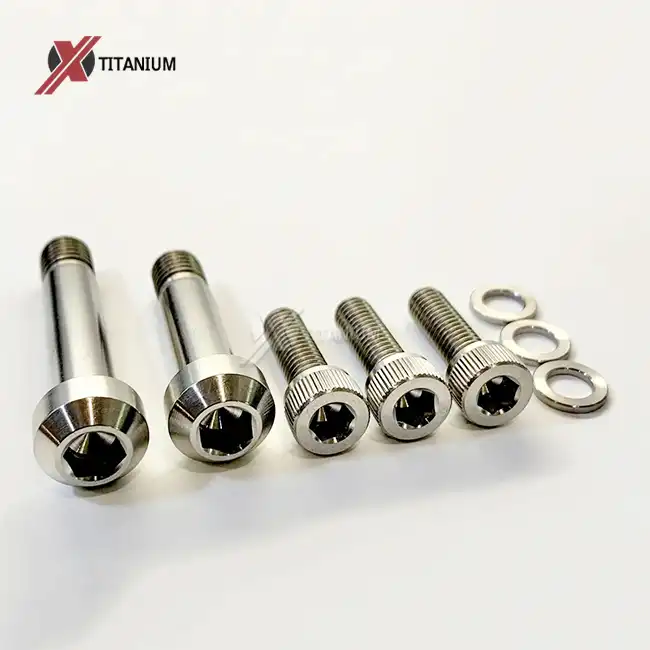
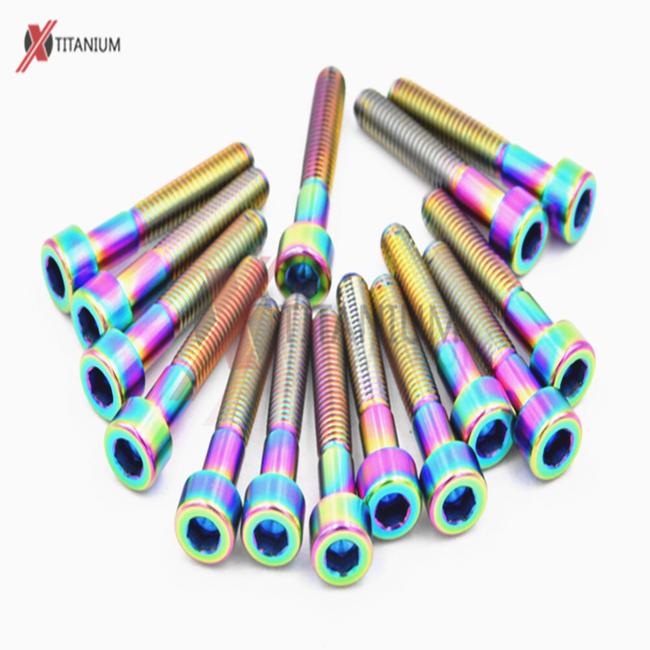
Anodized colors (gold, blue, green, purple, black, rainbow, and natural titanium), head types (hex, Torx, or custom), and lengths ranging from 10mm to 50mm are all customizable for brands and dealers who are building product lines. These choices let you make multi-SKU product catalogs that are good for both cosmetic upgrades and applications that need to make sure the fit is just right. MOQ usually starts at 500 to 1,000 pieces per SKU, which works for small to medium-sized brands that need to restock once a month.
Quality Control Standards to Require
Structured quality testing is needed for safety-critical screws. Check out four types of paperwork from a grade 5 titanium brake bicycle bolts M5 supplier: spectrochemical material verification; Go/No-Go gage thread testing to a 6g tolerance; proof load testing on random samples to confirm 950+ MPa tensile strength; and dimensional inspection reports confirming length tolerances. Any brand that sells brake parts faces supply chain risk if their seller can't provide these papers.
Safety and Reliability: Are Grade 5 Titanium Brake Bolts M5 Suitable for Daily Road Bike Use?
Fatigue Performance Under Real-World Conditions
The main worry for brake bolts is fatigue failure, not single-event overload. Ti-6Al-4V can only handle about 500–600 MPa of stress under cyclic loading, which is a lot more stress than a normal M5 brake bolt goes through when riding on the road. Studies on titanium fasteners used in aerospace and cars show that this alloy keeps its shape after millions of load cycles, which supports its use in cycling applications that need to be safe.
Addressing Concerns About Brittleness
A common question is whether titanium breaks when hit or when it gets cold. At low temperatures, Grade 5 titanium doesn't change from being ductile to brittle like some steels do. It has a 10% extension at break, which means it deforms clearly before breaking, giving you a warning instead of a quick failure. This feature is especially useful for bike riders who live in cold places or who ride in the mountains.
Return on Investment for OEMs and Resellers
Grade 5 M5 brake bolts have a strong product story for companies that make brake upgrade kits or full titanium fastener sets. The safety credentials have been checked, customers can see the weight savings, the resistance to corrosion has been seen after one winter, and there are color options that make the product stand out visually. These things allow for higher prices while lowering guarantee claims related to rust or failed fasteners.
Conclusion
When it comes to safety, Grade 5 titanium M5 brake bolts are a good choice for everyday road bike use. Their tensile strength, resistance to wear, and resistance to corrosion meet or beat the requirements of current disk brake systems. When installed with the right amount of torque and anti-galling compound, they work consistently for years without rusting or seizing like steel options do. When buying parts for brake systems, procurement teams must make sure that the parts are authentic Ti-6Al-4V with rolled threads and checked mechanical qualities. This is what makes a product safe or dangerous. Grade 5 titanium brake bicycle bolts M5 are the SKU where this sourcing discipline matters most.
FAQ
Do I need anti-seize compound when installing these bolts?
Yes. Titanium can cold-weld to aluminum under dry friction — a process called galling. Always apply copper paste or a titanium-specific prep compound before threading the bolt into an aluminum caliper or mount. This also ensures your torque wrench reading reflects actual clamping force rather than thread friction.
What is the correct torque for M5 titanium brake bolts?
The bolt itself can handle over 10 Nm, but the caliper or rotor manufacturer's limit — typically 5–7 Nm — governs the installation. Always reference the component specification, not the bolt's maximum capacity.
Can these bolts be reused?
Yes. Grade 5 titanium has good elastic memory. If the bolt was not torqued past its yield point (880 MPa yield strength), it can be removed, inspected, and reinstalled without performance loss — unlike aluminum fasteners, which deform more easily.
Is Grade 5 really necessary, or will Grade 2 work?
Grade 2 titanium has a tensile strength of only 345 MPa. Using it in brake caliper mounts is a safety hazard. Grade 5 is the only titanium grade appropriate for structural brake applications.
What lengths are available for different caliper standards?
Lengths from 10mm to 50mm cover flat mount, post mount, and IS mount configurations. Custom lengths are available for OEM or kit-specific requirements.
Partner with Chuanglian for Grade 5 Titanium Brake Bicycle Bolts M5
Based in Baoji, China, which is known as the titanium processing hub of the world, Chuanglian makes grade 5 titanium brake bicycle bolts M5 that are CNC machined to verified Ti-6Al-4V specifications. We are a reliable supplier of grade 5 titanium brake bicycle bolts M5, and we help small and medium-sized brands with orders as low as 500 pieces. Every order comes with full-color anodizing and material certification. You can email our team at info@cltifastener.com or djy6580@aliyun.com.
References
1. Donachie, M. J. Titanium: A Technical Guide. ASM International, 2000.
2. Boyer, R., Welsch, G., & Collings, E. W. Materials Properties Handbook: Titanium Alloys. ASM International, 1994.
3. ASTM B348: Standard Specification for Titanium and Titanium Alloy Strip, Sheet, and Plate. ASTM International, 2019.
4. Lütjering, G., & Williams, J. C. Titanium. Springer, 2007.
5. ISO 4762: Hexagon Socket Head Cap Screws — Product Grade A. International Organization for Standardization, 2004.
6. Peters, M., Kumpfert, J., Ward, C. H., & Leyens, C. "Titanium Alloys for Aerospace Applications." Advanced Engineering Materials, 2003.
Learn about our latest products and discounts through SMS or email