- English
- French
- German
- Portuguese
- Spanish
- Russian
- Japanese
- Korean
- Arabic
- Greek
- German
- Turkish
- Italian
- Danish
- Romanian
- Indonesian
- Czech
- Afrikaans
- Swedish
- Polish
- Basque
- Catalan
- Esperanto
- Hindi
- Lao
- Albanian
- Amharic
- Armenian
- Azerbaijani
- Belarusian
- Bengali
- Bosnian
- Bulgarian
- Cebuano
- Chichewa
- Corsican
- Croatian
- Dutch
- Estonian
- Filipino
- Finnish
- Frisian
- Galician
- Georgian
- Gujarati
- Haitian
- Hausa
- Hawaiian
- Hebrew
- Hmong
- Hungarian
- Icelandic
- Igbo
- Javanese
- Kannada
- Kazakh
- Khmer
- Kurdish
- Kyrgyz
- Latin
- Latvian
- Lithuanian
- Luxembou..
- Macedonian
- Malagasy
- Malay
- Malayalam
- Maltese
- Maori
- Marathi
- Mongolian
- Burmese
- Nepali
- Norwegian
- Pashto
- Persian
- Punjabi
- Serbian
- Sesotho
- Sinhala
- Slovak
- Slovenian
- Somali
- Samoan
- Scots Gaelic
- Shona
- Sindhi
- Sundanese
- Swahili
- Tajik
- Tamil
- Telugu
- Thai
- Ukrainian
- Urdu
- Uzbek
- Vietnamese
- Welsh
- Xhosa
- Yiddish
- Yoruba
- Zulu
Best Titanium Crank Spindle Bolts M10x1.0 Hollow: Buyer Guide
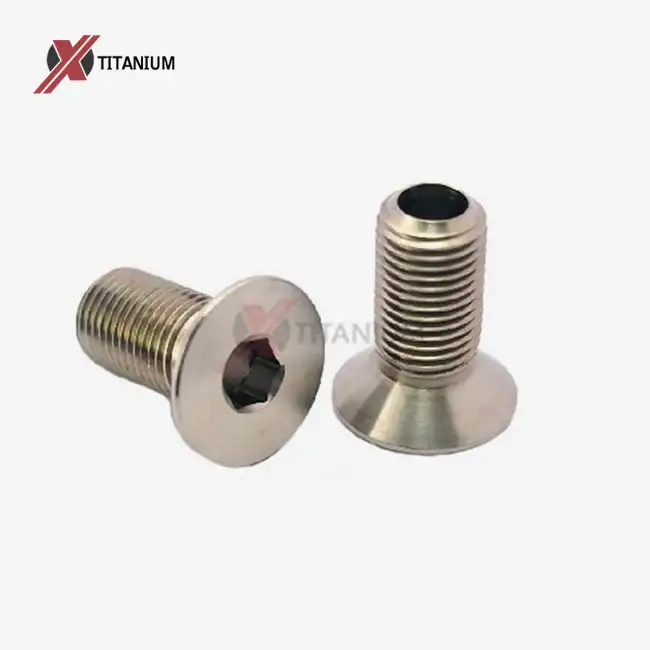
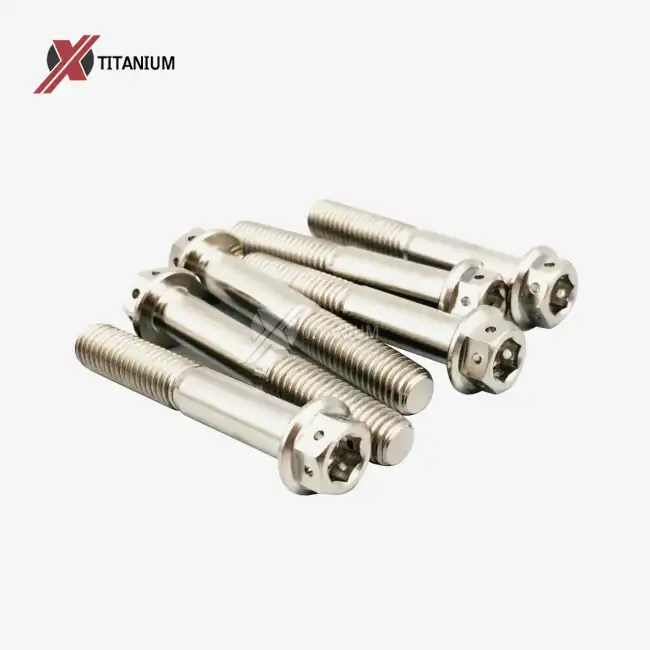
The best titanium crank spindle bolts M10x1.0 hollow combine Grade 5 (Ti-6Al-4V) material, a verified thread fit, controlled bore and wall geometry, and documented inspection. I wrote this buyer guide for engineers, purchasing managers, and distributors who want lightweight fasteners they can specify with confidence. Below, I explain how to confirm compatibility, judge machining quality, install the bolt correctly, and compare suppliers. At Chuanglian, we machine titanium parts in Baoji, China, and I draw on the questions we hear from buyers. Use this guide to build a clear specification before you request samples.
What Are Titanium Crank Spindle Bolts M10x1.0 Hollow?
Meaning of M10x1.0 and the Hollow Design
First, let me say the name. In millimeters, the number "1.0" tells you how far apart the thread crests are. "M10" means that the thread is supposed to be about 10 mm wide. More threads touch each other per unit of length when the pitch is small than when it is thick. The clamping load will stay in place better this way. We take out the core material and leave a hole in the middle to save weight. This is what "hollow" means. Forces that twist and bend mostly act on the top layers of a bolt. On the other hand, tension is based on the cross-section that is left over after boring. The answer is yes, a hollow design is not weak by nature. An engineer must check each wall thickness for its own load case, though.
Grade 5 Titanium Material and Core Data
The most common type of titanium metal, according to Donachie's technical guide, is Grade 5 titanium (Ti-6Al-4V). That's what we use to make these nuts. This one is only 4.43 g/cm³ dense, while steel is about 7.85 g/cm³ dense. The standard for our company says this:
| Item | Specification |
|---|---|
| Material | Titanium alloy, Gr5 (Ti-6Al-4V) |
| Thread | M10x1.0 |
| Length | 15 mm, 20 mm, 25 mm (customizable) |
| Head type | Hexagonal, Allen, Torx |
| Surface treatment | Polishing, anodizing, nitriding |
| Tensile / yield strength | ≥950 MPa / ≥880 MPa |
| Hardness / density | 36 HRC / 4.43 g/cm³ |
Your builders can use these numbers to figure out how much weight is on the building. The approval is still being held up until we see your picture and test results.
Why Choose Hollow Titanium Crank Spindle Bolts?
Because they are lighter and won't rust in acids and bases, titanium crank spindle bolts M10x1.0 hollow are a good choice. From what we can tell, they weigh about 30% less than steel bolts. Titanium looks high-end too, and it comes in colors like gold, blue, green, purple, rainbow, and Ti nature. People who want to buy titanium should still know that it isn't always better than steel or aluminum. Steel has a 200 GPa elastic modulus, but Ti-6Al-4V only has 114 GPa. This means that its preload behavior is different. To choose a hollow geometry, you should think about how much load you need to carry, the cost of the whole assembly, and the output volume.
How to Confirm Compatibility and Evaluate Hollow Crank Bolts?
Confirm M10x1.0 Crank Spindle Bolt Compatibility
Trying to find a match for "M10" is the fastest way to get the wrong part. Check the 1.0 mm pitch with a metric thread gage. Then, check to see what the thread runs in, how long it is overall, how long the thread can be used, how big the head is, how the drive interface is set up, and how the washers are arranged. Check the room around the crank spindle too. It's important that the threads don't bottom out when you check the fit. This is what ISO 965-1 says for external threads: tolerance class 6g. A lot of buyers ask for this. A sample part should be used to make sure the whole assembly works before you order a lot of it. Then, compare the supplier's picture to the original part paperwork for these titanium crank spindle bolts M10x1.0 hollow.
Check Bore, Wall Thickness, and Machining Quality
The weight of a hollow bolt doesn't tell you much about it by itself. Once more, look at the transition radii, wall thickness, bottom thickness, and bore diameter. A lot of OEM designs say that the wall should be regular within 0.1 mm and the bore should not be more than 0.05 mm off-center. You need to know what your goals are. There are weak spots in walls that aren't level where stress builds up, making each piece of the wall different strengths. That's why you should ask for a finite element analysis and test samples for stress and shear strength as the cross-section gets smaller. Also, look at how well the CNC works. Broken threads, burrs, and an uneven head shape can all make it harder to fit and depend on in the long term.
Compare Head Types, Lengths, and Finishes
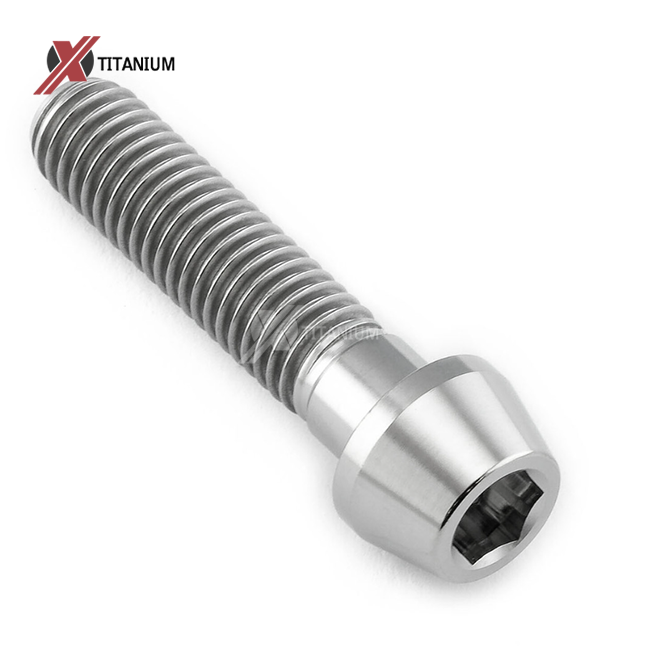
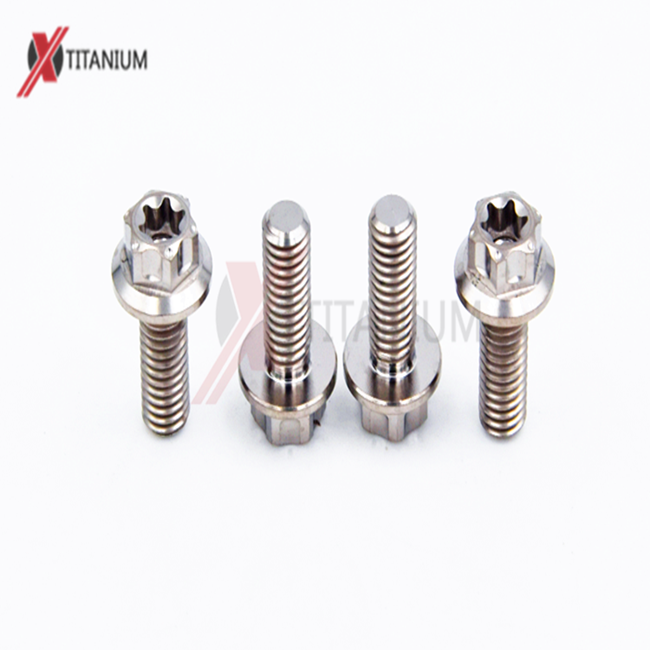
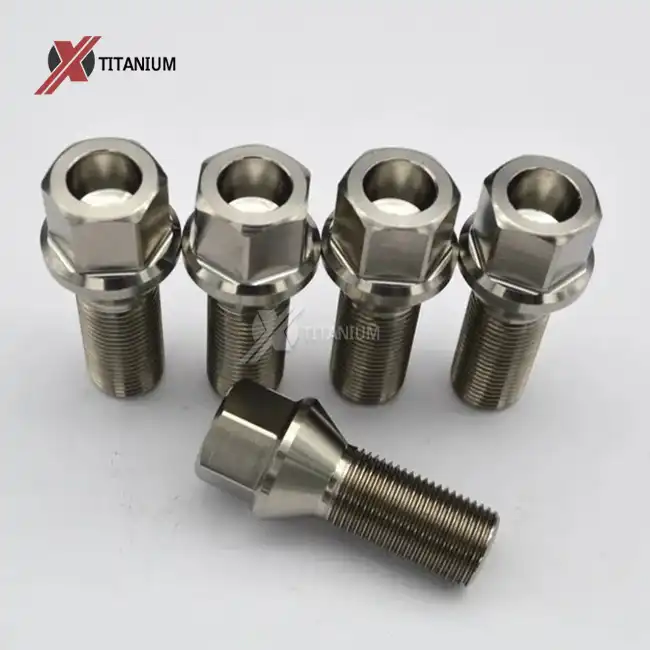
We have heads with hexagons, Allen, and Torx shapes, and the most common lengths are 15 mm, 20 mm, and 25 mm. You can also ask for different lengths. A drive inside a machine needs to be deep enough and have a wall that is thick enough to handle installation force without getting round. The three types of surface treatments are polishing, anodizing, and nitriding. They all change the surface's look and feel in different ways. Put together an easy comparison chart to help you with this. Standard replacements, premium products, and OEM solutions should all be put in the rows. Choose the type of head, the length, the finish, and the paperwork. That chart shows the pros and cons for both the buying team and the tech team.
Installation and Maintenance of M10x1.0 Titanium Crank Bolts
Prepare and Install the Bolt Correctly
When it's put together right, the titanium crank spindle bolts M10x1.0 hollow and crank assembly are safe. Make sure that the crank contact, the washer, the bolt, and its threads are all clean. Then, check each one for damage or dirt. You can be sure that the threads are straight and don't cross-thread if you start the bolt by hand. To get the crank tight enough, you should use a calibrated torque wrench and the number given by the maker or your engineering team. There isn't a single force number that can be used for everything because the right value depends on how the joint is built as a whole. The open part could get too tight if you use a wrench without a torque gage.
Control Galling and Lubricant Use
Ti threads can gall, which means the surfaces can tear, drag, and sometimes get stuck. You can use an allowed lube or anti-seize to help, but only if your standard lets you. Lubricant reduces friction, so the clamping load goes up for the same amount of force. If you don't change the torque, the bolt might be stressed too much. Things change even more when you add chemicals that lock threads together. It is important to test your exact mix of bolt, finish, spindle material, and lubricant during sample validation. Once you have that information, write it down in your building directions so that everyone can follow the same steps.
Inspect and Replace on a Schedule
Check the bolts that were put in place often. Cracks, warping, broken threads, and marks around the hollow part should all be looked for. Checks should be done less often during races than during regular rides because loads and pressure are higher. A bolt should be replaced if it's not clear how many times it has been used. Otherwise, a part that may have been dropped or overtightened could break. In a simple log, write down batch numbers so that you can find the source of any trouble. It takes less time to look into a complaint from the field if you keep good records.
Buying for B2B Procurement and Verifying Suppliers
Match the Sourcing Process to Your Role
Here are some things you should ask for based on what you want to buy. People who want to buy a replacement washer need to know exactly what will work with their old one and that they can count on delivery being on time. Distributors should check the minimum order quantity, how often the item can be ordered, barcodes, packaging, labeling, and customer service for titanium crank spindle bolts M10x1.0 hollow.
In order to make OEM products, companies need to have controlled drawings, approved samples, tolerances, torque requirements, surface specifications, and the ability to keep track of their products. In many OEM programs, the drawings are looked over, samples are tested, a small trial lot is made, and then the company gets more orders. Tell your seller early on what path you want to take so that the quote and sample plan can fit into your time frame.
Verify Supplier Quality for Grade 5 Titanium Hollow Crank Bolts
It is important to get a material certificate or mill test report that says the titanium is Grade 5. You should also get a certificate of conformity, a report on the size inspection, and a batch identification. ASTM B348 talks about titanium bars and billets, so it can help you choose which products to bring in. In the receiving area, check the overall and threaded length, the shape of the head, any hollow areas, the state of the surface, and the uniformity of the sample weight.
Find out what the thread diameter and pitch are. For OEM work, it's important to use a first-article method that includes reviewing the drawings, fitting the part, and getting approval on the measurements. You should also keep one accepted reference sample. Material descriptions that aren't clear, examples that can't be found, limits that aren't clear, and no way to keep track of them are all red flags.
Compare Total Cost, Not Only Unit Price
Bugs that cost a lot of money can be hidden by a low price. To find out how much it really costs per accepted part, you have to add up the sample, tooling, inspection, packing, freight, import fees, and the chance that the part will be turned down. If the price seems too low, you should find out more about the paper or the review's topic. Making hollow cuts takes longer than making solid turns. This study on bolted joints, like Bickford's text, shows that how well the joint works depends on how accurate the preload is. It costs more to fix a cheap bolt that shifts preload or fails inspection than to fix a part that isn't too expensive and works the first time.
Avoid Mistakes and Use a Clear Decision Process
Common Mistakes When Buying M10x1.0 Hollow Titanium Crank Bolts
Most people are wrong when they think that all M10 bolts can be used with any other type. The pitch, length, head shape, washer needs, and crank contact should all be the same. Not only that, but people pick the lightest design without thinking about the structural margin, service loads, or riding conditions for titanium crank spindle bolts M10x1.0 hollow. If you use the wrong torque, lubricant, or thread-locking products that haven't been approved, you could damage titanium threads. Carefully check the washer's thickness and stacking to make sure they fit right. Lastly, don't just look at the unit price when choosing a provider. Lead times that are always the same, clear papers, and help with checks are also very important.
A Step-by-Step Decision Process
A simple order should work. First, let's talk about what you need: a replacement, an aftermarket supply, a speed boost, or manufacturer-made goods. That done, make sure you know the thread size, length, engagement, head shape, hollow geometry, grade, finish, washer, torque, and testing needs. Third, write down your most important goals. First, safety and compatibility should be considered. Then, measurements, paperwork, longevity, weight, price, minimum order quantity, and wait time should all be the same. Fourth, compare different sellers by using samples, fit tests, and prices. For long-term projects, keep on file accepted plans, a way to let people know about changes, inspection standards, packing guidelines, and a way to keep track of changes.
How Chuanglian Supports Custom Orders
Boao is known as the "City of Titanium," and Chuanglian has been studying titanium and making things out of it for over ten years. We have twelve CNC machines, and we can make orders that are unique. First, we look over the titanium bars. The threads and heads are then cut with a CNC. The last step is to heat treat the parts and polish, anodize, or nitride the surfaces to finish them. Every run has tests for tensile strength and length. Our titanium things are used in sports, health, space flight, and the marine business. If you send us your picture, someone from our team will talk with you about the hole, wall, head, and finishing touches.
Conclusion
Titanium crank spindle bolts M10x1.0 hollow are lighter and won't rust, but they will only work if the whole assembly meets the requirements. The piece showed that M10x1.0 sets the pitch and width. This is also based on the length, head, screw, and spindle space. Steel type 5 is used for the strength numbers, and the empty form needs tests, a controlled bore, and wall thickness. Press down on the threads just right, use a good lube, and check them often to keep them safe. Getting paperwork from the supplier, checking samples, and comparing total costs can all lower the risk of buying. This means that in real life, a checked picture and tried samples are more important than the cheapest price or weight.
FAQ
Q1: Does M10x1.0 confirm that a bolt fits my crank?
A: No, it only checks the length and width of the threads. The length, head style, washer, and spindle contact must all match what you drew for titanium crank spindle bolts M10x1.0 hollow.
Q2: Is titanium always better than aluminum or steel?
A: Not all the time. There are different grades, shapes, and ways to machine titanium that can make it strong, not rust, or not very dense. Compare the load needs to the part's weight when it's all put together.
Q3: Should I use anti-seize on titanium bolts?
A: Only use it if the engineering specs or the company that made your crank say it's okay. To change torque numbers, you may need to add or remove lubricant. Make sure you know the exact mix before you start making it.
Request a Quote for Titanium Crank Spindle Bolts M10x1.0 Hollow from Chuanglian
Looking for a business that makes titanium crank spindle bolts M10x1.0 hollow? Chuanglian makes Grade 5 bolts that are polished, anodized, or nitrided to order. Email us at info@cltifastener.com or djy6580@aliyun.com with your drawing, number, and finish needs, and we'll get back to you with samples and a price.
References
1. ASM Handbook, Volume 2: Properties and Selection: Nonferrous Alloys and Special-Purpose Materials, 1990
2. Titanium: A Technical Guide, 2000
3. Materials Properties Handbook: Titanium Alloys, 1994
4. ISO 965-1: ISO General Purpose Metric Screw Threads, Tolerances, Part 1, 2013
5. ASTM B348: Standard Specification for Titanium and Titanium Alloy Bars and Billets, 2019
6. An Introduction to the Design and Behavior of Bolted Joints, 1995
Learn about our latest products and discounts through SMS or email