- English
- French
- German
- Portuguese
- Spanish
- Russian
- Japanese
- Korean
- Arabic
- Greek
- German
- Turkish
- Italian
- Danish
- Romanian
- Indonesian
- Czech
- Afrikaans
- Swedish
- Polish
- Basque
- Catalan
- Esperanto
- Hindi
- Lao
- Albanian
- Amharic
- Armenian
- Azerbaijani
- Belarusian
- Bengali
- Bosnian
- Bulgarian
- Cebuano
- Chichewa
- Corsican
- Croatian
- Dutch
- Estonian
- Filipino
- Finnish
- Frisian
- Galician
- Georgian
- Gujarati
- Haitian
- Hausa
- Hawaiian
- Hebrew
- Hmong
- Hungarian
- Icelandic
- Igbo
- Javanese
- Kannada
- Kazakh
- Khmer
- Kurdish
- Kyrgyz
- Latin
- Latvian
- Lithuanian
- Luxembou..
- Macedonian
- Malagasy
- Malay
- Malayalam
- Maltese
- Maori
- Marathi
- Mongolian
- Burmese
- Nepali
- Norwegian
- Pashto
- Persian
- Punjabi
- Serbian
- Sesotho
- Sinhala
- Slovak
- Slovenian
- Somali
- Samoan
- Scots Gaelic
- Shona
- Sindhi
- Sundanese
- Swahili
- Tajik
- Tamil
- Telugu
- Thai
- Ukrainian
- Urdu
- Uzbek
- Vietnamese
- Welsh
- Xhosa
- Yiddish
- Yoruba
- Zulu
Gr5 Titanium Motorcycle Bolts OEM Supply: Quality and Import Guide
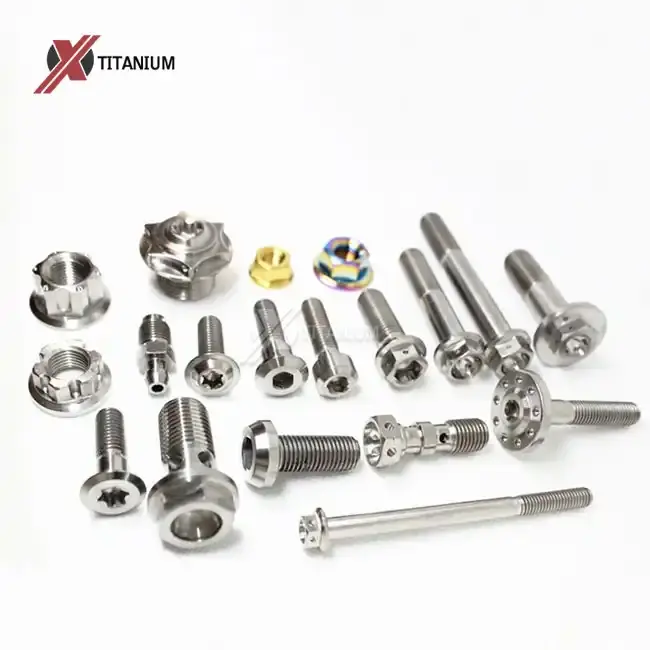
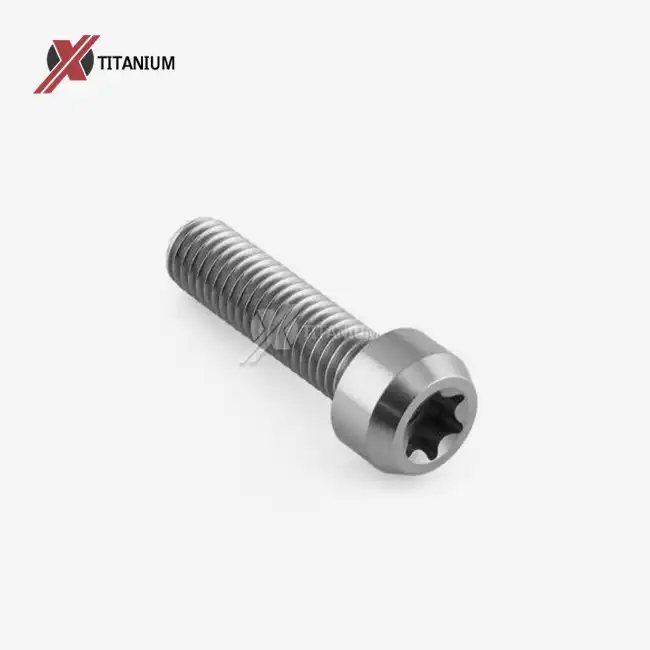
If you source aftermarket motorcycle fasteners under your own brand, the material choice you make at the component level defines your product's reputation on the shelf. Gr5 titanium motorcycle bolts — manufactured from the Ti-6Al-4V alloy — deliver a verified combination of 950–1050 MPa tensile strength, roughly 45% weight reduction versus steel, and exceptional corrosion immunity. For OEM brands expanding their premium product lines, understanding how to evaluate, source, and import these fasteners from a certified manufacturer is the clearest path to a stronger margin and a better product.
Understanding Gr5 Titanium Motorcycle Bolts: Key Properties and Benefits
The Metallurgy Behind Ti-6Al-4V
About 90% of the alpha-beta metal grade 5 titanium is titanium, 6% is aluminum, and 4% is vanadium. This stuff is only 4.43 g/cm³ dense, which is almost half of the density of carbon steel, which is 7.8 g/cm³. It can also be stretched about 880 MPa. Up to 400°C (752°F) of heat doesn't change the shape of the metal, which is very important for uses near engines and exhausts. Its oxide film heals itself, so chloride, road salt, and weak acids can't really hurt it. Its surface won't get dull like cadmium-plated or stainless steel screws do over time.
Why These Properties Translate to Real Riding Performance?
The weight edge does more than look good. The unsprung mass goes down straight away when steel caliper bolts, sprocket nuts, and suspension parts are swapped out for Ti-6Al-4V screws. This makes the frame more flexible and the dampers work better. This is why MotoGP and World Superbike teams use normal titanium bolts in these places. When CNC machines roll threads instead of cutting them, they keep the alloy's grain flow continuous. This makes it 30% more resistant to wear and stops early cracking in high-vibration chassis conditions.
Comparing Gr5 Titanium Motorcycle Bolts with Alternatives: Making the Right Choice
Just like when you choose the right screw, you need to know the good and bad points of the most common materials for Gr5 titanium motorcycle bolts. This is how procurement experts compare suppliers in a structured way:
- Gr5 Titanium vs. Grade 8.8 Steel: Gr5 titanium matches or slightly exceeds the tensile strength of Grade 8.8 steel while weighing 45% less. Steel corrodes aggressively in saline or acidic environments; titanium does not. The cost per bolt is higher, but the lifecycle value and brand positioning advantage justify the premium in the aftermarket segment.
- Gr5 Titanium vs. Grade 2 Titanium: Grade 2 is commercially pure titanium with a tensile strength of roughly 345 MPa — far below the load-bearing demands of brake calipers or suspension linkages. Gr5 (Ti-6Al-4V) is the correct specification for structural motorcycle applications. Suppliers offering "titanium bolts" without clearly stating the grade are likely supplying Gr2; always request the mill certificate.
- Gr5 Titanium vs. Aluminum 7075: Aluminum fasteners are lighter than titanium but significantly more prone to thread stripping, especially when threaded into dissimilar metals. Gr5 titanium is harder (36–38 HRC vs. approximately 15 HRC for 7075-T6), more fatigue-resistant, and far more durable under repeated removal and reinstallation cycles — a key consideration for workshop-grade aftermarket parts.
There is a big difference between graphite grade 5 and titanium grade 2. Titanium grade 2 is pure enough for industrial use, but its tensile strength is only 345 MPa, which is not strong enough for brake calipers and suspension links. For structural uses on motorcycles, Gr5 (Ti-6Al-4V) is what you should use. If someone sells "titanium bolts" but doesn't say what grade they are, it's likely that they only have Gr2. Always ask for the mill license.
OEM Supply of Gr5 Titanium Motorcycle Bolts: Ensuring Quality and Compliance
Standards That Matter in B2B Procurement
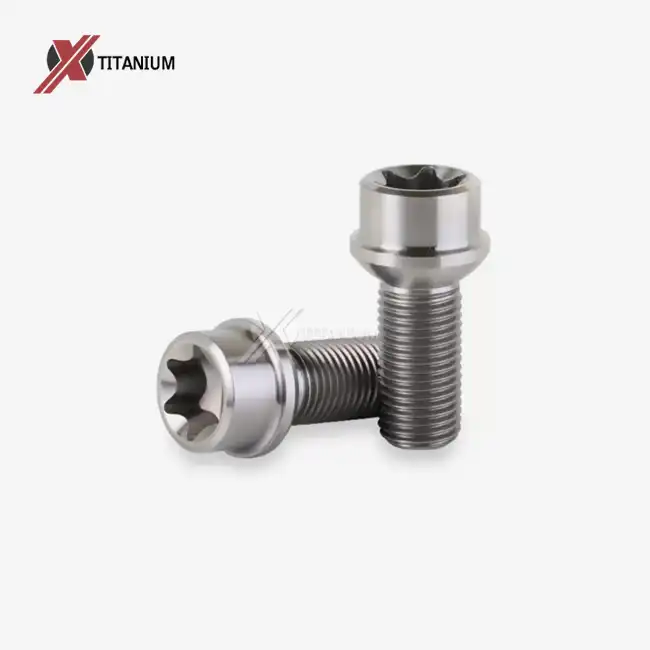
That you can trust, OEM companies make Ti-6Al-4V nuts that meet the needs of ASTM B348 (for material make-up and mechanical properties), ISO 7380 (for button head socket cap screws), and DIN 912 (for hexagon socket head cap screws). With ISO 9001 quality management certification, you can be sure that the methods used to make, check, and keep track of things are all up to standard. The material test report (MTR) and the proof of conformance should both be given to you by the service before you judge them. These two papers show both the chemical make-up and the mechanical strength.
Customization Capabilities That Drive Brand Differentiation
When it comes to making Gr5 titanium motorcycle bolts, a good company should have more than just plain stock things. At Chuanglian, we use CNC machines to make titanium fasteners that are accurate to within 0.05 mm and have threads that are 6g/6H. We have sizes from M6 to M12 in stock, but we can make them any size you need. To make the surface less likely to blister, you can smooth it, anodize it in different colors (gold, blue, green, purple, black, and rainbow), or nitride it. This will give your numbered bolt kits a unique look that shows how high-quality they are. The least amount of items that can be ordered is 500, and samples can be sent out anywhere from 7 to 15 business days after the order is placed.
How to Identify and Procure Authentic Gr5 Titanium Motorcycle Bolts?
Verification Before You Commit
Titanium fasteners that are fake or not very good are a real threat to the global supply chain. The most reliable way to be sure is to test its hardness. Real Gr5 titanium has a hardness of 36–38 HRC, while Grade 2 titanium, which is sold in stores, has a hardness of about 80 HRB. A simple Rockwell tester can show this to be a big difference. You need a mill license that says the stuff is made of Ti-6Al-4V and talks about ASTM B348. Some teams that are buying things also get XRF (X-ray fluorescence) analysis or SGS/BV inspection reports from a third party before they choose a seller.
Sourcing Channels and Import Considerations
When an OEM works directly with a verified Chinese manufacturer, they can save 30–50% on costs compared to going through a European or North American manufacturer for the same specs. Ti-based screws and nuts are subject to HS Code 7318.15 when they are brought into the US. A business invoice, a packing list, and a proof of origin should all be included with every shipment. These are all common import papers. Make sure you have clear NDA agreements in place before you share your secret designs. A skilled maker will sign these right away and keep them secret during all production runs.
Best Practices in Using and Maintaining Gr5 Titanium Motorcycle Bolts
Installation Protocols That Protect Both the Bolt and the Thread
Galling is a cold-welding process that happens when glue wears away between surfaces that match. Gr5 titanium motorcycle bolts can galle. To avoid this, you should always use ceramic or copper-based anti-seize paste before adding something. Because this lubricant lowers contact friction, you should loosen the manufacturer's suggested dry force by 10–15% to keep things from being too tight. It is important to have a calibrated torque wrench because it is the best way to keep threads from getting damaged in engine blocks and suspension parts that are made of titanium and aluminum.
Here are some simple steps you can take to make any item last longer:
- Periodic inspection: Visually check bolt heads and thread engagement points every 5,000–8,000 miles or after off-road use. Titanium does not rust, but mechanical loosening under vibration is possible without thread-locking compound on non-critical joints.
- Anti-seize reapplication: Whenever a bolt is removed and reinstalled, reapply anti-seize. Residual paste from prior installation is insufficient after exposure to heat cycles.
- Torque re-verification after break-in: On new builds, verify torque values after the first 200–300 miles. Initial seating under load can introduce slight relaxation in fastener preload.
You can be sure that Ti-6Al-4V fasteners will give you the fatigue resistance and dimensional stability that make them worth specifying in the first place if you always do these steps. The number of warranty returns is much smaller for many brands when they include a simple installation card with their bolt kits. This is especially true for brands that come with pressure guide cards and anti-seize cards.
Conclusion
One of a kind and strong places in the market for performance fasteners is held by Gr5 titanium motorcycle bolts. They are good for aftermarket brands that want to build a quality product identity because they are made of tried-and-true materials, can be changed to look how the brand wants, and last a long time. To get that value, you need to find a maker that uses materials that can be tracked, does accurate CNC machining, has legal certifications, and is easy to talk to. These things will help buyers see your brand as a good one.
FAQ
Q1: Are Gr5 titanium bolts stronger than Grade 8.8 steel bolts?
A: Steel Gr5 (Ti-6Al-4V) has a tensile strength of 950 to 1050 MPa and a yield strength of about 880 MPa. The specs for this are the same as or higher than those for Grade 8.8 steel. The biggest gain is that you can carry about 45% less weight while still having that much power.
Q2: How can I verify that a supplier is actually supplying Gr5 and not Grade 2 titanium?
A: Ask for the mill license (MTR) that says the material is made of Ti-6Al-4V and refers to ASTM B348. A hardness test (Gr5 = 36–38 HRC; Gr2 ≈ 80 HRB) is a quick way to check in the field. It is best to use third-party sources like XRF research or SGS check records.
Q3: What is the typical OEM lead time for custom titanium fasteners?
A: Most of the time, samples can be sent between 7 and 15 work days. Usually, it takes 25 to 35 days to make 500 to 5,000 pieces that meet the specifications. However, this can change depending on the time of year and how complicated the surface treatment is.
Q4: Does nitriding eliminate galling risk entirely?
A: Nitriding the surface makes it much harder, which makes it much less likely that it will hurt. When put in place with anti-seize paste, it provides strong safety in situations with high temperatures or cycles.
Partner with Chuanglian for Your Gr5 Titanium Motorcycle Bolt OEM Needs
It is known that Chuanglian makes Gr5 titanium motorcycle bolts. They are based in Baoji, which is known as the titanium production hub of China. For more than ten years, they have been CNC-machining for OEM names all over the world. We use materials that meet ASTM standards, protect your privacy with an NDA, have no minimum order number (MOQ) for as few as 500 pieces, and can anodize in different colors to fit your brand's colors. Our OEM team can be reached at info@cltifastener.com or djy6580@aliyun.com right away to get samples or a quote that fits your needs.
References
1. ASTM International. ASTM B348: Standard Specification for Titanium and Titanium Alloy Strip, Sheet, and Plate. ASTM International, 2021.
2. Boyer, R., Welsch, G., & Collings, E. W. Materials Properties Handbook: Titanium Alloys. ASM International, 1994.
3. Donachie, M. J. Titanium: A Technical Guide (2nd ed.). ASM International, 2000.
4. International Organization for Standardization. ISO 9001:2015 Quality Management Systems — Requirements. ISO, 2015.
5. Peters, M., Kumpfert, J., Ward, C. H., & Leyens, C. "Titanium Alloys for Aerospace Applications." Advanced Engineering Materials, Vol. 5, No. 6, Wiley-VCH, 2003.
6. Schutz, R. W., & Watkins, H. B. "Recent Developments in Titanium Alloy Application in the Energy Industry." Materials Science and Engineering: A, Vol. 243, Elsevier, 1998.
Learn about our latest products and discounts through SMS or email