- English
- French
- German
- Portuguese
- Spanish
- Russian
- Japanese
- Korean
- Arabic
- Greek
- German
- Turkish
- Italian
- Danish
- Romanian
- Indonesian
- Czech
- Afrikaans
- Swedish
- Polish
- Basque
- Catalan
- Esperanto
- Hindi
- Lao
- Albanian
- Amharic
- Armenian
- Azerbaijani
- Belarusian
- Bengali
- Bosnian
- Bulgarian
- Cebuano
- Chichewa
- Corsican
- Croatian
- Dutch
- Estonian
- Filipino
- Finnish
- Frisian
- Galician
- Georgian
- Gujarati
- Haitian
- Hausa
- Hawaiian
- Hebrew
- Hmong
- Hungarian
- Icelandic
- Igbo
- Javanese
- Kannada
- Kazakh
- Khmer
- Kurdish
- Kyrgyz
- Latin
- Latvian
- Lithuanian
- Luxembou..
- Macedonian
- Malagasy
- Malay
- Malayalam
- Maltese
- Maori
- Marathi
- Mongolian
- Burmese
- Nepali
- Norwegian
- Pashto
- Persian
- Punjabi
- Serbian
- Sesotho
- Sinhala
- Slovak
- Slovenian
- Somali
- Samoan
- Scots Gaelic
- Shona
- Sindhi
- Sundanese
- Swahili
- Tajik
- Tamil
- Telugu
- Thai
- Ukrainian
- Urdu
- Uzbek
- Vietnamese
- Welsh
- Xhosa
- Yiddish
- Yoruba
- Zulu
Best Bicycle Titanium Spokes for Racing, Touring, and Custom Builds
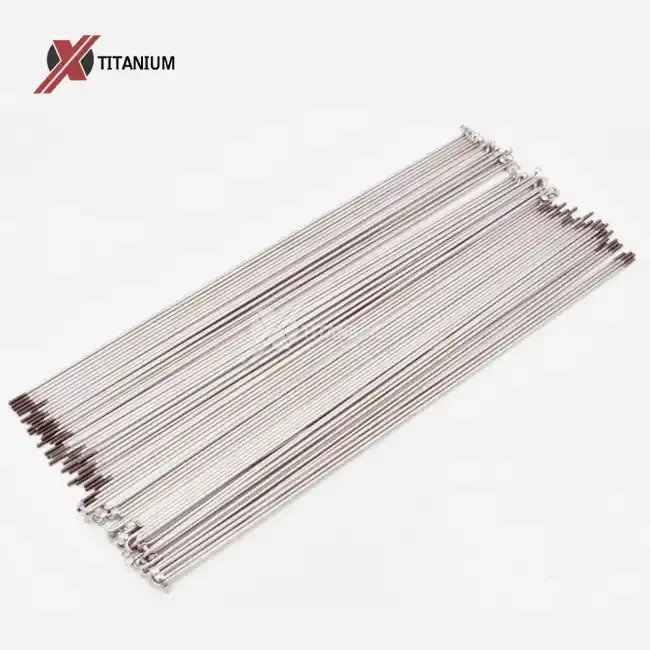
When it comes to building a high-performance wheelset, the spoke material you choose matters more than most riders realize. Bicycle titanium spokes, manufactured from Grade 5 Ti-6Al-4V alloy, deliver a tensile strength of 900–1050 MPa while weighing roughly 40% less than equivalent stainless steel spokes. That combination of low rotational mass and structural integrity makes them a compelling choice for racing, long-distance touring, and precision custom builds alike. This guide breaks down everything you need to know before committing to a titanium spoke upgrade.
Understanding Bicycle Titanium Spokes: Strength, Durability, and Benefits
Ti-6Al-4V, also known as Grade 5 titanium, is the same alloy that is used to make structural parts for spacecraft. Its density is only 4.43 g/cm³, which is about half of steel's density of 7.9 g/cm³. However, it still has a bending strength of 830 to 950 MPa. When it comes to building wheels, this means that a 32-spoke set made with titanium spokes can lose 100–150 g of spinning mass compared to a group made of stainless steel. Rotational inertia has a bigger effect on acceleration than steady weight, so that savings makes the pedaling reaction much faster on sprints and hills.
Why Elasticity Is a Feature, Not a Flaw?
Titanium's value of elasticity is about 114 GPa, while steel's is 200 GPa. At first, some builders see this as a problem, but skilled wheel engineers use it as a built-in way to reduce vibrations. When the spokes are properly tensioned, the natural flexibility of titanium absorbs road chatter before it reaches the rim. This keeps riders from getting tired on long gravel and touring rides without sacrificing lateral stiffness. Following the ASTM B348 material standards and ISO 4210 fatigue testing procedures makes sure that all production runs have the same mechanical behavior.
Corrosion Resistance Across All Environments
Titanium used in bicycle titanium spokes makes a solid oxide layer on its surface on its own, which protects it from corrosion and doesn't wear away over time. Titanium spokes don't rust or pit when exposed to salt spray, mud, or acidic road treatments for a long time, unlike chrome-moly or even 304 stainless steel. These conditions are common on coastal triathlon courses and Pacific Northwest dirt routes. Surface polishing reduces micro-crack starting points even more, which significantly increases fatigue life.
Titanium Spokes vs Other Spokes: Making the Right Choice
There are choices in the spoke market for stainless steel, carbon fiber, bladed aluminum, and titanium. Each of these materials has its own performance area. Procurement managers can make product lines that really serve their target groups better if they understand the trade-offs. Stainless steel spokes are still the workhorse of the industry. They are cheap, easy to find in standard gages, and every wheel builder in the world knows how to use them. Because they have a higher stiffness, tensioning is easy and reliable. The downside is that it's heavy, and in a high-end wheelset that costs between $800 and $2,000, every gram of extra weight makes it harder to compete.
Carbon fiber bladed spokes are popular on track and time-trial wheels because they have great aerodynamic cross-sections. On the other hand, they are fragile when hit from the side, tough in crashes, and hard to fix in the field. Also, the price per spoke is a lot higher than with titanium. Titanium is the lightest metal that has been shown to last a long time and be durable in all kinds of weather. It costs 5–10 times more per spoke than stainless steel, but the overall cost is lower because it doesn't need to be maintained or re-coated, and it has a fatigue life that is just as long as premium steel when the threads are rolled instead of cut. This is a manufacturing detail that keeps the alloy's grain flow and stops stress risers.
Choosing the Best Titanium Spokes for Different Bicycle Applications
There is no one spoke standard that works the same for all wheels. The right shape, gage, and finish are chosen based on the application situation.
Here's how different fields relate to different spoke arrangements for bicycle titanium spokes:
- Road Racing and Climbing Wheelsets: Butted profiles (2.0/1.8/1.5 mm) minimize weight at the spoke's mid-section while retaining full-gauge strength at the elbow and thread. Straight-pull configurations pair well with aerodynamic hubs and reduce the stress concentration inherent in a J-bend under high sprint loads.
- Enduro and Mountain Biking: Straight-gauge 2.0 mm or 2.2 mm spokes provide maximum impact resistance in high-flange, 32-hole or 36-hole lacing patterns. The titanium alloy's natural elasticity absorbs repeated high-amplitude shocks — the kind that stone-chip and root strikes produce — without fatiguing as rapidly as a stiffer material would.
- Touring and All-Road Builds: Corrosion resistance is the primary driver here. A J-bend spoke in 2.0 mm straight gauge, finished with electropolishing, will survive multi-year loaded touring in coastal, alpine, and tropical environments with no surface degradation. Custom lengths from 100 mm to 300 mm accommodate the wide hub-and-rim geometry variations found in touring builds.
- Bespoke and Custom High-End Builds: Anodized color options — gold, blue, green, purple, black, and rainbow — transform the wheelset into a visual statement. Anodizing also creates a harder surface layer that improves minor abrasion resistance without adding measurable weight.
High-End Builds Made Just for You: With gold, blue, green, purple, black, and rainbow anodized colors, the wheelset becomes a work of art. Anodizing also makes the surface harder, which makes it less likely to scratch without adding much weight.
Procurement Guide: Where and How to Source Titanium Spokes?
There are more factors to consider when buying titanium spokes at the OEM level compared to buying standard steel spokes. There are only a few qualified manufacturers that can make Ti-6Al-4V spoke wire of high quality, and not all of them can customize as deeply as boutique wheelset brands need.
Key technical checks during supplier qualification for bicycle titanium spokes should include making sure that the threads were rolled instead of cut, which can be done with a microscopic grain-flow inspection, and doing a batch-level spectroscopic analysis to make sure that the alloy is real Grade 5 and not the softer Grade 2 commercially pure titanium. The length should have a range of ±0.5 mm, and the straightness should not be more than 0.5 mm per meter to make sure the lacing is clean and there is no pre-stress warping. Note for installers: Always use an anti-seize spoke prep solution at the point where the spokes meet the nipple. Titanium's tendency to cold-weld against aluminum nipples is a real problem in the field, but it can be avoided completely by following the right steps for assembly.
Evaluating Cost vs Benefit: Is Titanium Right for Your Wheelset Line?
The cost of one spoke of Grade 5 titanium is high at first. For a set of 28 spokes, the spokes alone could cost $80 to $120, while fine stainless steel costs only $10 to $15. Titanium-spoked wheels, on the other hand, cost $800 to $2,000 per pair at sale, while similar steel builds cost $300 to $600. The profit profile gets a lot better, and the product story—astronautical alloy, non-rusting, lighter, more flexible—connects with the weight-conscious hobbyist group that drives sales of luxury wheels.
From the point of view of fleet and OEM, the longevity case gets even stronger. If there are no corrosion problems, there are fewer guarantee returns. With rolled threads, fatigue life is longer, which means that elite teams can go longer between service times. The real cost of ownership is less than what the original price increase suggests because of fewer replacements over the course of a season.
Conclusion
Bicycle titanium spokes are an advanced technology that has been tested and proven to work better in racing, travel, and custom wheelsets. The benefits of lighter weight, resistance to corrosion, and a more comfortable ride are real engineering benefits based on material science, not marketing speak. When lifetime value takes the place of unit cost as the main evaluation measure, the economics become more aligned for OEM brands and custom builders that are going after the premium market. The most important thing is to find a supplier that strictly controls the alloys they use, the accuracy of their thread rolling, and the sizes of their parts.
FAQ
Q1: Are titanium spokes compatible with standard brass and aluminum nipples?
A: Yes, but galvanic interaction is a real concern. Always apply anti-seize compound or dedicated spoke prep at the nipple interface to prevent cold-welding between titanium and aluminum.
Q2: What tension should I use when building with titanium spokes?
A: Recommended tension is typically 10–15% lower than equivalent steel builds, reflecting titanium's lower elastic modulus. Consult your wheel-building engineer and adjust lacing pattern accordingly — higher-flange hubs help maintain lateral stiffness.
Q3: Do rolled threads genuinely extend fatigue life?
A: Yes. Rolling preserves the alloy's grain flow, eliminating stress risers that cut threads create. Batch tensile testing consistently shows that rolled-thread Grade 5 spokes meet or exceed the 900 MPa threshold required for high-cycle spoke applications.
Q4: Can titanium spokes be anodized after manufacture?
A: Yes. Anodizing Grade 5 titanium produces a wide color range — gold, blue, green, purple, black, and rainbow — through controlled oxide layer thickness. The process adds negligible weight and improves minor surface abrasion resistance.
Q5: What is a realistic MOQ for custom-length titanium spokes?
A: Most qualified manufacturers support custom lengths from 100 mm to 300 mm with minimum order quantities starting around 500–1,000 pieces per specification, with bulk packaging of 1,000 pieces per box as standard.
Partner with Chuanglian — Your Trusted Titanium Bicycle Spokes Manufacturer
Chuanglian makes precise Ti-6Al-4V bicycle titanium spokes in Baoji, which is known as the center of titanium production in China. We can make J-bend and straight-pull shapes, sizes from 1.8 mm to 2.5 mm, unique lengths, rolled threads, and anodizing in any way you need. Our team is ready to meet your technical needs, whether you need a sample run or a monthly OEM volume. You can email us at info@cltifastener.com or djy6580@aliyun.com.
References
1. ASM International. Titanium: A Technical Guide. ASM International, 2000.
2. Brandt, Jobst. The Bicycle Wheel. Avocet, 1993.
3. ASTM International. ASTM B348: Standard Specification for Titanium and Titanium Alloy Bars and Billets. ASTM International, 2019.
4. ISO. ISO 4210: Cycles — Safety Requirements for Bicycles. International Organization for Standardization, 2023.
5. Lutjering, Gerd, and James C. Williams. Titanium. Springer, 2007.
6. Froes, F.H. Titanium: Physical Metallurgy, Processing, and Applications. ASM International, 2015.
Learn about our latest products and discounts through SMS or email