- English
- French
- German
- Portuguese
- Spanish
- Russian
- Japanese
- Korean
- Arabic
- Greek
- German
- Turkish
- Italian
- Danish
- Romanian
- Indonesian
- Czech
- Afrikaans
- Swedish
- Polish
- Basque
- Catalan
- Esperanto
- Hindi
- Lao
- Albanian
- Amharic
- Armenian
- Azerbaijani
- Belarusian
- Bengali
- Bosnian
- Bulgarian
- Cebuano
- Chichewa
- Corsican
- Croatian
- Dutch
- Estonian
- Filipino
- Finnish
- Frisian
- Galician
- Georgian
- Gujarati
- Haitian
- Hausa
- Hawaiian
- Hebrew
- Hmong
- Hungarian
- Icelandic
- Igbo
- Javanese
- Kannada
- Kazakh
- Khmer
- Kurdish
- Kyrgyz
- Latin
- Latvian
- Lithuanian
- Luxembou..
- Macedonian
- Malagasy
- Malay
- Malayalam
- Maltese
- Maori
- Marathi
- Mongolian
- Burmese
- Nepali
- Norwegian
- Pashto
- Persian
- Punjabi
- Serbian
- Sesotho
- Sinhala
- Slovak
- Slovenian
- Somali
- Samoan
- Scots Gaelic
- Shona
- Sindhi
- Sundanese
- Swahili
- Tajik
- Tamil
- Telugu
- Thai
- Ukrainian
- Urdu
- Uzbek
- Vietnamese
- Welsh
- Xhosa
- Yiddish
- Yoruba
- Zulu
Gr5 Titanium Chain Ring Bolt And Nut For Bicycle: Installation Guide
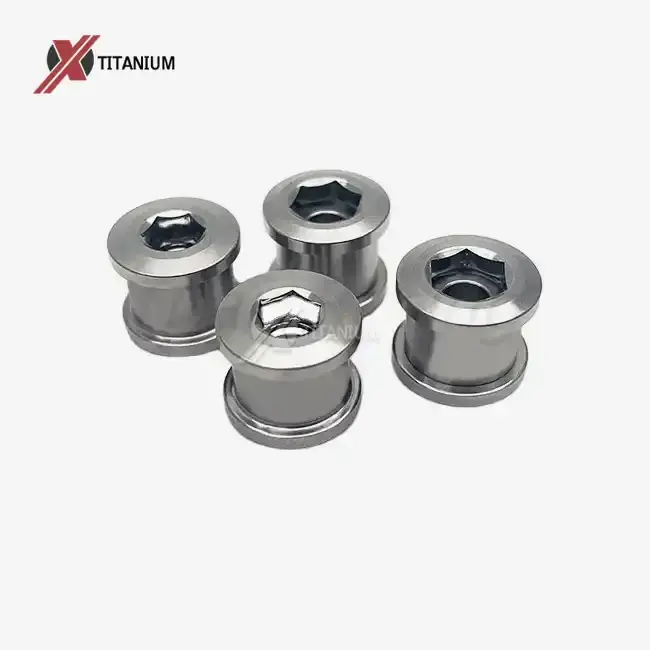
Installing the right fasteners on your drivetrain matters more than most riders realize. The Gr5 titanium chain ring bolt and nut for bicycle is a precision fastening system machined from Ti-6Al-4V alloy — the same aerospace-grade material used in jet engine components. Weighing roughly 50% less than steel equivalents while delivering tensile strength above 895 MPa, these bolts address three persistent problems in drivetrain maintenance: galvanic corrosion between dissimilar metals, rounded heads caused by soft aluminum fasteners, and unnecessary rotational mass. This guide walks through material properties, step-by-step installation, maintenance, and procurement essentials.
Understanding Gr5 Titanium Chainring Bolts and Nuts
90% of Ti-6Al-4V is titanium, 6% is aluminum, and 4% is vanadium. This particular mix makes a material with a density of 4.43 g/cm³, which is 43% lighter than steel, but it can still hold its shape under cyclical load. Commercially pure Grade 2 titanium is mostly used for corrosion-resistance tasks. Gr5 has a yield strength above 828 MPa, which means it can be used in high-torque drivetrain settings.
Gr5 vs. Gr2 Titanium: Why Grade Matters?
Gr2 titanium is soft enough to bend under the torque loads that are normal for installing a chainring. This causes head stripping and loose fasteners over time. Gr5 doesn't bend like 7075-T6 aluminum does, and it's also significantly lighter in multi-bolt systems. This difference is a real selling point, not just marketing copy, for online stores that want to attract weight-conscious riders.
Compatibility Across Bicycle Types
The titanium chainring nuts from Chuanglian have an M8 thread diameter and hex socket heads that work with normal Shimano and SRAM crank spiders. The different shaft lengths can be used for both 1x (single chainring, ~6.5 mm nut shaft) and 2x/3x (double or triple setups, ~8.5 mm) bikes. E-bikes, road bikes, mountain bikes, and dirt bikes that use these crankset standards can all use the same bolt shape.
Installation Guide for Titanium Chainring Bolts
The Gr5 titanium chain ring bolt and nut for bicycle and the crank spider are both protected by the right way to install it. If you rush this step, especially when working with titanium, you run the risk of thread galling, which is a cold-welding problem where surfaces that are joined together (titanium to titanium or aluminum to titanium) tighten up under pressure. Get an accurate torque wrench, a 5 mm hex key (T30 Torx for some), a chainring adjustment tool, and copper-based anti-seize paste ready before you start. Before installing, check each bolt for damage to the threads or the surface.
Step-by-Step Installation Process
This is the order in which to do the construction steps for a smooth, even finish:
- Apply anti-seize to threads: Coat bolt threads and the nut contact face with copper grease or anti-seize paste before any threading begins. This step is non-negotiable with titanium fasteners — skipping it risks permanent seizure.
- Seat the chainring and align: Position the chainring on the crank spider, aligning the reference mark (if present) with the crank arm. Insert bolts finger-tight through the ring into the nuts from the back of the spider.
- Torque in a cross pattern: Using a torque wrench, tighten to 6–8 Nm in a star/cross pattern — never sequentially around the circle. This distributes clamping force evenly and prevents chainring warping.
- Verify seating and recheck torque: After a short initial ride (15–20 minutes), recheck torque. Titanium fasteners settle slightly under initial load; a single re-torque check closes any residual gap.
Chuanglian's bolts have chamfered edges that lower the contact stress against the chainring face during fitting. This keeps the anodized surfaces safe and stops micro-cracking at the bolt hole.
Common Installation Mistakes to Avoid
If you torque the bolt more than 10 Nm, you could damage the crank spider, but the bolt itself might be okay. If you use the wrong nut shaft length, the bolt will bottom out before it reaches the right gripping force. This is a minor but dangerous failure mode that causes the chainring to move when it's loaded.
Performance and Maintenance
Gr5 titanium chainring bolts improve performance in a way that can be measured over the life of a product. A complete set of five bolts and nuts weighs about 10–15 grams less than steel. This means that they have less rotational inertia, which is important for speeding up in competitive cycling and is a big reason why so many people buy them online. Titanium doesn't rust in salty or acidic environments, so these bolts will still work after years of use in coastal or winter conditions, where steel bolts rust into the crank spider and have to be taken out destructively. That serviceability directly lowers the cost of maintenance over time for end users.
Maintenance Schedule and Inspection
Check the chainring bolts every 500–800 km or after a series of rides in bad weather. If the nuts are taken off for any reason, put on a thin layer of anti-seize again and check for thread contamination. Also, make sure the torque is still within the recommended range. Because titanium doesn't wear out as quickly under elastic cycle loads as steel does, the Gr5 titanium chain ring bolt and nut for bicycle can be used again and again as long as the threads are still good and the head contact is still in good shape.
Procurement Insights: Selecting the Right Titanium Chainring Bolt Sets
Small to medium-sized online stores and bicycle accessory brands decide what titanium fasteners to buy based on five practical factors: the consistency of color across batches, the thread gage, the complete set contents, the quality of the packaging, and the lead time.
When looking for these parts, expert buyers put these factors at the top of their lists:
- Anodizing consistency: Batch-to-batch color variation is the leading complaint in online reviews of titanium chainring bolts. Reliable suppliers perform spectrophotometric verification between anodizing runs to hold color within acceptable tolerance.
- Thread gauge certification: ISO 6g/6H thread class compliance (M8 x 0.75) verified using calibrated Go/No-Go gauges ensures the bolts interface correctly with Shimano and SRAM crank arms without modification.
- Complete set supply: Each retail set should include bolts, nuts, and washers — the absence of any element generates returns and negative reviews. Chuanglian supplies complete sets in retail-ready packaging with customizable branding.
- MOQ flexibility: Buyers sourcing multiple colorways benefit from suppliers offering mixed-color minimum order quantities at the 500–1,000 set range rather than forcing single-color bulk commitments.
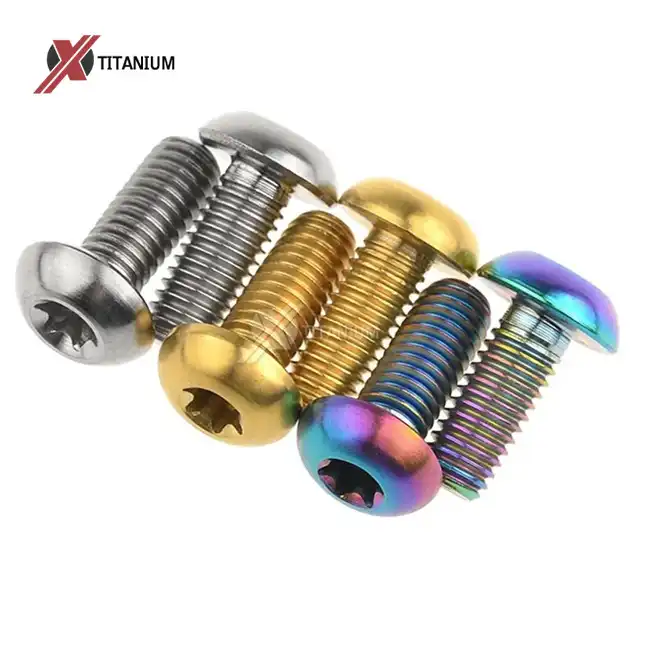
With these criteria, procurement teams can list products knowing that what gets sent to the warehouse will be the same as the sample that sold the product in the first place. Chuanglian uses CNC machines to make the Gr5 titanium chain ring bolt and nut for bicycle and does all of the anodizing, polishing, PVD nitriding, and multi-color surface treatments (like gold, blue, purple, black, green, and rainbow) in-house. This gives e-commerce sellers direct quality control over the factors that matter the most to them.
Why Gr5 Titanium Bolts Are the Preferred Choice for Distributors?
Chainring bolts made of steel rust. Strip of aluminum nuts. Gr5 titanium is in the middle of those two performance levels. It is about twice as strong as aluminum in terms of tensile strength, but it is almost half as light as steel and doesn't corrode like steel and aluminum do over time. When compared to aluminum chainring bolt sets, distributors and OEM brands that stock titanium ones report fewer guarantee returns. This is mostly because titanium doesn't break down easily in the ways that customers worry about most: head-rounding and thread-stripping.
At the moment, the ability to change colors adds a lot of value to the product. The "build culture" of cycling puts a lot of emphasis on how things look together. Matching anodized titanium gear has become a standard for high-engagement product photos on Instagram and TikTok. Stocking different colors from a single provider whose anodizing quality stays the same makes managing inventory easier and lets you reach more customers.
Conclusion
Gr5 titanium chainring bolts are better technically than steel and aluminum options, and they are easy to install as long as you use the right anti-seize compound and the right amount of force. For online stores and companies that make bicycle parts, the Gr5 titanium chain ring bolt and nut for bicycle offers real performance benefits and strong market appeal thanks to its lighter weight, range of colors, and resistance to corrosion. The most important thing for a product's long-term success is to get it from a manufacturer that has a history of controlling quality for both machining tolerances and anodizing consistency.
FAQ
Q1: What torque should I use when installing titanium chainring bolts?
A: Most of the time, 6–8 Nm of torque is suggested. Always check with the manufacturer's instructions for your crank, since some spiders have smaller limits. Because Gr5 titanium has a high tensile strength, going over 10 Nm could cause spider damage instead of bolt failure.
Q2: Why is anti-seize paste mandatory for titanium bolts?
A: Titanium can galle, which is a type of cold welding that happens when titanium threads press against metal without any oil or grease. Using copper-based anti-seize on the threads before fitting makes sure that the bolts can still be taken off after a long time of use.
Q3: How do I choose the correct nut shaft length?
A: For single chainring (1x) setups, the nut shaft needs to be about 6.5 mm long. About 8.5 mm is needed for double or triple (2x/3x) setups. If you use a shaft that is too long, the bolt will bottom out before it can firmly clamp the chainring.
Q4: Are these bolts compatible with Shimano and SRAM cranks?
A: Yes. As long as the thread size is M8 x 0.75 and the head shape is normal, it will work with Shimano and SRAM crank spiders on road, mountain, and dirt bikes.
Q5: Can titanium chainring bolts be reused after removal?
A: Gr5 titanium screws can be used more than once as long as the threads are clean and not harmed and new anti-seize is used each time. The material's fatigue resistance lets it be taken off and put back on many times.
Source Your Titanium Chainring Bolts from Chuanglian
Chuanglian offers confirmed Gr5 titanium chain ring bolt and nut for bike sets. They can be fully customized for OEMs, with options like multi-color anodizing, retail-ready packing, and mixed-color MOQs starting at 500 sets. We are a dedicated Gr5 titanium chain ring bolt and nut for bicycle maker based in Baoji, China's titanium production hub. We offer direct CNC machining and surface treatment that ensures stability from batch to batch. Email us at info@cltifastener.com or djy6580@aliyun.com to get samples or talk about bulk prices.
References
1. ASM Handbook, Volume 2: Properties and Selection: Nonferrous Alloys and Special-Purpose Materials — ASM International, 1990.
2. Titanium: A Technical Guide — Matthew J. Donachie Jr., ASM International, 2000.
3. Fatigue of Titanium Alloys — Journal of Materials Engineering and Performance, ASM International, 2004.
4. Bicycle Drivetrain Systems — Lennard Zinn & Tom Telander, VeloPress, 2009.
5. Mechanical Fastening, Joining, and Assembly — James Speck, Marcel Dekker, 1997.
6. Corrosion Behavior of Titanium Alloys in Aggressive Environments — Corrosion Science, Elsevier, 2011.
Learn about our latest products and discounts through SMS or email