- English
- French
- German
- Portuguese
- Spanish
- Russian
- Japanese
- Korean
- Arabic
- Greek
- German
- Turkish
- Italian
- Danish
- Romanian
- Indonesian
- Czech
- Afrikaans
- Swedish
- Polish
- Basque
- Catalan
- Esperanto
- Hindi
- Lao
- Albanian
- Amharic
- Armenian
- Azerbaijani
- Belarusian
- Bengali
- Bosnian
- Bulgarian
- Cebuano
- Chichewa
- Corsican
- Croatian
- Dutch
- Estonian
- Filipino
- Finnish
- Frisian
- Galician
- Georgian
- Gujarati
- Haitian
- Hausa
- Hawaiian
- Hebrew
- Hmong
- Hungarian
- Icelandic
- Igbo
- Javanese
- Kannada
- Kazakh
- Khmer
- Kurdish
- Kyrgyz
- Latin
- Latvian
- Lithuanian
- Luxembou..
- Macedonian
- Malagasy
- Malay
- Malayalam
- Maltese
- Maori
- Marathi
- Mongolian
- Burmese
- Nepali
- Norwegian
- Pashto
- Persian
- Punjabi
- Serbian
- Sesotho
- Sinhala
- Slovak
- Slovenian
- Somali
- Samoan
- Scots Gaelic
- Shona
- Sindhi
- Sundanese
- Swahili
- Tajik
- Tamil
- Telugu
- Thai
- Ukrainian
- Urdu
- Uzbek
- Vietnamese
- Welsh
- Xhosa
- Yiddish
- Yoruba
- Zulu
Best GR5 Titanium Bleed Nipples M7 for Motorsport Brake Systems
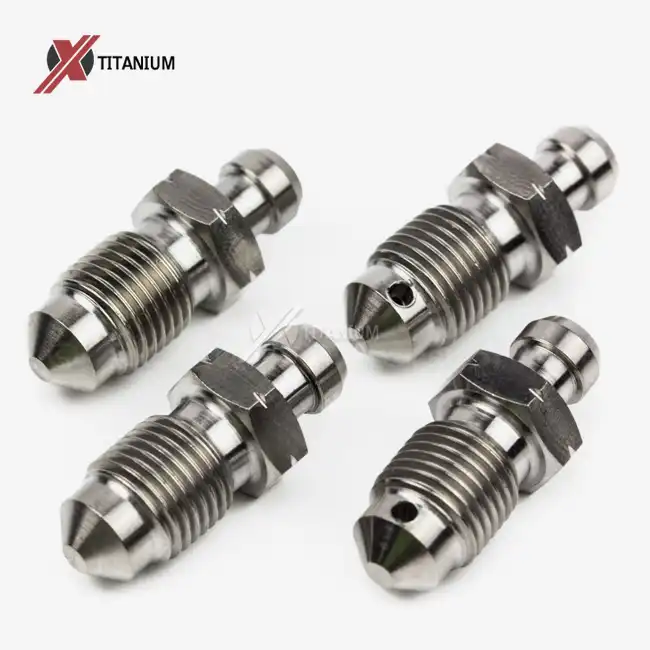
The best Gr5 titanium bleed nipples M7 for motorsport brake systems are made of Ti-6Al-4V material and have an exact M7 x 1.0 mm thread, a clean sealing seat, and an inspection that is written down. For its size, Grade 5 titanium is about 44% lighter than steel. It also forms a stable oxide film that doesn't rust and doesn't react with many chemicals. When it comes to race bikes and track cars, where water, heat, and bleeding wear down small parts quickly, these traits are important. These parts will keep your brake line sealed and your caliper threads whole. This guide shows you how to choose, install, and get these parts.
Why Gr5 Titanium Bleed Nipples M7 Matter in Motorsport Brake Systems
What a Bleed Nipple Does and What "Gr5" and "M7" Mean?
In the caliper or master cylinder is a bleed nipple, which is sometimes called a bleed screw. Techs can use it to get rid of air and old brake fluid that are stuck inside. If it doesn't seal well, air can get into the circuit, the lever doesn't work right, and it takes longer to service. "Gr5" stands for Ti-6Al-4V, which is Grade 5 titanium. What "M7" tells you is only the nominal thread diameter. You still need to know the pitch, length, and shape of the seat. Our Gr5 titanium bleed nipples M7 have a pitch of 1.0 mm, and the length is based on your drawing.
Performance and Dependability Factors
Parts used in motorsport are exposed to water, brake dust, cleaning chemicals, road salt, and repeated heat cycles. Since Gr5 titanium doesn't rust or oxidize, a titanium nipple is easier to take out at the next service than a steel one that has rusted. The weight savings at the wheel end aren't very big. I never show a bleed nipple by itself as a performance boost, and it won't make stopping shorter. It is useful if the threads are right, the sealing seat is stable, the fluid passages are clean, and the torque is right. Over time, brake fluid also soaks up water, which is why racers service it often. This means that they need a part that can be taken off and put back on many times.
How Gr5 Compares with Zinc-Plated and Stainless Steel
Steel is about 7.85 g/cm³ dense, while Ti-6Al-4V is about 4.43 g/cm³ dense. ASTM B348 says that Grade 5 bar must have a minimum tensile strength of 895 MPa. There is a chance that the coating on zinc-plated steel will wear off, but the steel itself is still good for cheap builds or mild conditions. Stainless steel doesn't rust, but it's heavier and can get stuck in some thread pairs. Titanium is good for racing programs that want to keep weight down and resist corrosion. Cost goals, fluid type, heat, and caliper material all play a role in making the right choice. When comparing brake systems, look at the whole system rather than just the material name.
Key Selection Criteria for the Best Gr5 Titanium Bleed Nipples M7
Material Proof and Batch Traceability
Begin with the paperwork for Gr5 titanium bleed nipples M7. Ask for a material certificate that shows the chemistry and mechanical data for Grade 5. Also, make sure the alloy meets ASTM B348 or the standard your program needs. A lot of OEM and motorsport buyers also want batch records. This way, if they need to, they can find the bar stock that a part came from. A part that just says "titanium" doesn't mean it's Grade 5 because some grades of titanium aren't as strong. The titanium billets from which our parts are made have been inspected, and we can talk about the inspection records your quality team needs before the first order.
Thread, Seat, and Fluid Passage Details
Your caliper must fit the thread. Check the caliper port to make sure the M7 x 1.0 mm pitch, thread length, and engagement depth are correct. Next, look at the seat that seals. It is important to machine a cone or ball seat so that it is free of burrs and other contaminants. A rough seat can leak fluid. So that air can flow freely out of the circuit, the fluid passage and cross hole must stay clear. Check the hex size, the space for the wrench, and the fit of the dust cap as well. Because M7 is a unique size, not all shops have the taps and gages that go with it. Ask suppliers how they cut and check the thread.
Define Your Application and Ordering Data
Write down what you want to use the parts for: race car, motorcycle, track-day bike, or replacement stock. Write down the brand and model of the caliper, the port specifications, the brake fluid, the operating environment, the yearly demand, and the delivery area. Then make the drawing using Gr5 material, M7 pitch, thread length, seat profile, overall length, hex size, finish, marking, and packaging. Not only unit price, but also engineering support, sample approval, consistency between batches, lead time, and documentation should all be taken into account when comparing suppliers. A clear specification up front cuts down on back and forth and keeps your brand safe from complaints about fitment down the road.
Chuanglian Gr5 Titanium Bleed Nipples M7: Specifications and Quality Control
Core Specifications
This is what our standard data sheet has on it. The metal is titanium alloy Gr5 (Ti-6Al-4V), and a CNC machine cuts each piece. The thread is M7 with a pitch of 1.0 mm, and the length can be changed. Since the standard is made to order, we build it based on your sample or drawing. Polishing, anodizing, and nitriding are some surface treatments that can be used. The parts are strong mechanically and don't react with acids, bases, or corrosion. They are also very light. The design works well for hydraulic and braking systems in cars, planes, boats, and factories.
Finishes and Colors
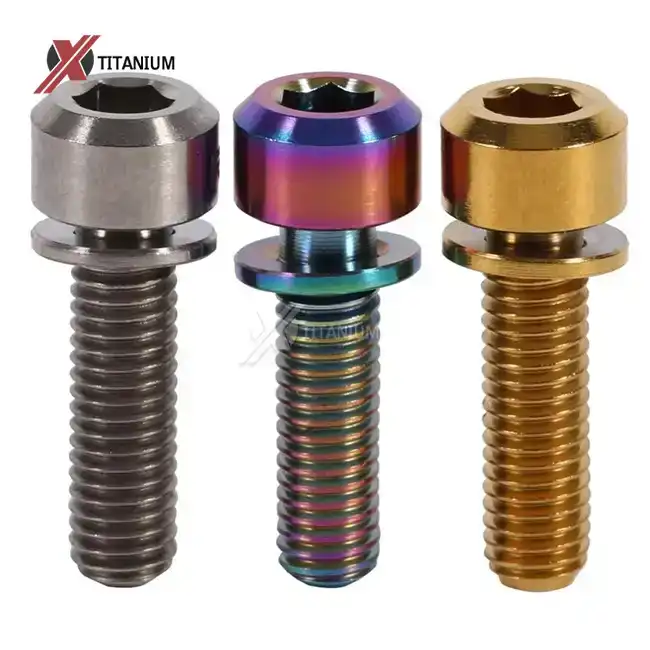
Looks, wear, and handling of Gr5 titanium bleed nipples M7 are all affected by the surface finish. When you polish titanium, it looks clean. Anodizing gives things color, and the colors we offer are natural titanium, gold, blue, green, purple, black, and rainbow. Nitrogenating the surface makes it harder, which may be good for buyers who are worried about thread wear. Color helps a brand separate lines of products on a shelf, and it also helps a mechanic find the right part. Before you place your order, let us know what kind of caliper material you need and how it will be used. Then, we'll talk about which finish works best for you. We check each finish on samples first.
Manufacturing Process and Inspection
There are four steps to our process. First, we find high-quality titanium billets and check them over. Second, CNC machining accurately cuts the thread and shapes the parts. Third, the surface is finished by polishing or anodizing it. Fourth, before being sent out, each piece is tested for its mechanical properties and accuracy in measurements. We work in Baoji, which is known as the "City of Titanium," and we've been machining titanium for more than ten years. We use twelve CNC machines and check every step of the process, from the raw materials to the finished goods.
Installation, Maintenance, and Common Pitfalls
Step-by-Step Installation
Both the titanium nipple and the aluminum caliper are safe when they are installed correctly. First, clean the bleed port. Next, look for damage, corrosion, or dirt on the caliper thread and seat. Make sure the replacement part you have is the right one, and start the thread by hand so it doesn't cross-thread. Tighten only to the torque that the manufacturer of the vehicle or caliper says is right. Extra force won't fix a bad pitch or a seat that's broken. Use the right fluid, keep the reservoir full, and keep an eye out for bubbles and leaks while you're bleeding. After the first heat cycle or test, check the nipple again.
Galling, Galvanic Contact, and Fluid Compatibility
Titanium threads can gall, which means that the surfaces can tear, drag, and stick together. If you use aluminum calipers, you can check another point. Titanium touching aluminum when it is wet or salty can cause galvanic problems. Before you approve any part, check with the maker of your caliper to see what thread compounds are allowed. Also, don't put compound on the tip or fluid holes. Nitriding is one of the surface options we offer, and I think you should use your own calipers to test samples. US brake fluids are rated by the Department of Transportation (DOT) and follow FMVSS No. 116. Some of these ratings are DOT 3, 4, and 5.1. Do your own bench test to make sure they are compatible.
Purchasing Pitfalls to Avoid
When someone buys Gr5 titanium bleed nipples M7, most problems start when they think "M7" means everything. Diameter doesn't tell you anything about pitch, thread length, seat geometry, or caliper compatibility by itself. Also, make sure that "titanium" really does mean Grade 5 and that this is supported by certificates and batch records. Before you commit, make sure you know about the production capacity, inspection steps, export paperwork, packaging, and labeling. Each market has its own certification needs, so let your supplier know what paperwork your clients want. Lastly, don't set unrealistic goals. There are weak spots in the brake system that a bleed nipple can't fix or shorten the distance it takes to stop.
Choosing a Qualified Supplier and Evaluating Samples
Why a Qualified Supplier Matters?
Even though a bleed nipple is small, it is part of a safety system, so the skill of the supplier is important. Before cutting metal, a qualified manufacturer looks over your drawing, thread standard, seat geometry, and application data. The things you should look for are CNC capabilities, process control, dimensional checks, cleaning steps, and batch management. Our team follows national, international, and industry standards. From the raw materials to the finished goods, quality control checks each step of the process. A partner who is technically responsive can find fitment issues early on, which saves you rounds of prototypes and keeps your brand name safe.
A Practical Evaluation Process
First, take pictures of the original nipple and caliper port and write down the part number, thread size, pitch, length, seat type, and wrench size. You should compare these details to the drawing provided by the supplier. You should also look at the material certificate, inspection records, cap details, finish, and markings. Next, test samples on your brake system for fit, tool access, sealing, bleeding performance, and machining quality. Once engineering gives the go-ahead, look over the total cost, MOQ, logistics, warranty, and delivery terms. Then, make a record of approved suppliers and a repeat-order specification. This way, every batch after this one will be the same.
Samples, MOQ, and Custom Requests
Brand owners usually need samples first, then a small test batch, and finally a steady supply. Let us know what you need in terms of quantity, finish, marking ideas, and packaging, such as private-label packaging or laser marking, and we'll let you know what we can do. MOQ, lead time, and sample cost depend on length, finish, and quantity because the standard is made to order. We give you a quote after we look over your drawing. Drawings that are easy to understand help us give you a good quote and plan for delivery, and they also keep sample rounds short.
Conclusion
For motorsport brake systems, Gr5 titanium bleed nipples M7 have low density, good resistance to corrosion, and strong mechanical properties. However, they will only work if the details match the caliper. M7 only lists the diameter, so buyers need to make sure they know the pitch, length, seat shape, and fluid passage. Proof of Grade 5 comes from material certificates and batch records. To protect the hydraulic sealing, a clean sealing seat and an accurate thread are used. When it comes to racing, titanium is better than zinc-plated steel because it has less mass, but cost and conditions will still decide which material is best. For safe installation, use the right torque, check carefully, and pay attention to galling and aluminum contact. A structured sample evaluation followed by a written specification makes sure that later batches are all the same.
FAQ
Q1: Are all M7 bleed nipples interchangeable?
A: In this case, No. M7 only gives the nominal thread diameter. Compare each part's pitch, thread length, seat profile, overall size, and caliper design to your drawing or the original part before you place your order. Fitment problems often happen because this check is skipped. The pitch on our Gr5 titanium bleed nipples M7 is 1 mm.
Q2: Do titanium bleed nipples shorten stopping distance?
A: They don't add any stopping power. They are better because they are lighter, don't rust, and are easier to service if you install them correctly. To keep dirt out of the bleed hole, you should also use a dust cap. The nipple works best when it is paired with the right torque and new fluid.
Q3: Which finishes and customization can I choose?
A: We can nitride, anodize, and polish your items. You can get it in natural titanium, gold, blue, green, purple, black, and rainbow colors. We can build to your drawing or sample, and you can change the overall length. Send us your marking and packaging requests, and we'll let you know what we can do.
Request Gr5 Titanium Bleed Nipples M7 from Chuanglian
A company called Chuanglian in Baoji, also known as the "City of Titanium," has been making Gr5 titanium bleed nipples M7 for more than ten years. The parts we make with CNC machines are made of Ti-6Al-4V and can be polished, anodized, or nitrided. To get our team to look over your order, please send your drawing, caliper model, and desired quantity to info@cltifastener.com or djy6580@aliyun.com.
References
1. ASTM International, Standard Specification for Titanium and Titanium Alloy Bars and Billets (ASTM B348/B348M), 2019
2. Boyer, Welsch, and Collings, Materials Properties Handbook: Titanium Alloys, ASM International, 1994
3. Donachie, Matthew J., Titanium: A Technical Guide, 2nd Edition, ASM International, 2000
4. Leyens and Peters, Titanium and Titanium Alloys: Fundamentals and Applications, Wiley-VCH, 2003
5. International Organization for Standardization, ISO 261: ISO General Purpose Metric Screw Threads, General Plan, 1998
6. National Highway Traffic Safety Administration, Code of Federal Regulations Title 49, Section 571.116, Motor Vehicle Brake Fluids, 2023
Learn about our latest products and discounts through SMS or email