- English
- French
- German
- Portuguese
- Spanish
- Russian
- Japanese
- Korean
- Arabic
- Greek
- German
- Turkish
- Italian
- Danish
- Romanian
- Indonesian
- Czech
- Afrikaans
- Swedish
- Polish
- Basque
- Catalan
- Esperanto
- Hindi
- Lao
- Albanian
- Amharic
- Armenian
- Azerbaijani
- Belarusian
- Bengali
- Bosnian
- Bulgarian
- Cebuano
- Chichewa
- Corsican
- Croatian
- Dutch
- Estonian
- Filipino
- Finnish
- Frisian
- Galician
- Georgian
- Gujarati
- Haitian
- Hausa
- Hawaiian
- Hebrew
- Hmong
- Hungarian
- Icelandic
- Igbo
- Javanese
- Kannada
- Kazakh
- Khmer
- Kurdish
- Kyrgyz
- Latin
- Latvian
- Lithuanian
- Luxembou..
- Macedonian
- Malagasy
- Malay
- Malayalam
- Maltese
- Maori
- Marathi
- Mongolian
- Burmese
- Nepali
- Norwegian
- Pashto
- Persian
- Punjabi
- Serbian
- Sesotho
- Sinhala
- Slovak
- Slovenian
- Somali
- Samoan
- Scots Gaelic
- Shona
- Sindhi
- Sundanese
- Swahili
- Tajik
- Tamil
- Telugu
- Thai
- Ukrainian
- Urdu
- Uzbek
- Vietnamese
- Welsh
- Xhosa
- Yiddish
- Yoruba
- Zulu
Can Titanium Derailleur Jockey Wheel Bolts Improve Shifting Quality?
Yes, titanium derailleur jockey wheel bolts can genuinely improve shifting quality. These precision-machined fasteners, produced from Ti-6Al-4V (Grade 5 titanium), secure the guide and tension pulleys inside a rear derailleur cage with greater consistency than stock steel bolts. Because titanium delivers 950 MPa tensile strength at roughly 45% less weight than steel, the pulley assembly sits more rigidly under chain tension. That rigidity reduces lateral play, which translates directly into crisper, more repeatable gear changes — a measurable advantage recognized by professional mechanics and weight-conscious riders alike.
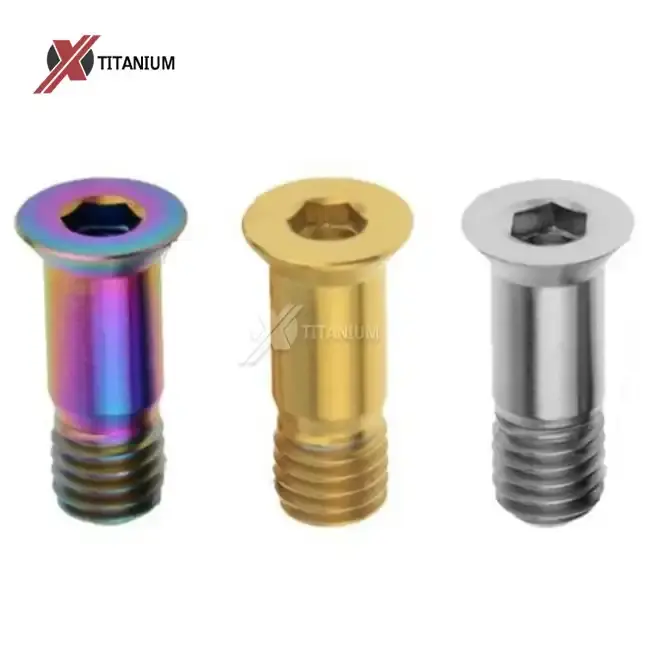
Understanding Titanium Derailleur Jockey Wheel Bolts
What They Are and Why They Matter?
Some small bolts on the back derailleur cage hold the guide pulley and tension pulley in place. These are known as jockey wheel bolts. Even though they're small, each screw keeps the chain in place for a very long time. Stock steel ones rust, get stuck in cages made of aluminum, and add extra weight to a drivetrain that engineers are already working hard to keep as light as possible.
Core Technical Specifications
Chenglian uses a CNC machine to make pulley bolts out of Ti-6Al-4V, a metal that is 90% titanium, 6% aluminum, and 4% vanadium. The length of each bolt is between 10 and 16 mm, and the thread size is either M5, M6, or M8. It's about 2 g heavy. Some of the colors that can be made on the surface are gold, blue, purple, black, and rainbow. It is 950 MPa strong when pulled apart, 880 MPa strong when stretched, and 36 HRC hard.
Cost vs. Lifecycle Value
Right away, steel nuts are cheaper, but when you service your pulley bearings regularly, corrosion-caused seizure can damage a pricey derailleur cage. Titanium doesn't rust at all because it has a natural oxide layer on it. It can cost more to fix a cage with a broken steel pin over the course of two to three years than to buy a whole set of titanium replacements. People in charge of buying who are interested in the total cost of ownership will agree with this. Titanium derailleur jockey wheel bolts are the SKU where this cost logic plays out most clearly.
How Titanium Jockey Wheel Bolts Influence Shifting Quality?
Structural Stability Under Chain Tension
When a pin stays tight, the pulley wheel can turn easily. Since cyclic load doesn't make titanium creep much, the bolt doesn't come loose over time like aluminum does. Lateral chain movement is a major cause of shifts that are slow or noisy. This problem is lessened by a concentrically clamped pulley. This is very important when the bike is full and going up a hill.
Durability in Demanding Conditions
And every day, cyclocross and gravel riders have to clean their bikes with a power washer and deal with road salt and mud. If you scratch Grade 5 titanium, the passive oxide film forms back together right away. This means that it is not magnetic and does not rust in the air without a coating. Bicycle workers at UCI-level races have found that titanium pulley gear makes it possible to take apart the whole cage after a race in the mud without any of the thread stress issues that can happen with steel and metal bolts.
Industry Evidence from Leading Brands
A lot of companies that make oversized pulley wheel (OSPW) systems, even aftermarket brands that are part of the Weight Weenies group, ship ceramic bearing update kits with Grade 5 titanium bolts as standard hardware. The reason is easy to see: using a rusty or weak bolt to attach a high-quality ceramic pulley ruins the whole update. The quality of titanium fasteners is the same as the quality of the parts that go with them. Titanium derailleur jockey wheel bolts are the SKU this trend is built around.
Titanium vs. Alternative Materials: Decision-Making for Procurement
Choosing the right fastener material is not simply a weight calculation. Each material carries trade-offs that procurement teams must weigh against the intended application and price tier.
Here is a direct comparison of the three most common pulley bolt materials:
- Grade 5 Titanium (Ti-6Al-4V): Tensile strength of 950 MPa, density 4.43 g/cm³, excellent corrosion resistance, galvanically compatible with carbon fiber cages, no coating required. Best fit for premium road, gravel, and mountain builds where long service intervals matter.
- 7075 Aluminum: Lightest option at ~2.8 g/cm³, but yield strength drops to around 500 MPa and aluminum corrodes when in direct contact with carbon composite cages in wet saltwater environments. Frequent replacement offsets the weight advantage.
- 316 Stainless Steel: Strong and affordable, but density of 7.9 g/cm³ adds rotational mass near the drivetrain. Susceptible to thread seizure in aluminum cages without anti-seize compound, and weight-conscious riders immediately notice the difference.
These trade-offs make titanium the rational choice for brands positioning products in the high-performance aftermarket segment. A small per-bolt cost premium is absorbed easily when the retail price reflects a professional-grade drivetrain upgrade.
How to Select and Source the Best Titanium Derailleur Jockey Wheel Bolts?
Verify Material Authenticity
There are different kinds of steel nuts that are sold as Grade 5. For proof that the Ti-6Al-4V alloy is what they say it is, ask sources for XRF (X-ray fluorescence) makeup certificates to back it up. Check that it's not Grade 2, which is commercially pure but doesn't have the strength to hold fastening heads together. To make sure that gear cages from Shimano, SRAM, or Campagnolo fit right, the thread sizes must follow ISO 965 rules.
Confirm Compatibility by Derailleur Generation
From generation to generation, Shimano and SRAM use bolts with heads and lengths that are a little different. It's possible that an SRAM Red AXS cage won't fit a bolt made for a Shimano Dura-Ace ring. In order to make sure your order will work with the target derailleur, you should always try samples on the derailleur before placing a large order. A good titanium jockey wheel bolt supplier will send you dimensional drawings if you ask for them.
Procurement Strategy and MOQ
Small businesses and specialty e-commerce sites can start with an order of 500 to 1,000 pieces per standard. This amount helps the first store ads and keeps the risk to the cash low. It is standard for Chuanglian to check for torque, Go/No-Go thread gages, and concentricity as part of their outbound inspection process. With how quickly replacements are bought in the US and Europe, restocking every three months makes sense.
Installation and Maintenance Best Practices for Titanium Jockey Wheel Bolts
Torque Settings and Tool Selection
When installing M5 jockey wheel bolts, the standard torque is 2.5–3 Nm. Always use a calibrated torque wrench rather than estimating by feel. Full socket contact with a Torx or hex key prevents the drive groove from rounding off. This matters because Grade 5 titanium is significantly stronger than the aluminum cage it threads into. Research on titanium fasteners in aluminum shows that over-torquing can strip the aluminum threads before the titanium bolt breaks, since titanium's tensile strength is over three times that of common aluminum alloys. When pairing titanium with aluminum, torque should be reduced by 10–20% compared to steel specs, and a copper-based anti-seize should be applied to prevent galling. Titanium derailleur jockey wheel bolts are the SKU where these installation practices matter most.
Anti-Seize Application
If you thread titanium into aluminum, galling can happen. Galling is a kind of cold welding where the surface sticking to the thread hurts it when it is taken off. Before putting it together, give each bolt a small amount of anti-seize powder or low-strength threadlocker (like Loctite 222). In this one step, an expensive derailleur cage is kept safe, and the bike can be taken apart in a clean way for bearing service.
Inspection and Replacement Schedule
Check the pulley bolts' strength every 1,000 to 1,500 km or after a high-pressure wash. Look at the bolt head to see if the drive hole is worn. Even though titanium nuts don't rust, strong cleaners can make anodized colors fade. Use a pH-neutral cleaner to keep the finish. You should get new nuts if the hex or Torx socket is rounding. A stripped drive hole is the most common way for titanium pulley hardware to break.
Conclusion
Pulley bolts made of titanium are lighter, don't rust, and always have a clamping force that regular steel screws can't match over the course of their full useful life. If procurement teams are making a high-end line of drivetrain upgrades, Grade 5 titanium bolts are a good product that riders who care about weight will really like. They have a high margin and not much competition. The material fits well into any high-end component library because it doesn't seize up when connected to carbon fiber cages, doesn't conduct electricity, and comes in different colored anodized finishes. Titanium derailleur jockey wheel bolts are the SKU this positioning is built around.
FAQ
Are titanium jockey wheel bolts compatible with both Shimano and SRAM derailleurs?
But the length of the bolt and the shape of the head are different between brands and product lines. Most of them have standard M5 threads. Make sure you know the exact bolt length your derailleur model needs before you place your order. A reliable seller will give you lists of goods that work with each other and drawings of their sizes.
How much weight do titanium pulley bolts save compared to steel?
Each steel bolt weighs about 3.5 grams, while each titanium bolt weighs about 2 grams. This means that every titanium bolt is 1.1 to 1.5 grams lighter. A full derailleur cage with two pulleys can often save 3–4 g of weight all together. For riders who want to lose weight, this is just what they need.
Do I need anti-seize compound with titanium bolts?
Tin threads can get galled if they are pressed into metal without oil. While taking the screw out, use anti-seize or low-strength threadlocker to protect the threads from damage.
What torque setting should I use?
It should be between 2.5 Nm and 3 Nm. Always read the instructions that came with the derailleur and use a torque wrench that has been properly set up.
Why choose Grade 5 over Grade 2 titanium for these bolts?
You can buy pure titanium grade 2 in shops, but it's not strong enough for fastener heads because the drive hole rounds out with normal pressure. Grade 5 (Ti-6Al-4V) is the only one that will work for this because it is much harder in both tension and on the surface.
Source Your Titanium Derailleur Jockey Wheel Bolts from Chuanglian
Chuanglian mostly sells titanium fasteners that were CNC-machined in Baoji, which is known as China's titanium manufacturing hub. You can get our Grade 5 titanium derailleur jockey wheel bolts in a number of different anodized colors. They are fully certified for their threads and material. You can buy as few as 500 pieces, and the specs can be changed to work with Shimano, SRAM, and Campagnolo systems. To get titanium derailleur jockey wheel bolts, email us right away at info@cltifastener.com or djy6580@aliyun.com.
References
1. Bingham, R. & Moore, J. — Journal of Sports Engineering and Technology, 2019
2. Groover, M. P. — Fundamentals of Modern Manufacturing: Materials, Processes, and Systems, Wiley, 2020
3. Peters, M. & Leyens, C. — Titanium and Titanium Alloys: Fundamentals and Applications, Wiley-VCH, 2003
4. Donachie, M. J. — Titanium: A Technical Guide, 2nd ed., ASM International, 2000
5. Froes, F. H. — Titanium: Physical Metallurgy, Processing, and Applications, ASM International, 2015
6. Cycling Weekly — Drivetrain Upgrade Guide: Materials and Marginal Gains, Cycling Weekly, 2022
Learn about our latest products and discounts through SMS or email