- English
- French
- German
- Portuguese
- Spanish
- Russian
- Japanese
- Korean
- Arabic
- Greek
- German
- Turkish
- Italian
- Danish
- Romanian
- Indonesian
- Czech
- Afrikaans
- Swedish
- Polish
- Basque
- Catalan
- Esperanto
- Hindi
- Lao
- Albanian
- Amharic
- Armenian
- Azerbaijani
- Belarusian
- Bengali
- Bosnian
- Bulgarian
- Cebuano
- Chichewa
- Corsican
- Croatian
- Dutch
- Estonian
- Filipino
- Finnish
- Frisian
- Galician
- Georgian
- Gujarati
- Haitian
- Hausa
- Hawaiian
- Hebrew
- Hmong
- Hungarian
- Icelandic
- Igbo
- Javanese
- Kannada
- Kazakh
- Khmer
- Kurdish
- Kyrgyz
- Latin
- Latvian
- Lithuanian
- Luxembou..
- Macedonian
- Malagasy
- Malay
- Malayalam
- Maltese
- Maori
- Marathi
- Mongolian
- Burmese
- Nepali
- Norwegian
- Pashto
- Persian
- Punjabi
- Serbian
- Sesotho
- Sinhala
- Slovak
- Slovenian
- Somali
- Samoan
- Scots Gaelic
- Shona
- Sindhi
- Sundanese
- Swahili
- Tajik
- Tamil
- Telugu
- Thai
- Ukrainian
- Urdu
- Uzbek
- Vietnamese
- Welsh
- Xhosa
- Yiddish
- Yoruba
- Zulu
Can Titanium Exhaust Bolts Prevent Rust and Reduce Vehicle Weight?
Go for a titanium exhaust bolt and you may save weight on fasteners and also prevent corrosion. Titanium generates a thin, persistent oxide coating that prevents the red rust you see on carbon steel. Grade 5 (Ti-6Al-4V) has a density close to 4.43 g/cm3, compared to about 7.85 g/cm3 for steel, allowing a weight reduction of over 40%. But titanium doesn’t eliminate all danger. Heat, thermal cycling, galling and galvanic contact still count. This document was written for exhaust manufacturers and brands that want clear answers before they sign off on a bolt.

Why Exhaust Fastener Material Matters?
Before comparing materials, it helps to see what an exhaust bolt actually endures.
The Conditions Exhaust Bolts Face
Exhaust bolts are among of the worst places to be on a motorbike or automobile. They’re exposed to temperature changes from ambient to several hundred degrees Centigrade, continuous engine vibration, rain, road salt and muck. Each cycle puts the threads and the clamping joint under stress. That moisture will rust carbon steel. Stainless steel may still seize if it is heated again and over. A seized or broken bolt and a 10 minute service work turns into an extraction job. For U.S. aftermarket companies, that issue manifests itself in warranty claims and disgruntled riders, thus fastener material merits the same consideration as the pipe itself.
What a Titanium Exhaust Bolt Is?
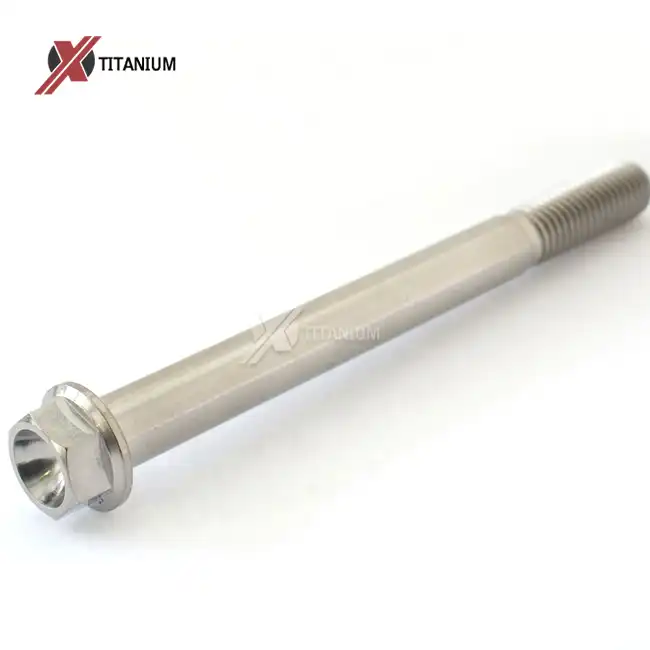
A titanium exhaust bolt is a threaded fastener for use in exhaust systems such headers, manifolds, downpipes, turbo flanges, mufflers, heat shields and brackets. Common forms include hex bolts, flange bolts, header bolts, silencer bolts and entire hardware packages. Chuanglian makes these parts of Grade 5 titanium alloy (Ti-6Al-4V) using CNC machinery. Custom sizes vary from M6 to M36. The three features that drive the interest are low density, self-forming protective oxide layer, and good corrosion resistance. When the customer chooses the item appropriately, such qualities mean lighter exhaust systems and simpler long-term service.
Why Grade and Build Quality Matter?
Titanium is not one level of performance. Grade 2 is economically pure, with strong corrosion resistance and ductility but reduced strength, and hence suitable for lightly loaded parts. Grade 5 includes aluminium and vanadium which increases strength and is the typical option for load bearing exhaust fasteners. Even in Grade 5, the behaviour of a bolt under preload and vibration varies with thread quality, geometry, and machining control. The minimum tensile strength for a Grade 5 bar is 895 MPa per ASTM B348. I always advocate asking for material certifications rather than taking a grade designation at face value.
Rust Resistance and Weight Savings
Rust and weight are the two reasons most buyers ask about titanium, so let's take them one at a time.
How Titanium Resists Rust
Titanium oxidises extremely fast with oxygen, forming a thin oxide coating on its surface. That coating protects the underlying metal, and if a scratch exposes new titanium, the film reforms. So a titanium exhaust bolt won’t get red rust from humidity, rain or road salt as carbon steel would. Our product data shows that our Gr5 bolts are also resistant to sea water, acids and chlorides. Stainless steel may pit in chloride-rich environments, so titanium is the better choice for cyclists along coasts or in places that salt winter roads. clean threads also make it simpler to take out at servicing time.
Where Corrosion and Discoloration Can Still Appear?
Titanium has its limitations. It is at the noble end of the galvanic range therefore when it comes in contact with aluminium in a damp joint the aluminium might corrode quicker. Damaged threads, unclean surfaces and mismatched washers further increase danger. Colour varies with heat. That's oxide development, not rust. At high temperatures, raw titanium becomes straw, blue or purple. Gold, blue, green, purple, black or rainbow anodised colours may fade near hot flanges. I would suggest anodising the cooler mounts and any exposed hardware, natural or nitrided in the hottest areas.
How Much Weight a Set Can Save?
Titanium has a density of about 4.43 g/cm³, whereas steel is around 7.85 g/cm³. Same geometry, which equals around 43% less mass. Our product data shows titanium exhaust bolts about 40% lighter than equivalent strength steel bolts. Just use a simple formula: weight savings = weight of steel fastener minus weight of titanium fastener. For example, a set of steel hardware weighing 100g would be reduced to about 57g in titanium at the same dimensions. The true number is decided by bolt count, length, head design and washers. Titanium bolts are best used as part of a larger lightweight scheme and combined with a titanium pipe.
Strength, Heat Resistance, and Sizing
Light weight means little if the bolt cannot hold clamp load in a hot joint. Strength and temperature come next.
Gr5 Strength Numbers
We provide Gr5 (Ti-6Al-4V) bolts with tensile strength 1,200 MPa, yield strength 1,100 MPa and hardness 350 HV. Fatigue resistance is very important on a vibrating exhaust. A bolt seldom fails after one stress. It breaks down after a few thousand cycles. Test tensile strength, yield strength and clamp load individually. A high figure on a data sheet is not indicative of steady preload in a hot joint. I would suggest you ask for test results on your specific manufacturing lot, not usual values.
Heat Limits and Thermal Expansion
Our standard indicates thermal resistance up to 500°C (932°F). Titanium alloys lose strength with increasing temperature , and several literature mention continued usage of Ti-6Al-4V up to around 400 deg C , so a safety margin is a good idea . Test each design around turbo outputs and manifold ports where metal temperature is the greatest. Special high-temperature alloys may be suitable for the hottest zone. Expansion is important too. Ti-6Al-4V expands 8.6 µm/m·K, whereas 304 stainless steel expands on the order of 17 µm/m·K. A stainless flange expands nearly twice as rapidly as a titanium bolt, altering clamp stress as the connection warms and cools. Check preload at operating temp.
Choosing Size, Head, and Finish
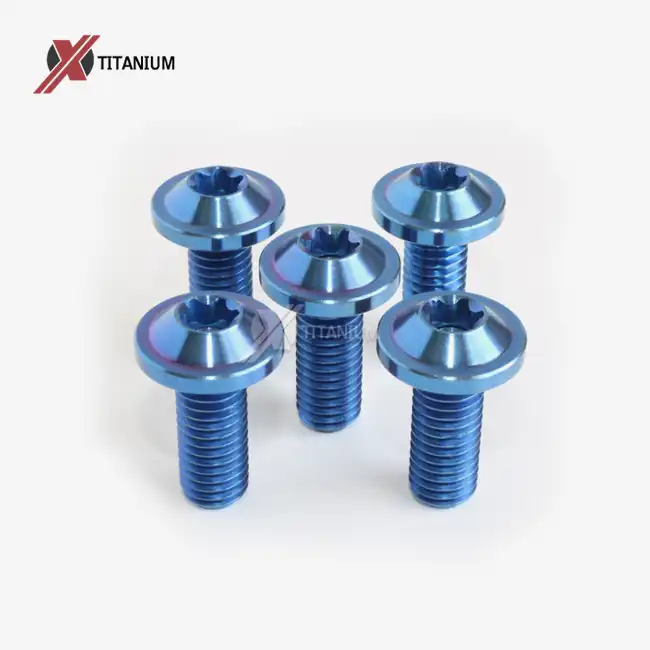
Start with the flange and the application. Motorcycle exhausts often use M6, M8, or M10 bolts, while heavier flanges may need larger sizes. We machine M6 to M36 and custom lengths. Confirm thread diameter, pitch, length, thread engagement, and head style against your drawing or a sample part. Hex, flange, socket, and button heads each suit different tools and clearances. Choose function first, then finish. We offer polishing, anodizing, and nitriding, in natural titanium, gold, blue, green, purple, black, and rainbow. Nitriding adds surface hardness and wear resistance, while anodizing mainly adds color.
Installation: Preventing Galling and Seized Bolts
A good bolt can still fail through poor assembly, so installation deserves its own checklist.
Prepare and Tighten Correctly
Galling happens when titanium threads cold-weld under pressure, usually during dry assembly or repeated servicing. A clean, repeatable process prevents most cases. Inspect and clean the threads, confirm bolt size and grade, start the bolt by hand, and tighten in stages with a calibrated torque wrench. No universal torque value exists, because diameter, pitch, lubrication, washer type, and joint materials all change the preload you get from a given torque. Take the value from your own engineering validation. Avoid impact guns, since high speed builds heat at the thread surface and raises galling risk.
Anti-Seize Compound
A high-temperature anti-seize compound reduces galling and helps later removal of titanium exhaust bolts. Nickel-based and copper-based products are common choices, so match the compound to the manufacturer's data sheet and your temperature zone. Apply a thin, even film to the threads only. Too much lubricant lowers friction, so the same torque produces higher clamp load, and that can stretch the bolt. For this reason, I suggest running torque tests with the exact compound you plan to use, then writing that value into your assembly instructions. Repeating the same process on the production line and in service manuals keeps results consistent.
Removing a Seized Bolt
If a bolt does seize, slow down. Use a tool that fits the head properly so it does not round off, apply penetrating oil, and use controlled heat only if nearby parts can tolerate it. Work the bolt back and forth in small turns instead of forcing one direction. After removal, inspect the threads on both the bolt and the flange, and replace any bolt that shows galling or deformation. Because seizure is a real risk in exhaust systems, many brands add installation notes to each kit. A clear instruction sheet costs little and prevents most damaged parts.
Buying, Verification, and Final Decision
Once the technical picture is clear, the next step is proving the part works and choosing a partner.
Verification Checks Before Approval
Pilot testing reduces risk before you approve a titanium exhaust bolt for production or resale. Useful checks include dimensional and thread-gauge inspection, surface examination, material composition verification, tensile or proof-load testing, hardness testing, torque-preload evaluation, and high-temperature assessment on a representative exhaust. Ask for material certificates, inspection reports, and batch traceability. Then road-test sample sets and watch installation torque, clamp stability, removal behavior, and finish appearance after heat. Chuanglian inspects every stage from raw material to finished product, and our documentation supports this approval process.
Titanium Versus Stainless Steel
Stainless steel costs less, and it works well for low-temperature, lightly loaded joints where weight has little value. Titanium makes sense when you need lower mass, better corrosion resistance in salty conditions, or a premium look for an exhaust brand. A stainless bolt in a wet, salty location can still pit and stain, and its weight adds up across a full set. Titanium costs more per piece, so weigh the extra spend against how you position your product. Racing, sport motorcycles, and premium aftermarket kits usually justify it. Basic commuter hardware may not.
Choosing a Supplier and Ordering
Look beyond pricing per unit. Production capacity, traceability, quality control, ability to customise, stability for repeat orders, comparisons. Chuanglian is located in Baoji, the City of Titanium, with more than 10 years expertise in titanium machining and a dozen CNC machine machines. Our products are used in the domains of racing, aerospace, marine and medical. Our quality system is ISO 9001 compliant. Please check with us for grade, dimensions, tolerances, thread standard, finish, sample availability, minimum order quantity, lead time and packing before placing an order. A reputable supplier will let you sample it first, then purchase small amounts, then reorder often.
Conclusion
A titanium exhaust bolt may resist corrosion and save weight, but outcomes rely on proper specification. Titanium's oxide covering protects against moisture, road salt and chlorides, and its density of around 4.43 g/cm³ decreases fastener mass by about 40 percent compared with steel. Grade 5 is the strength you want for exhaust joints. But there are also heat constraints, different expansion rates with stainless flanges, galling and galvanic contact with aluminium to consider. Risks are mitigated by the use of anti-seize compound, phased torque and testing at working temperature. A bolt has to perform to specification. Certificates, inspection and pilot runs. Stainless is still good for cold, low-load, cost-sensitive joints while titanium is good for weight-sensitive and luxury applications.
FAQ
Does a titanium exhaust bolt need anti-seize compound?
Yes. Titanium can gall against itself or other metals under pressure. Use a high-temperature anti-seize suited to your temperature zone, and set torque values by testing with that exact compound.
Is Grade 5 always better than Grade 2?
Not always. Grade 5 is the usual choice for load-bearing exhaust joints because of its higher strength. Grade 2 offers better ductility and suits lightly loaded parts. Match the grade to the load and the temperature.
Will anodized colors last near hot flanges?
Often they do not. Anodized colors can fade under high heat. Natural or nitrided finishes suit the hottest zones, while colored bolts fit cooler brackets and visible hardware.
Can Chuanglian make custom titanium exhaust bolts?
Yes. We CNC machine Gr5 bolts from M6 to M36, with custom sizes, lengths, and head designs available. Send a drawing or sample, and we will prepare a quotation.
Request the Right Titanium Exhaust Bolt Solution from Chuanglian
Chuanglian is a titanium exhaust bolt manufacturer in Baoji, the City of Titanium, with more than ten years of titanium machining experience. Send your drawing, size, quantity, and temperature zone to info@cltifastener.com or djy6580@aliyun.com, and we will quote CNC-machined Gr5 samples with the finish and head design you need.
References
1. ASM International, Materials Properties Handbook: Titanium Alloys, 1994.
2. ASTM International, ASTM B348 Standard Specification for Titanium and Titanium Alloy Bars and Billets, 2019.
3. Matthew J. Donachie, Titanium: A Technical Guide, 2nd Edition, 2000.
4. Christoph Leyens and Manfred Peters, Titanium and Titanium Alloys: Fundamentals and Applications, 2003.
5. ASM International, ASM Handbook, Volume 13B: Corrosion: Materials, 2005.
6. Manfred Peters, Jürgen Kumpfert, Carsten Ward, and Christoph Leyens, Titanium Alloys for Aerospace Applications, Advanced Engineering Materials, 2003.
Learn about our latest products and discounts through SMS or email