- English
- French
- German
- Portuguese
- Spanish
- Russian
- Japanese
- Korean
- Arabic
- Greek
- German
- Turkish
- Italian
- Danish
- Romanian
- Indonesian
- Czech
- Afrikaans
- Swedish
- Polish
- Basque
- Catalan
- Esperanto
- Hindi
- Lao
- Albanian
- Amharic
- Armenian
- Azerbaijani
- Belarusian
- Bengali
- Bosnian
- Bulgarian
- Cebuano
- Chichewa
- Corsican
- Croatian
- Dutch
- Estonian
- Filipino
- Finnish
- Frisian
- Galician
- Georgian
- Gujarati
- Haitian
- Hausa
- Hawaiian
- Hebrew
- Hmong
- Hungarian
- Icelandic
- Igbo
- Javanese
- Kannada
- Kazakh
- Khmer
- Kurdish
- Kyrgyz
- Latin
- Latvian
- Lithuanian
- Luxembou..
- Macedonian
- Malagasy
- Malay
- Malayalam
- Maltese
- Maori
- Marathi
- Mongolian
- Burmese
- Nepali
- Norwegian
- Pashto
- Persian
- Punjabi
- Serbian
- Sesotho
- Sinhala
- Slovak
- Slovenian
- Somali
- Samoan
- Scots Gaelic
- Shona
- Sindhi
- Sundanese
- Swahili
- Tajik
- Tamil
- Telugu
- Thai
- Ukrainian
- Urdu
- Uzbek
- Vietnamese
- Welsh
- Xhosa
- Yiddish
- Yoruba
- Zulu
Titanium Flanged Axle Nut: A Buyer’s Guide for OEM Sourcing Decisions
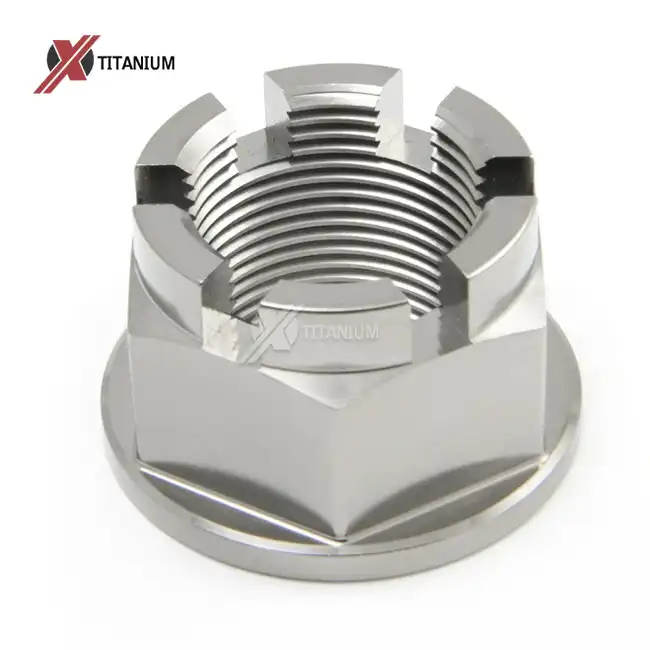
A titanium flanged axle nut is a good alternative for OEM sourcing if you can check grade, thread and tolerance before production and if low weight, corrosion resistance and a large clamping surface are needed. The ideal way is to fit the nut to the axle, to the torque technique and to the service environment, and then to check the machining and inspection controls of the supplier. In this article I’ll go over what to specify, how titanium compares to other materials, how to install the part and how to evaluate a source. I also demonstrate how Baoji Chuanglian New Metal Material Co., Ltd. manages special orders for Grade 5.
Understanding the Titanium Flanged Axle Nut
What a Titanium Flanged Axle Nut Does?
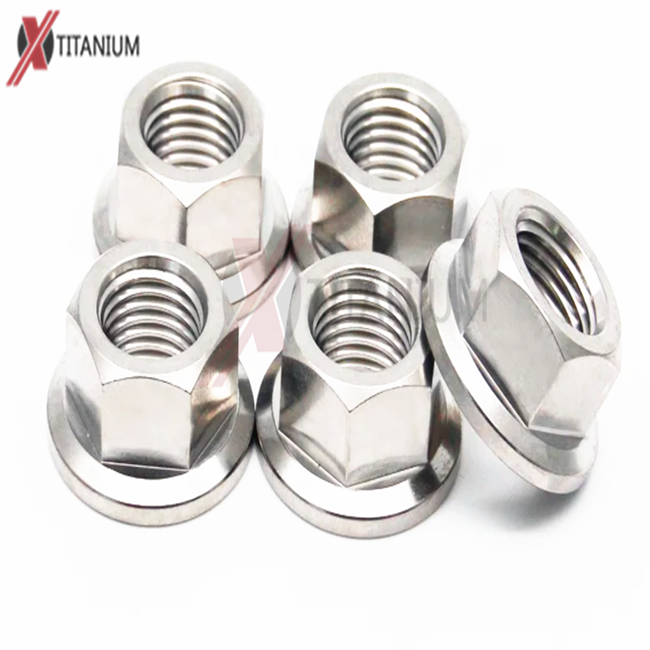
An axle is secured with a titanium flanged axle nut, which has an incorporated flange to disperse the clamping force across a larger surface. The flange may help with seating vs. a simple hex nut. It also may eliminate the requirement for a separate washer depending on the assembly design. This saves one part and reduces the probability of a missing or wrong washer at the assembly point . Buyers that need low density and corrosion resistance in a single component choose titanium. It should not be only about appearance and weight. The nut must be appropriate to the axle thread, weight, locking technique and working environment.
Titanium Compared With Steel, Stainless Steel, and Aluminum
Ti-6Al-4V has a density of 4.43 g/cm3, compared to regular steel at about 7.85 g/cm3. This means that a titanium component is 44% lighter for the same volume. Stainless steel is corrosion resistant, but still heavier than titanium. Aluminium is lighter than titanium, but the threads wear quicker and it deforms under axle clamp stresses more readily. Steel is frequently cheaper and fine for big volume tasks when weight is not a consideration. I would recommend customers to consider grade, strength, weight, galling propensity, cost, MOQ, lead time and certification demands all together. Then verify the outcome with an assembly test on the actual axle.
Where Distributors and OEM Buyers Use It?
This fastener, the titanium flanged axle nut, is used in motorcycle front and rear axles, bicycle hubs, racing cars, powersport equipment and light machinery. Custom builders and aftermarket shops often want Ti-6Al-4V nuts to complement a project. That allows distributors a premium line adjacent to the ordinary steel hardware. Cyclists who ride or race near the shore particularly desire corrosion resistance, since steel nuts may freeze up on an axle after frequent contact to salt. A few carefully picked sizes will cover several popular models for wholesale customers. A provider that does custom machining of components may fill in the gaps for less common axles.
Specifications to Confirm Before You Approve a Titanium Flanged Axle Nut
Material Grade and Mechanical Properties
Our nuts are machined from bar stock according to ASTM B348 and are made from Grade 5 Titanium (Ti-6Al-4V). Our spec sheet calls forth a density of 4.43 g/cm³, tensile strength of 900 MPa, and hardness of HRC 34-38. These numbers are important because they influence thread wear and clamp load capacity. Request a material certificate for each lot and ensure that the grade on paper is the same as the grade in the shipment. Grade 5 is different from commercially pure titanium which often has lesser strength and is more appropriate for weakly loaded parts rather than severely loaded axles .
Thread, Size, and Tolerance
Chuanglian machines are available in bespoke sizes from M6 to M100 in metric or imperial threads, with the tolerance of ±0.01mm indicated. That’s in the range of 3/8-inch and 1/2-inch threads. M10, M12, and M14 are common motorcycle sizes. M12 is not a designation that describes the whole thread. Check pitch, orientation of thread, length of engagement, flange diameter, overall height and tool access, too. A sketch or sample takes the guess work out. A detailed snapshot with dimensions also helps when your staff and the manufacturer have different first languages.
Surface Treatment and Color Options
Surface finishes include polishing, anodising, and nitridizing. The metal is polished to a crisp finish. In addition to the natural titanium colour, anodising adds colour in gold, blue, green, purple, black or rainbow. Nitriding is suitable for purchasers who need a tougher surface layer. Any treatment may slightly change the thread fit, friction and torque behaviour. I would propose accepting the completed samples instead than raw machined ones. Retailers who sell to the custom market usually carry a few colours per size to match popular builds so they can maintain inventory revolving around parts that churn.
Selecting, Installing, and Torquing a Titanium Flanged Axle Nut
Match the Nut to the Application
Start at the axle and work your way out. Specify the vehicle or component, the manufacturing quantity, the environment of use and the projected service life. The form of the flange and its retention may be different for a motorbike rear axle, a bicycle hub or a racing assembly. Standard sizes save lead time and tooling cost. Custom pitches, locking features, labelling or packing need further preparation. Complete drawing review, sample approval and first item inspection prior to mass production. This sequence finds fit issues while rectification is still cheap.
Torque and Installation Basics
Titanium can respond differently from steel because friction, lubrication, and surface finish change how much clamp load a given torque creates for a titanium flanged axle nut. Clean the threads and bearing surfaces, start the nut by hand, and tighten it with a calibrated tool. Do not copy steel torque values automatically. Use the axle maker's specification as a starting point, then validate it for the titanium grade, finish, and lubricant in use. Critical assemblies should go through torque, vibration, fatigue, and environmental testing before release to customers.
Galling, Lubrication, and Retention
Titanium can gall when it slides against itself or similar metals, and galling can lock the threads. An anti-seize compound suited to titanium, applied as the fastener maker directs, lowers that risk. It also changes friction, so re-check torque with the lubricant in place. Review galvanic effects too, especially where titanium touches aluminum or steel in wet conditions. Retention depends on the design. Options include a castellated nut with a cotter pin, safety wire, locking compound, or a prevailing-torque feature. Choose the method that the axle design already supports.
Evaluating a Titanium Flanged Axle Nut Manufacturer or Supplier
Machining Capability and Quality Control
Titanium needs careful CNC machining to hold thread accuracy, flange flatness, and surface quality from batch to batch. Chuanglian runs a dozen CNC machine tools plus other processing equipment. We inspect every step from raw material to finished product under an ISO 9001:2015 certified system. Ask any supplier how they verify alloy composition, check threads with gauges, and measure flange flatness. Raw material checks matter most, because a softer grade swapped in for Ti-6Al-4V would change strength. A visual check at the radius between the hex and the flange catches tooling marks that can start cracks.
Documents to Request
A serious supplier provides records that match the parts. Ask for material certificates, lot traceability, dimensional reports, thread-gauge records, surface-treatment records, and corrective-action procedures. These papers let your quality team trace a problem to a specific lot. They also give your customers proof of grade. For distributors, the same records support warranty claims and reduce disputes with downstream retailers. Request the list with your first inquiry so you can compare suppliers on equal terms rather than on unit price alone.
Customization, Packaging, and Order Terms
Beyond the part itself, confirm CNC capacity, prototype support, custom thread capability, logo marking, and packaging options. Distributors often need neutral or custom packaging, and barcode labels can speed up shelf stocking, so raise those needs early. Ask about MOQ, sample lead time, monthly capacity, and shipping terms for sea or air freight. Compare total landed cost, including freight and import duties in your country, instead of the factory price alone. Chuanglian brings more than ten years of titanium machining and research experience to these discussions.
Avoiding Sourcing Mistakes and Buying for Wholesale Orders
Common Sourcing Mistakes
Common mistakes with titanium flanged axle nuts include purchasing on weight or appearance, without considering thread pitch, using steel torque figures without testing and neglecting metal pairing. A quotation that is too cheap might mask poor inspection or unsteady manufacturing that ultimately will manifest itself as returns and customer complaints. Calibrated gauges, testing of samples, traceability rules and audits of suppliers reduce these hazards. When comparing three to five quotations, first align the same grade, tolerance, finish and list of documents. Only then does the pricing comparison make sense.
Buying for OEM and Wholesale Orders
Separate regular parts from special parts. We can supply standard M10, M12, M14, 3/8″ and 1/2″ sizes quicker. Proprietary axles often have proprietary flange geometry, thread specs, finishes, or markings. Submit a sketch, model or sample, forecast of quantities and your inspection criteria. Many distributors will take a tiny initial order, check the fit and on to repeat purchases following sample clearance. The real cost per item sold is based on yearly volume, MOQ, tiered pricing, packaging, and replacement demand.
How a Qualified Supplier Lowers OEM Risk
A good supplier does more than cut metal. It reviews the drawing, advises on material and finish, builds prototypes, and inspects the results. A sound approval path runs through requirements review, drawing confirmation, material approval, prototype production, dimensional inspection, assembly testing, first-article approval, and controlled production. Early technical talks catch wrong thread specifications and tight flange clearance before they cause delays or redesigns. Over time, you gain traceability, consistent repeat orders, predictable delivery, and quick handling of engineering changes.
Conclusion
Where the lowest unit price is not as important as weight, corrosion resistance and clamping stability, the titanium flanged axle nut has its place. Grade 5 (Ti-6Al-4V) has a density of 4.43 g/cm³, which is about 44% lighter than steel and has good strength. A size label is not enough to characterise the item. The buyer still has to validate grade, thread pitch, tolerance, flange dimensions and finish. Do not take torque from steel. Attention should be paid to galling and metal matching." Supplier inspections, including machining competence, inspection records and sample approval, decrease quality and field-service risk. Sound sourcing is based on validated performance and overall landed cost.
FAQ
Which material grade do you supply?
We supply Grade 5 titanium, Ti-6Al-4V, CNC machined, with a density of 4.43 g/cm³.
Can I use steel torque values on a titanium nut?
Not automatically. Friction, lubricant, and finish change the clamp load. Validate torque on your own axle assembly and follow the axle maker's guidance.
Does a titanium nut gall?
It can. Use an anti-seize compound suited to titanium and re-check torque with that lubricant applied.
Which sizes and colors are available?
Custom sizes run from M6 to M100 in metric or imperial threads. Finishes include polishing, anodizing, and nitriding, in natural, gold, blue, green, purple, black, and rainbow colors.
What details do you need for a quote?
Send a drawing or sample, thread size and pitch, flange dimensions, finish, markings, quantity, packaging, and delivery needs.
Request a Titanium Flanged Axle Nut Quote from Chuanglian
Ready to compare quotes? Chuanglian is a titanium flanged axle nut manufacturer in Baoji, the City of Titanium. We offer Grade 5 material, CNC machining, and ISO 9001:2015 certification. Send your drawing, sample, size, finish, and quantity to info@cltifastener.com or djy6580@aliyun.com, and our team will review your request.
References
1. Titanium, Lütjering and Williams, Springer, 2007
2. Titanium: A Technical Guide, Donachie, ASM International, 2000
3. Titanium and Titanium Alloys, Leyens and Peters, Wiley-VCH, 2003
4. An Introduction to the Design and Behavior of Bolted Joints, Bickford, CRC Press, 2007
5. ASTM B348/B348M, Standard Specification for Titanium and Titanium Alloy Bars and Billets, ASTM International, 2019
6. ISO 9001, Quality Management Systems – Requirements, International Organization for Standardization, 2015
Learn about our latest products and discounts through SMS or email