- English
- French
- German
- Portuguese
- Spanish
- Russian
- Japanese
- Korean
- Arabic
- Greek
- German
- Turkish
- Italian
- Danish
- Romanian
- Indonesian
- Czech
- Afrikaans
- Swedish
- Polish
- Basque
- Catalan
- Esperanto
- Hindi
- Lao
- Albanian
- Amharic
- Armenian
- Azerbaijani
- Belarusian
- Bengali
- Bosnian
- Bulgarian
- Cebuano
- Chichewa
- Corsican
- Croatian
- Dutch
- Estonian
- Filipino
- Finnish
- Frisian
- Galician
- Georgian
- Gujarati
- Haitian
- Hausa
- Hawaiian
- Hebrew
- Hmong
- Hungarian
- Icelandic
- Igbo
- Javanese
- Kannada
- Kazakh
- Khmer
- Kurdish
- Kyrgyz
- Latin
- Latvian
- Lithuanian
- Luxembou..
- Macedonian
- Malagasy
- Malay
- Malayalam
- Maltese
- Maori
- Marathi
- Mongolian
- Burmese
- Nepali
- Norwegian
- Pashto
- Persian
- Punjabi
- Serbian
- Sesotho
- Sinhala
- Slovak
- Slovenian
- Somali
- Samoan
- Scots Gaelic
- Shona
- Sindhi
- Sundanese
- Swahili
- Tajik
- Tamil
- Telugu
- Thai
- Ukrainian
- Urdu
- Uzbek
- Vietnamese
- Welsh
- Xhosa
- Yiddish
- Yoruba
- Zulu
China Customized Titanium Washer for Industrial Applications
China's advanced manufacturing capabilities have positioned the nation as a leading supplier of customized titanium washers for demanding industrial applications. These precision-engineered components leverage titanium's exceptional properties—including superior corrosion resistance, high strength-to-weight ratio, and biocompatibility—to deliver reliable performance across aerospace, petrochemical, medical device, and marine engineering sectors. Chinese manufacturers combine state-of-the-art production technologies with competitive pricing to offer tailored solutions that meet stringent international standards while addressing specific operational requirements of global industrial clients.
Introduction
As a result of their extraordinary strength, resistance to corrosion, and fact that they are lightweight, titanium washers have become increasingly important components in industrial applications. Because of titanium's one-of-a-kind qualities, these fastening solutions are an absolute need in settings where conventional materials are unable to provide appropriate performance. In today's contemporary industrial operations, customization plays an essential role. It enables organizations to acquire washers that are perfectly matched to their specific operational needs, which in turn improves the washers' efficiency and dependability across a wide range of applications.
This comprehensive guide covers fundamental aspects such as titanium washer types, material properties, and industrial use cases. We explore the advantages of sourcing customized washers from China, practical procurement advice for global B2B buyers, installation best practices, and how to evaluate suppliers to ensure quality and reliability. The overview aims to equip engineers and procurement professionals with actionable insights for informed decision-making in their supply chain strategies.
Understanding Titanium Washers in Industrial Use
Washers made of titanium are a specific category of anchoring components that are manufactured from titanium alloys. Their purpose is to provide improved performance in settings that are particularly demanding in the industrial sector. These components, which are created with accuracy, function as distribution of load elements that minimize damage to fasteners while simultaneously preserving structural integrity under harsh circumstances.
Composition and Principal Grades
The makeup of industrial chromium washers may vary depending on the needs of the application; nevertheless, Grade 2 and Level 5 titanium are the materials that are employed the most often because of their versatility. As a result of its exceptional resistance to corrosion and formability, grade 2 titanium, also known as functionally pure titanium, is a good material for use in application areas such as chemical processing and maritime applications. As a result of the presence of aluminum and vanadium, grade 5 iron (Ti-6Al-4V) has improved mechanical qualities. It also possesses better tensile strength, making it an ideal material for aerospace & high-stress applications.
Key Material Properties
With a tensile strength that varies from 240 MPa at Grade 2 to 950 Bhp for Grade 5, titanium is able to provide remarkable load-bearing capabilities while yet retaining its lightweight features. The material's resistance to corrosion is especially useful when it comes to protecting against saltwater, acids, and industrial chemicals. Additionally, the production of a passive oxide layer results in the provision of natural protection. When it comes to particular grades, the temperature tolerance spans from cryogenic temperatures all the way up to 600 degrees Celsius, which enables consistent operation in a wide range of thermal situations.
International Standards and Size Compliance
To guarantee that they are compatible with all countries across the world, titanium washers are manufactured in accordance with international standards such as ISO 7089, ISO 7090, Arp F467, and AMS regulations. The dimensional tolerances, surface finish, and mechanical qualities that are necessary for international procurement are defined by these standards. There is a wide variety of sizes available, commonly ranging from M3 to M100, and special dimensions may be obtained to fulfill certain assembly needs.
Why Choose Customized Titanium Washers from China?
China's manufacturing sector demonstrates robust capabilities in producing high-quality, customizable titanium washers at competitive prices while maintaining strict adherence to international quality standards. This expertise is equally evident in critical components like the urea supply pump, where precision and durability are paramount. The nation's titanium processing industry benefits from advanced production technologies, skilled workforce, and established supply chain networks that support efficient customization processes.
Superior Material Performance Comparison
When compared to other materials, such as steel, aluminum, stainless steel and copper, bronze washers have better mechanical and chemical qualities, which justifies their selection for applications that are of essential importance. Although stainless steel washers are efficient in terms of cost, they are susceptible to stress corrosion cracks in chloride conditions, whereas titanium is not affected by this phenomenon. Aluminum washers have the virtue of being lightweight, but they do not meet the standards for strength that are necessary for high-stress applications. Despite the fact that copper washers have good conductivity, they corrode very quickly in acidic environments, while titanium is able to keep its structural integrity.
Customization Benefits and Capabilities
When it comes to offering accurate dimension tolerances within less than 0.05 mm, material grading selection based on particular application necessities, and mechanical property modifications to match unique operating demands, Chinese manufacturers thrive in providing these services. In order to improve performance characteristics for specific environmental conditions, surface treatments such as anodizing, polishing, and coating coatings are used.
Real-World Application Success
In order to properly implement crucial fastening applications, offshore oil rigs that are operating in the frigid North Sea are using bespoke titanium washers that were made in China. These components are able to survive sustained exposure to saltwater while yet preserving their structural integrity under situations of dynamic stress. In aeronautical applications, lightweight titanium washers help to increases in fuel economy while also fulfilling demanding safety criteria. Similar success stories occur from these applications.
How to Select the Right Titanium Washer for Your Application?
Having a thorough grasp of the unique industrial environment, which includes load needs, exposure to corrosive chemicals, and operating temperatures, is the first step in making an advantageous option. This in-depth analysis guarantees that the component will function at its best and last for the longest possible time.
Environmental and Load Assessment
Various problems are presented in industrial contexts, which in turn impact judgments about the use of materials. Washing machines that are able to tolerate vibration loads of up to 2000 Hz and retain stability in dimension at temperatures that vary from -55 degrees Celsius to 180 degrees Celsius are required for use in aerospace applications. Facilities that process chemicals need compounds that are resistant to certain acids and bases that have pH values that fall outside of the regular operating range. It is essential to provide protection against the entry of chloride ions and galvanic corrosion when marine conditions are present.
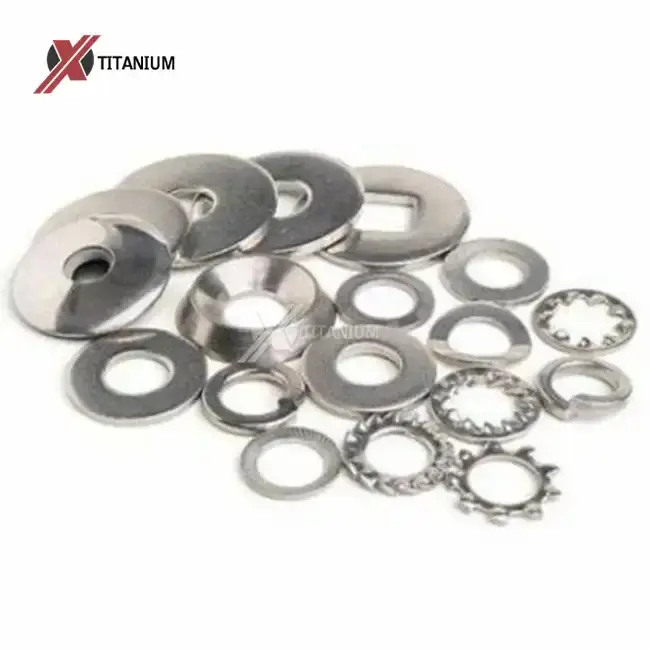
Flat Washers versus Lock Washers
Choosing between flat titanium washers and lock washers depends on functional requirements such as vibration resistance and assembly security. Flat washers provide optimal load distribution across bearing surfaces, making them suitable for static applications with consistent loading patterns. Lock washers incorporate spring action or serrated edges to prevent loosening under dynamic conditions, proving essential for rotating machinery and vibrating equipment installations.
Cost-Benefit Analysis and Investment Justification
The increased service life of titanium washers and the decreased maintenance needs that they require often result in a cheaper total cost of maintenance. This is despite the fact that titanium washers attract a premium price in comparison to conventional materials. Applications in the aerospace industry illustrate this idea by demonstrating that the replacement intervals for titanium washers are thirty percent longer than those for stainless steel counterparts. This results in a reduction in maintenance downtime and related expenses.
Procurement Insights for Buying Customized Titanium Washers from China
The comprehension of essential procurement aspects that improve supplier efficiency while guaranteeing quality compliance is beneficial to buyers who are in the business-to-business sector. In order to be successful, sourcing strategies should involve procedures such as quantity optimization, lead time planning, and supplier verification.
Order Planning and Quantity Considerations
Order lead times for customized titanium washers typically range from 15-30 days depending on specification complexity and order volume. Minimum order quantities often start at 100 pieces for standard configurations, with custom specifications requiring 500-1000 piece minimums to achieve economic production runs. Bulk purchasing discounts become available at quantities exceeding 5000 pieces, providing cost advantages for large-scale projects.
Supplier Selection and Verification Strategies
Verifying certificates such as ISO 9001, Australian Standard 9100 for the aerospace industry, including medical device certificates where appropriate is an important part of an effective supplier choice procedure. Obtaining insights into production capacities, systems for quality assurance, and traceability methods may be accomplished via the outcomes of factory audits. Direct partnerships with manufacturers remove markups that are added by intermediaries, while also improving product traceability and the availability of technical assistance.
Shipping and Logistics Best Practices
Global shipping logistics require careful consideration of packaging methods, transit times, and customs documentation. Air freight provides rapid delivery for urgent requirements but increases costs significantly. Sea freight offers economical solutions for large orders with extended lead times. Proper packaging prevents surface damage during transit while maintaining dimensional accuracy.
Installation and Maintenance Best Practices
In addition to maximizing the performance and longevity of titanium washers, proper installation procedures allow for the prevention of severe failure modes that affect the integrity of the assembly.
Installation Procedures and Load Distribution
The proper mounting processes guarantee that the load is distributed over the contact surfaces in the most efficient manner possible while also minimizing stress concentrations that may lead to the failure of the component. The process of surface preparation comprises cleaning contact areas in order to eliminate pollutants that impede the transfer of load responsibilities. In order to produce the appropriate clamping force and exceeding the material yield strength, torque standards need to be aligned with the bolt grade or thread pitch at the same time.
Maintenance and Inspection Protocols
Routine inspection schedules for the urea supply pump depend on application criticality and environmental exposure levels. Visual inspections identify surface corrosion, deformation, or cracking that indicates replacement requirements. Cleaning methods should avoid abrasive compounds that damage protective oxide layers. Protective measures in harsh industrial atmospheres include periodic lubrication with compatible compounds and contamination prevention through proper sealing.
Troubleshooting Common Issues
Surface galling occurs when improper installation techniques generate excessive friction during assembly. This condition manifests as surface scoring or material transfer between components. Stress corrosion cracking develops in high-stress environments with specific chemical exposures, requiring material grade evaluation and environmental modification. These troubleshooting approaches minimize downtime while safeguarding component integrity.
Company Introduction and Our Solutions
At Baoji Chuanglian Advanced Metal Material Co., Ltd., we provide a wealth of knowledge and a leading position in the market when it comes to the production of bespoke titanium washers for use in industrial applications all over the world. Our factory, which is situated in Baoji City, which is well known as the "City of Titanium," is able to produce precision-engineered solutions by using the experience of the local community as well as the modern manufacturing capabilities.
Advanced Manufacturing Capabilities
Our manufacturing facility is equipped with a dozen CNC machines and equipment and specialist processing equipment that was developed expressly for the purpose of making titanium components from scratch. We are able to maintain extensive machining processes that are capable of satisfying a wide variety of specification requirements thanks to years of technical innovation and equipment updates. The production capacity of our company can be scaled up effectively to meet the requirements of both the creation of prototypes and the manufacture of large-scale goods.
Quality Control and Certifications
Our quality control methods are very stringent, and they cover everything from the verification of raw materials to the inspection of final products. Each and every step of manufacturing is subjected to stringent testing in order to guarantee that it complies with worldwide standards such as ASTM, ISO, et AMS criteria. Traceability requirements are something that are needed for airplane, medical, and other sensitive applications, and our process for quality management satisfies those criteria.
Global Service and Support
Our B2B procurement solutions encompass initial inquiry processing, customization consultation, production planning, and comprehensive after-sales support. We provide technical assistance throughout the procurement process, ensuring optimal product selection and specification alignment. Our commitment to long-term partnerships includes ongoing support for evolving application requirements and expansion projects.
Conclusion
Customized titanium washers from China represent an optimal solution for industrial applications requiring superior performance, reliability, and cost-effectiveness. The combination of advanced manufacturing capabilities, competitive pricing, and comprehensive customization options positions Chinese suppliers as preferred partners for global B2B procurement strategies. Successful implementation requires careful supplier selection, proper specification development, and adherence to installation best practices to maximize component performance and operational efficiency.
FAQ
Which industries benefit most from titanium washers?
Aerospace, marine engineering, chemical processing, and medical device manufacturing industries gain significant advantages from titanium washers due to the material's exceptional corrosion resistance, strength-to-weight ratio, and biocompatibility. These sectors operate in demanding environments where conventional materials fail to provide adequate performance.
How does titanium's corrosion resistance compare to stainless steel?
Titanium demonstrates superior corrosion resistance compared to stainless steel, particularly in chloride environments and acidic conditions. While stainless steel suffers from stress corrosion cracking and pitting in seawater applications, titanium maintains structural integrity through passive oxide layer formation that provides natural protection.
What lead times should procurement teams expect for custom orders?
Custom titanium washer orders typically require 15-30 days for production and delivery, depending on specification complexity and order volume. Standard configurations may ship within 10-15 days, while specialized designs requiring unique tooling or testing may extend to 45 days.
Are there minimum order quantity requirements?
Most manufacturers establish minimum order quantities starting at 100 pieces for standard configurations to achieve economic production efficiency. Custom specifications often require 500-1000 piece minimums due to setup costs and tooling requirements.
Partner with Chuanglian for Premium Titanium Washer Solutions
Chuanglian stands ready to support your industrial applications with precision-engineered titanium washers designed to meet your exact specifications and performance requirements. Our experienced engineering team collaborates closely with procurement professionals to develop optimal fastening solutions that enhance operational efficiency and reduce total cost of ownership. Contact our titanium washer manufacturer team at info@cltifastener.com or djy6580@aliyun.com to discuss your specific needs and receive detailed technical proposals.
References
1. "Titanium Alloys for Industrial Applications: Properties and Performance Characteristics." Materials Science and Engineering Review, 2023.
2. "Corrosion Resistance of Titanium Fasteners in Marine Environments: Comparative Analysis with Alternative Materials." International Journal of Marine Engineering, 2022.
3. "Quality Standards and Testing Protocols for Aerospace Titanium Components." Aerospace Materials and Manufacturing Standards, 2023.
4. "Cost-Benefit Analysis of Titanium versus Stainless Steel in Chemical Processing Applications." Industrial Materials Economics Quarterly, 2022.
5. "Manufacturing Processes and Quality Control in Titanium Component Production." Advanced Manufacturing Technology Review, 2023.
6. "Global Supply Chain Management for Specialty Titanium Products: Best Practices and Risk Mitigation." International Procurement and Logistics Journal, 2022.
_1747726902556.webp)
Learn about our latest products and discounts through SMS or email