- English
- French
- German
- Portuguese
- Spanish
- Russian
- Japanese
- Korean
- Arabic
- Greek
- German
- Turkish
- Italian
- Danish
- Romanian
- Indonesian
- Czech
- Afrikaans
- Swedish
- Polish
- Basque
- Catalan
- Esperanto
- Hindi
- Lao
- Albanian
- Amharic
- Armenian
- Azerbaijani
- Belarusian
- Bengali
- Bosnian
- Bulgarian
- Cebuano
- Chichewa
- Corsican
- Croatian
- Dutch
- Estonian
- Filipino
- Finnish
- Frisian
- Galician
- Georgian
- Gujarati
- Haitian
- Hausa
- Hawaiian
- Hebrew
- Hmong
- Hungarian
- Icelandic
- Igbo
- Javanese
- Kannada
- Kazakh
- Khmer
- Kurdish
- Kyrgyz
- Latin
- Latvian
- Lithuanian
- Luxembou..
- Macedonian
- Malagasy
- Malay
- Malayalam
- Maltese
- Maori
- Marathi
- Mongolian
- Burmese
- Nepali
- Norwegian
- Pashto
- Persian
- Punjabi
- Serbian
- Sesotho
- Sinhala
- Slovak
- Slovenian
- Somali
- Samoan
- Scots Gaelic
- Shona
- Sindhi
- Sundanese
- Swahili
- Tajik
- Tamil
- Telugu
- Thai
- Ukrainian
- Urdu
- Uzbek
- Vietnamese
- Welsh
- Xhosa
- Yiddish
- Yoruba
- Zulu
Do you really know titanium alloy plate?
Titanium alloy plate is frequently mentioned as the gold standard when engineers and purchasing managers discuss high-performance materials. But the real question is: do you truly understand what makes this material different from pure titanium sold in stores or even high-quality stainless steel? A titanium alloy plate is not just flat-rolled titanium; it's a carefully designed product made by adding certain alloying elements to titanium, such as molybdenum, aluminum, or vanadium. These additions completely change the microstructure, turning the material into an alpha, beta, or alpha-beta phase metal with much better mechanical qualities, temperature stability, and resistance to rust, making it perfect for harsh industrial settings.
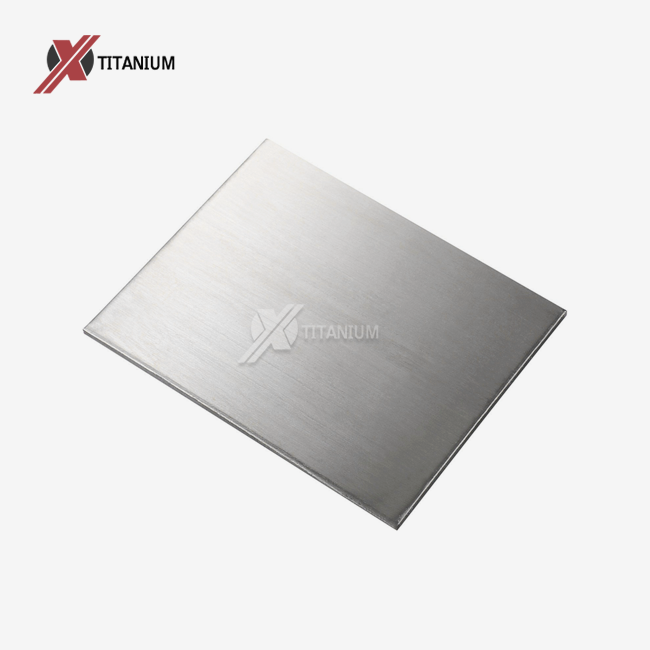
Understanding Titanium Alloy Plates: Properties and Grades
Many people don't notice the most important difference: how alloying changes titanium's basic properties. Pure titanium doesn't rust very well, but it doesn't have the tensile strength or wear resistance that aircraft bulkheads or chemical reactor vessels need. By adding aluminum and vanadium (as in Grade 5, or Ti-6Al-4V), producers can make titanium alloy plates that have tensile forces higher than 900 MPa and a density of only 4.43 g/cm³, which is about 40% less dense than steel.
How Material Grades Define Performance?
The grade you choose has a direct effect on how well your part will work when it's stressed. Grade 5 (Ti-6Al-4V) is mostly used in aircraft because, after solution treatment and age, its alpha-beta lattice gives it the best mix of strength and flexibility. This grade can handle temps up to 400°C without breaking down too much mechanically. Meanwhile, Grade 23 is an extra-low interstitial (ELI) version that has less nitrogen and oxygen. This improvement raises the fracture hardness by about 15 to 20 percent, making it the only choice for medical implants where cracks spreading inside the body could cause catastrophic failure.
Palladium is added to Grade 7 to make it much more resistant to reducing acids. This is especially important for industrial heat exchangers that are used in hydrochloric acid settings. Grade 9 (Ti-3Al-2.5V) is better at being cold shaped because it can be drawn deeper and bent more tightly without cracking. This is very useful when making complicated hydraulic tubes for aircraft fuel systems.
Heat Treatment's Role in Property Optimization
Heat treatment methods change the way machines work in basic ways. When you treat a solution at temperatures around 955°C, the beta phase elements dissolve evenly throughout the matrix. Then, rapid cooling freezes this distribution, making a structure that is neither stable nor unstable. After that, aging at 540–595°C forms small alpha particles inside the beta matrix. This makes the yield strength much higher through precipitation hardening.
On the other hand, annealing processes lower any remaining pressures from cold working and recover flexibility, which is important before trying secondary forming operations. Pickling and other surface processes get rid of the oxide scale and alpha case (an oxygen-rich layer that forms during hot processing), leaving behind clean metal that can be welded or bonded. Knowing about these heating processes helps buying teams choose the right state for the job, like annealed for the best shape-ability or aged for the best strength.
Comparing Titanium Alloy Plates with Alternative Materials
Cost is often the first thing that comes up when people talk about choosing materials, but smart engineers look at the total value over the whole lifecycle instead of just the buy price. Titanium alloy plates are lighter than stainless steel 316L, which weighs 8.0 g/cm³ compared to 4.43 g/cm³. In aircraft applications, this difference in density directly means less fuel use, and in sea uses, it means more cargo room. When an offshore platform cuts its structural weight by 45%, it often pays for itself in less time and money in shipping, installation crane capacity, and base needs within the first year of operation.
Resistance to corrosion is another important difference. 316L stainless steel works well in mild marine settings, but it gets pitting and crevice rust when salt levels are higher than 1000 parts per million and the temperature is high. Titanium alloys create a strong, self-healing layer of titanium dioxide (TiO₂) that stays solid in pH levels from 3 to 12 and salt levels higher than 100,000 ppm. Chemical makers say that titanium heat exchanger tubes can handle acetic acid for 20 to 30 years, while stainless steel needs to be replaced every 3 to 5 years.
Aluminum alloys have lower material costs and are easy to machine, but they can't be used at temperatures above 150°C for long, and when they're combined with steel bolts in salt water, they rust quickly. When building a fast patrol boat, a naval builder has to decide whether to use aluminum, which needs to be maintained for many years due to rust, or titanium, which doesn't need to be maintained for many years.
How to Procure Titanium Alloy Plates: From Supplier to Delivery
Comparing prices per kilogram is only one part of choosing a good provider. Material tracking rules are very strict in the titanium alloy plate business because a single flaw in an aircraft part can cause it to fail in a very bad way. Manufacturers with a good reputation keep certificates like AS9100 (aerospace quality management), ISO 9001, and NADCAP approval for certain processes. These licenses show that the seller has written down steps for every step of the production process, from checking the raw materials as they come in to making sure the end measurements are correct.
Documentation and Material Traceability
Material Test Reports (MTRs) are like a birth record for the material. They show the chemical make-up through spectrographic analysis, the mechanical traits through tensile testing, and the grain size through readings. The standards for ASTM B265 and AMS 4911 spell out the allowed ranges for each measure. Procurement experts with a lot of experience make sure that MTR values are well within the acceptable range and don't tend to crowd around the lowest levels. When problems happen further down the line, batch tracking is very important. Being able to track a rejected part back to a specific ingot melt lets for focused investigations instead of mass material returns.
Lead times range a lot depending on how complicated the specifications are. Standard Grade 5 plate in popular sizes (3–25 mm thick) usually ships within 4–6 weeks from well-known makers who keep stock. It could take 10 to 14 weeks for custom sizes, special surface finishes like bright annealing, or grades that aren't used very often because the material has to go through hot rolling, solution treatment, and final inspection. Minimum order numbers (MOQs) show how much a processing effort costs. For example, many sellers set MOQs between 100 and 500 kg to cover the costs of setting up special heat treatment processes.
Machining and Handling Titanium Alloy Plates: Best Practices
When machinists try to work with titanium alloy plates using the same rules they use for steel, they quickly run into problems. Titanium doesn't carry heat well (about 7 W/m·K compared to 50 W/m·K for steel), so cutting heat stays where it is, at the interface between the tool and the chip, instead of spreading out into the object. This buildup of heat speeds up the wear on the tools and hardens the layer being cut. For machining to go well, you need carbide or polycrystalline diamond (PCD) tools that are very sharp, cutting speeds that are slow (usually 50–60% of steel speeds), and a lot of cooling flow to get rid of the heat in the cutting zone.
Cutting factors need to be carefully improved. With feed rates of 0.1 to 0.2 mm per tooth and surface speeds of 30 to 45 meters per minute, the tool life is usually good and the dimensions are accurate. Interrupted cuts are especially hard because the heat cycles and repetitive loads make the tool edge break down faster. When drilling, peck drilling methods that let chip out often stop chip bonding to the flute walls. This is a typical way for drills to break, which means expensive workpieces have to be thrown away. Waterjet cutting gets rid of all heat-affected areas, so it's great for keeping the qualities of materials near the edges of cuts. Laser cutting works well when assisted gas protection is used to stop oxygen from picking up, but the quality of the edges needs to be checked with metallography to make sure no alpha case formation happened.
Finishing the surface needs the same amount of care. Pickling in hydrofluoric-nitric acid solutions gets rid of oxide scale and contamination layers, leaving raw metal with a uniform surface chemistry that can be bonded or coated later. Sandblasting makes the surface rougher in a controlled way, which makes the connection between adhesives stronger. This is very important when making titanium honeycomb sandwich panels for airplane floors. Polishing to a bright shine lowers the amount of stress on the surface, which makes wear performance better in parts that are loaded and unloaded many times, like chopper rotor hubs.
Advantages of Titanium Alloy Plates Over Traditional Materials
Lifecycle cost research always shows that titanium alloy plates are more cost-effective in harsh service settings. If a chemical plant wants to build reactor tanks out of titanium, the materials may cost 6–8 times more than if they were made out of stainless steel. But since the titanium unit doesn't need to be maintained for 25 years and the steel tank needs to be replaced every 5 years because of rust hole, the yearly cost estimate clearly favors the titanium unit. Getting rid of unexpected shutdowns, the cost of new materials, and missed production during changeouts adds a lot of value that isn't always seen in the initial capital planning.
Getting rid of extra weight directly leads to more efficient operations in many areas. Aerospace experts say that removing one kilogram from an airplane's structure saves about $1,000 a year in fuel costs over the life of the body. In high-stress places, replacing aluminum parts with titanium ones lets designers cut section thickness while keeping structural margins the same. This saves net weight, even though titanium is denser. Auto race teams use the same idea by using titanium in their exhaust systems and suspension parts to lower the amount of unsprung mass. This makes the car more nimble and faster.
Durability in harsh environments greatly increases the useful life of parts. Titanium marine structures are better at resisting biofouling than copper-nickel metals because the smooth oxide layer makes it harder for bacteria to stick to them. Offshore platform owners say that titanium pipe systems have kept their hydraulic efficiency for decades after they were installed, while steel versions lose flow rate over time as rust tubercles form. Titanium heat exchanger tube bundles allow desalination plants that handle seawater to work reliably for decades. This is because they don't need as much upkeep or chemicals as standard copper-nickel materials, which are prone to wear and rust.
Conclusion
To fully understand the titanium alloy plate, you need to go beyond its surface features and understand how its makeup, heat processing, and nanoscale engineering work together to make it perform so well in important situations. The material is very strong, doesn't weigh much, and doesn't rust. It solves important engineering problems in the medical, chemical processing, aircraft, and marine industries. To make implementation go smoothly, you need to work with providers who know what they're doing, have strict quality control systems, make sure you can track all of your materials, and offer expert help throughout the design and manufacturing process. When chosen and handled correctly, titanium metals provide lifetime value that explains their higher cost through lower upkeep, longer service life, and higher operating efficiency.
FAQ
What distinguishes Grade 5 from Grade 23 in practical applications?
Compared to Grade 5, Grade 23 has fewer intermediate elements like oxygen, nitrogen, and iron. This makes it about 15 to 20 percent stronger and more flexible. This means that Grade 23 must be used for medical procedures and important aircraft parts where cracks could spread and cause a disaster. The higher strength of Grade 5 means it can still be used for most structural uses in aircraft.
Can standard machining equipment handle titanium plate fabrication?
Standard equipment works as long as the right parameters are changed. Important changes include slower cutting speeds (50–60% of steel values), sharp carbide or PCD tools, and heavy cooling use to control heat buildup. When cutting profiles, waterjet cutting completely gets rid of the need to worry about heat.
What certifications should procurement teams verify when sourcing titanium?
AS9100 certification shows that you know how to handle quality in aircraft, and NADCAP certification shows that you know how to use special process controls for testing and heat treatment. ISO 9001 is a standard for quality system guarantee. Material Test Reports that list the chemical and mechanical qualities according to ASTM B265 or AMS standards are still needed for every shipment.
How does titanium pricing compare to stainless steel alternatives?
The cost of raw materials is usually 6 to 8 times higher than the cost of stainless steel types that are the same. Lifecycle cost analysis, which looks at things like maintenance, replacement frequency, and operating downtime, often shows that titanium is cheaper in situations where it needs to be resistant to corrosion or lightness, even though it costs more at first.
Partner with Chuanglian for Your Titanium Alloy Plate Requirements
Baoji Chuanglian New Metal Material Co., Ltd. has been making precise titanium alloy plates for difficult global uses for more than ten years. As the "City of Titanium" is known around the world, Baoji City is where our production facilities are located. These facilities are fully equipped with modern CNC machining machines and full heat processing capabilities. Our production methods include hot rolling, cold rolling, solution treatment, and age. These allow us to provide material grades from Gr5 to Gr23 in thicknesses ranging from 1 to 100 mm and lengths that can be customized up to 6000 mm.
Before being shipped, every plate goes through strict hardness tests, bend tests, and hydraulic checks. They are all supported by full Material Test Reports that make sure they meet ASTM B265 standards. Our quality management systems keep our ISO 9001 certification, and our expert team helps you choose the best materials for your unique working setting through application engineering. We can provide stable quality and predictable lead times whether you need aerospace-grade structure plate, corrosion-resistant chemical processing material, or nontoxic medical titanium. This is because we have a well-established supply chain and manufacturing capacity. Get in touch with our technical experts at info@cltifastener.com or djy6580@aliyun.com to talk about your needs with a titanium alloy plate seller who is dedicated to helping your project succeed.
References
1. Lutjering, G. and Williams, J.C. (2007). Titanium: Engineering Materials and Processes. Springer-Verlag Berlin Heidelberg.
2. Donachie, M.J. (2000). Titanium: A Technical Guide, 2nd Edition. ASM International, Materials Park, Ohio.
3. Boyer, R., Welsch, G., and Collings, E.W. (1994). Materials Properties Handbook: Titanium Alloys. ASM International.
4. Schutz, R.W. and Watkins, H.B. (1998). "Recent Developments in Titanium Alloy Application in the Energy Industry," Materials Science and Engineering A.
5. Peters, M., Kumpfert, J., Ward, C.H., and Leyens, C. (2003). "Titanium Alloys for Aerospace Applications," Advanced Engineering Materials, Vol. 5, No. 6.
6. ASTM International (2021). ASTM B265-20a: Standard Specification for Titanium and Titanium Alloy Strip, Sheet, and Plate. West Conshohocken, PA.
Learn about our latest products and discounts through SMS or email