- English
- French
- German
- Portuguese
- Spanish
- Russian
- Japanese
- Korean
- Arabic
- Greek
- German
- Turkish
- Italian
- Danish
- Romanian
- Indonesian
- Czech
- Afrikaans
- Swedish
- Polish
- Basque
- Catalan
- Esperanto
- Hindi
- Lao
- Albanian
- Amharic
- Armenian
- Azerbaijani
- Belarusian
- Bengali
- Bosnian
- Bulgarian
- Cebuano
- Chichewa
- Corsican
- Croatian
- Dutch
- Estonian
- Filipino
- Finnish
- Frisian
- Galician
- Georgian
- Gujarati
- Haitian
- Hausa
- Hawaiian
- Hebrew
- Hmong
- Hungarian
- Icelandic
- Igbo
- Javanese
- Kannada
- Kazakh
- Khmer
- Kurdish
- Kyrgyz
- Latin
- Latvian
- Lithuanian
- Luxembou..
- Macedonian
- Malagasy
- Malay
- Malayalam
- Maltese
- Maori
- Marathi
- Mongolian
- Burmese
- Nepali
- Norwegian
- Pashto
- Persian
- Punjabi
- Serbian
- Sesotho
- Sinhala
- Slovak
- Slovenian
- Somali
- Samoan
- Scots Gaelic
- Shona
- Sindhi
- Sundanese
- Swahili
- Tajik
- Tamil
- Telugu
- Thai
- Ukrainian
- Urdu
- Uzbek
- Vietnamese
- Welsh
- Xhosa
- Yiddish
- Yoruba
- Zulu
How to properly load and maintain titanium anode baskets?
To get reliable electroplating results and to make tools last longer, it is important to load and take care of titanium anode baskets the right way. These baskets, which are made of high-purity titanium (ASTM B265 Grade 1 or Grade 2), hold liquid anode materials like nickel, copper, or zinc balls and act as electrical channels that don't dissolve. When you add something correctly, the current flows evenly, which keeps the basket from failing early and fixing metal flaws. Regular maintenance keeps the basket's rust protection and structural integrity. This complete guide talks about the problems that procurement managers and process engineers in the aircraft, petroleum, medical device, and high-end manufacturing industries have to deal with on a daily basis.
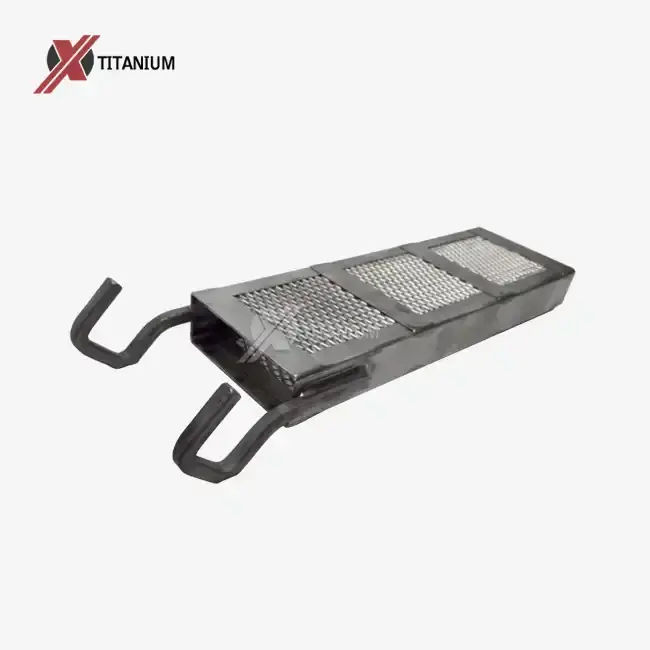
Understanding Titanium Anode Baskets and Their Functionality
Titanium anode baskets are a major step forward in the science of electroplating. Unlike regular solid anode bars, these special devices use titanium's one-of-a-kind anodic passivity feature, which means that when anodic conditions happen, a thin film of titanium dioxide forms on the surface. This passive layer keeps the basket from melting while still letting current flow to the anode material inside through contact points.
Core Material Advantages Driving Industrial Adoption
The choice of commercially pure titanium handles a number of problems that come up in tough electrolytic conditions. Titanium doesn't rust easily and can handle harsh acidic and basic fluids that are often used in Watts nickel baths, sulfuric acid copper plating, and chromic acid systems. It has a high strength-to-weight ratio because it has a low density (about 4.5 g/cm³). This makes it easier to handle during upkeep processes than stainless steel options. Because the material is very thermally stable, its dimensions stay the same at temperatures ranging from room temperature to 60°C, which is common in lines that decorate cars.
Baskets with uniform material qualities are made through cold rolling, hot rolling, heating, and freezing, among other methods. Acid cleaning, sanding, or grinding the surface is the best way to make the inactive oxide layer form. This improves both the conductivity at the contact places and the long-term chemical resistance. Before being shipped, every basket has to pass strict industry standards by going through quality control procedures that include strength tests, bending tests, and hydraulic tests.
Electrochemical Function and Industry-Specific Applications
During electroplating, these boxes keep the anode area the same even though the anode materials are constantly breaking down. This geometric stability fixes the important problem of changing anode-to-cathode ratios, which is a problem with solid anode designs. This makes the current density distribution uniform across the cathode surface, getting rid of differences in thickness that lead to rejection in high-quality tasks like through-hole plating on PCBs or coatings for medical implants.
These baskets are used in the aircraft industry to plate titanium bolts and structural parts with great accuracy, as the quality of the material is very important. Those used in petrochemical plants are used for electrowinning in chlor-alkali plants, where chlorine gas evolution needs very high corrosion resistance. Medical device makers like how biocompatible Grade 1 titanium is, which keeps metal from getting into the solution while coating surgery tools. For making lithium-ion electrodes, battery factories use cylinder-shaped baskets, and the energy density is directly affected by how accurately the dimensions are met.
Best Practices to Properly Load Titanium Anode Baskets
How the equipment is loaded has a big effect on how regular the plating is, how long the equipment lasts, and how safe it is to use. When things aren't done right, they cause hotspots, faster basket wear, and expensive production stops.
Weight Distribution and Capacity Guidelines
Based on the mesh structure and hook strength of titanium anode baskets, each basket design lists the heaviest weight that it can hold. Going over this limit puts stress on the weld joints and bends the mesh structure, which makes the current paths less even. Spread the weight of the nickel rounds or copper balls out evenly across the basket's space instead of putting most of it at the bottom. This even spread stops mechanical bowing and keeps the distance between the anode media and the basket wall constant.
The amount of load should be about 70–80% of the basket's total volume. When you overfill, the electrolytes can't move around as easily, which can cause areas of stagnation that make breakdown less even. Underfilling loses available anode surface area and makes refilling happen more often, which lowers the efficiency of production. Teams in charge of buying things should work with providers to find custom weight limits that fit the density of the anode material and the amount of work that needs to be done in batches.
Positioning Techniques for Optimal Current Flow
To make sure there are low-resistance electrical paths, the anode material needs to keep making touch with the basket mesh in many places. Once the basket is full, give it a light shake or bump to settle the contents and make new contact points. When using circular anode balls, which can cross and make separate pockets with bad conductivity, this method is especially important.
Keep enough space between the edge of the anode basket and the top of the cathode—usually 4 to 8 inches, but this depends on the plating chemistry and the current density needs. Edge burning happens on coated parts when there isn't enough space between them, and solution resistance and energy use go up when there is too much space. For vertical continuous plating systems to work, the rectangular baskets must be placed precisely so that the anode-to-cathode distance changes as little as possible along the length of the panel.
Case Study: Improving Throughput in Automotive Trim Plating
A Tier 1 car supplier that was having trouble with chrome shine issues on decorative trim changed the way it was loaded. They cut brightness difference from 12% to less than 3% by making sure that nickel rounds were distributed evenly across 75% of the baskets and by putting in place a settling process before the rounds were put into the tank. This change increased basket service life by six months and cut rejecting rates by 40%. This shows that proper loading has a direct effect on both quality measures and total cost of ownership.
Effective Maintenance Strategies to Extend Titanium Anode Basket Lifespan
Even though titanium is naturally strong, it's important to follow maintenance procedures to get the most out of your investment and avoid problems during production runs.
Cleaning Protocols for Deposit Removal
As the machine works, electrolyte chemicals, ferrous fines, and oxide scale build up on the basket's sides. These layers make the electrical resistance higher and can affect later plating runs. Set up a cleaning plan that depends on how much is being made. For high-throughput operations, this is usually every two to four weeks.
Take the basket out of the plating tank and rinse it with deionized water to get rid of the electrolyte on the surface. Soak for 15 to 30 minutes in a weak acid solution (5 to 10 percent sulfuric or hydrochloric acid at room temperature) to get rid of metallic oxides and salts. Cleaners with fluoride or hydrofluoric acid should not be used on titanium because they are very harsh on the inactive layer. Soft nylon brushes are used for mechanical motion to get rid of tough layers without scratching the mesh surface. Rinse well and check before putting back into work.
Visual Inspection Checklist for Early Problem Detection
Regular checks of titanium anode baskets find patterns of wear before they lead to a fatal failure. Check the hook connection places for cracks or darkening that could mean they are getting too hot from not touching the busbar properly. Check mesh welds for cracks or separation, especially in places that are under a lot of stress. Check for warping or bulge in the mesh that could be caused by overloading or damage from impacts while being handled.
Check the size of the mesh openings on a regular basis. A big increase in size means that material is being lost due to chemical attack, which is usually caused by fluoride exposure or too much voltage. Check the stability of the basket's dimensions by comparing them to the original specs. If the basket is bending, it means that the material was not chosen correctly for the working temperature range or was damaged by thermal cycles.
Refurbishment Versus Replacement Decision Criteria
Titanium is very easy to weld, which makes fixes cheap. TIG welding with Grade 2 filler rod can be used to repair broken hooks, which restores electrical connection for a lot less money than buying a new basket. Small mesh tears can be fixed by welding pieces of titanium sheet together. But baskets that have a lot of mesh thinning, a lot of structural fails, or too much physical warping need to be replaced.
Work with providers that offer repair services to get more use out of your assets. A skilled maker can look at the damage, suggest cost-effective ways to fix it, and provide detailed paperwork that proves the repair's integrity. This joint method cuts down on downtime and makes the best use of budgets for capital tools.
Comparison and Selection Criteria for Titanium Anode Baskets
Material choice has a direct effect on how well something works, how often it needs upkeep, and how much it costs over its entire life.
Material Performance: Titanium Versus Alternatives
Stainless steel baskets are cheaper at first, but they rust quickly in acidic coating baths, adding iron and chromium to the electrolytes. Their usual service life of 6 to 12 months isn't even close to titanium's 5 to 10 year lifespan in the same settings. Graphite options are resistant to chemicals, but they are not very durable mechanically—they break easily when handled, and they don't conduct electricity well, so they need to be maintained often.
Titanium has a better total cost of ownership because it is chemically neutral, structurally strong, and conducts electricity well. Even though they cost three to four times as much as stainless steel, the longer life and lack of problems with bath contamination make a strong economic case. Instead of just looking at the original purchase price, procurement studies should look at how often things need to be replaced, how much they cost to fix, and how often they are rejected for quality reasons.
Design Customization for Application-Specific Requirements
The shape of the basket has a big effect on how well it plates. For rotogravure cylinder plating, where the anode-cathode spacing needs to be exact, cylindrical shapes work well. Rectangular layouts make the most of PCB Vertical Continuous Plating lines by matching panel sizes for even current flow. Different types of anode materials can be used with custom-sized meshes. For example, larger mesh (with ¼-inch holes) works for big nickel rounds, while smaller mesh (with ⅛-inch openings) stops small copper balls from getting out.
The choice of surface treatment strikes a balance between chemical protection and transmission. Bright or shiny finishes make the surface smoother, which makes it easier to clean by preventing deposits from sticking. Acid-pickled surfaces improve the consistency of the inactive layer for the best rust protection. Sandblasted finishes make contact points have more surface area, which lowers electrical resistance for high-current uses.
Supplier Evaluation and Procurement Strategy
To find trustworthy titanium anode basket providers, you need to look at more than just price. Certification standards like ISO9001, AS9100 (for aircraft uses), and medical device quality systems show that the manufacturing process is controlled. Ask for material test results that confirm agreement with ASTM B265 and trace element standards. Impurities like iron or silicon can hurt performance.
Manufacturing skills like TIG welding knowledge, precision making tools, and in-house testing facilities show how advanced the production process is. Suppliers that offer unique design work with engineering teams to make sure that the basket layouts are best for each metal system. Check the security of the supply chain. For example, producers should keep an inventory of raw materials and enough output capacity to protect against changes in wait times that could affect project plans.
Procurement Guide: Ordering and Working with Titanium Anode Basket Suppliers
To easily go through the buying process, you need to know how to use sourcing methods, create specifications, and handle relationships.
Sourcing Channels and Manufacturer Engagement
Working directly with well-known makers of titanium anode baskets gives you access to tech help and customization options that you can't get through middlemen. At industry shows like NASF SUR/FIN and Electrochemical Society workshops, you can talk to a lot of sellers in person and get a feel for their scientific knowledge. Suppliers that meet basic quality standards are already on government-approved seller lists and listings of professional associations.
Digital B2B platforms make it easier to buy from suppliers around the world, but suppliers' qualifications need to be carefully checked. Before starting big sales, check business licenses, export compliance paperwork, and customer references. Videoconferencing lets you take virtual walks of a facility, so you can see how things are made and how quality control is done without having to pay for expensive foreign travel.
Specification Development and Quotation Analysis
Specifications that are very detailed help keep communication clear and make sure that the goods provided meet practical needs. Include the size of the basket, the type of mesh (expanded or weaved), the material grade (Grade 1 for the best rust protection or Grade 2 to save money), how you want the surface to be treated, and how much weight you want it to hold. Give details about the hook design that works with current busbar systems, such as the wire material (titanium-clad copper lowers resistance) and the shape of the connection.
Ask for detailed quotes that break down the prices of materials, labor for manufacturing, surface treatment, and testing/certification. This openness lets you compare prices from different sources and finds ways to improve specifications. When you sign a bulk buying agreement, you promise to buy a lot of something, which can lead to lower prices. You can also set up framework agreements for regular releases that fit production plans.
Building Strategic Supplier Partnerships
There are more benefits to having long-term ties with qualified producers than just saving money on processing costs. Technical teamwork allows for constant improvement—suppliers who know how your finishing processes work may suggest changes to the design that will improve performance or lower upkeep needs. Consignment stocking programs keep extra baskets on hand without spending money on new equipment. This cuts down on the time it takes to get emergency supplies.
Set clear rules for communication, such as who the expert contacts are, how to report problems with the quality, and what kind of after-sales help is expected. Performance measures like on-time delivery, quality agreement rates, and how quickly you answer expert questions are looked at in regular business reviews. This organized partnership method lowers the risks in the supply chain and encourages new ideas by working together to solve problems.
Conclusion
In conclusion, loading and maintaining titanium anode baskets correctly has a direct effect on the quality of the treatment, the life of the equipment, and how well it works. Using best practices for things like weight distribution, cleaning procedures, and inspection plans will get you the best return on your investment with the least amount of downtime. When choosing a material, lifetime cost analysis should be given more weight than the original buy price. This is because titanium is more durable in harsh electrochemical conditions. Strategic relationships with qualified suppliers give manufacturers that care about quality the technical know-how, customization options, and stable supply chains they need to stay ahead of the competition.
Partner with Chuanglian for Superior Titanium Anode Basket Solutions
The Baoji Chuanglian New Metal Material Co., Ltd. is in China's "City of Titanium," and they have been making high-performance titanium anode baskets for difficult electroplating uses for more than ten years. Our thorough quality control system makes sure that every basket meets strict international standards, such as ASTM B265 requirements, from choosing the raw materials to the final review. We have a dozen CNC machine centers and high-tech TIG welding equipment, which lets us make precise custom cylinder, rectangular, and other basket shapes that fit your exact plating system needs.
Our engineering team works directly with procurement managers and process engineers to find the best mesh shapes, surface treatments, and weight capacities that make plating more regular and increase its useful life. We are a reliable company that makes titanium anode baskets for the aircraft, petroleum, medical device, and automobile industries around the world. We offer full material tracking, open design options, and quick expert support for the whole lifespan of the product. Contact our team at info@cltifastener.com or djy6580@aliyun.com to discuss your specific application challenges and receive detailed quotations backed by our promise to provide excellent quality and on-time delivery.
References
1. ASTM International. (2020). Standard Specification for Titanium and Titanium Alloy Strip, Sheet, and Plate (ASTM B265-20). West Conshohocken, PA: ASTM International.
2. Schlesinger, M., & Paunovic, M. (2010). Modern Electroplating (5th ed.). Hoboken, NJ: John Wiley & Sons.
3. Schutz, R. W., & Thomas, D. E. (1987). Corrosion of Titanium and Titanium Alloys. In Corrosion: Metals Handbook (Vol. 13, pp. 669-706). Materials Park, OH: ASM International.
4. National Association for Surface Finishing. (2018). Guidelines for Anode Systems in Electroplating Operations. Washington, DC: NASF Technical Committee.
5. Dini, J. W. (1993). Electrodeposition: The Materials Science of Coatings and Substrates. Park Ridge, NJ: Noyes Publications.
6. Kanani, N. (2004). Electroplating: Basic Principles, Processes and Practice. Oxford, UK: Elsevier Advanced Technology.
Learn about our latest products and discounts through SMS or email