- English
- French
- German
- Portuguese
- Spanish
- Russian
- Japanese
- Korean
- Arabic
- Greek
- German
- Turkish
- Italian
- Danish
- Romanian
- Indonesian
- Czech
- Afrikaans
- Swedish
- Polish
- Basque
- Catalan
- Esperanto
- Hindi
- Lao
- Albanian
- Amharic
- Armenian
- Azerbaijani
- Belarusian
- Bengali
- Bosnian
- Bulgarian
- Cebuano
- Chichewa
- Corsican
- Croatian
- Dutch
- Estonian
- Filipino
- Finnish
- Frisian
- Galician
- Georgian
- Gujarati
- Haitian
- Hausa
- Hawaiian
- Hebrew
- Hmong
- Hungarian
- Icelandic
- Igbo
- Javanese
- Kannada
- Kazakh
- Khmer
- Kurdish
- Kyrgyz
- Latin
- Latvian
- Lithuanian
- Luxembou..
- Macedonian
- Malagasy
- Malay
- Malayalam
- Maltese
- Maori
- Marathi
- Mongolian
- Burmese
- Nepali
- Norwegian
- Pashto
- Persian
- Punjabi
- Serbian
- Sesotho
- Sinhala
- Slovak
- Slovenian
- Somali
- Samoan
- Scots Gaelic
- Shona
- Sindhi
- Sundanese
- Swahili
- Tajik
- Tamil
- Telugu
- Thai
- Ukrainian
- Urdu
- Uzbek
- Vietnamese
- Welsh
- Xhosa
- Yiddish
- Yoruba
- Zulu
What sizes do titanium countersunk washers come in?
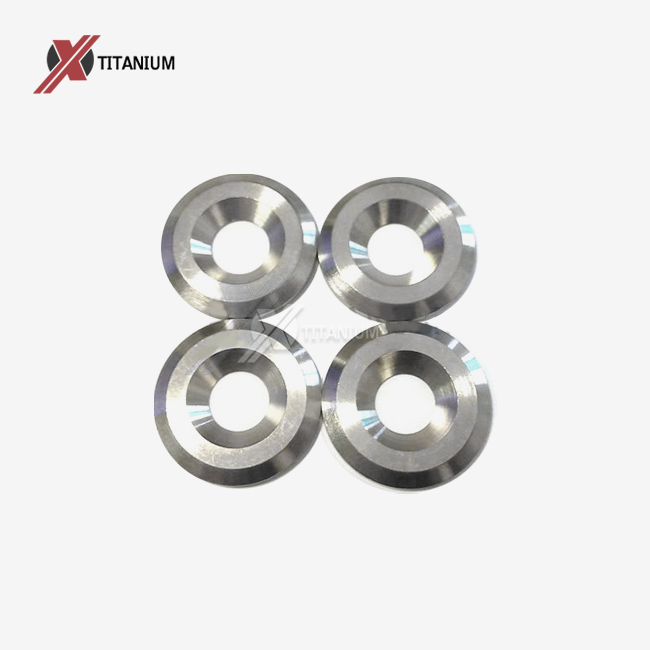
There is a wide range of sizes of titanium countersunk washers to meet the needs of different industrial fixing applications. The standard metric sizes are M3 to M20, with outside diameters of 6mm to 50mm, inside diameters of 3mm to 20mm, and thicknesses range from 0.5mm to 5mm. These precision-engineered parts are mostly made from Grade 2 commercially pure titanium or Grade 5 Ti-6Al-4V alloy. They have conical bearing surfaces that are meant to sit flush with mating substrates. This makes sure that the load is distributed evenly while keeping a slim profile that is important for medical, marine, and aerospace uses.
Understanding Titanium Countersunk Washers: Overview and Importance
What Makes Titanium Countersunk Washers Essential for Critical Applications?
Titanium countersunk washers are a special kind of fixing part that is designed with a cone-shaped bearing surface that lets them fit exactly under countersunk screw heads. In contrast to regular flat washers, these parts are designed to solve specific engineering problems where surface protrusions would reduce airflow efficiency, get in the way of moving parts, or cause hydrodynamic drag. The cone shape spreads stress over a larger contact area, which keeps the base from getting damaged, especially when attaching to composite panels or buildings with thin walls.
The choice of material is very important. Titanium has a mass of about 4.51 g/cm³, which means it is 45% lighter than stainless steel versions while still having the same or better mechanical performance. In aircraft uses, where every gram counts when it comes to fuel economy and carrying capacity, this strength-to-weight edge is mission-critical. Titanium is lighter than steel, and its passive oxide layer makes it very resistant to corrosion in chloride-rich environments. This means that steel options don't have to deal with the problems of rust weeping and crevice corrosion that happen in naval and chemical plant sites.
Industry Applications Driving Size Requirements
Because of how they work, different areas have different physical requirements. Aerospace companies usually need smaller, lighter titanium countersunk washers in the M3 to M8 range for fitting electronics and putting together the inside of aircraft cabins, where weight and room are limited. Manufacturers of engine parts, on the other hand, define bigger M10 to M16 sizes that can handle cycling high temperatures and motion loads while they are in use.
Marine engineering projects put rust protection ahead of reducing weight as much as possible. M6 to M12 titanium countersunk washers are often used in deck gear and hull fittings on racing boats and submersibles. The flush installation keeps the water clean and stops line snags. Medical device makers need the purest materials possible, so they buy Grade 2 titanium countersunk washers in smaller sizes (M2 to M5) for surgical tool kits and internal device housings. Each production batch comes with a biocompatibility certification.
Standard Sizes and Specifications of Titanium Countersunk Washers
Dimensional Standards and Measurement Conventions
When you're ordering titanium countersunk washers, you need to know their inner diameter, outer diameter, and thickness. The standard bolt size is shown by the "M" number in metric systems, which is the same as the inner diameter. A 6mm bolt shaft can fit in an M6 titanium countersunk washer, but makers usually add 0.2 to 0.5 mm of space to make assembly easier and less likely to get stuck. The link between the inner diameter and the outer diameter is usually proportional. Standard ratios produce OD values that are about 2.5 to 3 times the inner diameter to make sure there is enough material for the bearing area without too much.
Material Grades and Their Impact on Sizing
Grade 2 commercially pure titanium is very easy to shape and doesn't rust. Its tensile strength can reach 275 MPa and its hardness is around 160 HV. This grade works well for chemical processing equipment and naval gear that needs to be very passive in harsh conditions. Grade 5 Ti-6Al-4V is an alpha-beta metal with 6% aluminum and 4% vanadium. It has a tensile strength of up to 895 MPa and a hardness of up to 349 HV. Because the mechanical qualities are better, the designs can be smaller and lighter while still meeting the same load standards as Grade 2 titanium countersunk washers.
Knowing these things about the material helps you choose the right size. In structural situations, a Grade 5 titanium countersunk washer that is 1.5 mm thick can often be used instead of a 2.5 mm Grade 2 part, which saves 40% of the weight. When purchasing managers look at quotes from suppliers, they should make sure that the material certifications meet the needs of the application. Changing grades without engineering review can damage the structure of the assembly or add extra costs that aren't necessary.
Countersunk Angle Variations and Compatibility
Countersunk angles are an important but often forgotten factor that affects how well a titanium countersunk washer works. Most aircraft and North American standards call for angles of 100 degrees, while most European metric screws use angles of 90 degrees. 82-degree curves are used in some specific situations, especially in cars and consumer goods. The titanium countersunk washer's conical angle should match the angle of the screw head it's meant to fit. This will ensure proper fitting and even load transfer. Angle mismatches cause point contact instead of surface contact, which greatly increases bearing stress and raises the risk of failure before its time.
Manufacturers like Chuanglian keep tools for all three angle standards, so when a customer places an order, they can be sure that the geometry will work with what they want. When engineering teams are looking for titanium countersunk washers, they should check the bolt head specs from fastener sources to make sure that all the parts of the system are the same size. For unique projects, custom angle choices become available, but the minimum order quantity usually goes up for non-standard shapes.
Comparing Titanium Countersunk Washer Sizes with Alternatives
Material Performance Across Size Ranges
Stainless steel countersunk washers are still easy to find in a wide range of sizes. They are made of cheaper materials but have a much higher density. A 316 stainless steel M8 washer weighs about 3.2 grams, while a Grade 5 titanium countersunk washer equivalent weighs about 1.8 grams. This is a 44% weight penalty that adds up quickly when you have hundreds of screws in an assembly. The rust resistance curve is also very different. While 316 stainless steel works well in normal pH settings, titanium stays inactive from pH 1 to 14. This makes it essential for chemical processing and purification systems where localized rust could weaken the structure.
Aluminum alloy countersunk washers are denser than steel washers, but they are weaker and can't handle high temperatures. Aluminum's rate of thermal expansion is almost twice that of titanium's. This causes differences in movement in temperature-cycling situations that can loosen joints or cause grinding wear. Anodized coats on aluminum countersunk washers wear off over time, but titanium's natural oxide layer heals itself when it gets scratched, keeping it protected against rust for a long time.
Size-Specific Advantages in Demanding Environments
Titanium countersunk washers have special qualities that show up in different ways depending on the size. The weight savings are greatest for smaller washers (M3 to M6), since the difference in mass between them and steel options is most noticeable in small parts. In household goods and medical devices, where a decrease in overall weight affects mobility and user comfort, these forms are most common. The sizes in the middle (M8 to M12) are the best compromise between price and performance. They are ideal for naval deck gear and aircraft secondary structure fittings.
Titanium countersunk washers are usually chosen for larger sizes (M16 to M20) when resistance to rust is more important than cost. Offshore platform structures and chemical reactor vessels need these sizes for flanged connections and pressure vessel seals, where the costs of replacing parts are much higher than the prices of the premium materials at first. Titanium isn't magnetic, which makes it useful for mine-sweeping equipment and medical devices that can be used with MRIs but need bigger fastening systems that won't damage sensitive equipment.
How to Choose the Right Size Titanium Countersunk Washer for Your Project?
Engineering Considerations and Load Requirements
Figuring out the bearing stress at the joint contact is the first step in choosing the right titanium countersunk washer size. To find the bearing stress, engineers first figure out how much compression the bolt has to handle. Then, they divide that number by the amount of bearing space under the titanium countersunk washer. Material datasheets list the highest levels of stress that can be put on a material. For Grade 2, this is usually around 150 MPa, and for Grade 5, it's 300 MPa. This calculation directly affects the choice of top width. If there isn't enough bearing area, stress builds up, which can damage the base or cause the titanium countersunk washer to bend.
Custom Sizing and OEM Manufacturing Capabilities
About 80% of industrial fixing needs can be met by standard stock titanium countersunk washer sizes. However, unique measurements are often needed for specific uses. When making prototypes, retrofitting projects that use existing hole patterns, and weight-optimized designs, the inner diameter, outer diameter, and width are often not specified in the usual way. Companies that use CNC machines can make unique titanium countersunk washers from bar stock or plate material at a low cost, especially when the order quantity is more than 500 pieces.
Over a dozen CNC machines are kept in Chuanglian's machining facilities in Baoji, which is known as China's "City of Titanium." These machines can make unique titanium countersunk washers with tolerances of ±0.05mm. During the design process, our engineering team works with customers to look over technical models and suggest improvements that make the product easier to make without lowering its performance. Custom surface treatments, such as anodizing in gold, blue, green, purple, black, and colorful finishes, make it easier to find parts in complicated systems.
Supplier Evaluation and Quality Assurance
When purchasing managers look at titanium countersunk washer providers, they should put quality system certifications ahead of price alone. AS9100 approval means that the process controls are up to aircraft standards. These controls include being able to track materials, following rules for measurement checking, and writing down testing methods. ISO 9001 gives basic quality control guidelines that can be used in business settings. Companies that make medical devices need providers that are certified with ISO 13485. This makes sure that biocompatibility tests and safe production conditions are carried out.
Each output lot comes with a material test record that provides important confirmation. These papers show that the titanium grade was confirmed by spectroscopic analysis, that the mechanical qualities were confirmed by tensile tests, and that the resistance to rust was shown by salt spray exposure. Our quality control methods test every batch of production, and we keep records that can be linked to certificates from the mills that supply our raw materials. This paperwork is very important in the aircraft and medical industries, where material source checks happen all along the supply chain.
Installation Tips for Titanium Countersunk Washers Based on Size
Proper Installation Techniques Across Size Ranges
How to install titanium countersunk washers depends on their size and what they will be used for. Smaller washers (M3 to M6) need to be handled carefully so that they don't cross-thread or get out of place while being put together. When you use guide holes with exact countersink depths, you can be sure that washers will seat properly and not cock, which would cause loads to be concentrated widely. The countersink depth should be such that the screw head sits 0.1 to 0.2 mm below the top surface of the titanium countersunk washer. This way, the screw head can make full contact across the conical interface without pushing it too hard, which could damage the base material or bend the washer.
When fitting titanium parts, torque standards need extra attention. Titanium doesn't have as much stiffness of elasticity as steel, so screws stretch more when the same amount of force is applied to them. This changes the relationship between torque and stress. To get the same pressure, Grade 5 titanium bolts with titanium countersunk washers usually need 15-20% less force than steel bolts of the same type. By using measured torque tools, you can avoid over-tightening, which can damage threads or break titanium countersunk washers. When putting together titanium-on-titanium surfaces, anti-seize compounds with molybdenum disulfide lower the risk of galling.
Avoiding Common Installation Pitfalls
When titanium countersunk washers and screws are the wrong size, they can fail in a number of ways. When washers don't have enough inner circle space, they get stuck on bolt shanks when they're being tightened. This stops the bolts from fitting properly and creates side loads that bend the fasteners. When there is too much space between the washers, they can move around during service, putting loads in odd places. The best balance is achieved by keeping a 0.2-0.5 mm gap between the standard bolt width and the other parts.
The most sneaky fitting flaw is when the countersink position isn't right. When a 100-degree titanium countersunk washer is pushed onto a 90-degree screw head, it only touches the screw head along the edges, which greatly reduces the useful bearing area. During production, this shape difference is often not noticed, but it shows up in service as faster wear, pitting rust, or opening before it should. Angle fit should be checked as part of the seller approval process, and sample parts should be inspected for size before production numbers are approved.
Conclusion
The performance of titanium countersunk washers is unmatched in settings where weight is important and rust is common. They come in sizes ranging from M3 to M20 to meet the needs of a wide range of industries. When buying teams know about measurement standards, material grade differences, and best fitting practices, they can choose parts that have the best technical performance and lifecycle costs. Customizing sizes through CNC cutting lets you use products for specific tasks that aren't covered by catalogs.
For adoption to go smoothly, angle compatibility, correct torque methods, and source approval based on quality systems rather than price alone must all be carefully thought out. Companies that need reliable titanium fixing solutions can work with makers that offer full material tracking, quick engineering support, and production stability that has been shown to work in challenging aircraft, marine, and medical device applications.
FAQ
What are the most common sizes for aerospace applications?
For structural and semi-structural uses, aerospace systems mostly use M4, M5, M6, and M8 titanium countersunk washers. When installing an interior cabin, smaller M3 and M4 sizes are preferred because they are lighter. Engine parts and main structure connectors have dimensions between M8 and M12 so they can handle higher motion loads and heat cycles. For aerospace-grade washers, the material must always be Grade 5 Ti-6Al-4V, come with full material certifications, and have 100-degree countersink angles that meet NAS and MS requirements.
Can custom sizes be manufactured for specialized industrial projects?
Custom size is one of the main things that titanium countersunk washer makers who work with high-performance businesses can do. CNC cutting from titanium bar stock or plate material can be used for projects that need non-standard measurement pairings, custom countersink angles, or changed thickness profiles. Minimum order numbers are usually between 100 and 500 pieces, depending on how complicated the design is. Lead times for making the tools and making the product can last up to four weeks. Working together as engineers during the blueprint step helps make ideas more efficient.
How does washer size influence corrosion resistance and mechanical strength?
In small but important ways, titanium countersunk washer measurements affect how well it works. Larger outer sizes increase the bearing surface area, which lowers localized stress densities that can speed up fretting rust at the edges of joints. Thicker washers have a higher section stiffness, which means they don't bend or deform when they're loaded unevenly. They also keep the contact pressure even, which saves the base materials. Material grade selection has a bigger effect on total rust resistance than size differences. Grade 2 materials are the most durable in all measurements when it comes to the environment. Due to its higher mechanical strength, Grade 5 allows for smaller and lighter forms that can hold the same amount of weight as Grade 2 options.
Partner with a Trusted Titanium Countersunk Washer Manufacturer
Chuanglian mainly makes titanium countersunk washers that are precisely designed and made to very strict standards for use in aircraft, marine, chemical processing, and medical devices. Our Baoji facility has been making titanium for more than ten years and has full CNC capabilities. It can make standard and special sizes from Grade 2 and Grade 5 materials. We have strict quality control processes that make sure that every production batch has the same dimensions, surface finish, and ability to track materials.
Our engineering team helps customers come up with the best washer measurements for their individual loading conditions and weather risks by giving them expert advice during the design creation process. Whether your project needs stock sizes with fast shipping or custom measurements with special surface treatments, we deliver the dependability and speed that demanding uses need. You can email our team at info@cltifastener.com or djy6580@aliyun.com to discuss your unique needs, get approved samples of materials, or get full quotes for your next project.
References
1. Boyer, R., Welsch, G., & Collings, E.W. (1994). Materials Properties Handbook: Titanium Alloys. ASM International, Materials Park, Ohio.
2. Donachie, M.J. (2000). Titanium: A Technical Guide, 2nd Edition. ASM International, Materials Park, Ohio.
3. Lutjering, G., & Williams, J.C. (2007). Engineering Materials and Processes: Titanium, 2nd Edition. Springer-Verlag, Berlin Heidelberg.
4. Veiga, C., Davim, J.P., & Loureiro, A.J.R. (2012). "Properties and applications of titanium alloys: A brief review." Reviews on Advanced Materials Science, 32(2), 133-148.
5. Bania, P.J. (1994). "Beta titanium alloys and their role in the titanium industry." JOM Journal of the Minerals, Metals and Materials Society, 46(7), 16-19.
6. Schutz, R.W., & Watkins, H.B. (1998). "Recent developments in titanium alloy application in the energy industry." Materials Science and Engineering: A, 243(1-2), 305-315.
Learn about our latest products and discounts through SMS or email