- English
- French
- German
- Portuguese
- Spanish
- Russian
- Japanese
- Korean
- Arabic
- Greek
- German
- Turkish
- Italian
- Danish
- Romanian
- Indonesian
- Czech
- Afrikaans
- Swedish
- Polish
- Basque
- Catalan
- Esperanto
- Hindi
- Lao
- Albanian
- Amharic
- Armenian
- Azerbaijani
- Belarusian
- Bengali
- Bosnian
- Bulgarian
- Cebuano
- Chichewa
- Corsican
- Croatian
- Dutch
- Estonian
- Filipino
- Finnish
- Frisian
- Galician
- Georgian
- Gujarati
- Haitian
- Hausa
- Hawaiian
- Hebrew
- Hmong
- Hungarian
- Icelandic
- Igbo
- Javanese
- Kannada
- Kazakh
- Khmer
- Kurdish
- Kyrgyz
- Latin
- Latvian
- Lithuanian
- Luxembou..
- Macedonian
- Malagasy
- Malay
- Malayalam
- Maltese
- Maori
- Marathi
- Mongolian
- Burmese
- Nepali
- Norwegian
- Pashto
- Persian
- Punjabi
- Serbian
- Sesotho
- Sinhala
- Slovak
- Slovenian
- Somali
- Samoan
- Scots Gaelic
- Shona
- Sindhi
- Sundanese
- Swahili
- Tajik
- Tamil
- Telugu
- Thai
- Ukrainian
- Urdu
- Uzbek
- Vietnamese
- Welsh
- Xhosa
- Yiddish
- Yoruba
- Zulu
How are titanium clad copper bars manufactured?
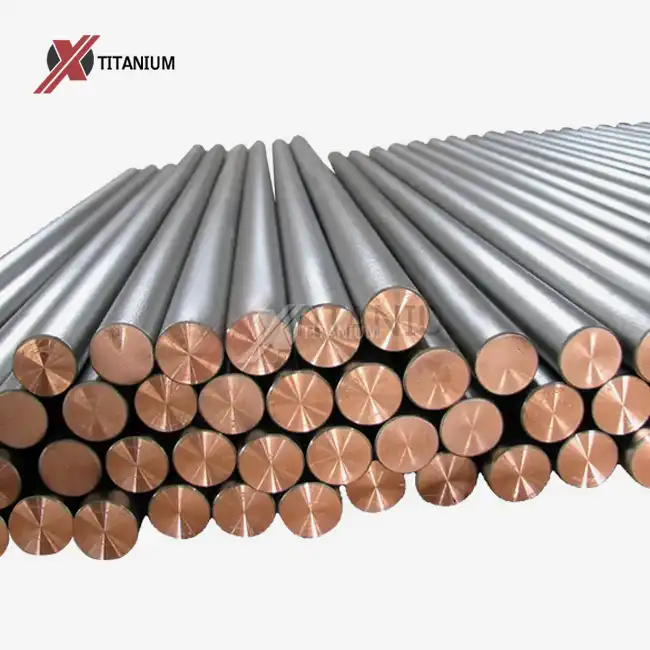
Titanium clad copper bars are hybrid conductors made using advanced metallurgical bonding techniques that join a titanium top layer that doesn't rust with a copper core that conducts electricity very well. Explosive welding, hot rolling, or diffusion bonding are used to form an atomic-level bond between the two metals. This makes sure that the bar keeps copper's great electrical conductivity while getting titanium's better rust resistance. This hybrid structure solves the main problem in industry, which is how to keep electrical performance high in toxic conditions without affecting the structure's strength or service life.
Understanding Titanium Clad Copper Bars
The conducting core of a titanium-clad copper bar is made up of high-purity oxygen-free copper (usually C10200 or C11000 grades according to ASTM B170), and the outside is made up of commercially pure titanium (Grade 1 or Grade 2 according to ASTM B265). Metallurgists use something called the "skin effect" in this construction: the titanium protects against acidic media, and the copper inside handles electrical transfer with little voltage drop.
Material Composition and Structural Design
At Baoji Chuanglian New Metal Material Co., Ltd., we make these bars with copper cores that are 10mm to 200mm in diameter and titanium layers that are 0.1mm to 2mm thick. The thickness of the titanium depends on how harsh the application is. For example, a chlor-alkali busbar might need 1.5 mm of titanium cladding to protect it from wet chlorine, but a softer industrial application might only need 0.5 mm. Since electricity mostly moves through the copper core, the mixture keeps about 98% of the conductivity rate of pure copper. The titanium layer has an average material density of 4.5 g/cm³. This makes it a strong but lightweight conductor that can withstand acidic, alkaline, and salt attacks that would destroy copper in months if it weren't protected.
Performance Benefits and Application Scope
There are measured benefits to the composite construction that directly lead to lower operating costs. Corrosion resistance makes parts last longer, from months to decades in harsh settings, so they don't have to be replaced as often and production doesn't have to stop. Over time, the bars keep the electrical resistance fixed, which improves energy efficiency. Corroding copper raises resistance, which causes working voltages and energy use to rise by 15-20% before failure.
Chemical processing plants use titanium clad copper bars for electrolytic cell infrastructure, marine engineering projects ask for them for cathodic protection systems, and semiconductor fabrication plants put them in plating equipment where complete chemical inertness is needed to keep contamination under control.
Manufacturing Process of Titanium Clad Copper Bars
To make a strong metal link between titanium and copper, you need to use complex manufacturing methods that take into account their various chemical qualities, melting points, and rates of heat expansion. Manufacturers use three main gluing methods, and each has its own benefits based on the size of the bar, the amount of output needed, and the performance standards.
Explosion Welding: The Foundation Method
Explosion welding uses controlled explosion to push the surfaces of titanium and copper together at very high speeds, making an atomically strong link at the contact. Manufacturers put titanium and copper plates next to each other with an exact space between them, and then explosives are set off across the titanium surface. The explosion wave speeds up the titanium plate as it moves toward the copper at more than 2,000 meters per second. For microseconds, the pressure is above 10,000 atmospheres and the temperature reaches 1,500°C.
When these conditions are met, the surfaces of both metals melt for a short time and mix at the border, creating a stronger metal bond than either parent metal alone. Ultrasonic testing confirms that the contact is fully bonded; any gaps in the bonding create thermal barriers that cause warming in certain areas during operation. This method works great for big plates that are then hot-rolled to make bars. It gives the bonds a strength of over 130 MPa shear force.
Hot Rolling and Extrusion Refinement
After explosion welding joins the plates together, hot rolling smooths out the mixture to make bars with exact measurements and better mechanical properties. The joined plates are heated to temperatures between 800°C and 900°C in controlled environments to stop rusting. Multiple rolling passes make the material thinner while stretching it out, and cooling processes in between lower the pressures inside it.
The hot rolling method improves the diffusion zone at the junction of the titanium and copper, which makes the bond stronger while keeping the diameter tolerances to within ±0.5mm. We have a dozen CNC machines that let us precisely control the width from 10mm to 200mm and the length from 500mm to 3,000mm to fit the needs of each customer. Hot extrusion is another way to make bars straight from smaller billets. It does this by pushing hot material through dies that shape the cross-section while keeping the structure that holds it together.
Surface Treatment and Quality Assurance
Post-bonding preparation makes sure that bars meet strict industry standards for mechanical performance, surface finish, and accuracy of dimensions. Using controlled acid solutions for pickling gets rid of metal scale, and bright finishing or polishing makes surfaces smooth, which lowers the resistance to electrical contact. For normal uses, acid cleaning is one way to prepare the surface. For rough finishes that make mechanical grip better, sandblasting is another. For cleanrooms, glossy surfaces are the best choice.
During production, we do a lot of strict quality tests. For example, hardness tests make sure the metal has been heated correctly, bending tests make sure it can be bent without delaminating, and hydraulic tests check the strength of the structure when it is under pressure. Electrical conductivity testing is done on every production run to make sure the composite meets the International Annealed Copper Standard (IACS) of at least 58%. Bond strength testing shows that the shear resistance is higher than what is required by standard.
Technical Specifications and Performance Attributes
To determine whether titanium clad copper bars meet application requirements, procurement experts need accurate technical data. Performance traits are more than just the features of the material. They also include how the composite reacts to practical pressures, changes in temperature, and chemical contact that are common in industrial settings.
Electrical and Thermal Conductivity
The copper core still conducts electricity better than 98% of the time when it is pure copper, and its resistance is usually less than 1.75×10⁻⁸ Ω·m. Because of this low resistance loss, a 50 mm bar can send 5,000 amps with voltage drops that are similar to solid copper. The titanium coating also stops rust, which would normally raise resistance by 30 to 40 percent yearly in acidic environments. The thermal conductivity stays high, around 350 to 380 W/m·K, which makes it easy for heat to escape in high-current situations. The titanium layer's melting point of 1,668°C makes it much more thermally stable than copper, which can only handle temperatures up to 1,085°C. This keeps the surface from wearing down during welding or short overloading conditions that soften pure copper.
Mechanical Strength and Corrosion Resistance
The combination has a tensile strength of more than 400 MPa and a yield strength of about 300 MPa, which is a lot more than the 200 MPa of heated copper. Because of this increased strength, smaller cross-sections can carry the same loads, which lowers the cost of materials and the weight of installation. Elongation values between 15 and 25 percent ensure that the material is flexible enough to be bent during installation without the risk of delamination. The titanium covering is very resistant to rusting in acidic and basic environments (pH runs from 1 to 14).
It keeps its shape in sulfuric acid baths, sodium hydroxide cells for electrolysis, and ocean cooling systems, where copper rusts in months. Independent tests show that rust rates are less than 0.01 mm per year in strong acids, which is 200 times better than copper that isn't protected. Our factory follows ISO9001 quality management standards, and the plates we make meet ASTM B898 standards for reactive metal clad plate and GB/T 12769 Chinese standards for bimetallic composite materials.
Decision Factors for Selecting Titanium Clad Copper Bars
When choosing the best conductor material, you have to weigh technical performance against cost and source skills. Systematic review systems help purchasing managers compare different materials and check the skills of vendors before committing to long-term supply relationships.
Material Comparison and Cost-Benefit Analysis
When you compare titanium clad copper bars to other options, you can see that they are more cost-effective in tough situations. Pure copper is cheaper at first, but it needs to be replaced every 6 to 18 months in settings that are corroded. This means that replacement work costs, production downtime, and waste costs add up to more than the purchase price of the wrapped bar within two years. Stainless steel doesn't rust, but it doesn't carry electricity as well as copper does, so it needs bigger cross-sections and uses more energy, which costs an average electrowinning business $5,000 to $15,000 a year in extra power costs.
Copper-clad aluminum is lighter, but it's not as good at conducting electricity, and it can rust where the coating is broken. The titanium-copper alloy has a 20-year service life and requires little upkeep. This means that it has a 40–60% lower total cost of ownership than other options when you consider how often it needs to be replaced, how much energy it uses, and how reliable the process is because of its stable electrical properties.
Supplier Evaluation Criteria
Checking the qualifications of suppliers guards against quality problems that put operations at risk. Manufacturers you can trust keep certifications that show they know how to control the manufacturing process and work with metals. These include ISO9001 quality management, ASTM B898 compliance for explosive bonding methods, and industry-specific certifications like AS9100 for aircraft uses. Production skills are very important.
Companies that have their own explosion welding, hot rolling, and CNC cutting tools keep quality control tighter than companies that outsource important steps. The fact that our Baoji plant is in China's "City of Titanium" gives us direct access to titanium mills and copper refineries, which lets us track materials and keep prices low. We have full testing labs that check every production lot for ultrasonic bond damage, conductivity, and mechanical problems. For each lot, we give certificates of compliance that show the material makeup, accuracy in measurements, and performance confirmation.
Practical Considerations for Procurement and Engineering Teams
The successful adoption of titanium clad copper bars requires matching product specifications to application requirements and setting clear source contact methods that prevent mistakes that slow down the project or affect the performance of the component.
Application-Specific Selection Guidelines
In electrowinning, copper cores with a titanium covering thickness of 1.0 to 1.5 mm and a capacity of 3,000 to 8,000 amps are usually used, with bars placed horizontally above electrolyte baths. The thickness of the titanium must be able to survive acid mist and electrolyte splashes for 15 to 20 years of service without letting copper rust through. For chlor-alkali uses, the covering needs to be 1.5 to 2.0 mm thick and able to fight wet chlorine gas. The ends need to be sealed properly so that chlorine doesn't get into the copper core.
Electronics coating processes require thinner covering (0.5 to 0.8 mm) with smooth surfaces to reduce the risk of contamination. They put more emphasis on the surface finish than on maximum rust protection. Marine cathodic protection systems usually have bars with a bigger width (100–150 mm) and a mild 1.0 mm covering. This is because strong chemical resistance is less important in the ocean than resistance to rust.
Supplier Communication and Verification
By including diameter limits, length requirements, titanium thickness ranges, surface finish choices, and relevant standards in detailed requests for quotes, you can speed up the process of getting accurate bids. Ask for test results on the materials that show how pure the copper is, the grade of the titanium, the bond strength, and the conductivity. Before placing large orders, make sure you get production samples and test them for accuracy in measurements, quality of the surface, and bond strength using ultrasonic inspection or damaging testing if the quantity justifies the cost.
Set clear delivery dates that take into account hot rolling campaigns, explosion welding plans, and finishing operations. Lead times for normal specifications are 8–12 weeks, and they can go up to 14–18 weeks for custom measurements that need special tools. Our engineering team at Chuanglian helps customers figure out the best bar sizes and titanium thickness for their needs while keeping costs low. They do this by giving expert advice throughout the design process.
Dependability and consistent performance are at the heart of the long-term value offer. Installations using high-quality titanium clad copper bars have reported 95%+ uptime over decades, removing the production stops and emergency repairs that come with copper infrastructure that corrodes. Every year, stable electrical resistance compounds save energy, and keeping copper ions out of solutions and soldering baths improves process rates and product quality.
Conclusion
Through controlled blast welding, precise hot rolling, and stringent quality control, the production of titanium clad copper bars represents clever metallic engineering that addresses practical industrial problems. The hybrid structure has clear benefits, including a 20-year service life in places where copper would be destroyed in months, energy efficiency that stays the same over decades of use, and mechanical strength that lets installations last for a long time.
When making choices about what to buy, it helps to know about the producing methods that decide how reliable a product is. Checking the supplier's in-house welding tools, full-service testing labs, and quality standards can keep you safe from low-quality materials that break too soon. Matching the width of the titanium coating and the size of the copper core to the seriousness of the application improves performance and keeps costs low. These bars are important for many industries, from hydrometallurgy to making semiconductors, because they keep operations running smoothly and meet quality standards that give them a competitive edge in their markets.
FAQ
How does titanium cladding affect electrical conductivity?
The titanium layer doesn't have a big effect on conductivity because most of the current goes through the copper core. Since the titanium covering isn't very thick (0.5–2.0 mm) compared to the copper core thickness, quality bars keep more than 98% of the conductivity of pure copper. The material keeps its low electrical resistance, which is necessary for power transfer to work well.
What certifications should I verify when sourcing these bars?
Reliable providers keep their ISO9001 quality management approval and show that they follow the ASTM B898 rules for explosive gluing processes. Industry-specific certifications, such as AS9100 for aircraft or medical device certifications, show that a company has improved quality control skills that are suitable for mission-critical tasks.
Can titanium clad copper bars be custom fabricated to specific dimensions?
Manufacturers who can do a lot of different kinds of cutting can make titanium clad copper bars with widths, lengths, and titanium thicknesses that are exactly what an application needs. CNC cutting allows for very accurate tolerances in dimensions, and special surface processes can be used to fit the needs of a specific location or setting.
Partner with Chuanglian for Superior Titanium Clad Copper Bar Solutions
We make titanium clad copper bars at Baoji Chuanglian New Metal Material Co., Ltd. by combining our knowledge of metals with strict quality control, resulting in reliable conductors for your most difficult uses. Our Baoji plant has been working with titanium for more than ten years and uses high-tech explosion welding and CNC machining centers to make bars that meet ASTM B898 and ISO9001 standards. We can make options for you that are exactly matched to your needs, with titanium coating ranging from 0.1 mm to 2 mm and widths from 10 mm to 200 mm. Our engineering team offers full expert support throughout the design process, assisting in the optimal selection of materials for optimal performance and cost effectiveness. Get in touch with our experts at info@cltifastener.com or djy6580@aliyun.com to talk about your titanium-clad copper bar needs with a reputable maker and provider that is dedicated to providing top quality products at reasonable prices and on time.
References
1. Davis, J.R. (2001). Copper and Copper Alloys. ASM International Handbook Committee, Materials Park, Ohio.
2. Findik, F. (2011). Recent Developments in Explosive Welding. Materials & Design, 32(3), 1081-1093.
3. Acarer, M., Gülenç, B., & Findik, F. (2003). Investigation of Explosive Welding Parameters and Their Effects on Microhardness and Shear Strength. Materials & Design, 24(8), 659-664.
4. American Society for Testing and Materials (2019). ASTM B898: Standard Specification for Reactive and Refractory Metal Clad Plate. ASTM International, West Conshohocken, Pennsylvania.
5. Kahraman, N., Gülenç, B., & Findik, F. (2005). Joining of Titanium/Stainless Steel by Explosive Welding and Effect on Interface. Journal of Materials Processing Technology, 169(2), 127-133.
6. Pouraliakbar, H., Khalaj, G., & Jandaghi, M.R. (2015). Constrained Groove Pressing and Subsequent Annealing of Al-Mn-Si Alloy: Microstructure Evolutions, Crystallographic Transformations, Mechanical Properties, and Electrical Conductivity. Materials & Design, 86, 106-115.
Learn about our latest products and discounts through SMS or email