- English
- French
- German
- Portuguese
- Spanish
- Russian
- Japanese
- Korean
- Arabic
- Greek
- German
- Turkish
- Italian
- Danish
- Romanian
- Indonesian
- Czech
- Afrikaans
- Swedish
- Polish
- Basque
- Catalan
- Esperanto
- Hindi
- Lao
- Albanian
- Amharic
- Armenian
- Azerbaijani
- Belarusian
- Bengali
- Bosnian
- Bulgarian
- Cebuano
- Chichewa
- Corsican
- Croatian
- Dutch
- Estonian
- Filipino
- Finnish
- Frisian
- Galician
- Georgian
- Gujarati
- Haitian
- Hausa
- Hawaiian
- Hebrew
- Hmong
- Hungarian
- Icelandic
- Igbo
- Javanese
- Kannada
- Kazakh
- Khmer
- Kurdish
- Kyrgyz
- Latin
- Latvian
- Lithuanian
- Luxembou..
- Macedonian
- Malagasy
- Malay
- Malayalam
- Maltese
- Maori
- Marathi
- Mongolian
- Burmese
- Nepali
- Norwegian
- Pashto
- Persian
- Punjabi
- Serbian
- Sesotho
- Sinhala
- Slovak
- Slovenian
- Somali
- Samoan
- Scots Gaelic
- Shona
- Sindhi
- Sundanese
- Swahili
- Tajik
- Tamil
- Telugu
- Thai
- Ukrainian
- Urdu
- Uzbek
- Vietnamese
- Welsh
- Xhosa
- Yiddish
- Yoruba
- Zulu
Gr5 Titanium Double Banjo Bolts vs Steel: Which Is Best for Racing?
For most racing projects, Gr5 titanium double banjo bolts are the way to go if weight, corrosion resistance and custom machining are more important than purchasing price. Ti-6Al-4V has a density of around 4.43 g/cm3 whereas steel is about 7.85 g/cm3 . So each bolt weighs much less. Steel still has the edge on rigidity, affordability and availability, and fits verified, high-volume projects. Depends on your thread, sealing design, pressure and budget The proper response. Below I compare the two materials and show you how to specify, install and purchase them with certainty.
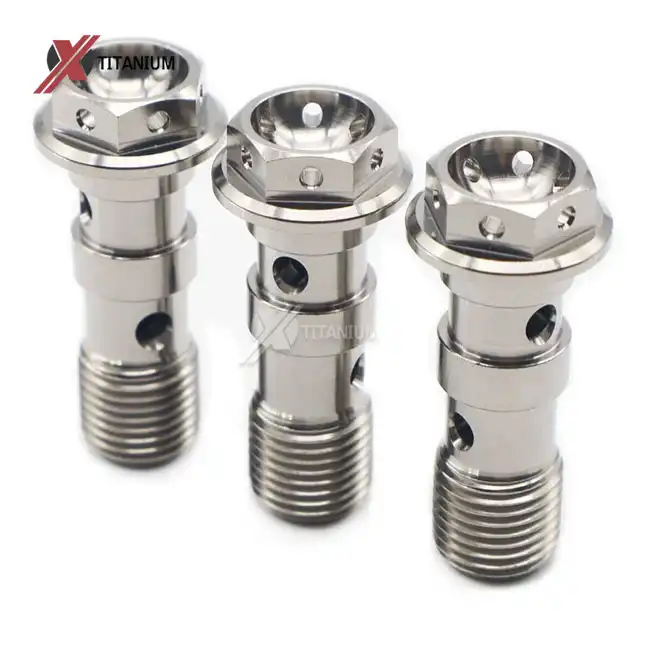
What Are Gr5 Titanium Double Banjo Bolts?
How a Double Banjo Bolt Works
A twin banjo bolt is a hollow bolt with cross drilled holes. It allows two banjo fittings to share one threaded port so that two fluid lines join at one place. You will find them on brake callipers, master cylinders and clutch systems when space is at a premium. The whole junction includes bolt, two fittings, sealing washers and hose ends. Fluid enters the bolt via side ports, travels down the bore and exits to the next fitting. Because of this approach, the performance depends on bore size and sealing faces as much as on metal. A good bolt maintains the flow and joint free of leaks.
Why Ti-6Al-4V Suits Racing
Grade 5 is an alloy known as Ti-6Al-4V . It has around 6 percent aluminium and 4 percent vanadium . Our Gr5 standard allows for a minimum tensile strength of 130,000 psi, minimum yield strength of 120,000 psi, and minimum elongation of 10 percent. The alloy is resistant to seawater and many chemicals so it won’t suffer the corrosion that destroys simple steel gear. It also machines well on CNC equipment allowing for unique bore, heads and lengths. This blend is valued by racers because every gram of spinning or unsprung mass counts. These values are consistent with common standards such as ASTM B348 and the ASM Handbook.
Where Racers Use Them
This is most often seen on motorcycles, where two front callipers generally share a single feed line. They are also used in the brake and clutch circuits in karts, race cars and prototype builds . Low-volume teams love Gr5 titanium double banjo bolts because a CNC shop can adjust the thread or length without new tooling. Buyers in marine and aircraft utilise comparable designs on fluid lines exposed to salinity or strict weight limitations. Whatever the vehicle, check that the fluid, pressure and temperature are correct for the part. One system's bolt may not fit another's.
Gr5 Titanium Double Banjo Bolts vs Steel: Core Performance Comparison
Weight and Strength
Weight and Strength The most obvious discrepancy is shown by density. Ti-6Al-4V is around 4.43 g/cm 3, whereas steel is about 7.85 g/cm 3, therefore the same form in titanium weighs roughly 44 percent less. Actual savings depend on bolt size and length, head design and bore, therefore a single bolt saves just a few grams. You can get better value by replacing hose fittings, bleed screws and other fasteners. Gr5 has a minimum tensile strength of around 895 MPa, which is between ISO class 8.8 and 10.9 steel (800 and 1,040 MPa minimum, following ISO 898-1). Titanium wins on strength per gram, not on brute strength.
Stiffness, Corrosion, and Heat
Steel is more rigid. Its elastic modulus is ~200 GPa while Ti-6Al-4V is ~114 GPa. Titanium would bend more under the same strain. In a clamped banjo joint, this modifies the way that torque is converted to clamp force, therefore follow the torque value from your supplier or test lab. Titanium likes to corrode. It provides a stable oxide coating so that red rust does not develop from road salt, rain or brake dust. Zinc-plated steel is corrosion resistant until the coating wears off. Stainless steel represents a midway ground. Titanium also handles brake heat rather well, but the fluid and washers tend to fail before the metal does.
Cost and Availability
Steel banjo bolts are cheaper and are carried by numerous providers, generally in stock for popular sizes. Titanium costs extra since the raw metal is more expensive and harder to process. The greater expense is machining the bore, sealing faces and thread therefore quality differs across producers. A inexpensive titanium bolt with a rough sealing face might leak and that costs more than the price difference. The surface you choose is important, too. We have anodising, polishing, and nitriding in natural titanium, gold, blue, green, purple, black, and rainbow colours. Colour is an added attraction for brand owners when selling upgrade kits.
Is Titanium or Steel Better for Racing?
When Titanium Is the Better Choice
Choose titanium when weight, corrosion, or appearance drives the build. Motorcycles gain most, because a bike carries several banjo bolts and weighs far less than a car, so each gram matters more. Teams that race in rain or near the coast also gain from corrosion resistance, since steel hardware can rust at the head and thread. Brand owners selling premium brake kits benefit from color options and a clean polished finish. Custom machining helps when an unusual thread or short stack height rules out catalog parts. Titanium makes sense when the extra cost buys a measurable result.
When Steel Is the Better Choice
Steel remains a sound choice in many cases. Its higher stiffness gives predictable clamp force, and it costs less. Large production runs, tight budgets, and series with approved designs often favor steel, because a material change means new testing. Steel parts are also easy to source in standard sizes, so repairs at the track go quickly. If a team has already validated a steel bolt in its brake circuit and has no weight target, switching adds risk with little gain. An honest comparison admits this. A material should earn its place by solving a real problem.
A Simple Scoring Matrix for Your Project
A scoring matrix keeps the decision objective. List weight, strength, stiffness, corrosion resistance, temperature and pressure limits, cost, lead time, and custom needs. Give each item a weight based on your project, then score titanium, steel, and alternatives. Stainless steel resists rust at lower cost than titanium but weighs about the same as other steels. Aluminum is lighter, but you must check wear, thread strength, and pressure carefully. Whatever wins, have a qualified engineer approve any Gr5 titanium double banjo bolts or clutch part before it goes on a race vehicle. Test results, not marketing claims, should settle the final call.
How to Specify and Size Gr5 Titanium Double Banjo Bolts
Check Material and Documents
A grade name alone proves little. Ask for a material certificate that confirms Ti-6Al-4V, along with dimension reports and batch traceability. Confirm how the maker produces the part: CNC machined, forged, or cold formed. Ask about finish, since sealing faces need a smooth, flat surface to seal against washers. At Chuanglian, we inspect every production step from raw material to finished product, and we CNC machine our parts. Request records before you approve a sample, and keep them with your batch files. This habit protects your brand if a customer ever reports a problem.
Match Thread, Length, and Bore
Thread diameter and pitch must match the port exactly. Motorcycle brake ports often use M10 × 1.0 or M10 × 1.25, and a quick visual check cannot tell them apart. We produce M6, M8, M10, M12, and M14 threads, with lengths from 10 mm to 100 mm. To pick the length, add the thickness of both banjo fittings, both sealing washers, and any spacer, then allow full thread engagement without bottoming out. The bore and cross holes must stay clear, so share the hole size you need. A drawing or 3D CAD file removes guesswork on head size, stack height, and hole position.
Confirm Pressure and Torque
Pressure capability belongs to the whole joint, not to the bolt alone. Wall thickness, thread form, washer type, and torque all play a part. No universal number fits every design, so I advise buyers to run their own sealing and pressure tests on samples under real system conditions. Titanium's lower stiffness means over-tightening can distort seats or strip threads, while under-tightening leaks. Use the torque value from your fitting maker or test lab, and tighten with a calibrated wrench. Treat the first sample batch as a test, and approve production only after leak checks pass.
Installation, Common Mistakes, and Custom Orders
Safe Installation Steps
Clean the threads and sealing faces first. Fit new sealing washers, and set the fittings at the right angle before tightening. Start the bolt by hand to avoid cross-threading, and check that it does not bottom out before the fittings clamp. Titanium can gall, which means the threads seize and tear, especially when dry or against dissimilar metals. Use lubricant or anti-seize only as directed, because it changes the clamp force that a given torque produces. After tightening, bleed the system, then inspect for leaks, hose clearance, and routing. Recheck after heat cycles and replace any damaged Gr5 titanium double banjo bolts part.
Mistakes Buyers Make
Buyers repeat a few errors. They pick a bolt by diameter alone and forget pitch, length, and seat design. They assume every Gr5 part carries the same pressure capability. They mix unverified bolts, fittings, and washers from different sources, which can cause leaks or flow restriction. Some chase the lowest price and then pay for extra testing, downtime, or returns. A better approach compares machining quality, documentation, delivery time, and technical support along with price. The cheapest bolt rarely stays cheapest once failures appear. Brake parts demand extra caution, since a leak affects rider safety.
Ordering Custom Parts from Chuanglian
Chuanglian is based in Baoji, known as the "City of Titanium." We have more than ten years of experience machining titanium and run a dozen CNC machine tools. We customize our Gr5 titanium double banjo bolts by size, bore, length, and finish. A typical order moves through technical review, quotation, drawing approval, sample evaluation, test confirmation, and batch production. Surface options include polishing, anodizing, and nitriding in natural, gold, blue, green, purple, black, and rainbow tones. Please settle MOQ, lead time, labeling, and packaging early, so repeat orders match your first batch.
Conclusion
Gr5 titanium double banjo bolts and steel bolts each fit different racing needs. Titanium, at about 4.43 g/cm³, cuts mass by roughly 44 percent against steel, resists corrosion, and suits custom CNC designs. Steel offers higher stiffness, lower cost, and easy availability. Strength per gram favors titanium, while raw strength and validated designs can favor steel. Performance depends on the whole joint: thread match, bore size, sealing faces, length, torque, installation care, and documented inspection. Buyers who score materials against project goals, test samples, and avoid common mistakes reach safer results. The better material is the one that meets the specific application's requirements and passes testing.
FAQ
Are Gr5 titanium double banjo bolts stronger than steel?
Not in every case. Gr5 has a minimum tensile strength of 130,000 psi, which sits between ISO class 8.8 and 10.9 steel. Its advantage is strength per unit of weight.
Which thread sizes are common?
M10 × 1.0 and M10 × 1.25 are common on motorcycle brake ports. Always measure the mating port. We also make M6, M8, M12, and M14.
Do titanium bolts gall?
Yes, they can. Clean threads, lubricant or anti-seize used as directed, and the specified torque lower the risk.
Can I order custom parts?
Yes. Send a drawing or sample with thread, length, bore, finish, and quantity, and our team will review the project.
Request Gr5 Titanium Double Banjo Bolts from Chuanglian
Ready to compare materials for your next build? Send your drawing, thread size, length, and quantity to Chuanglian, a Gr5 titanium double banjo bolts supplier in Baoji. We offer M6 to M14 threads and lengths from 10 mm to 100 mm. Email info@cltifastener.com or djy6580@aliyun.com, and our team will review your CNC-machined, custom-finish project.
References
1. ASTM International, Standard Specification for Titanium and Titanium Alloy Bars and Billets (ASTM B348), 2019
2. ASM International, ASM Handbook Volume 2: Properties and Selection: Nonferrous Alloys and Special-Purpose Materials, 1990
3. Donachie, M. J., Titanium: A Technical Guide, 2nd Edition, ASM International, 2000
4. Leyens, C. and Peters, M., Titanium and Titanium Alloys: Fundamentals and Applications, Wiley-VCH, 2003
5. Boyer, R., Welsch, G., and Collings, E. W. (Eds.), Materials Properties Handbook: Titanium Alloys, ASM International, 1994
6. International Organization for Standardization, ISO 898-1: Mechanical Properties of Fasteners Made of Carbon Steel and Alloy Steel, 2013
_1742980398281.webp)
Learn about our latest products and discounts through SMS or email