- English
- French
- German
- Portuguese
- Spanish
- Russian
- Japanese
- Korean
- Arabic
- Greek
- German
- Turkish
- Italian
- Danish
- Romanian
- Indonesian
- Czech
- Afrikaans
- Swedish
- Polish
- Basque
- Catalan
- Esperanto
- Hindi
- Lao
- Albanian
- Amharic
- Armenian
- Azerbaijani
- Belarusian
- Bengali
- Bosnian
- Bulgarian
- Cebuano
- Chichewa
- Corsican
- Croatian
- Dutch
- Estonian
- Filipino
- Finnish
- Frisian
- Galician
- Georgian
- Gujarati
- Haitian
- Hausa
- Hawaiian
- Hebrew
- Hmong
- Hungarian
- Icelandic
- Igbo
- Javanese
- Kannada
- Kazakh
- Khmer
- Kurdish
- Kyrgyz
- Latin
- Latvian
- Lithuanian
- Luxembou..
- Macedonian
- Malagasy
- Malay
- Malayalam
- Maltese
- Maori
- Marathi
- Mongolian
- Burmese
- Nepali
- Norwegian
- Pashto
- Persian
- Punjabi
- Serbian
- Sesotho
- Sinhala
- Slovak
- Slovenian
- Somali
- Samoan
- Scots Gaelic
- Shona
- Sindhi
- Sundanese
- Swahili
- Tajik
- Tamil
- Telugu
- Thai
- Ukrainian
- Urdu
- Uzbek
- Vietnamese
- Welsh
- Xhosa
- Yiddish
- Yoruba
- Zulu
Gr5 Titanium Fancy Nut Uses in Motorcycle Racing and Tuning Projects
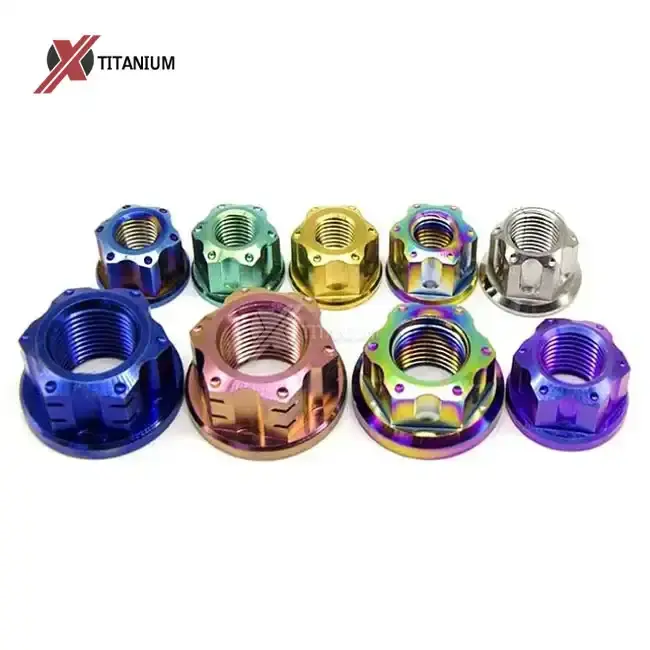
When serious riders and racing teams look for every possible edge, fasteners rarely make the headline — until something fails. The Gr5 titanium fancy nut for motorcycle builds has quietly become one of the most sought-after upgrade components in both competitive racing and street tuning. Precision CNC-machined from Ti-6Al-4V alloy, these nuts deliver tensile strength exceeding 895 MPa while weighing roughly 45% less than equivalent steel hardware. Available in anodized colors including Gold, Blue, Purple, Black, and Rainbow, they serve both functional and aesthetic roles. This guide covers everything from material science to procurement strategy.
Understanding Gr5 Titanium Fancy Nuts and Their Core Properties
What Makes Ti-6Al-4V Different from Other Titanium Grades?
Gr5, whose full name is Ti-6Al-4V, is an alpha-beta titanium alloy with about 6% aluminum and 4% vanadium. With a density of only 4.43 g/cm³, this mixture has a tensile strength of ≥895 MPa and a yield strength of ≥828 MPa, which are about the same as Grade 10.9 steel. Gr2 economically pure titanium, on the other hand, has a tensile strength well below 345 MPa. This means it can't be used for load-bearing fasteners like axle nuts or triple clamp pinch bolts. Gr5 also keeps its shape up to 400°C (750°F), which is very important near exhaust pipes and brake pads, where heat cycling happens all the time.
How to Verify Authentic Gr5 Material?
In many online markets, fake titanium fasteners are easy to find. As per ASTM B348 Grade 5 guidelines, reliable makers use XRF spectrometry to check the makeup of the alloy and prove that the aluminum content is between 5.5 and 6.75% and the vanadium content is between 3.5 and 4.5 %. When buying in bulk, you should always ask for a mill certificate and find out if the sellers use Go/No-Go thread gages at 6g tolerance class to prove the dimensions are correct. These steps keep your users and the people in your supply chain safe from hardware that isn't safe.
Benefits of Using Gr5 Titanium Fancy Nuts in Motorcycle Racing and Tuning
There is a lot of evidence that Gr5 titanium fancy nut for motorcycle improves efficiency in racing. A 2019 study in the Journal of Materials Engineering and Performance confirmed that when Ti-6Al-4V fasteners were put under high-frequency vibrational loads, fatigue cracks spread much less quickly than in stainless steel fasteners of the same type. This is especially helpful in high-RPM engine environments.
In both racing and tuning, these parts are useful because of the following main benefits:
- Weight reduction at the wheel: Installed as rear sprocket nuts or wheel axle hardware, titanium fasteners reduce rotating and unsprung mass. Lighter unsprung weight translates to more responsive suspension behavior and faster directional changes, measurable at the track level.
- Corrosion immunity in aggressive environments: Gr5 titanium spontaneously forms a stable oxide layer that resists road salts, mild acids in cleaning agents, and atmospheric moisture. This eliminates the rust and seizing commonly seen with steel nuts on aluminum components after a season of wet-weather riding.
- Thermal stability near heat sources: Engine mounts, exhaust clamps, and brake caliper bolts all experience sustained heat exposure. Gr5 retains its mechanical properties up to 400°C without embrittlement, avoiding the gradual loosening caused by repeated thermal expansion cycles.
- Aesthetic versatility: The anodized finish — available in Ti natural, Gold, Blue, Green, Purple, Black, and Rainbow — is not purely cosmetic. Anodizing and PVD treatments add surface hardness, reducing galling during installation and improving color retention over time.
All of these benefits work together to solve two major problems that performance motorcycle builders face: making bikes more reliable under stress and lowering the cost of long-term maintenance. When e-commerce buyers look for replacement fastener kits, these features also mean lower return rates and better product reviews.
Comparing Gr5 Titanium Nuts with Other Fastener Materials in Motorcycles
Titanium vs. Stainless Steel vs. Aluminum
Grade 316 stainless steel doesn't rust, but it's very dense—about 8 grams per cubic centimeter—almost twice as dense as Gr5 titanium fancy nut for motorcycle. This difference in weight adds up to something important when you have a full bolt kit that includes frame, chassis, and engine parts. Although aluminum nuts are smaller, they can't hold as much weight. In high-stress areas, aluminum screws often fail because the threads strip under torque.
The best place for Gr5 titanium is where its mechanical strength meets or beats that of stainless steel, its weight is close to that of aluminum, and its resistance to rust is higher than that of both. From the point of view of lifecycle cost, titanium fasteners need to be replaced a lot less often. When business-to-business buyers compare the total landed cost per unit to the average product lifespan, titanium fasteners always give a better return on investment (ROI) over 3–5 year product cycles.
How to Choose and Procure High-Quality Gr5 Titanium Fancy Nuts for Your Motorcycle Projects?
Key Supplier Qualifications to Evaluate
Buying decisions should be based on more than just the unit price. Check that providers meet these requirements: they must have ISO 9001:2015 certification, follow RoHS rules, have written quality control processes that include tensile testing and surface inspection, and be able to make retail-ready packaging with barcodes and English-language directions. In this type of product, custom specs are important. For standard stock, we have metric thread sizes M6, M8, and M10. For custom builds, we may need imperial thread sizes M5 through M36. A good maker should be able to do both without raising the MOQ too much.
Forecasting wait times for Gr5 titanium fancy nut for motorcycle is just as important for FBA-based e-commerce businesses as making sure each unit is of high quality. Check to see if the seller keeps high-velocity SKUs in stock and can ship them to a freight forwarder within the time frame you decided on. Bulk pricing tiers that start at 500 to 2,000 pieces are a good place to start and work well with planning your first FBA inventory.
Installation and Maintenance Tips to Maximize the Performance of Gr5 Titanium Nuts
Torque Specification and Anti-Galling Practice
Before fitting, put an anti-seize compound on any titanium-to-aluminum contact. The compound can be copper-based or titanium-specific. This stops galling, a cold-welding effect that can lock titanium threads against soft metal surfaces for good. Because of the greasing factor, when you torque, you should lower the dry torque standard by 10–15%. The main reason thread damage happens on titanium fasteners is still overtightening.
Routine Inspection and Long-Term Care
Every 5,000 miles or at every service gap, check the titanium screws. Looking for surface coloring patterns that aren't the same as regular tints caused by heat can be a sign of too much or too little thermal exposure. When aluminum studs are exposed to saltwater, you shouldn't use titanium nuts with them without an assembly paste or non-conductive washer. This is because titanium's cathodic position in the galvanic series can speed up rust in nearby anodic metals when an electrolyte is present.
Conclusion
Gr5 titanium fancy nut for motorcycle is a good idea from a technical and business point of view for motorbike racing and tuning. Their better strength-to-weight ratio, ability to stay stable at high temperatures, and resistance to corrosion all solve real engineering problems that race teams and riders face. For online stores that sell hardware, these items really stand out from regular steel hardware because they look great and can be proven to work. Titanium fasteners from a certified manufacturer with documented quality control are the best way to make long-lasting parts, whether you're building a track-day machine or putting together a high-end aftermarket catalog.
FAQ
Q1: Can Gr5 titanium nuts be torqued to OEM steel specifications?
A: Most of the time, yes, because Grade 5 titanium is about as strong as high-tensile steel. Use anti-seize product and lower the dry power specification by 10–15% to account for the oil.
Q2: Why choose Gr5 over Grade 2 titanium for motorcycle fasteners?
A: Grade 2 titanium is much softer than grade 1 titanium, and its tensile strength is much lower than what is needed for motorbike uses that need to hold weight. In axle and brake gear, thread loss is a real risk. For structural bolts, Gr5 is the right standard.
Q3: Does the anodized color fade over time?
A: Standard anodizing may fade a little over a few years due to UV light. PVD-coated versions have better surface strength and color stability. When you order, let us know what finish you want.
Q4: What sizes are available for motorcycle applications?
A: CNC-machined Gr5 titanium fancy nuts come in sizes M5 to M36 and thread types metric and imperial. They can be used in almost all common motorcycle fastener positions.
Q5: How do I confirm material authenticity before bulk ordering?
A: Ask for a mill certificate and an XRF spectrometry report that proves the composition of the ASTM B348 Grade 5 alloy. Reliable sellers don't think twice about giving these.
Partner with Chuanglian — Your Trusted Gr5 Titanium Fancy Nut Supplier
Chuanglian's titanium fasteners are CNC-machined in Baoji, China, which is known as the world's titanium production hub and has ISO 9001:2015 approval. We offer M5–M36 sizes, seven anodized color choices, retail-ready custom packaging, and lead times that work with FBA as a direct Gr5 titanium fancy nut for motorcycle manufacturers. Email us at info@cltifastener.com or djy6580@aliyun.com to get bulk prices and sample requests right away.
References
1. Journal of Materials Engineering and Performance — "Fatigue Behavior of Ti-6Al-4V Alloy Fasteners Under Vibrational Loading," ASM International, 2019.
2. ASTM B348 Standard Specification for Titanium and Titanium Alloy Bars and Billets — ASTM International, 2021.
3. Titanium: A Technical Guide — Matthew J. Donachie, ASM International, 2000.
4. Journal of Tribology — "Galling Resistance of Titanium Alloy Fasteners with Surface Treatment," ASME, 2018.
5. Corrosion Science — "Galvanic Corrosion Behavior of Ti-6Al-4V Coupled with Aluminum Alloys in Saline Environments," Elsevier, 2020.
6. SAE International Journal of Materials and Manufacturing — "Weight Reduction Strategies in Motorsport Fastener Systems Using Titanium Alloys," SAE International, 2017.
Learn about our latest products and discounts through SMS or email