- English
- French
- German
- Portuguese
- Spanish
- Russian
- Japanese
- Korean
- Arabic
- Greek
- German
- Turkish
- Italian
- Danish
- Romanian
- Indonesian
- Czech
- Afrikaans
- Swedish
- Polish
- Basque
- Catalan
- Esperanto
- Hindi
- Lao
- Albanian
- Amharic
- Armenian
- Azerbaijani
- Belarusian
- Bengali
- Bosnian
- Bulgarian
- Cebuano
- Chichewa
- Corsican
- Croatian
- Dutch
- Estonian
- Filipino
- Finnish
- Frisian
- Galician
- Georgian
- Gujarati
- Haitian
- Hausa
- Hawaiian
- Hebrew
- Hmong
- Hungarian
- Icelandic
- Igbo
- Javanese
- Kannada
- Kazakh
- Khmer
- Kurdish
- Kyrgyz
- Latin
- Latvian
- Lithuanian
- Luxembou..
- Macedonian
- Malagasy
- Malay
- Malayalam
- Maltese
- Maori
- Marathi
- Mongolian
- Burmese
- Nepali
- Norwegian
- Pashto
- Persian
- Punjabi
- Serbian
- Sesotho
- Sinhala
- Slovak
- Slovenian
- Somali
- Samoan
- Scots Gaelic
- Shona
- Sindhi
- Sundanese
- Swahili
- Tajik
- Tamil
- Telugu
- Thai
- Ukrainian
- Urdu
- Uzbek
- Vietnamese
- Welsh
- Xhosa
- Yiddish
- Yoruba
- Zulu
Why Choose Titanium Derailleur Jockey Wheel Bolts for Performance?
When you're building or sourcing a high-performance drivetrain upgrade kit, every component earns its place — including the bolts that hold the jockey wheels in position. Titanium derailleur jockey wheel bolts deliver a rare combination of Grade 5 (Ti-6Al-4V) tensile strength at 950 MPa, a density of just 4.43 g/cm³, and natural corrosion immunity that steel simply cannot match. At roughly 2 grams per bolt, the weight saving is marginal in isolation, yet meaningful across a complete drivetrain build — and in competitive cycling, marginal gains accumulate. For brand owners and specialty e-commerce operators sourcing precision fasteners, these bolts represent a high-margin, low-competition SKU with genuine technical merit.
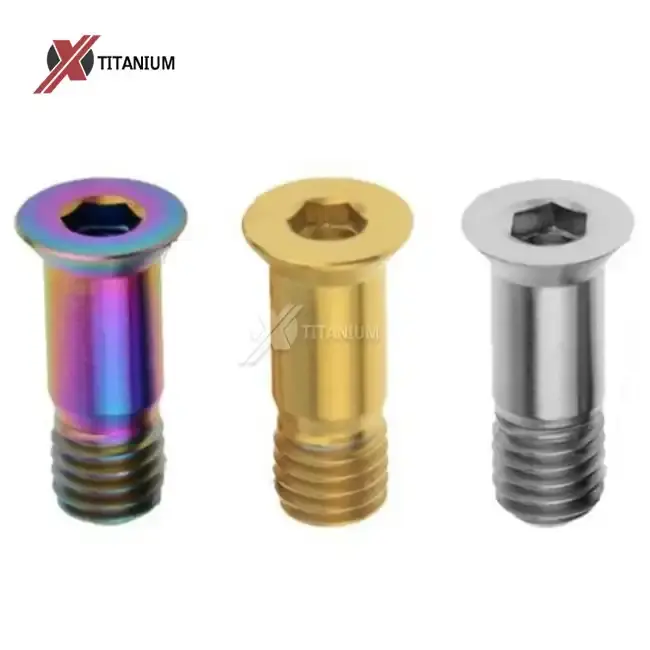
Understanding Titanium Derailleur Jockey Wheel Bolts: Features and Benefits
Material Excellence That Riders Can Feel
The aerospace-standard metal used in these nuts is Ti-6Al-4V, which has a tensile strength of 950 MPa and a yield strength of 880 MPa. It is much stronger than 316 stainless steel while weighing about 45% less. Because they are stronger and lighter, professional builders are choosing titanium pulley cage fasteners over steel ones more and more. The natural oxide layer on the alloy protects it from corrosion from air, road salt, and acidic drivetrain lubricants. This stops the thread seizing caused by rust that breaks expensive derailleur cages during seasonal maintenance.
Vibration Damping and Long-Term Reliability
Titanium has an elastic modulus of about 110 GPa, which is about half that of steel. This means that the material can absorb small shocks sent through the engine. That damping property lowers fatigue stress at the thread interface during long rides on rough terrain. This makes both the bolt and the derailleur cage it holds in place last longer. There are thread sizes M5, M6, and M8 on our CNC-machined titanium jockey wheel bolts, and the lengths range from 10 mm to 16 mm. Polishing, anodizing, and nitriding are some surface treatments that can be used. Ti natural, Gold, Blue, Green, Purple, Black, and Rainbow are the colors that are available. This gives your brand a unique look that plain steel gear can't match.
Titanium vs Other Materials: Making the Right Procurement Decision
Picking between aluminum, steel, and titanium derailleur jockey wheel bolts for pulley cage bolts isn't just a matter of weight; it's also a matter of total cost and risk. Here are the most important things that buying managers need to compare:
- Titanium vs. Steel: Steel bolts are inexpensive and strong, but they corrode, seize in aluminum cages, and add unnecessary weight. A titanium equivalent saves up to 45% in mass while exceeding steel's fatigue resistance. The higher unit price is offset by dramatically reduced warranty claims and returns.
- Titanium vs. Aluminum: Aluminum bolts are lighter on paper, but Grade 5 titanium holds a hardness of 36 HRC against aluminum's typical 15–20 HRC range. Aluminum hex interfaces strip under repeated torque cycles; titanium heads maintain integrity across hundreds of installation and removal cycles, which matters greatly for mechanics servicing premium builds.
- Titanium vs. Carbon Composite: Carbon fasteners carry brittleness risks under lateral load and are galvanically aggressive against aluminum components. Titanium is galvanically compatible with carbon fiber cages — a critical consideration for OSPW (oversized pulley wheel) kit manufacturers bundling premium fasteners with ceramic bearing upgrades.
Because of these differences, brand owners who need a clip that their customers will never have to repair twice should choose titanium. Your brand's image and your profit margins will be safe if you buy Grade 5 material from a trusted source who can do XRF composition testing and ISO 965-compliant thread gaging.
Installation and Maintenance: Maximizing Value from Titanium Jockey Wheel Bolts
Torque Specifications and Anti-Seize Protocol
For installing M4–M5 jockey wheel bolts, the torque that should be used is between 2.5 Nm and 3 Nm. If you go beyond this range, you could damage the derailleur cage threads before the bolt itself gives way. This is a common mistake mechanics make when they use steel-bolt techniques on titanium hardware. Before fitting, you should always put on a small layer of anti-seize compound or low-strength thread-locking fluid (like Loctite 222). When titanium is threaded into aluminum without oil, galling can happen, which is a cold-welding effect.
Routine Inspection and Cleaning
Check the titanium derailleur jockey wheel bolts every 1,000 to 1,500 kilometers or after any ride in salty, wet, or muddy circumstances. Because titanium doesn't rust, it's easy to clean the surface: a soft brush and mild degreaser will bring back the finish without damaging the anodized layer. Make sure the bolt head doesn't have any rounding at the hex or Torx contact. This is a sign that the bolt was over-torqued in the past. It is much cheaper to replace bolts when they show signs of wear than to buy a new derailleur cage.
Procurement Insights: Where and How to Source Titanium Jockey Wheel Bolts?
Finding precision titanium fasteners at the M4–M5 scale is very hard when it comes to quality control. For small-diameter threads, you need very precise CNC tools, and not all factories can keep the tolerances needed for a derailleur cage to engage reliably. When looking into a titanium jockey wheel bolt maker or provider, make sure to do these things first:
- Request XRF spectroscopy reports confirming Ti-6Al-4V (Grade 5) composition — not commercially pure Grade 2, which lacks the yield strength required for sustained chain tension loads.
- Require Go/No-Go gauge reports verifying thread dimensions against ISO 965 standards for Shimano and SRAM cage compatibility.
- Ask for torque-to-failure test data on sample lots, confirming the head drive interface survives repeated installation cycles.
- Confirm concentricity tolerances: a non-concentric bolt shaft causes pulley wobble, degrading drivetrain efficiency and increasing chain wear.
Small brands and specialty stores can test how well their products sell before committing to bigger orders for titanium derailleur jockey wheel bolts thanks to MOQ terms that start at 500 to 1,000 pieces. This SKU category usually gets restocked every three months, and if you bundle jockey wheel bolts with matched chain ring bolts or quick-release titanium skewers, the average order value goes up by a lot.
Why Titanium Jockey Wheel Bolts Are the Preferred Choice for Performance Cycling?
The cycling aftermarket awards parts that blend measurable performance data with a unique look more and more. Titanium pulley cage fasteners meet both of these requirements. Titanium hardware is used on Weight Weenies community builds, dirt race rigs, and UCI-legal road sets because it is the right material and doesn't just look good. When custom builders organize their engine parts by color, brands that carry anodized titanium bolts in six or more colors say that the bolts stick better. When it comes to procurement ROI, the margin structure on premium titanium fasteners is much better than that on standard steel fasteners. There really is a niche, people are buying from them again and again, and low-commitment rivals can't get in because of the technical requirement.
Conclusion
Titanium derailleur jockey wheel bolts are the perfect combination of engineering knowledge and rider aspiration. The properties of the material can be checked: 950 MPa tensile strength, 4.43 g/cm³ density, and Grade 5 alloy certification; also, the use makes sense. These nuts offer a high profit margin, real technical difference, and good looks for brand owners and sourcing managers who are building out a speed drivetrain accessories line. This niche part can become a reliable source of recurring income if you choose a supplier with clear quality controls and flexible MOQ terms.
FAQ
Q1: What thread size do most derailleur jockey wheel bolts use?
A: Most Shimano and SRAM rear derailleur cages hold the gear wheel in place with M4 or M5 holes. Different generations of derailleurs have different exact length needs. For example, some SRAM types need 14.5 mm bolts, while others need 16 mm. Before placing a bulk order, you should always make sure you know what the model needs.
Q2: Why specify Grade 5 titanium instead of Grade 2?
A: Grade 2 titanium is clean enough for business use. It's not stiff enough to handle constant chain tension and repeated torque cycles because it's too soft. Grade 5 (Ti-6Al-4V) has a yield strength of 880 MPa and a hardness of 36 HRC, which are both important for making sure that the hex or Torx drive contact stays intact over the life of a component.
Q3: Do titanium bolts work with carbon fiber derailleur cages?
A: No, titanium is more galvanic compatible than carbon fiber. This means that it doesn't speed up corrosion at the contact interface like aluminum fasteners do when they are used in wet or salty environments.
Q4: Is anti-seize compound necessary?
A: There is a strong recommendation. Titanium threads can get stuck on aluminum cage threads if they are not oiled. This can make removal difficult and could damage the cage. This can be fixed by using a low-strength thread-locking fluid or anti-seize paste.
Partner with Chuanglian for Precision Titanium Fasteners
Certified Grade 5 (Ti-6Al-4V) titanium derailleur jockey wheel bolts are made by Chuanglian. They can be fully CNC machined, anodized in multiple colors, and there is a minimum order quantity of 500 pieces. These bolts are made for brand owners and specialty stores who want to be sure of the quality. As a reputable company that sells titanium derailleur jockey wheel bolts, we can make custom specifications to work with both Shimano and SRAM systems. To get samples and prices, email us at info@cltifastener.com or djy6580@aliyun.com.
References
1. ASM International. Titanium: A Technical Guide. 2nd ed. ASM International, 2000.
2. Callister, William D. Materials Science and Engineering: An Introduction. 10th ed. Wiley, 2018.
3. ISO. ISO 965-1: General Purpose Metric Screw Threads — Tolerances. International Organization for Standardization, 2013.
4. Cycling Weekly. "The Science of Marginal Gains in Bike Component Selection." Cycling Weekly, 2022.
5. Lutjering, G., and J. C. Williams. Titanium. 2nd ed. Springer, 2007.
6. Bicycle Retailer and Industry News. "Aftermarket Drivetrain Upgrades: Trends in Premium Fastener Specifications." BRAIN, 2023.
Learn about our latest products and discounts through SMS or email