- English
- French
- German
- Portuguese
- Spanish
- Russian
- Japanese
- Korean
- Arabic
- Greek
- German
- Turkish
- Italian
- Danish
- Romanian
- Indonesian
- Czech
- Afrikaans
- Swedish
- Polish
- Basque
- Catalan
- Esperanto
- Hindi
- Lao
- Albanian
- Amharic
- Armenian
- Azerbaijani
- Belarusian
- Bengali
- Bosnian
- Bulgarian
- Cebuano
- Chichewa
- Corsican
- Croatian
- Dutch
- Estonian
- Filipino
- Finnish
- Frisian
- Galician
- Georgian
- Gujarati
- Haitian
- Hausa
- Hawaiian
- Hebrew
- Hmong
- Hungarian
- Icelandic
- Igbo
- Javanese
- Kannada
- Kazakh
- Khmer
- Kurdish
- Kyrgyz
- Latin
- Latvian
- Lithuanian
- Luxembou..
- Macedonian
- Malagasy
- Malay
- Malayalam
- Maltese
- Maori
- Marathi
- Mongolian
- Burmese
- Nepali
- Norwegian
- Pashto
- Persian
- Punjabi
- Serbian
- Sesotho
- Sinhala
- Slovak
- Slovenian
- Somali
- Samoan
- Scots Gaelic
- Shona
- Sindhi
- Sundanese
- Swahili
- Tajik
- Tamil
- Telugu
- Thai
- Ukrainian
- Urdu
- Uzbek
- Vietnamese
- Welsh
- Xhosa
- Yiddish
- Yoruba
- Zulu
GR5 Titanium Bleed Nipples M7 Uses for Racing and Aerospace Brakes
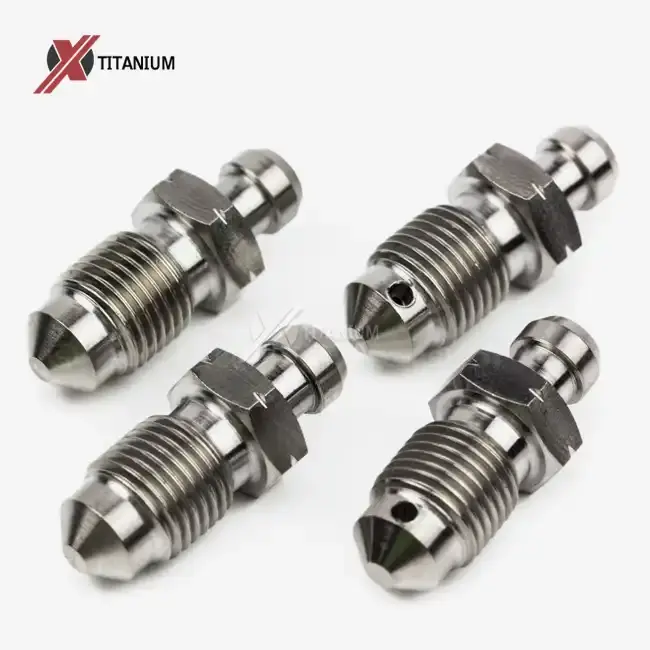
When brake system reliability is non-negotiable, the choice of every component matters — including something as seemingly small as a bleed nipple. Gr5 titanium bleed nipples M7 are precision-machined from Ti-6Al-4V (Grade 5) titanium alloy, engineered specifically for high-performance racing and aerospace brake applications. With a tensile strength between 895–1000 MPa, a density of just 4.43 g/cm³, and complete resistance to DOT 3, 4, and 5.1 brake fluids, these M7-threaded components deliver zero-compromise sealing performance where standard steel or brass hardware simply cannot compete.
Understanding GR5 Titanium Bleed Nipples M7 Specifications and Benefits
Core Material and Thread Specifications
The M7 thread standard has an outer diameter of 7 mm and a pitch of 1 mm. It is a unique size that is mostly found on Japanese motorbike brake calipers and some European systems made by Brembo and Nissin. Many providers can't work with M7 because it's not a standard metric size. At Chuanglian, our CNC machine centers have special M7 tools, and before a part is shipped, every thread is checked with ISO-calibrated "Go/No-Go" gages. The Ti-6Al-4V metal has 90% titanium, 6% aluminum, and 4% vanadium. It meets ASTM B348 standards and is about 45% stronger per unit weight than steel bolts of the same type. The conical seating tip is machined to very tight concentricity tolerances, which makes sure a hydraulic-tight seal that can handle pressures inside the system of more than 2,000 psi.
Key Performance Advantages
Because of these benefits, titanium bleed screws are a real improvement in engineering, not just a matter of style. Here are the main performance benefits that procurement engineers always put first:
- Corrosion immunity: The passive oxide layer on Ti-6Al-4V resists salt water, road brine, aggressive brake fluids, and atmospheric oxidation indefinitely — eliminating the caliper seizure caused by corroded steel nipples in coastal and track environments.
- Thermal stability: With a melting point above 1,600°C, these components maintain dimensional integrity through the extreme heat cycles generated during competition braking, where caliper temperatures routinely exceed 300°C.
- Weight reduction: Each Gr5 titanium bleed nipples M7 weighs significantly less than its steel counterpart. Across a full brake system, cumulative unsprung weight savings contribute meaningfully to handling precision at racing speeds.
- Surface finish options: Available in natural titanium, anodized gold, blue, green, purple, black, and rainbow PVD finishes — supporting brand differentiation requirements for OEM clients who demand visual identity on every component.
These benefits directly meet the needs of motorsport teams, aerospace maintenance crews, and high-end aftermarket brake brands that can't have parts fail when they're under a lot of stress.
Comparative Analysis: GR5 Titanium vs. Alternative Materials
When looking at brake bleed screws, the choice of material has real risk effects. Gr2 titanium doesn't rust, but its tensile strength is only about 345 MPa, which is too low for high-cycle race conditions. Even though stainless steel is somewhat resistant to corrosion, it can still be damaged by galvanic corrosion when threaded into aluminum calipers, and its higher density makes it heavier than it needs to be. Aluminum bleed nipples are light, but they are structurally weak; they tear easily and can't handle repeated torque cycles without deforming.
GR5 titanium is in a different performance level. Because it has a tensile strength of 895–1000 MPa, almost no galvanic potential against metal, and no chemical reaction with brake fluids, it has a lifetime value that is higher than all usual options. Purchasing managers who work with racing brands often say that moving from stainless steel to Grade 5 titanium nipples got rid of all guarantee returns for bleed hardware that had seized or come loose.
Installation and Maintenance of Titanium Brake Bleed Nipples
Installation Protocol
When Gr5 titanium bleed nipples M7 are installed correctly, the thread integrity and seal efficiency are kept. The recommended torque range is 4–6 Nm, which is just right to seat the cone-shaped tip against the tapered bore of the caliper without putting too much stress on the aluminum thread. Titanium-to-aluminum contact can galle, which means that the threads may join together cold when pressure is applied. To avoid this, a thin layer of copper-free ceramic anti-seize compound or PTFE paste is usually put on the threads before they are installed. Do not put any solution on the bleed port holes or the conical closing tip.
Maintenance and Inspection Intervals
Compared to steel options, titanium bleed nipples don't need as much maintenance. Check the bolt head for tool marks every time you change the brake fluid. PVD-coated versions (black or gold finish) have a harder surface that doesn't leave marks after multiple bleeding processes. Look for signs of mechanical damage on the cone-shaped tip. If you fit the titanium bleed nipple correctly and keep the aluminum caliper in good shape, it should last for many seasons without needing to be replaced.
Procurement Guide: Sourcing M7 Titanium Bleed Nipples for B2B Clients
OEM Customization and Quality Verification
Finding a real Gr5 titanium bleed nipple M7 source for brake component brand makers takes more than just looking at a price sheet. It is necessary for technical proof to check the spectrographic material certification (Ti-6Al-4V composition report), the measurement inspection records that include Go/No-Go thread data, and the hydraulic seal test results for each batch. With every order, Chuanglian gives full reports on the materials used and how well they work mechanically. Laser-engraved brand logos, custom anodized color matching, and custom packaging design are all OEM customization options that help differentiate product lines by brand. Our normal MOQ for the M7 specification is 300 pieces, which is low enough to accommodate smaller starting amounts needed to test the market.
Logistics and Supply Chain Planning
At Chuanglian, it takes between two and four weeks to make standard Gr5 titanium bleed nipples M7 after a sample is approved. For first-time partnerships, the typical B2B procurement cycle takes 6–8 weeks, from sending in the technical drawing to validating samples, setting up standards for AQL inspections, and trial production. Restocking every three months works well with the demand cycles of medium-sized brake accessory brands that sell in the US, Japan, Italy, and the UK.
Why Racing and Aerospace Professionals Specify Grade 5 Titanium Bleed Hardware?
In the paddocks for Moto2 and World Superbike, brake caliper repair is done quickly and while the parts are very hot. During a pit-lane bleed process, a nipple that seizes, breaks, or leaks brake fluid is a real safety risk. The non-reactive surface of grade 5 titanium, its resistance to thermal fatigue, and its known mechanical behavior under repeated torque cycles make it the material of choice for both professional teams and high-end aftermarket brands.
Maintenance on aerospace hydraulic systems has to follow the same strict rules. Ti-6Al-4V is good for MRO procurement because it doesn't corrode, has a low density, and meets ASTM standards. This means that material traceability is required. Since more than ten years ago, Chuanglian has been making titanium screws and precision-machined parts in Baoji, which is known as China's main titanium production hub. Before being sent out, every batch of M7 bleed nipples goes through a 100% dimensional inspection and a hydraulic seal sampling. This helps meet the quality traceability needs of safety-critical brake brands.
Conclusion
The technical case for Gr5 titanium bleed nipples M7 is clear: Grade 5 titanium is the best material for any situation where brake system failure is unthinkable because it is stronger, doesn't rust, stays stable at high temperatures, and works with aluminum caliper systems. The M7 specification is still an area that isn't well covered, and there is a real market potential for makers that want to target Japanese motorbike platforms and certain European caliper fitments. Chuanglian has been making products for over ten years and has full material certification and flexible OEM customization services. This makes us a reliable long-term supply partner for brake component brands that work in tough global markets.
FAQ
Q1: What distinguishes GR5 from Gr2 titanium in brake applications?
A: Gr2 titanium is commercially pure and has great resistance to rust, but its tensile strength is only 345 MPa. GR5 (Ti-6Al-4V) can reach 895–1000 MPa, which means it can be used for solid brake parts that are put under a lot of mechanical stress and high hydraulic pressure over and over again.
Q2: Is M7 thread compatible with standard Brembo calipers?
A: M7 is used on some smaller generations of Brembo calipers and a lot of Japanese OEM brake systems. Before you order, you should always use calipers to measure the existing thread's outer diameter, which is about 6.9 mm. This is because M8 and M10 threads are more common in automotive applications.
Q3: Do titanium bleed nipples require anti-seize compound?
A: Titanium doesn't rust, but threads made of titanium and aluminum can get galled together. A little copper-free ceramic anti-seize or PTFE paste should be put on the thread only, never the cone-shaped closing tip.
Q4: Are these nipples compatible with all brake fluid types?
A: Ti-6Al-4V doesn't react with chemicals and works well with DOT 3, DOT 4, DOT 5.1 glycol-based fluids, and DOT 5 silicone-based fluids without breaking down.
Q5: What surface finishes are available for OEM branded products?
You can choose from natural titanium, polished, anodized gold, blue, green, purple, black, rainbow, and PVD-coated finishes. Logos can be laser-engraved, and OEM clients can get custom packaging.
Request a Custom Quote from Chuanglian — Your Trusted Gr5 Titanium Bleed Nipple M7 Manufacturer
Chuanglian makes precise titanium brake parts that come with full material approval, 100% measurement inspection, and the ability for OEMs to make changes. Our engineering team is ready to help you with your needs, whether you want branded packages, custom anodized colors, or a low-MOQ trial run of M7 titanium bleed nipples. Email us at info@cltifastener.com or djy6580@aliyun.com to get datasheets and a custom quote.
References
1. ASM International. Titanium: A Technical Guide. ASM International, 2000.
2. Boyer, R., Welsch, G., & Collings, E. W. Materials Properties Handbook: Titanium Alloys. ASM International, 1994.
3. ASTM International. ASTM B348: Standard Specification for Titanium and Titanium Alloy Bars and Billets. ASTM International, 2019.
4. Donachie, M. J. Titanium: A Technical Guide, 2nd Edition. ASM International, 2000.
5. Brembo S.p.A. Brembo Racing Technical Manual: Brake Caliper Maintenance and Component Specifications. Brembo, 2021.
6. SAE International Journal of Materials and Manufacturing — "Corrosion Behavior of Titanium Alloys in Automotive Brake Fluid Environments." SAE International, 2018.
Learn about our latest products and discounts through SMS or email