- English
- French
- German
- Portuguese
- Spanish
- Russian
- Japanese
- Korean
- Arabic
- Greek
- German
- Turkish
- Italian
- Danish
- Romanian
- Indonesian
- Czech
- Afrikaans
- Swedish
- Polish
- Basque
- Catalan
- Esperanto
- Hindi
- Lao
- Albanian
- Amharic
- Armenian
- Azerbaijani
- Belarusian
- Bengali
- Bosnian
- Bulgarian
- Cebuano
- Chichewa
- Corsican
- Croatian
- Dutch
- Estonian
- Filipino
- Finnish
- Frisian
- Galician
- Georgian
- Gujarati
- Haitian
- Hausa
- Hawaiian
- Hebrew
- Hmong
- Hungarian
- Icelandic
- Igbo
- Javanese
- Kannada
- Kazakh
- Khmer
- Kurdish
- Kyrgyz
- Latin
- Latvian
- Lithuanian
- Luxembou..
- Macedonian
- Malagasy
- Malay
- Malayalam
- Maltese
- Maori
- Marathi
- Mongolian
- Burmese
- Nepali
- Norwegian
- Pashto
- Persian
- Punjabi
- Serbian
- Sesotho
- Sinhala
- Slovak
- Slovenian
- Somali
- Samoan
- Scots Gaelic
- Shona
- Sindhi
- Sundanese
- Swahili
- Tajik
- Tamil
- Telugu
- Thai
- Ukrainian
- Urdu
- Uzbek
- Vietnamese
- Welsh
- Xhosa
- Yiddish
- Yoruba
- Zulu
Titanium Seat Clamp Bolt Torque: Installation Tips and Common Errors
Getting torque right on a titanium seat clamp bolt is one of those details that separates a reliable build from a frustrating one. Whether you're running a bicycle accessories store or sourcing components for your own brand, understanding how torque behaves with Grade 5 Ti-6Al-4V hardware directly affects rider safety, component longevity, and customer satisfaction. This guide walks through what torque actually means for titanium fasteners, how to install them correctly, and which mistakes to avoid — backed by material science and real-world procurement knowledge.
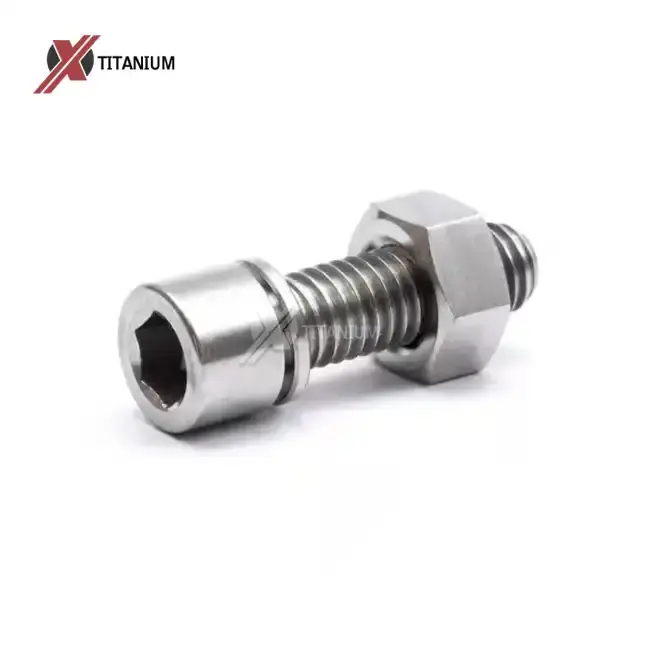
Understanding Titanium Seat Clamp Bolt Torque
Why Torque Behaves Differently With Titanium
The density of titanium is 4.43 g/cm³, which is about 45% less than steel. However, Grade 5 Ti-6Al-4V has a tensile strength of 950 MPa to 1,050 MPa. That mix changes how power is turned into binding force. Titanium's modulus of elasticity is lower than steel's (about 114 GPa vs. 200 GPa), which means it bends a little more when it's loaded. This flexibility is a good thing because it helps the bolt keep the same clamping force even when it is moving and changing temperatures.
The important thing to remember about seat clamp uses is that the bolt's power is rarely what stops it from working. For carbon fiber frames, the highest seat clamp torque is usually between 4 and 6 Nm, and for aluminum frames, it's usually between 6 and 8 Nm. That's not even close to what the titanium seat clamp bolt can handle. The frame or clamp sets the ceiling. The most common installation mistakes can be avoided by recognizing this difference.
Installation Tips for Titanium Seat Clamp Bolts
When you follow a consistent order, installation is easy and correct. If you skip any step of preparation, problems will start.
Pre-Installation Preparation
Before putting the clamp together, use a dry cloth or brush to clean the threads on the bolt and the threaded receiver on the clamp. Any grit or residue makes the friction uneven, which throws off your torque reading. It is necessary to use a small amount of copper-based anti-seize compound or titanium paste on the threads because titanium's passive oxide layer can break down when it comes into high contact with other metals or itself. This is known as galling or cold welding. Squeaky bolts are one of the most common complaints from riders who have to change their saddle height after a long time of use. This single step stops them from happening.
Tightening Sequence and Torque Values
These are the main things that must be done to make sure that force is applied correctly:
- Use a calibrated torque wrench. A beam-type or click-type wrench with a precision of 0.1 Nm will keep you in line. A regular hex key doesn't show force and shouldn't be used for final tightening on safety-critical parts.
- Tighten in graduated increments. At 50% of the target torque, check that the seatpost is straight, and then move on to full torque. This two-step process makes sure that the clamping force is spread out evenly across it.
- Respect the frame manufacturer's limit, not the bolt's limit. For carbon frames, don't go over 5 Nm. 6 to 8 Nm is usually fine for aluminum. Always follow the frame's own instructions.
- Inspect thread engagement. For solid clamping, M5 and M6 titanium seat clamp bolts (which are the usual diameters for seat clamps) should engage at least 1.0 times the diameter of the bolt in the thread depth. If you don't engage enough, you could pull out under load.
Professional mechanics and end users who buy titanium bolts from online stores both do these things. That's why putting torque information in product listings directly lowers the number of bad reviews and returns.
Common Errors and How to Avoid Them
When used in seat clamps, most titanium seat clamp bolt failures are caused by a few simple mistakes during installation. Knowing about each one makes it easier for both buyers and sellers to explain what they want.
Over-tightening is the worst thing that can happen. Grade 5 Ti-6Al-4V has a yield strength of more than 830 MPa, but if you use more force than the seat clamp can handle, it will crush carbon fiber layups or bend aluminum clamp bodies. The bolt will live on, but the frame might not. Your torque limit should always be based on the weaker part of the system, never on the fastener itself.
Under-tightening is the same problem. A seatpost that slips under the weight of a rider is a real safety risk, especially when the rider is trying to climb or race. If the rider's saddle height changes in the middle of a ride, they lose biomechanical efficiency and could get hurt. There is a reason for the recommended torque range. Going below it is not "safe," it's a different kind of risk.
Dry installation without anti-seize will cause the thread sides to get galled. When galling happens, the bolt and clamp may become permanently joined, which means they have to be taken apart in a way that damages the frame. This isn't just a theoretical risk; it's a well-known way that titanium fasteners fail when they are installed without lubrication.
Mismatched specifications are a problem at the buying level. M5 and M6 are both standard thread sizes for seat clamps, but they can't be switched out. Also, thread contact depth changes when the length changes (20 mm to 60 mm from Chuanglian). Fitment problems can be avoided completely by checking the width, pitch, and length against the clamp manufacturer's data sheet before placing an order.
Titanium vs. Steel and Aluminum: Torque and Performance Comparison
When looking at how well different bolt materials work in seat clamp situations, titanium, steel, and aluminum all fall short in a number of important ways. Class 8.8 steel bolts have about the same tensile strength as Grade 5 Ti-6Al-4V, but they weigh about 80% more and can rust in places where they are wet or sweaty. Seat clamp bolts made of steel often seize, which makes many riders want to improve. While aluminum bolts are lighter, they break when they are loaded and unloaded over and over again. This is because aluminum has a set fatigue limit that titanium does not have under normal cycling loads. This means that a titanium seat clamp bolt has a much longer service life before it breaks from fatigue.
When it comes to torque tolerance, titanium's elastic properties mean that it can handle small vibrations without coming loose, which means that it doesn't need to be re-torqued as often over time. On the other hand, aluminum nuts can work-harden and break easily, especially if the anodizing is scratched and the base metal is fretted. For online sellers, this performance profile directly means fewer warranty claims and better reviews from customers, which is a clear business benefit.
Procurement and Supplier Guidance
What to Evaluate When Sourcing
A trustworthy company that sells titanium seat clamp bolts should meet a number of requirements. Spectroscopy checks the chemical composition and confirms that the alloy is real Ti-6Al-4V and not recycled or tampered with material. To make sure that everything fits perfectly, thread tolerance testing with Go/No-Go gauges up to a 6g tolerance class is used. Batch tensile testing to ensure strength above 900 MPa is a proven way to make sure safety. Chuanglian uses these quality controls at every step of the production process, from taking in the raw materials to CNC machining, thread rolling, surface treatment, and final checking.
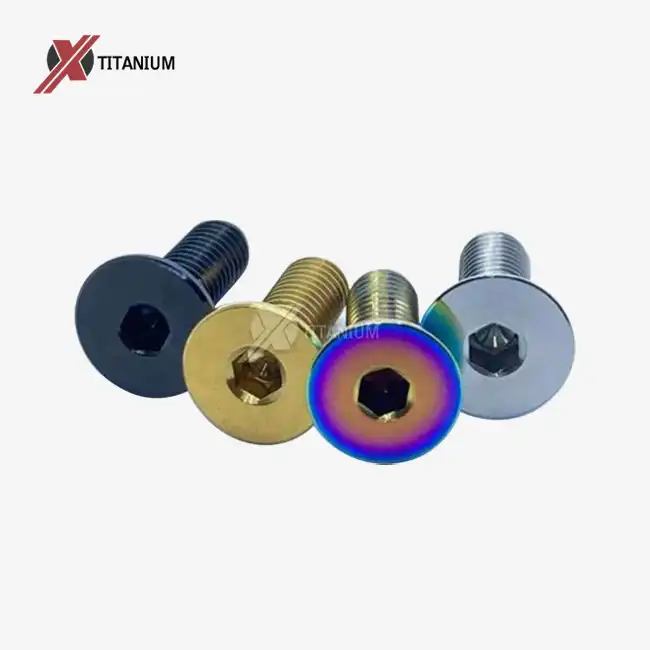
Low MOQ is important for business-to-business purchases. You can buy 500 pieces of Chuanglian's titanium seat clamp bolts in any of seven anodized finishes, which are natural titanium, gold, blue, green, purple, black, and rainbow. This helps online stores that sell different colors to meet the needs of different customers without having to keep a lot of one color on hand.
Conclusion
To control the torque on titanium seat clamp bolts, you need to do three things: prepare, calibrate, and stick to the specifications. Use anti-seize compound, a calibrated wrench, and pay attention to the frame's torque limit instead of the bolt's. Grade 5 Ti-6Al-4V hardware is stronger than almost every seat clamp assembly it holds together; the fastener itself doesn't break down very often. It is just as important for sourcing teams and online sellers to find a provider who keeps records of material certifications and thread tolerances as it is to know the torque value itself.
FAQ
Q1: What is the recommended torque for a titanium seat clamp bolt?
A: The frame and seat clamp, not the bolt, decide how much force can be used. Most carbon frames allow 4–6 Nm, while most aluminum frames allow 6–8 Nm. Always follow the instructions that came with the frame. Because Grade 5 Ti-6Al-4V nuts can hold much more weight, the clamp system is always what limits how much weight can be put on them.
Q2: Do I need anti-seize compound on titanium threads?
A: Yes, always and always. Titanium is prone to galling, which is a cold-welding effect that happens when threads stick together under pressure. This can't happen if copper paste or a special anti-seize compound is put on the threads before installation. This keeps the bolt adjustable for as long as it's used.
Q3: Can I reuse a titanium seat clamp bolt after removal?
A: Grade 5 Ti-6Al-4V bolts can usually be used again as long as the threads don't show any signs of deformation and anti-seize is applied again. Carefully check the thread flanks before reinstalling. If you over-torque a bolt or see any signs of thread damage, you should get a new one.
Q4: How often should I inspect seat clamp hardware?
A: A functional check should be done every 200 to 300 hours of riding. Check to see that the seatpost stays in place when it's loaded and that the threads on the bolt haven't corroded or changed shape. Titanium's resistance to rust makes inspections much less frequent than with steel.
Get a Quote From Chuanglian — Your Trusted Titanium Seat Clamp Bolt Manufacturer
Chuanglian offers high-quality Grade 5 titanium seat clamp bolts in sizes of M5, M6, and M8. These bolts come in seven anodized colors, and the minimum order quantity (MOQ) is as low as 500 pieces for mixed-color support. Our thread-rolled, CNC-machined screws come with full material certification and are in stock so they can be sent out quickly. To get a bulk quote right away, email our team at info@cltifastener.com or djy6580@aliyun.com.
References
1. Machinery's Handbook, Industrial Press, 2020.
2. ASM Handbook, Volume 2: Properties and Selection — Nonferrous Alloys and Special-Purpose Materials, ASM International, 1990.
3. Fatigue of Structures and Materials, Springer, 2009.
4. Bicycle Design: An Illustrated History, MIT Press, 2016.
5. Mechanical Engineering Design, Shigley & Mischke, McGraw-Hill, 2019.
6. Corrosion Engineering: Principles and Practice, McGraw-Hill, 2008.
Learn about our latest products and discounts through SMS or email