- English
- French
- German
- Portuguese
- Spanish
- Russian
- Japanese
- Korean
- Arabic
- Greek
- German
- Turkish
- Italian
- Danish
- Romanian
- Indonesian
- Czech
- Afrikaans
- Swedish
- Polish
- Basque
- Catalan
- Esperanto
- Hindi
- Lao
- Albanian
- Amharic
- Armenian
- Azerbaijani
- Belarusian
- Bengali
- Bosnian
- Bulgarian
- Cebuano
- Chichewa
- Corsican
- Croatian
- Dutch
- Estonian
- Filipino
- Finnish
- Frisian
- Galician
- Georgian
- Gujarati
- Haitian
- Hausa
- Hawaiian
- Hebrew
- Hmong
- Hungarian
- Icelandic
- Igbo
- Javanese
- Kannada
- Kazakh
- Khmer
- Kurdish
- Kyrgyz
- Latin
- Latvian
- Lithuanian
- Luxembou..
- Macedonian
- Malagasy
- Malay
- Malayalam
- Maltese
- Maori
- Marathi
- Mongolian
- Burmese
- Nepali
- Norwegian
- Pashto
- Persian
- Punjabi
- Serbian
- Sesotho
- Sinhala
- Slovak
- Slovenian
- Somali
- Samoan
- Scots Gaelic
- Shona
- Sindhi
- Sundanese
- Swahili
- Tajik
- Tamil
- Telugu
- Thai
- Ukrainian
- Urdu
- Uzbek
- Vietnamese
- Welsh
- Xhosa
- Yiddish
- Yoruba
- Zulu
Titanium Crank Bolt Uses: Road Bikes, MTB, and Motorcycle Parts
Titanium crank bolts serve as precision fasteners that secure crank arms to bottom bracket spindles across high-performance cycling and motorcycle applications. Manufactured from Grade 5 Ti-6Al-4V alloy, a titanium crank bolt delivers tensile strength exceeding 900 MPa while weighing roughly 45% less than a comparable steel bolt. This combination makes them the preferred choice for elite road cyclists chasing rotational mass savings, enduro MTB riders demanding corrosion-free longevity in muddy terrain, and motorcycle engineers seeking reliable, lightweight drivetrain hardware. For OEM brands and procurement teams building premium component lines, understanding where and why these fasteners excel is the starting point for smarter sourcing decisions.
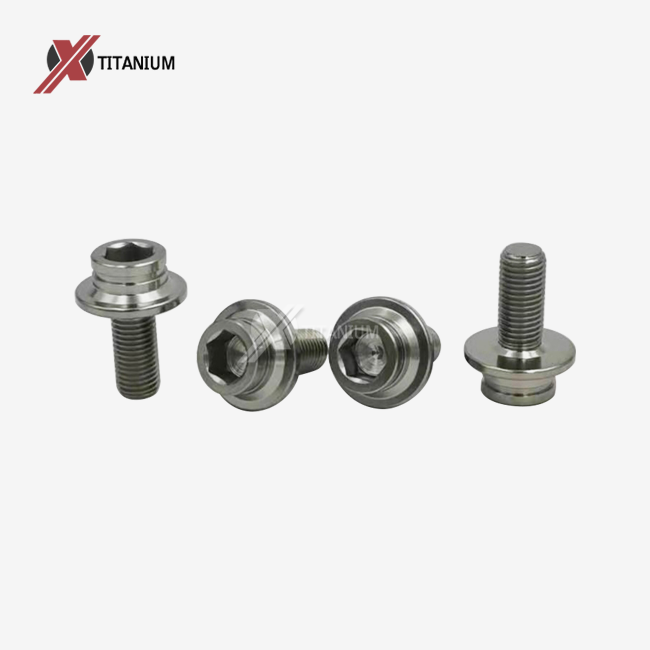
Understanding Titanium Crank Bolts and Their Benefits
What Makes Ti-6Al-4V the Right Alloy for This Application?
Grade 5 titanium has a density of 4.43 g/cm³, which is about 45% less than steel. It is made up of 90% titanium, 6% aluminum, and 4% vanadium. It has a yield strength of about 880 MPa, and its passive oxide layer forms on its own, protecting it from sweat, road salt, and acidic trail debris without any coating on the surface. Rolled threads keep the grain continuous, which makes them much more resistant to wear than cut-thread options. This is a very important benefit for a gear joint that has to handle cyclic pedaling loads every ride.
Here are the main ways that Grade 5 titanium improves performance in crank fastener uses:
- Superior strength-to-weight ratio: Tensile strength of 900–1,050 MPa combined with low density means the bolt handles high installation torques (35–50 Nm for fixing bolts) without adding unnecessary mass to the rotating assembly.
- Corrosion immunity: The alloy resists saltwater, dilute acids, sweat, and alkali environments, eliminating the seized-bolt problem common in steel hardware after a wet season of riding.
- Outstanding fatigue life: Rolled-thread production maintains grain flow, extending fatigue life under the alternating loads that characterize pedaling and motorcycle engine vibration cycles.
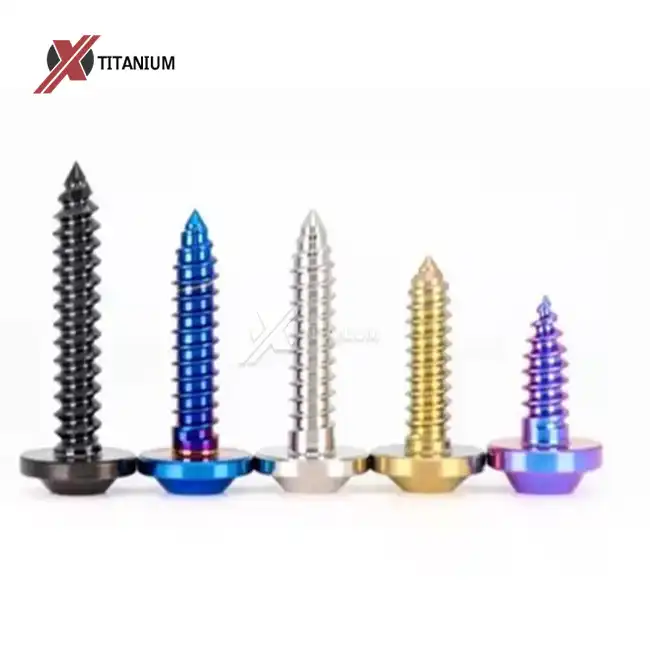
- Anodizing versatility: The oxide layer can be thickened electrolytically to produce colors — natural, gold, blue, green, purple, black, and rainbow — giving OEM brands a differentiation tool without adding weight or compromising mechanical integrity.
When brands sell a titanium crank bolt in the competitive high-end bicycle and motorcycle aftermarket, these qualities directly lead to lower insurance costs, longer product lifecycles, and a believable premium positioning story.
Titanium vs. Steel and Aluminum Crank Bolts – A Comparative Analysis
Reading the Performance Data That Procurement Teams Need
When choosing between materials, you should talk about the total cost of ownership, not just the price per unit. Steel Chromoly nuts are cheap, but they rust in areas of the engine that are often wet, and they add weight to the rotating assembly, which slows it down. Aluminum bolts are very light, but they don't have much load resistance. Installing them over and over with a lot of torque can strip the threads, which means they need to be replaced more often and have a higher chance of breaking in the field.
Titanium is at an interesting point in the road. It can hold as much weight as or more than high-tensile steel, lasts much longer than aluminum in corrosive conditions, and is better at resisting wear than aluminum. If a professional road cyclist or OEM engineer replaces a single seized steel crank bolt on a carbon crankset, they could break a part that is worth hundreds of dollars. The extra cost of a titanium replacement, which comes off easily after a few seasons of use, is usually more than made up for by the fact that parts don't get damaged. For B2B companies that make crankset systems that need to meet quality standards of CPK 1.33 or higher, the batch-to-batch dimensional stability of CNC-machined Grade 5 titanium also makes the inspection process easier.
Practical Guide to Installing Titanium Crank Bolts on Road Bikes, MTB, and Motorcycles
Installation Protocol That Protects Both the Bolt and the Crankset
Anti-seize oil is a must-do step in the preparation process for titanium crank bolt. Titanium can galle, which is a type of cold welding, when it is pressed against steel or aluminum and pushed together. This risk is completely eliminated by using a copper-based anti-seize paste or a titanium assembly lubricant on the threads before installation.
When it comes to torque specs, you should always use the numbers provided by the crankset manufacturer. For two-piece cranksets, the torque for pinch bolts is usually 12–14 Nm, and the torque for central locking bolts is usually 35–50 Nm. These goals are the same for nuts made of titanium and steel of the same grade. When you use a measured torque wrench instead of an impact driver, you avoid over-torque situations that could damage the carbon fiber crank surfaces.
Thread-locking compound compatibility should be checked for use in motorcycle drivetrains. Many low-strength threadlockers stick well to the oxide layer of titanium, but high-strength versions can make it harder to take the part apart later. During the fatigue test part of product development, engineering teams that are putting titanium fasteners into new motorbike systems should make sure that the mix of lubricant and locking compound works well. OEM brands that followed this protocol say that the parts were easy to take apart after a long time of use in the field. This supports the "fit-and-forget" reputation that titanium fasteners have in the professional cycling and motorsport communities.
How to Choose the Right Titanium Crank Bolt Supplier – Procurement Considerations
Vetting Criteria That Protect Your Brand and Your Production Schedule
When you choose a supplier, you either control or introduce procurement risk. A trustworthy titanium crank bolt maker should show proof of the Ti-6Al-4V composition using XRF spectrometry, not just a mill certificate. This is because using Grade 2 commercially pure titanium (tensile strength ~345 MPa) instead of Grade 5 in a crank application creates a hidden risk of failure that only comes to light when customers complain.
A serious OEM brand should ask for thread tolerance documentation using 6g Go/No-Go gage records, proof-load test data exceeding 120% of the maximum installation torque, and CPK ≥ 1.33 process capability reports before approving a supplier for titanium crank bolt products. Support for laser-engraved brand logos, anodized color customization across the full spectrum (natural to rainbow), and M6–M20 thread range coverage round out the list of features that make this product worth your attention. When it comes to names with set product start dates, delivery reliability is given the same amount of weight. If a provider does their own CNC machining, heat treatment, and surface treatment instead of hiring outside companies to do the finishing, they can better control wait times and make sure quality at every stage of production.
Future Trends and Innovations in Titanium Crank Bolts for Mobility Industries
Where Material Science and Manufacturing Technology Are Headed
Electric bikes are increasing the need for drivetrain parts that are light and can handle higher motor-assisted torque loads over longer lifetimes. As a result, titanium alloy research is improving microstructures to raise fatigue limits without making the metal denser. New developments in surface engineering, like physical vapor deposition (PVD) coatings and plasma nitriding, are making surfaces harder than they could be with just anodizing. This lowers the risk of galling and increases wear resistance in high-cycle uses.
With precision CNC machining, thread geometry errors are getting better to sub-micron levels. This makes it possible for current bottom bracket standards like T47, PF30, and BSA threaded shells to fit more tightly. If purchasing teams work with suppliers now, before these new standards become the norm, they can get validated parts faster, which saves money on re-qualification costs as product lines change.
Conclusion
Titanium crank bolts are in a clear performance tier: they are stronger than aluminum, lighter than steel, and less likely to rust than either. Drivetrains for road bikes, mountain bikes, and motorcycles need Grade 5 Ti-6Al-4V because it has the right mechanical properties. CNC machining and anodizing give OEM brands the freedom to customize finished products and make them stand out. The total-cost case is clear for procurement teams building high-end crankset lines: fewer failures in the field, longer service intervals, and a story about premium materials that works with end users. Three practical steps turn these material benefits into consistent, bankable product quality: choosing the right supplier, making sure that materials can be tracked, and following the right installation procedures.
FAQ
Q1: Does a titanium crank bolt require anti-seize lubricant?
A: Yes. Titanium galls against steel and aluminum threads without lubrication. Copper-based anti-seize paste or a dedicated assembly lubricant applied to the threads before installation is mandatory.
Q2: Can I apply the same torque values used for steel bolts?
A: Grade 5 titanium carries comparable strength to high-tensile steel, so manufacturer torque specifications — typically 12–14 Nm for pinch bolts and 35–50 Nm for fixing bolts — apply to both materials. Always use a calibrated torque wrench.
Q3: Is Grade 2 titanium acceptable for a crank bolt?
A: No. Grade 2 commercially pure titanium has a tensile strength of roughly 345 MPa, which is inadequate for the cyclic, high-torque demands of a crank interface. Only Grade 5 (Ti-6Al-4V) should be specified.
Q4: How much weight does switching to titanium fasteners actually save?
A: A pair of M15 titanium fixing bolts typically saves 15–25 grams compared to steel equivalents — meaningful at the rotational assembly level where weight reduction most directly affects acceleration response.
Q5: Will anodized color coatings hold up under regular use?
A: Anodizing is a surface oxidation process rather than a dye layer, so it offers solid durability. PVD coatings provide greater abrasion resistance in high-friction contact zones and are worth specifying for premium-tier applications.
Partner With Chuanglian for Premium Titanium Crank Bolt Supply
From Baoji, China's well-known titanium production hub, Chuanglian has been sending precision-machined titanium fasteners to OEM brands and procurement teams around the world for more than ten years. Our selection of Grade 5 Ti-6Al-4V titanium crank bolts includes thread sizes from M6 to M20, a full range of anodized colors, laser brand etching, and quality standards of CPK 1.33 for each batch. Email our team at info@cltifastener.com or djy6580@aliyun.com to get samples, technical data sheets, or bulk prices from a reputable titanium crank bolt maker.
References
1. ASM International. Titanium: A Technical Guide. ASM International, 2000.
2. Froes, F.H. Titanium: Physical Metallurgy, Processing, and Applications. ASM International, 2015.
3. Boyer, R.R. "An Overview on the Use of Titanium in the Aerospace Industry." Materials Science and Engineering: A, 1996.
4. Donachie, M.J. Titanium: A Technical Guide, 2nd ed. ASM International, 2000.
5. Bicycle Product Suppliers Association (BPSA) Industry Report. BPSA, 2022.
6. Lutjering, G., and Williams, J.C. Titanium, 2nd ed. Springer, 2007.
_1742980398281.webp)
Learn about our latest products and discounts through SMS or email