- English
- French
- German
- Portuguese
- Spanish
- Russian
- Japanese
- Korean
- Arabic
- Greek
- German
- Turkish
- Italian
- Danish
- Romanian
- Indonesian
- Czech
- Afrikaans
- Swedish
- Polish
- Basque
- Catalan
- Esperanto
- Hindi
- Lao
- Albanian
- Amharic
- Armenian
- Azerbaijani
- Belarusian
- Bengali
- Bosnian
- Bulgarian
- Cebuano
- Chichewa
- Corsican
- Croatian
- Dutch
- Estonian
- Filipino
- Finnish
- Frisian
- Galician
- Georgian
- Gujarati
- Haitian
- Hausa
- Hawaiian
- Hebrew
- Hmong
- Hungarian
- Icelandic
- Igbo
- Javanese
- Kannada
- Kazakh
- Khmer
- Kurdish
- Kyrgyz
- Latin
- Latvian
- Lithuanian
- Luxembou..
- Macedonian
- Malagasy
- Malay
- Malayalam
- Maltese
- Maori
- Marathi
- Mongolian
- Burmese
- Nepali
- Norwegian
- Pashto
- Persian
- Punjabi
- Serbian
- Sesotho
- Sinhala
- Slovak
- Slovenian
- Somali
- Samoan
- Scots Gaelic
- Shona
- Sindhi
- Sundanese
- Swahili
- Tajik
- Tamil
- Telugu
- Thai
- Ukrainian
- Urdu
- Uzbek
- Vietnamese
- Welsh
- Xhosa
- Yiddish
- Yoruba
- Zulu
Top Titanium Crank Spindle Bolts M10x1.0 Hollow for OEM Builds
When OEM drivetrain engineers need to shave critical grams without compromising structural integrity, titanium crank spindle bolts M10x1.0 hollow represent one of the most technically demanding fastener solutions in the cycling industry. Machined from Grade 5 Ti-6Al-4V alloy with a precision-bored hollow core, these bolts deliver approximately 30–40% weight reduction over steel equivalents while maintaining tensile strength above 950 MPa. This guide walks procurement directors, structural engineers, and supply chain managers through specifications, material trade-offs, installation protocols, and sourcing strategy for competition-grade OEM builds.

Understanding Titanium Crank Spindle Bolts M10x1.0 Hollow
What Sets the Hollow Architecture Apart?
The through-bore or blind-bore middle cavity is what makes these screws unique, and it can only be made with modern CNC machining. A typical misunderstanding is that taking away core material makes the bolt much weaker. The outer wall and threaded engagement zone, not the central axis, actually carry most of the torque and shear forces. Concentricity tolerance of the inner hole must be kept within ±0.05mm, and wall thickness regularity must be kept within ±0.1mm, so that stress risers don't form that could cause fatigue cracking when cycling loads are applied.
Thread Specification and OEM Fit
The M10x1.0 fine-pitch thread, which is machined to a 6g tolerance class, has a tighter flank engagement than coarse-pitch threads. This makes it a good choice for press-fit bottom bracket interfaces where vibration resistance is a must. When using hollow-spindle crankarm systems, where the effective thread contact length may be shorter than when using solid spindles, fine-pitch threads are important because they produce more gripping force per degree of rotation.
Titanium vs. Other Materials: Making an Informed Choice
Performance and Weight Compared
The choice of material for titanium crank spindle bolts M10x1.0 hollow has measurable effects on how well the system works. Ti-6Al-4V is 4.43 g/cm³ dense, while steel is 7.85 g/cm³ dense. This gives it a strength-to-weight ratio that no steel or aluminum bolt can match at the same cross-section. Stainless steel is pretty good at resisting corrosion, but it's heavier and wears out faster when loaded with high-frequency oscillating loads. Press-fit bottom brackets need holding torques that are higher than 500 MPa, which aluminum M10 bolts can't safely handle. On the other hand, they are lighter. What's most important at the buying level can be seen in the following comparison:
Grade 5 Ti-6Al-4V has a tensile strength of at least 950 MPa and a density of 4.43 g/cm³. It is 30–40% lighter than steel and doesn't rust in salty or acidic conditions. It's perfect for competition-grade OEM crank systems.
- Ti-6Al-4V (Grade 5): Tensile strength ≥950 MPa, density 4.43 g/cm³, excellent corrosion resistance in saltwater and acidic environments, 30–40% lighter than steel, ideal for competition-grade OEM crank systems.
- Chromoly Steel: High tensile strength but prone to rust without coating; heavier by roughly 77% in mass, unsuitable for weight-critical drivetrain architecture.
- 6061 Aluminum: Lightest option but yield strength caps around 270–310 MPa, creating unacceptable failure risk under standard installation torque ranges for M10 interfaces.
- Stainless Steel (316L): Corrosion-resistant but density comparable to chromoly; adds mass without meaningful strength advantage over Ti-6Al-4V at hollow geometry.
These differences make titanium the only material that can meet the needs of serious OEM crank system manufacturers for weight, strength, and resistance to corrosion at the same time. The higher cost per unit is more than made up for by fewer warranty claims, longer service life, and the better brand positioning that comes with a titanium-specified drivetrain line.
Installation and Torque Guidelines for Hollow Titanium Crank Spindle Bolts
Anti-Seize is Non-Negotiable
Titanium crank spindle bolts M10x1.0 hollow have a high surface friction coefficient and can galle, which is a cold-welding reaction, when it is torqued against steel or aluminum spindle threads that are not oiled. Before installing, use a copper-based anti-seize paste or a titanium preparation solution on all thread sides and the bolt seat face. It is possible for the bolt and the spindle to become permanently locked and lose their threads if the installation is done dry. This is an expensive failure mode for OEM assemblers.
Torque Range and Tooling
We suggest that you follow the torque specs given by the crank maker. For M10x1.0 interfaces, these specs are usually between 30 and 40 Nm. You must use a measured click-type torque wrench. Do not go over 45 Nm; after that, the hollow-wall shape can be deformed by the thread, even though Ti-6Al-4V has a high yield strength. The choice of head type (hex socket, Allen, or Torx) affects how well power is transmitted. When torque values are close to their limits, torx designs spread drive force across more contact points, which lowers the chance of head rounding.
Procurement and Supply Chain Considerations for OEMs
Qualifying a Hollow Titanium Bolt Supplier
There aren't many places to get hollow titanium fasteners that meet the exact size requirements of OEM bottom bracket makers. Most standard fastener distributors can't keep bore concentricity within ±0.05 mm when they have a lot of fasteners to sell. When buying titanium crank spindle bolts from a company, procurement teams should make sure that they meet the following quality control standards:
- Dimensional concentricity verification using CMM or optical measurement, confirming bore-to-shank alignment within ±0.05mm per batch.
- Thread gauge certification: Go/No-Go ring gauges for M10x1.0 (6g class) confirming thread profile on 100% of parts or statistically valid AQL samples.
- Chemical composition traceability: Spectroscopic mill certificates confirming Ti-6Al-4V alloy composition, ruling out substitution with lower-grade titanium.
- Destructive torque proof testing: Random-sample batch testing to confirm head-to-shank junction integrity at 45 Nm without plastic deformation.
- Surface inspection: Microscopic checks for bore burrs, thread galling, and PVD or anodize coating uniformity.
These checkpoints for titanium crank spindle bolts M10x1.0 hollow separate suppliers who can work with OEM programs for a long time from those who can only make good prototypes. Established producers with specialized CNC capacity can make 3,000 to 10,000 pieces per month with a lead time of 4 to 6 weeks.
Chuanglian Titanium Crank Spindle Bolts M10x1.0 Hollow — Product Specifications
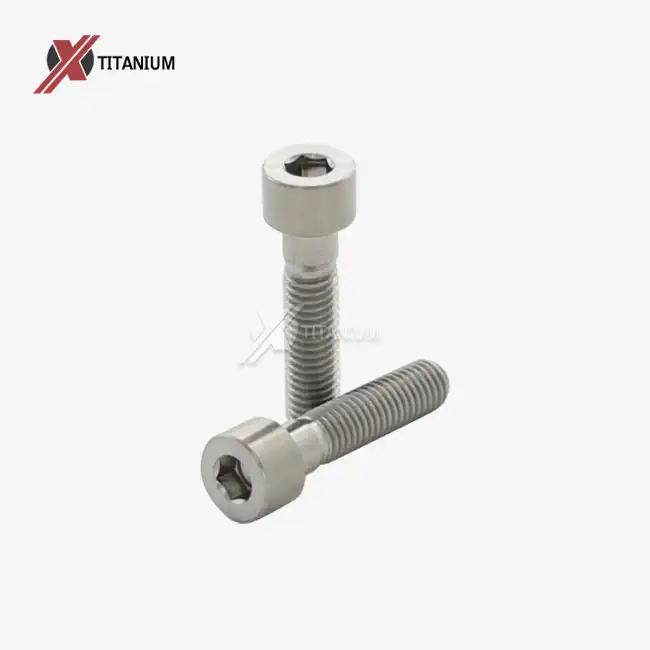
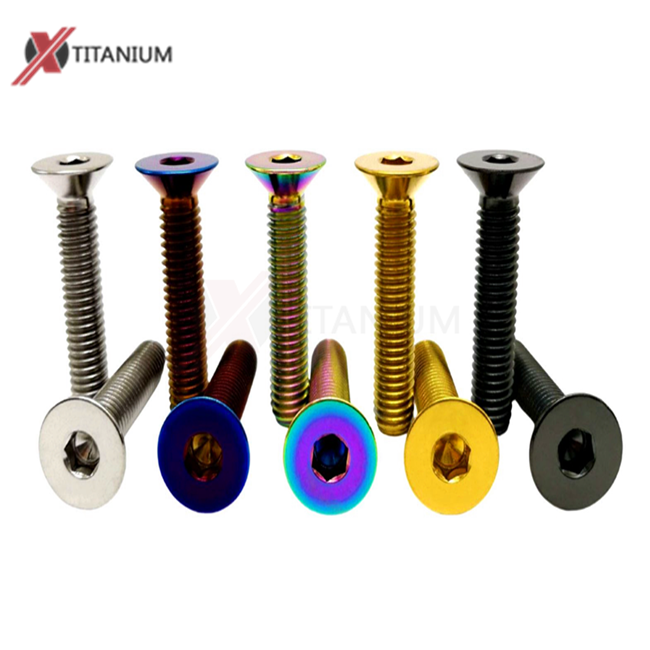
Baoji Chuanglian New Metal Material Co., Ltd. is based in Baoji, which is known as the titanium manufacturing hub of China. They make Grade 5 Ti-6Al-4V billets into hollow M10x1.0 crank spindle bolts that can be fully tracked in terms of their dimensions. Standard lengths are 15mm, 20mm, and 25mm, but custom lengths can be made by sending in a drawing. Different types of heads come in hexagonal, Allen, and Torx shapes. You can get a natural titanium shine, anodized colors (Gold, Blue, Green, Purple, Black, and Rainbow), or nitriding, which makes the surface harder.
Tensile strength of at least 950 MPa, yield strength of at least 880 MPa, hardness of 36 HRC, and density of 4.43 g/cm³ are the engineering standards. These bolts have been used for years by OEM and aftermarket customers around the world in saltwater, acidic, and extreme weather conditions and have always worked well. Custom hollow bore diameters and wall thickness configurations can be made possible through collaborative engineering review, which can include FEA analysis if needed.
Conclusion
Titanium crank spindle bolts M10x1.0 hollow are a mix of cutting edge materials science and precise CNC manufacturing. The weight savings are real, the strength credentials can be checked, and the supply base is small enough that it's very important to find a good long-term partner. OEMs that make bottom brackets and crankarms for competition-grade drivetrain systems can easily choose Ti-6Al-4V hollow bolts. The harder part is finding a source that has the cutting depth and quality infrastructure to keep up with high production volumes.
FAQ
Q1: Does the hollow design compromise structural safety?
A: No. Torque and shear forces act on the outer diameter and thread engagement zone. The hollow core removes non-load-bearing material. Machined from Ti-6Al-4V, a properly designed hollow bolt maintains a safety factor exceeding standard competitive cycling loads. Bore concentricity must be verified within ±0.05mm to ensure wall uniformity.
Q2: What torque value applies to M10x1.0 hollow titanium bolts?
A: Follow the crank manufacturer's specification — typically 30–40 Nm. Use a calibrated torque wrench and do not exceed 45 Nm. Always apply anti-seize compound; installing titanium bolts dry against steel or aluminum threads causes irreversible galling.
Q3: Are these bolts universally compatible with all cranksets?
A: No. M10x1.0 is a specific fine-pitch metric thread used on select BMX three-piece cranks, certain track interfaces, and specific boutique bottom bracket systems. Verify thread diameter and pitch on your spindle before ordering. Many standard road cranks use M8 bolts; ISIS and Octalink systems often require M12 or M15.
Q4: How does anodizing affect thread precision?
A: Anodizing builds a thin oxide layer, typically 5–25 microns. On thread flanks, this can affect fit if threads are anodized after machining. Chuanglian masks or post-machines threaded sections to maintain 6g tolerance class after surface treatment.
Partner With Chuanglian for OEM Titanium Fastener Supply
OEM drivetrain manufacturers in North America, Europe, and Asia receive titanium crank spindle bolts M10x1.0 hollow from Chuanglian. We are a reliable supplier of titanium crank spindle bolts for OEM programs that need precision. We have over ten years of experience CNC-machining titanium, a strict quality system, and full customization support, including custom bore diameters and proprietary surface finishes. Today, ask for a study of the technical plans or a sample batch. Email us at info@cltifastener.com or djy6580@aliyun.com.
References
1. Donachie, M. J. Titanium: A Technical Guide. ASM International, 2000.
2. Boyer, R., Welsch, G., & Collings, E. W. Materials Properties Handbook: Titanium Alloys. ASM International, 1994.
3. Mechanical Fasteners for Cycling Applications: Standards and Testing Protocols. European Bicycle Manufacturers Association (EBMA) Technical Report, 2019.
4. Leyens, C., & Peters, M. (Eds.). Titanium and Titanium Alloys: Fundamentals and Applications. Wiley-VCH, 2003.
5. Thread Form Standards for Metric Fine Pitch Fasteners (ISO 965-1). International Organization for Standardization, 2013.
6. Froes, F. H. Titanium: Physical Metallurgy, Processing, and Applications. ASM International, 2015.
Learn about our latest products and discounts through SMS or email