- English
- French
- German
- Portuguese
- Spanish
- Russian
- Japanese
- Korean
- Arabic
- Greek
- German
- Turkish
- Italian
- Danish
- Romanian
- Indonesian
- Czech
- Afrikaans
- Swedish
- Polish
- Basque
- Catalan
- Esperanto
- Hindi
- Lao
- Albanian
- Amharic
- Armenian
- Azerbaijani
- Belarusian
- Bengali
- Bosnian
- Bulgarian
- Cebuano
- Chichewa
- Corsican
- Croatian
- Dutch
- Estonian
- Filipino
- Finnish
- Frisian
- Galician
- Georgian
- Gujarati
- Haitian
- Hausa
- Hawaiian
- Hebrew
- Hmong
- Hungarian
- Icelandic
- Igbo
- Javanese
- Kannada
- Kazakh
- Khmer
- Kurdish
- Kyrgyz
- Latin
- Latvian
- Lithuanian
- Luxembou..
- Macedonian
- Malagasy
- Malay
- Malayalam
- Maltese
- Maori
- Marathi
- Mongolian
- Burmese
- Nepali
- Norwegian
- Pashto
- Persian
- Punjabi
- Serbian
- Sesotho
- Sinhala
- Slovak
- Slovenian
- Somali
- Samoan
- Scots Gaelic
- Shona
- Sindhi
- Sundanese
- Swahili
- Tajik
- Tamil
- Telugu
- Thai
- Ukrainian
- Urdu
- Uzbek
- Vietnamese
- Welsh
- Xhosa
- Yiddish
- Yoruba
- Zulu
How Do Titanium Cup and Cone Washers for Bicycle Hubs Compare in Use?
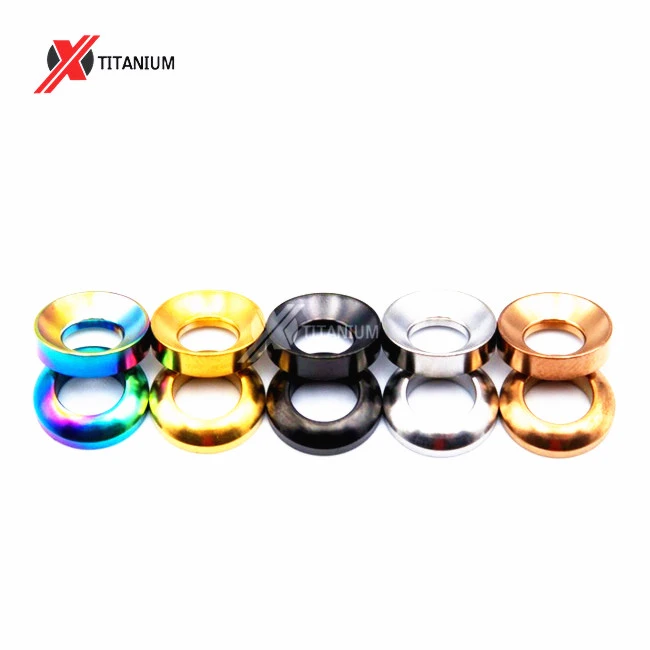
When mechanics and procurement managers ask how titanium cup and cone washers for bicycle hubs perform against conventional options, the short answer is: significantly better in corrosion resistance, weight, and long-term durability. These precision-machined components sit at the heart of traditional loose-ball bearing hubs—specifically classic Shimano and Campagnolo systems—where cone angle accuracy and surface finish directly affect how smoothly a wheel spins. Compared to steel equivalents, titanium versions resist rust, weigh roughly 50% less, and hold their geometry through years of wet-road and trail abuse without deforming.
Understanding Titanium Cup and Cone Washers: Properties and Benefits
It's helpful to know what these parts do and why their shape is so important in the field before you compare materials.
Function Within the Hub Bearing System
The axle, the free steel balls, and the hub shell all weigh heavy. The cup and cone nut pair holds them all together. When there is a difference in surface finish or measurement mistake, the angled face of the cone hits the ball bearings directly. This means that any rough spinning, too much play, or wear before its time is due. Hubs made for professionals have to be within 0.05 mm of the standard in terms of size.
Why Titanium Grade 5 (Ti-6Al-4V) Stands Out?
Titanium grade 5 (also written as Ti-6Al-4V) is about 4.43 g/cm³ dense and can hold its shape for about 950 MPa. This makes it about twice as strong as stainless steel when it comes to weight. There is already an oxide layer on the surface that protects it from chemicals like road salt, sweat, and cleaning products; you don't need to add another layer.
Surface Finish and Its Real-World Impact
Chuanglian uses CNC turning and precision polishing to make the cone faces as rough as Ra ≤ 0.2 μm. The rolling friction is less where the ball hits the cone at that level of finish. This makes the wheels spin more freely, which riders can feel. The surface gets harder with anodizing and PVD nitriding, which come in natural titanium, gold, blue, green, purple, black, and many other colors. This keeps it from galling while it's being adjusted. Titanium cup and cone washers for bicycle are the SKU where this level of surface finish and treatment matters most.
Titanium Cup and Cone Washers vs Other Materials: A Comparative Analysis
Understanding how titanium stacks up against alternatives is what ultimately guides smart purchasing decisions. Here is a direct comparison across the materials most commonly found in hub bearing components.
Steel: The Traditional Benchmark
Standard steel cone washers are inexpensive and widely available, but they corrode quickly in humid or coastal environments. Even chrome-moly steel requires frequent re-greasing to prevent pitting on the cone face. Once surface pitting begins, bearing adjustment becomes inconsistent, and replacement is the only fix.
Aluminum: Lightweight but Fragile Under Load
Aluminum washers are occasionally marketed as a weight-saving option, but Grade 2 aluminum deforms under the 6–10 Nm clamping loads typical of hub axle nuts. A deformed cone face loses angular accuracy, which introduces play into the bearing almost immediately. In practical use, aluminum cones have a much shorter service life than either steel or titanium in this application.
Titanium vs Cartridge Bearings: Different Solutions
Many modern hubs use sealed cartridge bearings that eliminate the need for cup-and-cone adjustment altogether. However, a substantial market of classic Shimano 105, Ultegra, and Campagnolo Record hubs—still widely ridden and maintained—relies on the adjustable cup-and-cone format. For those hubs, titanium replacements extend service intervals and reduce total maintenance costs over time without requiring a hub replacement.
These comparisons show a consistent pattern: titanium costs more upfront, but its durability and corrosion resistance mean the component rarely needs replacement, making the lifecycle cost lower than steel in most real-world scenarios.
Installation, Maintenance, and Optimization for Titanium Cup and Cone Washers
Correct installation is where the technical advantage of titanium either gets realized or wasted. The material's properties only deliver their full benefit when the mechanic follows the right procedure. Titanium cup and cone washers for bicycle are the SKU where installation discipline determines whether the upgrade actually performs.
Anti-Galling Preparation Before Assembly
Titanium is prone to cold-welding—a process called galling—when two titanium surfaces are torqued against each other under pressure. Applying a thin film of copper-based anti-seize paste or a dedicated Ti-Prep lubricant to the cone threads and mating faces before assembly prevents binding during adjustment and disassembly. Skipping this step is the most common installation error seen in field reports.
Adjustment Technique for Cup and Cone Hubs
Correct bearing preload requires a cone wrench and a cassette locknut wrench used simultaneously. The cone should be threaded inward until zero play exists, then backed off just slightly—approximately one-eighth of a turn—before locking the nut. The polished titanium cone face allows finer tactile feedback during this process than a worn steel cone, making precise adjustment more repeatable.
Maintenance Intervals and Wear Monitoring
Because titanium resists corrosion and maintains surface integrity longer than steel, annual re-greasing is sufficient for most road use, compared to the recommended six-month interval for steel cones in wet climates. Signs that replacement is needed include visible scoring lines on the cone face, detectable lateral play after adjustment, or rough rotation under a light spin test. Titanium cones that show no scoring can be reused across multiple hub rebuilds.
Procurement Insights: Selecting and Buying Titanium Cup and Cone Washers
Two things that make or break a sourcing project for small brands and specialty dealers looking for hub components are how clear the specifications are and how well the seller can do their job.
Before making an order, buying teams should make sure that the following core requirements are met:
- Material certification: XRF or mill certificate confirming Ti-6Al-4V (Grade 5) composition, not Grade 2 commercially pure titanium, which lacks sufficient hardness for high-torque clamping.
- Dimensional tolerances: Inner diameter, outer diameter, and thickness held to ±0.05 mm; cone angle ground to specification for the target hub model (Shimano, Campagnolo, or custom).
- Surface finish: Cone contact face polished to Ra ≤ 0.2 μm; optional PVD or anodizing for color and added surface hardness.
- MOQ flexibility: Suppliers who can work with 500–1,000 piece runs support the typical purchase volumes of specialty distributors without forcing overstock.
Industry Trends and Future Outlook for Titanium Cup and Cone Washers
Most mid-range and speed bikes now have sealed cartridge systems, which has hurt the market for loose-ball bearing hubs. Still, the market for classic hub repair is strong as ever. This is because many Shimano and Campagnolo hubs can be fixed, even though the original manufacturers' new parts are getting harder to find.
There is a steady market for specialized titanium replacement parts because of that hole. People who take care of old steel road bikes, randonneuring bikes, and traditional Japanese touring bikes are always on the lookout for new parts that are better than the steel ones that came with the bikes. Distributors who keep titanium hub bearing parts in stock say they get repeat orders all the time because there aren't many suppliers with the level of accuracy needed.
Sustainable living is another thing. A titanium cone washer that lasts the life of the hub is better because it doesn't need to be replaced as often as a steel cone washer that does. This is something that more and more riders agree with. Long-lasting parts are part of their plan to play the sport with less waste.
Conclusion
Titanium cup and cone washers for bicycle hubs last longer, don't rust, and have a smoother surface than their steel and aluminum counterparts. These are the things that professional mechanics and component distributors care about the most. It takes longer to fix and can serve a market where good competitors are hard to find, which makes up for the higher cost of the materials. In a stable sub-market, brands that make repair kits for classic hub systems can easily stand out by getting precision-machined Grade 5 titanium cone washers from a trusted maker. This will help them build customer confidence.
FAQ
Do titanium cup and cone washers work with standard steel axle nuts and cones?
Yes, grade 5 titanium hardware can be used with grade 5 stainless steel hardware. Titanium and stainless steel don't corrode against each other very much when riding normally. Put anti-seize paste on parts that will touch to keep them from grinding together while you're building.
Why specify Grade 5 rather than Grade 2 titanium for this application?
Grade 2 titanium is as pure as it gets for sale, but it is also pretty soft—it can bend when a hub cone is locked in place. As many times as you change the shape of Grade 5 (Ti-6Al-4V), it stays in the same cone shape. Its hardness is between 35 and 40 HRC.
What surface treatment option offers the best wear resistance?
The surface that is PVD nitrided is the hardest. This keeps the cone face from galling and extends its life. Anodizing gives things color and helps keep them from rusting. It is enough to clean the surface until Ra is less than 0.2 μm for a smooth bearing contact.
What is the typical dimensional range available?
Sizes range from 12 mm to 20 mm for the outside, 5 mm to 8 mm for the inside, and 1.5 mm to 2.5 mm for the width. Drawings given by the customer can be used to make custom sizes.
What is the minimum order quantity for a first sample run?
Most sources of precision titanium that can do cup-and-cone shape need at least 500 to 1,000 pieces to make a run. Smaller test amounts are available during the verification stage.
Request a Quote from Chuanglian — Titanium Cup and Cone Washer Manufacturer
Titanium cup and cone washers for bicycle wheels are bought from Chuanglian by distributors and part names in the US, Europe, and Japan. CNC tools are used to make these. Titanium is something we've been working with for more than ten years. From the raw stock to the finished parts, we check all of our materials very carefully. We can work with orders that come in every three months, small initial runs, and orders that are made to order. Connect with our team right away to talk about prices and details:
- Website: cl-titanium.com
- Email: info@cltifastener.com
- Email: djy6580@aliyun.com
References
1. Shimano Technical Documents — Shimano Dealer's Manual: Wheel Hub Components, Shimano Inc., 2022.
2. Callister, W.D. & Rethwisch, D.G. — Materials Science and Engineering: An Introduction, John Wiley & Sons, 2020.
3. ASTM International — ASTM B265: Standard Specification for Titanium and Titanium Alloy Strip, Sheet, and Plate, ASTM International, 2021.
4. Bicycle Quarterly — Bearing Systems and Long-Term Hub Performance in Touring Bicycles, Bicycle Quarterly Journal, 2021.
5. Peters, M., Kumpfert, J., Ward, C.H., & Leyens, C. — Titanium Alloys for Aerospace Applications, Advanced Engineering Materials, 2003.
6. Groover, M.P. — Fundamentals of Modern Manufacturing: Materials, Processes, and Systems, John Wiley & Sons, 2019.
Learn about our latest products and discounts through SMS or email