- English
- French
- German
- Portuguese
- Spanish
- Russian
- Japanese
- Korean
- Arabic
- Greek
- German
- Turkish
- Italian
- Danish
- Romanian
- Indonesian
- Czech
- Afrikaans
- Swedish
- Polish
- Basque
- Catalan
- Esperanto
- Hindi
- Lao
- Albanian
- Amharic
- Armenian
- Azerbaijani
- Belarusian
- Bengali
- Bosnian
- Bulgarian
- Cebuano
- Chichewa
- Corsican
- Croatian
- Dutch
- Estonian
- Filipino
- Finnish
- Frisian
- Galician
- Georgian
- Gujarati
- Haitian
- Hausa
- Hawaiian
- Hebrew
- Hmong
- Hungarian
- Icelandic
- Igbo
- Javanese
- Kannada
- Kazakh
- Khmer
- Kurdish
- Kyrgyz
- Latin
- Latvian
- Lithuanian
- Luxembou..
- Macedonian
- Malagasy
- Malay
- Malayalam
- Maltese
- Maori
- Marathi
- Mongolian
- Burmese
- Nepali
- Norwegian
- Pashto
- Persian
- Punjabi
- Serbian
- Sesotho
- Sinhala
- Slovak
- Slovenian
- Somali
- Samoan
- Scots Gaelic
- Shona
- Sindhi
- Sundanese
- Swahili
- Tajik
- Tamil
- Telugu
- Thai
- Ukrainian
- Urdu
- Uzbek
- Vietnamese
- Welsh
- Xhosa
- Yiddish
- Yoruba
- Zulu
Titanium Seat Clamp Bolt Size Guide for Popular Bicycle Frames Now
If you sell bicycle hardware or build complete bikes, getting the seat clamp bolt spec right is non-negotiable. The wrong size means a slipping saddle, damaged frame threads, or a frustrated customer leaving a one-star review. This guide covers everything you need—correct sizing for popular frame types, material comparisons, installation tips, and smart sourcing advice—so your product listings stay accurate and your buyers stay safe.
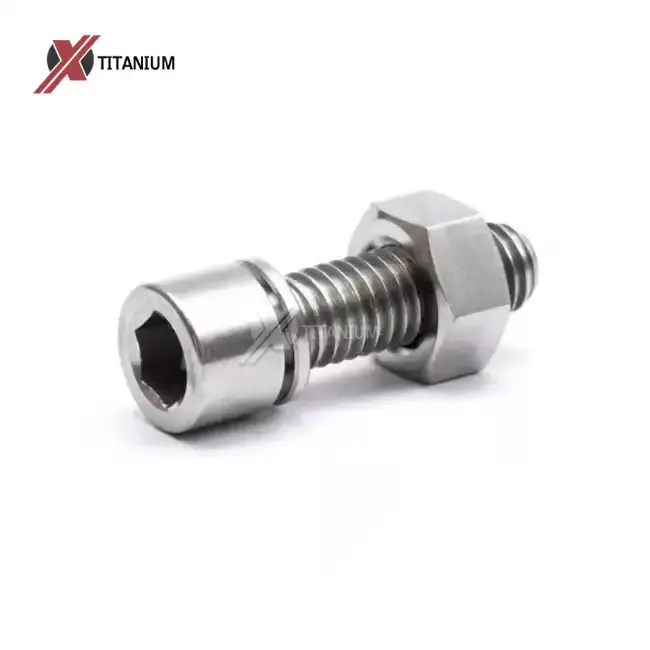
A titanium seat clamp bolt secures the seat post inside the frame's seat tube by tensioning the clamp collar. Made from Grade 5 Ti-6Al-4V alloy, it delivers 950 MPa tensile strength at roughly 45% less weight than a comparable steel bolt, while resisting rust caused by sweat, rain, and road spray—three conditions every cyclist faces.
Understanding Titanium Seat Clamp Bolts: Key Features and Benefits
What Makes the Material Stand Out?
The alloy Ti-6Al-4V is used in spacecraft and is made up of 90% titanium, 6% aluminum, and 4% vanadium. Its density is about 4.43 g/cm³, which is about half that of steel. However, it can hold its own weight in tension for 950 to 1,050 MPa. We don't often see that mix. Steel rusts, aluminum wears out over time and breaks, and carbon fasteners break when torque is applied. This is why professional frame builders use titanium: it doesn't fail in any of the three ways listed above.
Size Standards Across Popular Frames
Most of the time, M5 and M6 threads are used. M5 bolts with lengths of 20 mm to 30 mm are used in most road and gravel frames. Different lengths of M6 nuts are often used on cross-country and trail mountain bike frames. When used for downhill and BMX, M8 at 35–60 mm is sometimes needed. Making sure of the thread diameter before placing an order stops mismatched inventory, which is a common and expensive sourcing mistake.
Long-Term Maintenance Advantage
Titanium doesn't react chemically with acidic environments, so it doesn't stick to aluminum clamp bodies like steel does. If you leave a steel bolt in a metal clamp for one wet season, it can become stuck there for good. Titanium stays can be taken off. That one feature saves time on repairs and keeps the frame from getting damaged when the saddle height is changed, which makes it a real selling point for online ads aimed at commuters and tourers.
How to Choose the Right Titanium Seat Clamp Bolt Size for Your Bicycle Frame?
Core Sizing Metrics
To describe a seat clamp bolt, you need to know its thread diameter (M5 or M6), its length (from the head to the tip), and its thread pitch (0.8 mm for M5 and 1.0 mm for M6 according to the ISO metric standard). If you guess the length wrong by even 3 mm, the threads might not contact properly or the bit might bottom out in a blind hole, both of which weaken the holding force.
Matching Size to Frame Type
Based on common production frames, here is a useful size guide:
- Road/Gravel frames (aluminum or carbon): M5 × 20–25 mm, hex or Torx head, 4–6 Nm torque
- Hardtail MTB frames: M6 × 25–35 mm, hex socket, 5–7 Nm
- Full-suspension/Enduro: M6 × 30–40 mm, Torx T25/T30, 6–8 Nm
- BMX/Jump: M8 × 35–50 mm, heavy hex, up to 10 Nm
- Carbon frames (all types): Always follow the frame manufacturer's max torque, typically capped at 5–6 Nm regardless of bolt material
Always follow the frame manufacturer's max torque, which is usually capped at 5–6 Nm no matter what kind of bolt it is.
OEM Versus Aftermarket Considerations
OEM clients who put bolts into lines that put together whole bikes need tighter tolerances—at least a 6g thread class—to pass end-of-line torque checks. Aftermarket sellers who want to improve can list standard tolerance nuts with a clear specification table so that customers can match them on their own. Instead of cut threads, rolled threads are better for both markets because they keep the grain flow lines and increase fatigue life by up to 20%, according to literature in the field of fastener engineering. Titanium seat clamp bolt is the specific SKU where both requirements converge.
Titanium Seat Clamp Bolt vs Other Materials: An In-Depth Comparison
Weight and Strength Trade-off
While steel is cheap and strong, it adds weight and rusts over time. Aluminum is very light, but it has a clear wear limit. If you load it over and over, it will finally break. Titanium doesn't have a set limit for fatigue under normal riding stress levels, which means it lasts longer than both options in long-term uses. That means that e-commerce sellers will get fewer warranty returns.
Corrosion and Total Cost of Ownership
An anodized aluminum bolt might cost $1 to $2, while a Grade 5 titanium bolt would cost $4 to $10. The price difference seems big until you think about how often you have to replace things. If you install a titanium bolt with the right anti-seize compound, it should last as long as the frame does. Steel nuts that are used in seaside or high-humidity areas usually need to be replaced every one to two seasons. For B2B sellers who are trying to figure out how quickly they can sell their stock, the fact that steel is often bought again is actually a disadvantage, not an advantage.
Application-Specific Recommendation
When mountain biking, there are a lot of vibrations and mud, which are perfect conditions for titanium's corrosion resistance and fatigue performance. When it comes to road riding, weight saves are important, and the 45% mass reduction over steel helps reach total bike weight goals. In both cases, titanium is more reliable than aluminum over the long term, which makes it a premium item that can be found in any bicycle hardware store. Titanium seat clamp bolt is the specific component where these advantages are most relevant.
Installation and Maintenance Guidelines for Titanium Seat Clamp Bolts
Tools and Preparation
A torque wrench that has been calibrated is required, not optional. Titanium threads gall (cold join) when they are placed dry and under a lot of pressure. Before inserting, you should always use a small amount of copper-based anti-seize paste or titanium assembly paste. Make sure you use the right size hex key or Torx bit. Tools that are too worn out will damage the drive recess and make customers unhappy.
Torque Application Best Practices
Tighten slowly: first get to 50% of the target torque, then go all the way to full torque in one smooth motion. Do not go over the maximum that the seat clamp manufacturer says you can. On carbon frames, that limit protects the frame, not the bolt. Most of the time, the Grade 5 titanium screw is stronger than the clamp body. When you over-torque, you either break the clamp or the seat tube. Neither of these problems is caused by the bolt, but your user will blame it for both of them.
Inspection and Cleaning Schedule
Check the bolt every 500 hours of riding or every time you change the height of the saddle. On the clamp body contact surface, look for thread damage, drive hole wear, and rust. To clean, use a dry brush. Do not use alkaline degreasers, as they can damage anodised surface finishes. Use anti-seize again every time you reinstall something. If you do these simple things to take care of your bolt, it won't break down over the course of several riding seasons.
Procuring Titanium Seat Clamp Bolts: What B2B Buyers Need to Know?
Supplier Qualification Criteria
Make sure the supplier gives you mill certificates that show the Ti-6Al-4V composition was checked using spectrometry. Ask for proof of thread tolerance, including Go/No-Go gage results for M5 and M6 at 6g class. Ask for data from a batch tensile test that shows results above 900 MPa. No matter how much they charge, suppliers who can't give you these documents when you ask for them put your supply chain at risk of safety. Titanium seat clamp bolt is the SKU where these documents matter most.
Bulk Order Logistics and Color Options
Standard MOQ from approved makers starts at 500 pieces per standard. Orders of different colors can be made at the same level. Natural titanium, gold, blue, green, purple, black, and rainbow are some of the anodized colors that are usually available. Standard sizes that are in stock have a lead time of 7–15 business days. Custom lengths or thread specifications take 20–30 days. Make sure you understand the Incoterms, the packaging details (such as single poly bags vs. bulk), and the QC report before you place your first order.
Certification and Quality Standards
For tools to work with any bolt, the head geometry should be machined to DIN 912 or ISO 4762. Polishing, anodizing, and nitriding are some surface treatments that can be used. Each has a different set of benefits. Polished bolts look good on clean builds, anodized bolts add color and a mild amount of surface hardness, and nitrided bolts have the highest level of surface hardness for environments with a lot of wear. Customers won't be unhappy or ask for returns if the finish is right for the job.
Conclusion
By choosing the right size of seat clamp bolt, you protect riders' safety, cut down on guarantee returns, and build your brand's image for being accurate. Grade 5 titanium meets the performance goals that steel and aluminum can't: it's light, doesn't rust, and won't wear out over the frame's lifetime. The specs in this article give you the information you need to confidently source and list M5 bolts for road builds and M6 bolts for trail bikes. Titanium seat clamp bolt sizing is where this decision starts.
FAQ
Why does a titanium seat clamp bolt require anti-seize compound?
Titanium's oxide layer breaks down under high contact pressure, causing threads to cold weld to the clamp body. Copper paste or specialist anti-seize compound prevents this by reducing friction at the thread interface.
Can I apply the same torque as a steel bolt?
Grade 5 titanium matches the strength of high-tensile steel (Class 8.8–10.9). However, always follow the seat clamp's maximum torque rating—typically 5–6 Nm for carbon frames—because the frame is the limiting factor, not the bolt.
What is the fatigue life advantage over aluminum?
Titanium has no defined fatigue limit under normal cycling loads. Aluminum works-hardens over time and eventually fractures under cyclic stress. A titanium seat clamp fastener in standard use offers significantly longer service life.
Will titanium cause galvanic corrosion in a carbon frame?
Titanium is compatible with carbon composites. If the clamp collar is aluminum, the aluminum may slowly sacrifice itself in wet conditions, but the titanium bolt remains unaffected. Applying grease isolates the metals and prevents the issue entirely.
Does PVD coating serve only an aesthetic purpose?
No. Physical Vapor Deposition creates a hard ceramic-like shell that improves scratch resistance and lowers the friction coefficient, which supports consistent torque application and reduces galling risk during installation.
Partner with Chuanglian for Your Titanium Seat Clamp Bolt Supply
Since 2000, Baoji Chuanglian New Metal Material Co., Ltd. has been making Grade 5 titanium bolts in Baoji, which is known as China's titanium production hub. Our titanium seat clamp bolts are CNC-machined to meet DIN 912 / ISO 4762 standards. They are thread-rolled for better wear performance and come in seven anodized colors. The minimum order quantity is only 500 pieces. We can make mixed-color first orders as a direct titanium seat clamp bolt manufacturer, give full mill certificates, and ship stocked sizes within 7–15 business days. To get samples and prices, email us at info@cltifastener.com or djy6580@aliyun.com.
References
1. Donachie, M. J. — Titanium: A Technical Guide, ASM International, 2000.
2. Bickford, J. H. — An Introduction to the Design and Behavior of Bolted Joints, CRC Press, 2007.
3. ISO 4762 — Hexagon Socket Head Cap Screws, International Organization for Standardization, 2004.
4. DIN 912 — Hexagon Socket Head Cap Screws, Deutsches Institut für Normung, 2003.
5. Bicycle Quarterly — "Material Science in Modern Bicycle Components," Vol. 18, 2020.
6. Lütjering, G. & Williams, J. C. — Titanium, Springer, 2007.
Learn about our latest products and discounts through SMS or email