- English
- French
- German
- Portuguese
- Spanish
- Russian
- Japanese
- Korean
- Arabic
- Greek
- German
- Turkish
- Italian
- Danish
- Romanian
- Indonesian
- Czech
- Afrikaans
- Swedish
- Polish
- Basque
- Catalan
- Esperanto
- Hindi
- Lao
- Albanian
- Amharic
- Armenian
- Azerbaijani
- Belarusian
- Bengali
- Bosnian
- Bulgarian
- Cebuano
- Chichewa
- Corsican
- Croatian
- Dutch
- Estonian
- Filipino
- Finnish
- Frisian
- Galician
- Georgian
- Gujarati
- Haitian
- Hausa
- Hawaiian
- Hebrew
- Hmong
- Hungarian
- Icelandic
- Igbo
- Javanese
- Kannada
- Kazakh
- Khmer
- Kurdish
- Kyrgyz
- Latin
- Latvian
- Lithuanian
- Luxembou..
- Macedonian
- Malagasy
- Malay
- Malayalam
- Maltese
- Maori
- Marathi
- Mongolian
- Burmese
- Nepali
- Norwegian
- Pashto
- Persian
- Punjabi
- Serbian
- Sesotho
- Sinhala
- Slovak
- Slovenian
- Somali
- Samoan
- Scots Gaelic
- Shona
- Sindhi
- Sundanese
- Swahili
- Tajik
- Tamil
- Telugu
- Thai
- Ukrainian
- Urdu
- Uzbek
- Vietnamese
- Welsh
- Xhosa
- Yiddish
- Yoruba
- Zulu
How Does Titanium Clad Copper Bar Revolutionize Industrial Applications?
Titanium clad copper bar is a new kind of composite material that solves one of the biggest problems in high-performance manufacturing: how to make a material that is both electrically conductive and resistant to corrosion. This man-made material has the electrical efficiency of copper and the chemical stability of titanium. It does this by metallurgically connecting a thin layer of titanium to a core of high-purity copper. Industries that work in harsh settings, like electrowinning and naval power systems, have found that this material removes the usual trade-off between performance and longevity. This means that parts don't need to be replaced as often, and operations don't have to be interrupted as often.
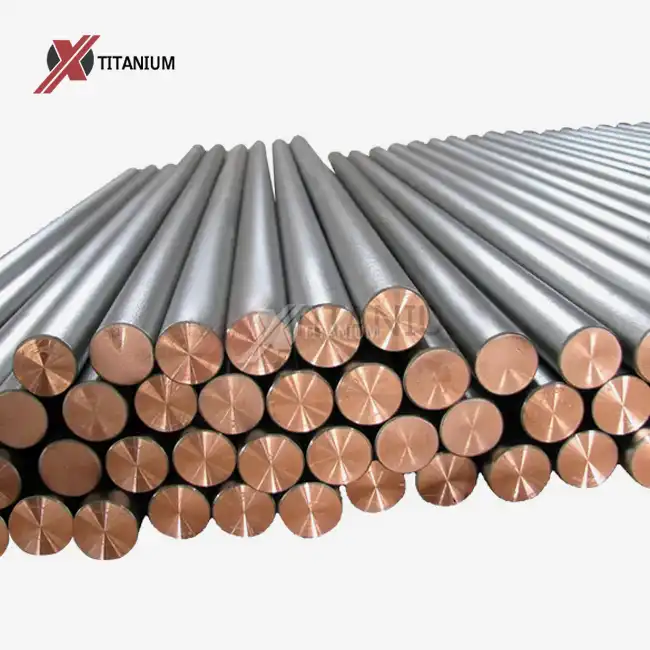
Understanding Titanium Clad Copper Bar: Composition and Properties
Metallurgical Structure and Bonding Process
During the production process, an atomic-level bond is made between the copper base and titanium layer. This is usually done by explosion bonding or hot rolling. Surface coats can come off when they are stressed, but this mechanical bonding makes sure that the two metals work together as a single structure. When we make things at Chuanglian, we use controlled hot rolling and melting methods that keep this bond strong even when temperatures change quickly, which happens a lot in industrial settings.
The titanium layer on the outside is between 0.1 mm and 2 mm thick, and it was carefully measured to protect the copper core without changing its ability to carry electricity. The copper middle, which is generally a high-conductivity grade without oxygen, keeps more than 98% of its original electrical properties. Current can flow through the highly conductive heart because of this arrangement, and the titanium outside protects it from chemical attack.
Physical and Electrical Characteristics
Our titanium-clad copper bars have a joining strength of more than 130 MPa, which was proven by strict shear testing procedures. The electrical resistance stays below 1.75×10⁻⁸ Ω·m, which is about the same as wires made of pure copper. Thermal stability goes up to temperatures close to 400°C, which is much higher than what most electrochemical processes need.
Testing materials at our Baoji plant includes checking for strength, bending, and hydraulic pressure. These quality checks make sure that each batch is the same, which is something that buying managers in the chemical and aircraft industries often worry about. We offer different surface finishes, such as bright, polished, pickled, acid-cleaned, and sanded, so engineers can choose the exact surface state they need for their installation or joining processes.
The average mass of the titanium-clad copper bar is 4.5 g/cm³, which makes it much lighter than solid titanium parts while still having the same level of protection to rust. This lighter weight means that less structural load is needed in places like marine cathodic protection structures or overhead busbar systems.
Industrial Challenges Solved by Titanium Clad Copper Bar
Corrosion-Induced Failures in Aggressive Environments
When introduced to acidic fluids, chloride-rich liquids, or sea atmospheres, pure copper conductors break down very quickly. Titanium clad copper bar solves this problem by protecting the copper core with a titanium layer. Copper dissolution messes up cathode layers in hydrometallurgical electrowinning processes and means that parts need to be replaced often. A zinc electrowinning plant in Montana found that when using regular copper, the cathode bar broke down every 18 months, and the cost of repair plus the time lost from work was over $85,000 each time.
When the same conditions were used, switching to titanium-clad copper bars made the service life last longer than five years. Copper ions can't get into the solution because of the titanium layer on top. This keeps the coating pure and stops the galvanic rusting that happens where liquid meets air. Process engineers noted steady voltage drops across cells, which means that the same amount of energy is used each time and the costs of running the business are known ahead of time.
Thermal Efficiency and Energy Savings
For electrochemical processes to work, the materials need to have low electrical resistance and not react chemically. Titanium has a conductivity that is about 70 times lower than copper's. This leads to a lot of resistance warmth and wasted energy. Stainless steel options aren't as good at resisting rust, but they're also not very good at conducting electricity. Their cell voltages are 15–20% higher than copper-based systems.
The wrapped structure gives copper-level conductivity where it's needed, in the current flow, and titanium protects the surface. A chlor-alkali company in Louisiana found that replacing membrane cell power lines with titanium-clad copper bars saved 12% of the energy they used. They were able to save money because the titanium-clad copper bars cut down on resistance losses and stopped voltage drift caused by rust.
Maintenance Cost Reduction and Uptime Improvement
In the chemical and naval industries, maintenance plans are often based on how often conductors need to be replaced. When parts corrode, they can cause unexpected shutdowns, safety risks because the structure is weak, and damage to other equipment that is linked. The longer service life of the titanium-clad copper bar cuts down on repair work, extra parts inventory, and output stops.
A naval engineering company that works on platforms in the Gulf of Mexico said that titanium-clad copper bar busbar installations didn't need any upkeep over a four-year period of tracking. With older materials, they needed to be inspected every year and replaced every two years. There were direct cost savings and prevented income losses from production stops, which had an effect on the budget.
Comparative Analysis: Titanium Clad Copper Bar vs. Alternatives
Performance Benchmarking Against Pure Metals
When choosing a material for a difficult purpose, you have to look at a lot of performance factors at the same time. Pure copper has an electrical conductivity of about 100% IACS, but it doesn't have any resistance to the surroundings. At 30% of copper's mass, aluminum is lighter than copper, but it is only 61% as conductive and has lower mechanical strength. Stainless steel types don't rust, but they only carry electricity 2 to 3 percent as well as copper.
The titanium-clad copper bar has a performance rating that isn't possible with a single metal. Because it is made of copper, the conductivity stays above 95% IACS, and the titanium layer gives it rust protection that meets Grade 2 titanium standards. The tensile strength is more than 250 MPa, which is strong enough for structural uses in hanger bars and busbar supports.
When expert teams look at materials, they weigh the cost of buying them at the beginning against the cost of keeping them over time. The titanium-clad copper bar costs about 40% more per kilogram than pure copper, but the longer replacement time and lack of upkeep make the total cost of ownership more favorable. An study of ten electroplating plants showed a payback time of three years and a 60% cost advantage over the life of the equipment, which lasts fifteen years.
Application-Specific Material Selection
Different work settings pose different material problems for titanium clad copper bar. It is important for petrochemical heat exchangers to be able to move heat well and not react with sulfur chemicals. Electrical substations put a lot of emphasis on the ability to carry power and handle mechanical loads. Marine buildings have to deal with rust from salt water and collision forces.
For tasks like electrowinning and electroplating, where high current capacity is needed and strong chemicals are present, the titanium-clad copper bar is the best piece of equipment. Chemical engineers like that the material keeps copper from getting mixed in, which is very important when making metals for electronics or medicinal chemicals.
Power delivery systems don't gain as much unless the sites are in toxic environments, like seaside substations or industrial plants where chemicals are in the air. When considering options, project engineers should look at how bad the environment is; moderate or controlled settings might not be worth the extra cost.
Procurement Insights for Global B2B Buyers
Supplier Evaluation and Qualification Criteria
When choosing a provider of titanium-clad copper bars, you need to look at more than just price quotes. A vendor's manufacturing potential tells you if they can meet the requirements for titanium layer thickness consistency, bonded integrity, and dimensional limits. At Chuanglian, we have a dozen CNC machining centers and other specialized processing tools that let us make changes to diameters from 10 mm to 200 mm and lengths up to 3000 mm.
Certifications for quality systems give people faith in the control and tracking of processes. We follow the international rules for titanium goods and titanium-clad copper bars, which makes sure that our paperwork meets the needs of the chemistry, medical, and aircraft industries. Managers in charge of buying things should ask for reports on bonded strength tests, records of acoustic inspections that show 100% metallurgical bond coverage, and material certificates that show where the copper and titanium came from.
In this specialized market, providers are set apart by their technical help skills. When engineers need to choose the right titanium thickness, surface treatments, or physical specs for their individual working conditions, they often need help from application engineers. Our expert team in Baoji City has more than ten years of experience handling titanium and can help you choose the right material, make fitting suggestions, and fix problems.
Supply Chain Considerations and Lead Times
Industrial setups need reliable shipping plans so that projects can be finished on time. Custom titanium-clad copper bar production has several steps, including preparing the core, joining the coating, heat processing, and final cutting. All of these steps need to be carefully controlled. Depending on the difficulty of the design and the number of orders, standard wait times are between six and ten weeks.
Early on in the buying process, global B2B buyers should set up rules for how to communicate. Our team stays in touch through info@cltifastener.com and djy6580@aliyun.com to answer technical questions and give information on the progress of orders. We know that delays in projects can have a domino effect on other projects' schedules, especially when plant growth or retrofits are planned together.
Strategies for buying in bulk can help you get the best prices on materials for projects that have more than one step. People who work in procurement and are in charge of long-term building projects often set up framework deals that lock in prices and ensure delivery times. These kinds of deals are good for everyone: buyers get a stable supply chain, and producers can make the best use of their output schedules.
Certification and Proof of Compliance
Aerospace, medical products, and nuclear power are just a few of the industries that have strict standards for tracking materials. At our factory, we test every batch of products thoroughly, and the paperwork that comes with it includes reports on their chemical makeup, their mechanical properties, and non-destructive examinations. Customers can meet the standards of their quality control systems with this paperwork package that comes with orders.
Understanding the rules that apply to your application helps you choose the right materials. For electrochemical uses, titanium-clad copper bars may need to be certified to ASTM B898 standards. Biocompatibility paperwork is needed to make medical devices. Because we've provided titanium-clad copper bars to customers in the industrial, aircraft, medical, and marine sectors, our quality control system can handle all of these different needs.
Future Outlook: Titanium Clad Copper Bar in Industrial Innovations
Emerging Applications in Energy Infrastructure
As the world moves toward green energy sources, new possibilities open up for smart materials like titanium clad copper bar. Infrastructure for charging electric cars needs high-current lines that can handle all kinds of weather. In seaside or ocean settings, solar and wind power systems need electrical parts that don't rust. More and more, energy storage devices use electrochemical processes, and when conductors get dirty, it affects how well batteries work and how long they last.
Titanium-clad copper bars are a good way to meet these new needs. The growth of smart grids includes putting together distributed power systems with parts that are placed in places that can't be managed. This means that standard substations can't control the temperature or humidity. This material is good for expanding energy infrastructure because it is good at both electricity performance and environmental protection.
Manufacturing Technology Advancements
Explosion bonding and diffusion bonding are still being improved, which should lead to better contact properties and bigger size options. Finding the best titanium metal mixtures for covering uses could improve some qualities, like how well they handle high temperatures or wear. These technological advances will make it possible for a wider range of uses and could lower the cost of production by making processes more efficient.
Because we want all of our technologies to work together, Chuanglian is always looking for ways to improve the way they make things. Our place as a dependable titanium-clad copper bar provider that can meet changing industry standards is maintained by investment in cutting-edge testing tools and process control systems. Customers gain from these changes because the products are now more consistent and there are more ways to customize them.
Sustainability and Lifecycle Considerations
More and more, industrial sustainable programs stress how to make tools last longer and use resources more efficiently. Materials that last longer between replacements use fewer raw materials and make less waste. The long-lasting nature of the titanium-clad copper bar helps the circular economy goals by reducing the number of times that parts need to be thrown away and new ones made.
Lifecycle environmental effect studies are becoming more and more common in North America and Europe. Following these safety trends means using materials that last longer and need less upkeep. Purchasing managers who use sustainability data to judge suppliers will find that long-lasting materials help with environmental reporting and following the rules.
Conclusion
In conclusion, titanium clad copper bar has a special mix of electrical efficiency and chemical protection that you can't find in other materials. This combined system solves important practical problems in electrochemical processing, naval uses, and harsh industrial settings. The metallic bonding process makes a strong material that keeps working well even after long periods of time between services. This lowers the cost of upkeep and unplanned downtime. As industrial processes improve and demands for sustainability grow, materials with higher lifecycle value become more important for staying competitive and following the rules.
FAQ
What industries benefit most from titanium clad copper bar?
Titanium-clad copper bars are very helpful in electrochemical businesses like electrowinning, electroplating, and chlor-alkali production. Corrosion protection is useful in marine engineering for things like offshore bases and onboard power systems. Parts last longer in chemical processing plants that work in acidic or salt conditions. This material is also useful for power distribution systems in seaside or industrial places with toxic air.
How does the composite material compare in cost to pure copper?
The initial cost of the titanium-clad copper bar is about 40% higher than for pure copper wires of the same type. Lifecycle cost analysis, on the other hand, shows that the economics are good because the service lasts longer and needs less upkeep. In harsh settings, replacements can happen every 18 to 24 months for pure copper and every 5 to 7 years for titanium-clad copper bar. When shutdown costs and upkeep work are taken into account, the titanium-clad copper bar usually has a lower total cost of ownership over a ten-year period.
Can titanium clad copper bar be customized for specific applications?
You can choose from diameters between 10 mm and 200 mm, lengths up to 3000 mm, and titanium layer thicknesses between 0.1 mm and 2 mm. Different installation needs can be met by surface processes like bright, polished, pickled, acid-cleaned, and sanded. Our research team helps you come up with specifications for titanium-clad copper bars based on your application's working conditions, present load, and mechanical stress factors.
Partner with Chuanglian for Your Composite Material Needs
Chuanglian has more than ten years of experience working with titanium and making titanium-clad copper bars, which can help you with your most difficult projects. Every titanium-clad copper bar we produce meets exact standards for bonding strength, measurement accuracy, and surface finish thanks to our sophisticated quality control system. Our engineering team can help you choose the best materials and create the best applications for your project, whether it's for electrolytic processing, marine infrastructure, or advanced manufacturing. Get in touch with our experts at info@cltifastener.com or djy6580@aliyun.com to talk about your needs with a reliable titanium-clad copper bar maker.
References
1. Davis, J.R. (2001). Copper and Copper Alloys: ASM Specialty Handbook. ASM International, Materials Park, Ohio.
2. Boyer, R., Welsch, G., & Collings, E.W. (1994). Materials Properties Handbook: Titanium Alloys. ASM International.
3. American Society for Testing and Materials (2019). ASTM B898-11: Standard Specification for Reactive and Refractory Metal Clad Plate. ASTM International, West Conshohocken, Pennsylvania.
4. Lysaght, V.E. (1988). Indentation Hardness Testing. Chapman and Hall, New York.
5. International Copper Association (2017). Copper in Electrochemical Processes: Performance and Applications. Copper Development Association Technical Report.
6. Zhang, L. & Xu, J. (2015). "Explosive Bonding of Dissimilar Metals for Industrial Applications." Journal of Materials Processing Technology, Vol. 218, pp. 122-135.
_1748247519019.webp)
Learn about our latest products and discounts through SMS or email