- English
- French
- German
- Portuguese
- Spanish
- Russian
- Japanese
- Korean
- Arabic
- Greek
- German
- Turkish
- Italian
- Danish
- Romanian
- Indonesian
- Czech
- Afrikaans
- Swedish
- Polish
- Basque
- Catalan
- Esperanto
- Hindi
- Lao
- Albanian
- Amharic
- Armenian
- Azerbaijani
- Belarusian
- Bengali
- Bosnian
- Bulgarian
- Cebuano
- Chichewa
- Corsican
- Croatian
- Dutch
- Estonian
- Filipino
- Finnish
- Frisian
- Galician
- Georgian
- Gujarati
- Haitian
- Hausa
- Hawaiian
- Hebrew
- Hmong
- Hungarian
- Icelandic
- Igbo
- Javanese
- Kannada
- Kazakh
- Khmer
- Kurdish
- Kyrgyz
- Latin
- Latvian
- Lithuanian
- Luxembou..
- Macedonian
- Malagasy
- Malay
- Malayalam
- Maltese
- Maori
- Marathi
- Mongolian
- Burmese
- Nepali
- Norwegian
- Pashto
- Persian
- Punjabi
- Serbian
- Sesotho
- Sinhala
- Slovak
- Slovenian
- Somali
- Samoan
- Scots Gaelic
- Shona
- Sindhi
- Sundanese
- Swahili
- Tajik
- Tamil
- Telugu
- Thai
- Ukrainian
- Urdu
- Uzbek
- Vietnamese
- Welsh
- Xhosa
- Yiddish
- Yoruba
- Zulu
How is titanium anode mesh manufactured?
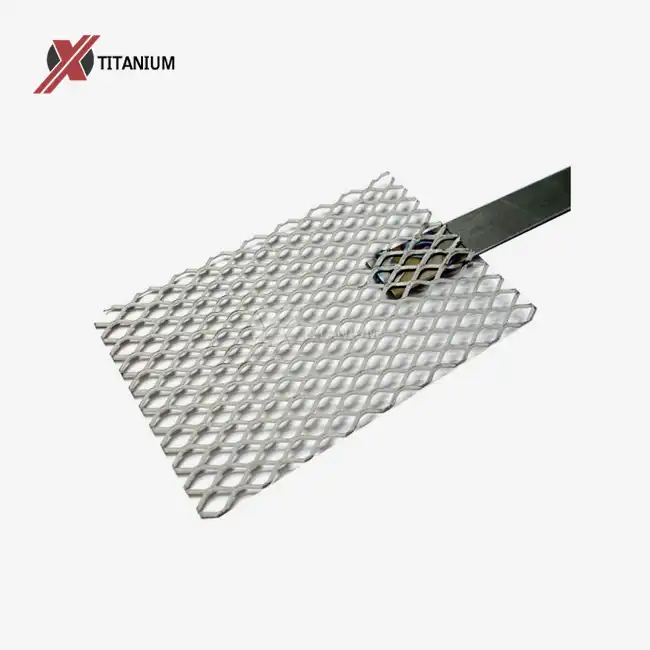
Titanium anode mesh is made through a multi-step process that combines exact metal shaping methods with advanced covering technologies. Starting with high-purity titanium Grade 1 or Grade 2 sheets that meet ASTM B265 standards, the material is either stretched or punched holes in it to make the mesh structure. The made mesh is then prepared on the outside by pickling it with acid to get rid of oxides. Next, a catalytic layer is applied using heat decomposition methods. This is usually mixed metal oxide (MMO) or platinum. Controlled heat treatment makes sure that the layer sticks and that the electrochemical reactions start. During production, strict quality controls such as hardness testing, dimensional verification, and electrical conductivity measures make sure that the products always work the same way in demanding electrochemical uses across all fields.
Understanding Titanium Anode Mesh: Basics and Benefits
Titanium anode mesh is an important part of current electrochemical systems because it protects against rust and works efficiently with electricity. In processes like electroplating and water treatment, this designed material acts as an electrode carrier and has performance qualities that are hard for other materials to match.
What Makes Titanium Anode Mesh Unique?
The main benefit comes from titanium's high resistance to rust and steadiness in the form factor. Titanium anode mesh doesn't break down like disposable anodes do during operation; it keeps its shape over long service cycles. Grades 1 and 2 of commercially pure titanium make a passive oxide layer that protects the parent metal and lets electrons move when coated with the right materials that help the reactions happen.
This protected film stays the same in pH levels from 0 to 14. This means that the mesh can be used in both highly acidic electroplating pools and alkaline chlor-alkali cells. The low density of the material—about 60% lighter than steel—makes installation easier and lowers the amount of structure loads needed for large-scale projects. Most industrial electrochemical methods can work at temperatures up to 80°C without losing any function.
Key Performance Characteristics
When paired with the right coverings, modern titanium anode mesh has enough electrical conductivity for industrial current levels. The base gives the device its mechanical support, and the catalytic layer, which could be MMO or platinum, speeds up the electrochemical processes that are wanted. When compared to lead or graphite anodes, this mix saves energy because it lowers overpotential.
The service life is much longer than with other materials. Titanium baskets that aren't coated and used in normal nickel or copper electroplating baths can usually work for five to ten years before they stop working. This is because of mechanical wear rather than rust. In settings where chlorine is made, MMO-coated configurations have a coating life of one to five years, based on the current density and operating conditions. For procurement-focused operations, these success measures mean less maintenance needs and a lower total cost of ownership.
By letting more electrolytes flow, the mesh design itself makes the process more efficient. Patterns that are expanded or punctured let fluid run through the electrode assembly. This helps the current be spread out evenly and stops concentration differences in one area that would lower the quality of the product. This design thought solves a common problem in precise electroplating where yield rates are affected by uniformity.
The Manufacturing Process of Titanium Anode Mesh
Understanding how things are made helps buying teams judge the skills of suppliers and plan for changes in quality. The steps in the manufacturing process are choosing the right material, making it, cleaning the surface, applying a finish, and finally testing it to make sure it works well.
Material Selection and Quality Verification
The first step in production is to find titanium sheets or coils that meet the requirements of ASTM B265. There must be at least 99.5% pure titanium in grade 1 titanium, with oxygen levels below 0.18%, iron levels below 0.20%, and carbon levels below 0.08%. Grade 2 allows a slightly higher oxygen level of up to 0.25%, which makes the material stronger while still being very resistant to rust. Reputable producers keep full track of their materials by using mill test papers that show the chemical make-up and mechanical qualities.
Through spectroscopic analysis and mechanical testing, incoming material checking makes sure that all the rules are followed. This quality gate stops low-quality input from going into production. This is an important control point because material flaws can spread to later steps of processing and might not show up until the product is used in the field.
Mesh Formation Techniques
Expansion and piercing are the two main ways that titanium anode mesh is formed. For expanded mesh production, titanium sheets are slit in a staggered pattern, then stretched to open the gaps, creating a diamond-shaped opening pattern without material waste—resulting in lightweight structures with high open area ratios for titanium anode mesh. Common specifications include opening sizes of 6x3mm, 10x5mm, and 12.5x6mm, selected based on application requirements for titanium anode mesh.
CNC punching or laser cutting are used to make holes in titanium sheets that are round or square for perforated mesh. This method gives you exact control over the size and spacing of the holes, so it can be used in situations where you need to meet certain open area percentages or aesthetic standards. When mechanical strength is more important than weight reduction, perforated designs are best.
Surface Preparation and Coating Application
Surface preparation is important for the adhesion of coatings and their electrical performance. Using hydrofluoric and nitric acid mixes at controlled temperatures and ratios, acid pickling gets rid of the natural oxide layer and surface contaminants. This process makes a clean, reactive titanium surface that is ready for a layer to stick to. Some standards call for extra steps to be taken, like sandblasting to make the surface rougher or alkaline cleaning to get rid of any organic materials that are still there.
The most difficult part of the producing process is applying the coating. Mixed metal oxide films usually have iridium oxide, ruthenium oxide, and tantalum oxide in special mixes that work best with certain electrochemical processes. The precursor solution is put on by brushing, spraying, or dipping metal chlorides that have been dissolved in acidified alcohols. The covered mesh is then broken down by heat in controlled atmosphere furnaces at temperatures between 350°C and 550°C.
The catalytic layer is built up to the required thickness over a number of covering processes. This thickness is usually between 6 and 12 microns. In each turn, the solution is applied, the solvent evaporates, and the material breaks down at high temperatures. The cumulative process needs 8 to 15 rounds, based on the coating mass that is wanted, which is usually between 8 and 12 grams per square meter. Using platinum chloride predecessors, similar steps are taken to make platinum films, but because they are expensive, they can only be used in certain situations.
Heat Treatment and Stabilization
Post-coating heat treatment does two things: it makes sure that all of the precursors are broken down, and it also bonds the coating strongly to the base. Temperatures that are precisely controlled keep the covering from delaminating or cracking due to thermal shock. Hold times at high temperature let atoms move around at the junction between the coating and the substrate, making a layer in the middle that makes the adhesion stronger.
Rates of cooling need the same amount of care. Too fast of cooling can cause thermal stress that is higher than the coating's tensile strength, and too slow of cooling can let grains form that make electrical activity less effective. Manufacturers who are good at thermal processing keep the temperature uniformity within ±5°C across the furnace room. This makes sure that the qualities of each output run are the same.
Final Quality Inspection and Testing
Full testing makes sure that finished goods meet all the standards before they are shipped. Dimensional inspection checks the shape of the mesh by comparing the general measurements, opening size, and wire diameter to the drawing limits. Using X-ray fluorescence or gravimetric ways to measure the thickness of the coating makes sure that the right amount of catalytic material is loaded.
Electrical resistance testing finds spots in the layer that aren't connected or substrates that don't carry electricity well. By putting samples through high current levels and harsh electrolytes in virtual service settings, accelerated life testing can predict how long something will last in real life. Tensile strength and bend tests, among others, are used to make sure that the structure is strong enough to be handled and put in place without damage.
Material properties are checked by hardness testing on both the base and the coating. Weld integrity on built baskets or special designs is confirmed by hydrostatic testing. Each package comes with paperwork that includes material certificates, dimensional reports, coating analyses, and test data. This gives buyers who care about quality the tracking they need for their own internal validation processes.
Comparing Titanium Anode Mesh With Alternatives
Comparing titanium anode mesh and other anode materials in a fair way helps with purchasing decisions. When you look at durability, running costs, and application suitability in a variety of workplace settings, you can see that performance is not the same.
Performance Against Graphite and Lead Anodes
In some electroplating situations, graphite anodes work well and don't cost much at first, but they are easily broken and don't fight rust well in oxidizing settings. During operation, graphite is used up and needs to be replaced often, which causes downtime for upkeep and costs for removal. This wear-and-tear property is taken away by titanium anode mesh, which keeps its dimensions stable over time.
Because they are cheap and have good electrochemical qualities, lead anodes have generally been the most common choice for some electrochemical processes. Concerns about the environment and health are making it harder to use lead, which is pushing people to switch to other materials. Titanium anode mesh that has been treated with the right catalysts has electrochemical performance that is the same as or better than lead. It also protects plant workers from toxic metal exposure.
Total Cost of Ownership Analysis
Standard materials are cheaper to buy at first—graphite and lead anodes cost a lot less per unit than titanium anode mesh systems. When you look at the total cost of ownership over several years of running, this price difference gets a lot smaller. Titanium has a longer service life, so it doesn't need to be replaced as often. This lowers the costs of purchasing, keeping supplies, and installing equipment over the course of its life.
Energy saving issues change the economic balance even more. Titanium anode mesh covered with MMO work at lower overpotentials than graphite, which means they use 10% to 20% less electricity in normal chlor-alkali situations. For businesses that use a lot of energy and have continuous shifts, these efficiency gains save a lot of money on utility costs, which quickly covers the higher starting equipment cost within 18 to 24 months.
When you just compare prices, you might not think about the secondary costs that come with maintenance. Consumable anodes need to be inspected, measured, and replaced on a frequent basis. Titanium anode mesh doesn't need much care other than being cleaned every so often. This frees up expert staff to do more useful work instead of regular electrode servicing. This operational simplification is especially welcome in production plants with lean repair teams.
Environmental and Safety Advantages
Titanium anode mesh produce much less trash than options that are used up. Graphite anodes make carbon particles that get into the electrolytes and need to be filtered. Dissolving lead anodes, on the other hand, add heavy metals to the electrolytes and need special waste treatment. Titanium anode mesh doesn't make any dissolving products, so the electrolyte stays pure and it's easier to follow environmental rules.
Getting rid of lead handling makes the workplace safer. Titanium is inert, so it doesn't pose any risks when breathed in or touched. This means that people don't have to wear safety gear and there are no longer any blood lead tracking programs that are required for lead exposure. These safety changes lower the company's risk of liability and improve measures for environmental, social, and governance issues that are becoming more important to stakeholders.
Procurement Guide for Titanium Anode Mesh
To be a good buyer, you need to know how to evaluate suppliers, what customization options are available, and how to handle orders for made titanium anode mesh products. Strategic methods to buying improve both the performance of the product and the dependability of the supply chain.
Supplier Selection Criteria
Quality approvals are the first filters used to find a seller. Basic quality management skills can be seen in ISO 9001 certification, while more advanced quality systems can be seen in AS9100 for aircraft or ISO 13485 for medical products. Process controls are usually stricter at suppliers who work with more than one demanding industry than at suppliers who only work with basic markets.
The evaluation of manufacturing skills goes beyond the study of certifications. Site trips show how advanced the equipment is, how the process is documented, and how knowledgeable the technical staff is. Automated coating systems and computerized heat processing show that a facility is committed to accuracy compared to human operations that can vary depending on the person doing them. If a seller has their own testing labs with spectroscopy, microscopy, and electrical analysis tools, that shows technical depth compared to suppliers who use outside testing services.
Material tracking systems tell the difference between producers and sellers of goods. Full records of the material's journey from the titanium mill to the finishing application and final tests ensure the reliability needed for important uses. Electrochemical systems that need high quality materials shouldn't deal with suppliers who can't provide specific material certificates and process records.
Customization and OEM Capabilities
There are standard mesh setups that work well for many uses, but unique designs often work better for certain process needs. Reputable makers offer technical support to help customers choose the right mesh geometry, coating, and dimensions based on their specific process needs. Through design changes, this consultative method finds ways to improve current flow, lower electrical resistance, or make mechanical durability better.
OEM manufacturing lets you put your own name on the products or add them to bigger units. Suppliers with experience in contract manufacturing know how to protect intellectual property and follow non-disclosure rules, which are important things to think about when creating unique electrode designs. Flexible minimum order amounts let you make prototypes and increase production without having to make huge initial promises.
Pricing Structures and Lead Times
Clear price models make planning and comparing costs easier. Reliable providers give detailed quotes that break down the prices of the substrate, the coating, the manufacturing, and the tests. It is common for volume discounts to apply at certain number levels. Knowing these "break points" can help you get the best unit prices without having to carry too much inventory.
Lead times depend on how complicated the setup is and when the production is scheduled. Standard mesh sizes and coatings can usually be shipped in two to three weeks. However, unique shapes or coatings may take eight to twelve weeks for planning, tooling, and production. Setting up blanket purchase orders with scheduled releases helps balance reducing inventory with the risk of long wait times for things that are used regularly.
Maintenance Tips and Longevity of Titanium Anode Mesh
Paying attention to operational practices, normal upkeep, and finding problems early on are all important for getting the most out of the titanium anode mesh service life. With proper care, replacement times are shortened and electrochemical performance stays the same over the span of the equipment.
Routine Cleaning and Inspection Protocols
When you clean something regularly, insulating layers don't build up and raise the electrical resistance, which leads to limited current concentrations. Cleaning how often relies on the type of electrolyte and the working current density. Cleaning once a week is best for harsh environments, and cleaning once a month is enough for benign ones. Using soft brushes for mechanical cleaning gets rid of loose deposits without hurting catalytic surfaces. Mineral scales can be removed by cleaning with diluted acid solutions, but when choosing a cleaning agent, it's important to make sure it won't damage the layer.
Visual inspection during cleaning finds new problems before they become major ones. Changes in the color or shape of a coating indicate that it needs to be replaced or closely watched. If there is mechanical damage like bent wires, broken welds, or mesh tears, it needs to be fixed right away because weak structures break down faster because they concentrate stress.
Operational Best Practices
The way density is managed now has a direct effect on how long a layer lasts. Operating within the limits set by the maker stops the covering from wearing off faster due to too much chemical stress. Gradual current rising during starting and managed stop processes reduce the effects of thermal shock that can crack the coating. Keeping the electrolyte temperatures fixed stops thermal cycling, which wears down the bonds between the coating and the substrate over many rounds of expanding and contracting.
Controlling the balance of the electrolytes is also very important. Corrosive attack on surfaces or material can be stopped by keeping certain pH ranges, contaminant levels, and additive amounts. In some situations, controlling the amount of chloride in the air stops localized pitting erosion that weakens titanium's inactive film. The chemical environment stays safe by analyzing and adjusting the electrolytes on a regular basis.
Troubleshooting Common Issues
When the voltage goes up during operation, it usually means that the coating is wearing off or that an insulation layer is building up. Systematic analysis finds the root cause. For example, cleaning gets rid of deposits, but a voltage rise on clean surfaces means the layer has reached the end of its useful life. By keeping an eye on how voltage changes over time, you can plan for replacements before a major failure stops production.
Passivation is when the electrode stops conducting electricity. This can happen when the voltage is too high and breaks down the titanium oxide, or when a fluid containing fluoride attacks the electrode. Voltage tracking with automatic shutdown safety and electrolyte chemistry controls are two ways to stop fluoride from getting into the system. Understanding these ways that things can go wrong helps buying teams choose the right coatings and operating safety measures when they are first choosing tools.
Conclusion
To create long-lasting, effective electrodes for tough industrial uses, titanium anode mesh making blends metallurgical knowledge with electrochemical engineering. The production process—from carefully choosing the materials to applying the coatings and making sure the quality is checked thoroughly—directly affects how well they work and how long they last. When procurement experts know about these production details, they can evaluate suppliers' skills, define the right configurations, and put in place maintenance practices that get the best return on investment. The material is better at resisting corrosion, lasts longer, and works more efficiently than traditional alternatives. These factors make it a good choice for electroplating, water treatment, cathodic protection, and electrochemical synthesis, all of which need long-term value driven by reliability and performance consistency.
FAQ
What distinguishes MMO-coated from platinum-coated titanium mesh?
Mixed metal oxides, mostly ruthenium and iridium oxides, are found in MMO coatings. These oxides work very well in chlorine evolution and oxygen evolution processes and are much cheaper than titanium anode mesh coated with platinum. Platinum coatings last longer in some cathodic situations and very acidic environments, but because they are so much more expensive, they can only be used in situations where MMO coatings don't work well enough. The choice is based on the electrochemical processes that need to be carried out, the working surroundings, and the budget.
Can titanium electrode mesh be repaired or recoated?
Mesh surfaces that still have their structural stability can go through recoating after the catalyst runs out. The process of recoating includes sandblasting off the old coating, acid pickling to make the titanium surface clean again, and then following standard production methods to put on a new catalytic coating. When replacing the substrate would cost more than recoating, it makes economic sense to do it again for big or complicated systems. Because of the cost of processing, it's often cheaper to buy new simple mesh panels than to fix up old ones.
How do I specify the correct mesh opening size?
The mesh opening sizes should be small enough to fit the tiniest bits or parts while still letting as much electrolyte run through as possible. To keep material from escaping, applications that use particulate anode materials need holes that are smaller than the width of the pellet. In electroplating and water treatment, the right balance is between mechanical strength and hydraulic resistance. A smaller mesh gives structure support, while a larger mesh lowers pressure drop. Consulting with expert sellers can help you get the best mesh geometry for your application needs because they have a lot of experience in the field.
Partner With Chuanglian for Reliable Titanium Anode Mesh Solutions
Baoji Chuanglian New Metal Material Co., Ltd. has been making precision titanium anode mesh for demanding industry clients around the world for more than ten years. An advanced CNC machine and strict quality control systems at our Baoji facility in China's famous "City of Titanium" make sure that every mesh assembly meets the highest standards for electrochemical performance. We keep track of all of the materials from approved titanium mills all the way through to testing and final coating application. This gives aircraft, petrochemical, and medical device makers the clear paperwork they need.
Along with your process engineers, our engineering team recommends the best mesh designs, coating options, and special measurements that are perfect for your application. Our OEM manufacturing is flexible enough to handle both small trial runs and large production runs. This is true whether you need standard expanded mesh for electroplating or custom-coated parts for specialized electrochemical processes. You can reach our technical sales team at info@cltifastener.com or djy6580@aliyun.com to talk about your titanium anode mesh needs with a provider that is dedicated to on-time delivery and high-quality work.
References
1. Titanium: A Technical Guide, 2nd Edition, Matthew J. Donachie, ASM International, 2000.
2. Modern Electroplating, 5th Edition, Mordechay Schlesinger and Milan Paunovic, John Wiley & Sons, 2010.
3. Corrosion and Protection of Titanium, V.I. Pokhmurskii and E.I. Vasyliv, Universal Publishers, 2005.
4. Handbook of Electrochemistry, Cynthia G. Zoski, Elsevier Science, 2007.
5. ASTM B265-20: Standard Specification for Titanium and Titanium Alloy Strip, Sheet, and Plate, ASTM International, 2020.
6. Surface Engineering of Light Alloys: Aluminium, Magnesium and Titanium Alloys, Hanshan Dong, Woodhead Publishing, 2010.
Learn about our latest products and discounts through SMS or email