- English
- French
- German
- Portuguese
- Spanish
- Russian
- Japanese
- Korean
- Arabic
- Greek
- German
- Turkish
- Italian
- Danish
- Romanian
- Indonesian
- Czech
- Afrikaans
- Swedish
- Polish
- Basque
- Catalan
- Esperanto
- Hindi
- Lao
- Albanian
- Amharic
- Armenian
- Azerbaijani
- Belarusian
- Bengali
- Bosnian
- Bulgarian
- Cebuano
- Chichewa
- Corsican
- Croatian
- Dutch
- Estonian
- Filipino
- Finnish
- Frisian
- Galician
- Georgian
- Gujarati
- Haitian
- Hausa
- Hawaiian
- Hebrew
- Hmong
- Hungarian
- Icelandic
- Igbo
- Javanese
- Kannada
- Kazakh
- Khmer
- Kurdish
- Kyrgyz
- Latin
- Latvian
- Lithuanian
- Luxembou..
- Macedonian
- Malagasy
- Malay
- Malayalam
- Maltese
- Maori
- Marathi
- Mongolian
- Burmese
- Nepali
- Norwegian
- Pashto
- Persian
- Punjabi
- Serbian
- Sesotho
- Sinhala
- Slovak
- Slovenian
- Somali
- Samoan
- Scots Gaelic
- Shona
- Sindhi
- Sundanese
- Swahili
- Tajik
- Tamil
- Telugu
- Thai
- Ukrainian
- Urdu
- Uzbek
- Vietnamese
- Welsh
- Xhosa
- Yiddish
- Yoruba
- Zulu
How Long Do Gr5 Titanium Motorcycle Bolts Last During Everyday Riding?
No single mileage or year figure applies to every rider. Still, Gr5 titanium motorcycle bolts can stay in service for many years of everyday street riding when the size, torque, and joint design are correct. Ti-6Al-4V does not rust from rain or road salt. Thread wear, over-torque, galling, and vibration fatigue usually decide the replacement date, not corrosion. Fairing and cover bolts often last longest, while brake, axle, and suspension bolts need regular inspection. In this article, I explain what shortens bolt life, how titanium compares with other materials, and what to check when you buy from a titanium manufacturer.
What Are Gr5 Titanium Motorcycle Bolts?
The Ti-6Al-4V Alloy Behind the Bolt
This is an alpha-beta titanium alloy with about 6% aluminum and 4% vanadium. This mix of titanium is used most of the time. It's better than just grades like Grade 2. It weighs 4.43 grams per cubic centimeter. It turns into a thin, stable oxide film that can't be hurt by water, salt, or most chemicals. Titanium bars and billets are talked about in ASTM B348. It says that Grade 5 should have at least 895 MPa of tensile strength. That standard only talks about bar stock, so a finished bolt still needs its own material proof, size checks, and thread checks.
Strength and Weight Compared With Steel
People who ride bikes choose titanium because it is light. Ti-6Al-4V is only 4.43 g/cm³, while steel is 7.85 g/cm³. Every screw saves a little bit, but it adds up over the course of a kit, especially for parts that don't move, like brake gear. It's about as strong as steel in the middle range. Tensile strength for base class 8.8 is 800 MPa and for class 10.9 it's 1,040 MPa. Titanium also isn't as stiff as steel. It has a modulus of about 114 GPa, while steel has a stiffness of about 200 GPa. It will stretch more when the same amount of weight is put on it.
Chuanglian Gr5 Titanium Motorcycle Bolt Options
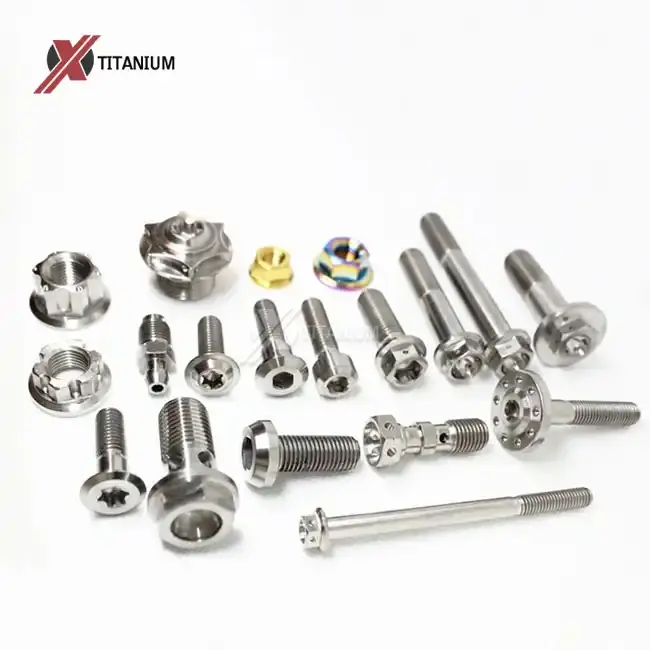
We sell these main kinds of Gr5 titanium motorcycle bolts:
- CNC machining and custom standards: A CNC machine makes each bolt from a sample or drawing you give us. We have sizes from M6 to M12, and we can also make sizes that you need. Please describe the bolt's head shape, length, and threads so that it can fit the original part or your own design.
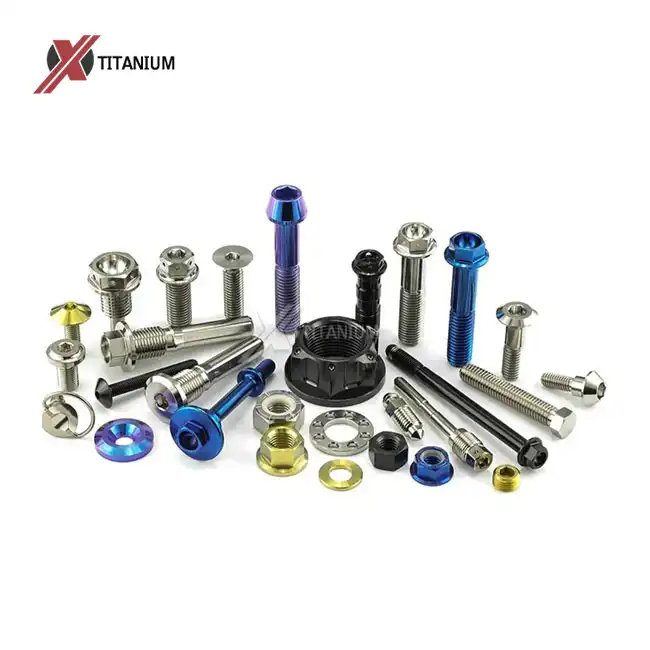
- Surface treatment: Things get smooth and shiny when they are polished. As the anodizing process goes on, a small layer of oxide is formed. This layer's thickness gives it its color, and nitriding makes the surface harder so it doesn't break. Some bolts are only there to look good, while others are taken off a lot. Each type of bolt needs different care.
- Color range: It comes in rainbow, blue, green, purple, black, gold, and blue. You should agree to a sample before we make a lot of them because the color of anodized depends on how thick the oxide is and how the surface is. The minimum order quantity can change based on what the customer wants. Items can be packed one at a time or in large groups.
This lets a brand get many types of goods from the same source that fit, look good, and cost right.
Real-World Lifespan of Gr5 Titanium Motorcycle Bolts in Everyday Riding
Why One Mileage Number Does Not Exist
The joint lasts for a certain amount of time, not just the metal. The covered bolt on your commuter bike doesn't get used very often, but the handlebar clamp bolt gets bent and shaken a lot. John Bickford's work on threaded joints shows that a steady clamp load can keep the parts in place as long as the preload is correct. The load moves more when the bolt is loose, though. You get hurt on the swings. That's why I judge life by the inspection records, which show where the Gr5 titanium motorcycle bolts are and how tight they are. When it's outside, titanium doesn't rust, so a bolt that stays in place and isn't broken can last for years.
Torque, Galling, and Thread Condition
When you press two threads together, they can tear. It's called galling. If you tighten it up quickly, the threads will get hot because titanium doesn't let heat move very well. The high contact pressure can also break the oxide film. Because galling hurts threads and makes them hard to take off, it shortens their lives. Nitriding it is an even better way to keep it safe. For less risk, use clean threads, a slow closing speed, and the right anti-seize. When friction is low, the clamp load goes up while the torque stays the same. Don't change the torque value because your manual doesn't say whether it's for dry or oiled parts. Instead, ask the company that made the manual.
Corrosion, Road Salt, and Aluminum Contact
Because Ti-6Al-4V titanium doesn't mix with chlorides, road salt and air from the coast don't usually damage the bolt's body. Most of the time, the weak spot is the metal around it. Titanium is not as durable as aluminum, so if the two touch in a salty, wet place, the aluminum may rust faster. Steel is often used to make engine cases, swingarms, and triple clamps. The threads are safe because they have a thin layer of anti-seize on them and are cleaned often. If you ride your bike in the winter, wash it afterward because dirt that holds water can damage the clutch. Tiny bits of oxide are what give the anodized color. It can come off at the head with your tool.
Lifespan by Bolt Location
Fairing and Bodywork Bolts
These nuts hold the least amount of weight, so they last the longest. Being tired is not as likely to hurt you right away as dealing is. Most of the time, people cross-thread, over-tighten into plastic, miss grommets, and take it off a lot to clean or take care of the chain. Since they are made of titanium, these Gr5 titanium motorcycle bolts won't rust. A polished or anodized head makes them look expensive, which is what many brands want. Read the work directions while the torque wrench is set to a low setting. Many covered parts don't need a lot of force, so this is the case. Check to see if the holes are getting round when you take off a bolt. If so, change the ones with broken threads.
Engine Cover and Exhaust Bolts
Bolts have to deal with wind, oil, and heat. Ti-6Al-4V stays strong up to about 752°F (400°C). It's hot enough for a lot of brace and cover spots. Make sure you check or measure the temperature of the joint where it meets the cylinder head before you change the materials. The set-up can change as the engine wakes up and cools down. Titanium, aluminum, and steel all grow at different speeds. Check the torque again after the first round of heating. Check for thread wear, stains, and coming loose every time you clean it. When the temperature is used to rate the anti-seize, it's easier to take off and less likely to hurt.
Brake, Axle, Handlebar, and Suspension Bolts
Because these joints are dangerous, I take a different approach to working with them. You can buy parts for the brakes, calipers, frame, and suspension. Still, a material swap in these places needs to be approved by the motorcycle maker or looked over by an engineer. A lot of original bolts are made of high-strength steel and are all the same class, length, and thread engagement. Titanium, on the other hand, is not as stiff, which changes how the joint is filled. Connect with the right amount of power and force. Check for cracks, thread wear, and heat marks often. When a bolt has been in a crash, overloaded, or used too many times, you can't be sure of its load history. It's better to get a new one.
Gr5 Titanium vs Steel, Stainless Steel, and Aluminum Motorcycle Bolts
Titanium vs High-Strength Steel
A lot of original parts are still made from high-strength steel. As per ISO 898-1, that's the least force that can be used to separate Class 10.9 steel. ASTM B348 says that Grade 5 bar must have a minimum of 895 MPa. That's not all. Most of the time, steel screws are cheaper and stronger. Titanium is lighter and less likely to rust than any other metal. It weighs about 44% less than something the same size. I agree with the designer if they say that heavy-duty parts should be made of steel. Load tests show that Gr5 titanium motorcycle bolts can be used in places that are sensitive to weight and rust as long as the change is okay.
Titanium vs Stainless Steel
It's easy to find steel that doesn't rust. A2-70 stainless steel nuts made to ISO 3506 must have a tensile strength of at least 700 MPa. This is not strong enough for Grade 5 (895 MPa bar). Titanium is about 45% lighter than steel, since steel has a mass of about 8 g/cm³. Steel also gets galls, so it also needs anti-seize. The bolt is lighter and has a unique look that goes with a line of high-end goods because it is made of titanium metal. To begin, stainless steel makes gear that looks good cheap.
Titanium vs Aluminum
Aluminum bolts are lighter. Alloy 7075 is only about 2.8 g/cm³ dense, while Ti-6Al-4V is 4.43 g/cm³ dense. The trade-offs are strength and power to hold weight. Aluminum heads and threads break more quickly when they are taken off and put back on. So, riders use it to cover light bulbs and make other small parts that are just for looks. You can heat, squish, and pull titanium over and over again, and it will last longer. When picking out a material, you shouldn't just go by one number on a sheet. Its temperature, weight, price, and the joint as a whole are also things you should think about.
Installing, Choosing, and Buying Gr5 Titanium Motorcycle Bolts
Installation and Inspection Routine
Check the bolt and the hole that was tapped for burrs and other junk. If you need to, use the right anti-seize. To tighten, you should use a torque wrench that has been calibrated and a steady, moderate speed. If you don't want to get hot or hurt, don't use contact tools. When you service it, look for cracks, issues with the smooth drive, thread warping, and color changes from too much heat. You should get new nuts if any of them are broken or have been over-stressed in the past. People who ride on tracks should make it easy to remember when they check the power.
Choosing Size, Head Style, and Finish
Make sure that the diameter, thread pitch, length, and thread engagement of your Gr5 titanium motorcycle bolts are all the same as the original part or the instructions from the manufacturer. Socket heads, flange heads, button heads, and hex heads all clamp tools in different ways and have different ways to get to them. Before you order, make sure there is enough space. You can get the best fit if the seller tells you the thread tolerance class, such as 6g for external threads. Pick a style that works for you, whether you want something to look good, be colored, or be easy to take off. Workshops should get mixed-up sets and stores that sell things should get kits that are made just for that model.
Buying From a Titanium Manufacturer
The most important thing about buying something is that it is real and that each batch is the same. Ask for proof of the Ti-6Al-4V grade, the standard that was used, the maximum size and shape, thread specifications, details on the surface treatment, and inspection records. Since 2006, Chuanglian has lived and worked in Baoji, which is known as the "City of Titanium," studying and making titanium. Twelve CNC tools are used to check every step of the process, from the raw materials to the finished goods. Our titanium goods are used in lots of different fields, like health, space flight, and racing. Make sure you like the fit, finish, and color of the samples before you start making the whole thing. Next, look at a test order and see how it matches up with the examples.
Conclusion
It's not always true that Gr5 titanium motorcycle bolts will last a certain amount of time. What kind of joint it is, how much torque, galling, vibration, temperature, and environment it is in all affect how long it lasts. Ti-6Al-4V is about 44% lighter than steel, and it doesn't rust on the road or in the rain. That is, a bolt generally stops working before it rusts. When it comes to most things, fairing bolts last the longest. The bolts on the engine and exhaust should be checked with heat. The brake, axle, handlebar, and suspension bolts should all be approved by the maker, and they should be checked often. In some places, steel that is very strong can still hold more weight than titanium or steel. Use the right amount of torque, anti-seize, and clean threads on the bolt to keep it safe. Also, check it often. Making sure that records of materials are checked and that machining is always done the same way help quality when there are a lot of sales.
FAQ
Q1: How often should I replace Gr5 titanium motorcycle bolts?
A: There's not a set amount of time between them. You should get a new one if your Gr5 titanium motorcycle bolts have cracks, broken threads, rounded drive features, heat damage, or the same bolt keeps coming loose. It also needs to be changed after a crash or too much use. Always check the force and follow the manufacturer's plan for key parts when you fix it.
Q2: Do titanium bolts need anti-seize?
A: It does work in most threaded joints. This makes it easier to take things off and less painful to grind your teeth. Find out from your manual whether the torque number is for threads that are dry or oily. If the stuff doesn't say to, don't mix it with threadlocker.
Q3: Can I replace steel brake or axle bolts with titanium?
A: Not unless the person who built the bike or a trained engineer says it's okay. When you get a new bolt, it's always the same length, strength class, and thread engagement. Titanium isn't as stiff, though, which changes how joints work. A safer place to start is with cover bolts and coverings for looks.
Request Samples of Gr5 Titanium Motorcycle Bolts From Chuanglian
Because Chuanglian lives in Baoji, which is called the "City of Titanium," he has worked with titanium for over ten years. Besides that, he has twelve CNC tools. There are a lot of different styles and sizes of Gr5 titanium motorcycle bolts, including gold, blue, green, purple, black, and rainbow. More than that, we can polish, anodize, and nitride them. To get a quote review, send your drawing, sample, or specs to info@cltifastener.com or djy6580@aliyun.com.
References
1. ASTM International, ASTM B348/B348M: Standard Specification for Titanium and Titanium Alloy Bars and Billets, 2019.
2. ASM International, Materials Properties Handbook: Titanium Alloys, 1994.
3. Matthew J. Donachie, Titanium: A Technical Guide, 2nd Edition, ASM International, 2000.
4. John H. Bickford, Introduction to the Design and Behavior of Bolted Joints, 4th Edition, CRC Press, 2007.
5. Richard T. Barrett, Fastener Design Manual, NASA Reference Publication 1228, 1990.
6. International Organization for Standardization, ISO 898-1: Mechanical Properties of Fasteners Made of Carbon Steel and Alloy Steel, 2013.

Learn about our latest products and discounts through SMS or email