- English
- French
- German
- Portuguese
- Spanish
- Russian
- Japanese
- Korean
- Arabic
- Greek
- German
- Turkish
- Italian
- Danish
- Romanian
- Indonesian
- Czech
- Afrikaans
- Swedish
- Polish
- Basque
- Catalan
- Esperanto
- Hindi
- Lao
- Albanian
- Amharic
- Armenian
- Azerbaijani
- Belarusian
- Bengali
- Bosnian
- Bulgarian
- Cebuano
- Chichewa
- Corsican
- Croatian
- Dutch
- Estonian
- Filipino
- Finnish
- Frisian
- Galician
- Georgian
- Gujarati
- Haitian
- Hausa
- Hawaiian
- Hebrew
- Hmong
- Hungarian
- Icelandic
- Igbo
- Javanese
- Kannada
- Kazakh
- Khmer
- Kurdish
- Kyrgyz
- Latin
- Latvian
- Lithuanian
- Luxembou..
- Macedonian
- Malagasy
- Malay
- Malayalam
- Maltese
- Maori
- Marathi
- Mongolian
- Burmese
- Nepali
- Norwegian
- Pashto
- Persian
- Punjabi
- Serbian
- Sesotho
- Sinhala
- Slovak
- Slovenian
- Somali
- Samoan
- Scots Gaelic
- Shona
- Sindhi
- Sundanese
- Swahili
- Tajik
- Tamil
- Telugu
- Thai
- Ukrainian
- Urdu
- Uzbek
- Vietnamese
- Welsh
- Xhosa
- Yiddish
- Yoruba
- Zulu
How Strong Is Titanium Compared to Other Metals?
Titanium is one of the most amazing metals used in modern engineering, especially when it is made into titanium forgings, which are parts that are made by controlled bending under compression at high temperatures. Titanium is strong enough to be used in construction, but it's lighter and less expensive than steel. Its tensile strength ranges from 63,000 psi for widely pure types to over 180,000 psi for advanced alloys like Ti-6Al-4V. Titanium forgings are needed for parts of airplane engines, tools used for digging deep underwater, and medical implants that need to work well even when they are under a lot of pressure. In addition to its high strength, titanium's polished grain structure, which is achieved by forging, makes it more resistant to wear and more difficult to break than stainless steel in situations where it is loaded and unloaded many times.
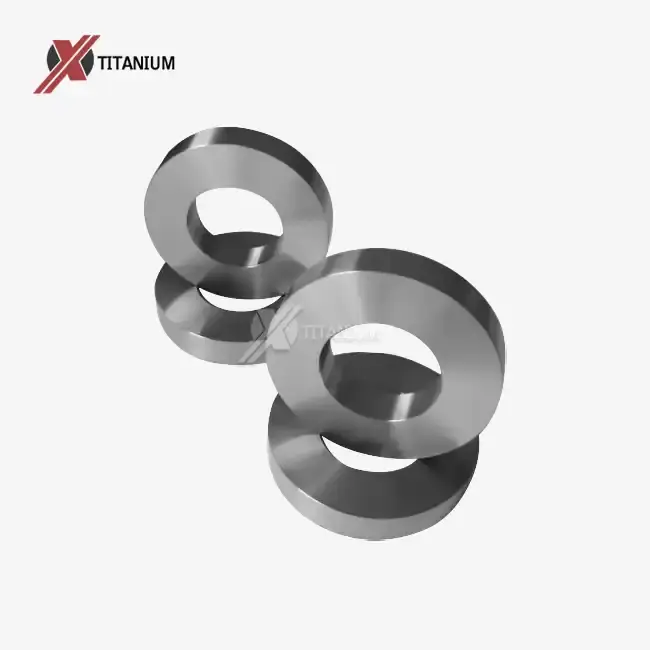
Understanding Titanium Forgings and Their Strength
The Forging Process and What Makes It Different
In order to make forged titanium parts, huge compression forces must be applied to a hot titanium billet in the form of punching, pressing, or rolling for the desired shape. Casting, in which liquid metal fills a frame, is very different from this process. During forging, the metal's internal grain structure lines up along the shape of the part, making paths of greatest strength right where the mechanical loads will be during service. This grain flow optimization solves a very important problem that procurement engineers have to deal with: it gets rid of the mechanical porosity and microcracking that happen in cast parts and can cause them to fail catastrophically in safety-critical applications.
Key Titanium Grades and Their Mechanical Properties
Grade 5 titanium alloy, which is actually called Ti-6Al-4V, is the most common type used in industrial forging because it has the best mix of strength, workability, and heat treatability. This alpha-beta metal has tensile strengths of between 130,000 and 180,000 psi, based on how it is heated. It is made up of 6% aluminum and 4% vanadium. The aluminum stabilizes the alpha phase, which makes it stronger and more resistant to rust. The vanadium stabilizes the beta phase, which makes it more flexible and easy to shape.
Commercially pure titanium grades (Grades 1-4) are not as strong but are very resistant to rust and biocompatible, which makes them perfect for medical devices and tools used in chemical processing. Titanium alloys usually have a value of elasticity of 16.5 million psi, which is about half that of steel. This means that they don't shield against stress as well in orthopedic implants and are more flexible than steel in aircraft structural parts.
How Heat Treatment Enhances Forged Titanium Performance
The final mechanical qualities of titanium parts are greatly affected by the heat process that happens after they are forged. When Ti-6Al-4V forgings are treated with a solution and then aged, the yield strength can go up by 20–30% compared to when they are annealed. During forging, the microstructure and features are determined by the temperature range chosen.
This can be below the beta transus (alpha-beta forging) or above it (beta forging). Alpha-beta forging keeps the two-mode microstructure that balances strength and flexibility, while beta forging changes the structure to make it more resistant to breaking. These metallurgical controls let makers change the qualities of parts to meet specific operating needs. For example, they can focus on wear life for rotor discs or fracture resistance for parts in pressure vessels.
Industry Applications Demanding Superior Strength
Forged titanium is used by aerospace makers for landing gear cylinders, engine bulkheads, and turbine parts that need to be able to handle high-cycle wear at temperatures ranging from below zero to over 800°F in engine exhaust. Forgings have a polished grain structure that makes them resistant to cracks spreading. This is important for parts that will be stressed millions of times during their service life.
In underwater stress joints and blowout preventer stacks used in offshore oil and gas operations, titanium forgings are used in settings with high pressures (over 15,000 psi) and corrosive seawater, where regular steels break down quickly. For hip stems and knee parts, medical device makers use forged titanium because the forging process gets rid of metallurgical flaws that could act as places where wear cracks start in the body.
Comparing Titanium Forgings with Other Metals
Titanium Versus Aluminum: Strength and Weight Trade-offs
But titanium is better in challenging situations than aluminum alloys, even though aluminum alloys are easier to work with and cost less. Tensile strengths of the best aluminum alloys are only about 80,000 psi, which is less than half of Ti-6Al-4V's strength. Titanium, on the other hand, stays strong at temperatures where aluminum starts to soften a lot. Common aluminum alloys only keep 50% of their room temperature strength at 400°F, but titanium metals stay structurally sound above 900°F.
Titanium is about 60% heavier than aluminum because it has a lower density (0.16 lb/in³ vs. 0.10 lb/in³), but because it is stronger, it can be made into smaller pieces that are just as or more efficient as aluminum. When flight engineers divide the tensile strength by the density, they get the strength-to-weight ratio. Titanium always does better than aluminum in situations where the highest load-bearing capacity has to be reached while staying within strict weight limits.
Titanium Versus Stainless Steel: Corrosion Resistance and Durability
Tensile strengths of stainless steel types like 316 and 17-4 PH are about the same as those of titanium alloys. Some precipitation-hardened steels can even go over 200,000 psi. The main difference shows up in corrosive settings, where titanium's inactive oxide layer protects against damage almost completely. Titanium is completely resistant to chloride stress corrosion cracking, which is a way that stainless steels fail in chemical processes and saltwater environments.
Titanium metals don't corrode much after decades of being exposed to seawater, but even high-quality stainless steels need coats or cathodic protection to keep them from rusting. When steel is replaced with titanium, the weight cost gets big. Steel is about 75% heavier than titanium for the same volume because it has a density of 0.28 lb/in³. This loss in weight makes titanium a popular choice for mobile equipment, aerospace structures, and offshore platforms where less mass directly means better fuel economy, longer range, or more payload capacity.
Forged Versus Cast Titanium: Why Processing Method Matters
Casting titanium can save you money on complicated shapes and small production runs, but the changes to the material's mechanical properties make them unsuitable for important parts. Because the grains are bigger and there are always tiny holes in titanium, cast titanium has 20 to 30 percent less tensile strength than formed titanium. The forging process breaks up the as-cast branching structure and makes small, evenly spaced grains that give the metal better flexibility and toughness.
When checking for fatigue, the biggest difference is seen: forged titanium parts have fatigue limits that are 40–50% higher than molds. This means that they will last longer when loaded and unloaded many times. Forgings are better for quality assurance engineers than casts because the combined microstructure gets rid of internal flaws that can't be found with non-destructive testing. This lowers the risk of failures in the field in safety-critical applications.
Hot Forging Versus Cold Forging Techniques
When hot forging is done at temperatures between 1600°F and 1950°F, based on the material, it is possible to deform the metal more and make more complicated forms with less tooling force. The higher temperature makes titanium more flexible while also making it less likely to crack when it is deformed. When you do cold forging below the recrystallization temperature, you get parts with better surface finish and tighter limits on size. This means that you don't have to do as much cutting afterward.
Titanium isn't very flexible at room temperature, though, so cold forging can only be used for simple shapes and small deformation ratios. Most industrial titanium forgings are made using hot or warm forging methods, where temperatures are carefully kept in check to keep certain phase ratios. As a key point, the beta transus temperature (1830°F for Ti-6Al-4V) is important. Forging just below this temperature keeps the alpha-beta microstructure that finds the best balance between strength and flexibility.
Benefits and Advantages of Choosing Titanium Forgings
The mechanical benefits of titanium forgings go beyond just high strength and include a thorough performance profile that lowers the total cost of ownership over the duration of the product. When you look at running costs, repair intervals, and service life extension, these benefits become even more clear.
Exceptional Strength-to-Weight Ratio Driving Performance
When you split the tensile strength by the density, you get the specific strength of Ti-6Al-4V forgings, which is about 1.1 million inches. This is higher than both aluminum alloys and stainless steels in this important way. This benefit is immediately seen in aircraft, where lowering the weight of a rotating machine part by one pound can save 10 to 20 pounds on fuel and supporting structure.
Forged titanium is used by racing teams for connecting rods, valves, and suspension parts because it has less moving mass, which makes acceleration and control better. Titanium's high strength-to-weight ratio helps marine engineers build submarine cars that can go deeper underwater while still remaining buoyant. It's easy to measure the performance improvements: switching from steel landing gear parts to titanium forgings can cut the weight of an airplane by 30–40% while keeping the same safety limits.
Corrosion Resistance Reducing Lifecycle Costs
Titanium's passive oxide film heals itself instantly when it gets broken, so there's no need for protective coatings, cathodic protection systems, or rust allowances in design estimates. Titanium heat exchanger parts last 25 to 30 years, while coated steel parts only last 5 to 7 years in chemical processing plants that work with acids, alkalis, and chlorine environments. Offshore bases that use titanium forgings for important structural parts don't have to pay for the inspections and upkeep that are needed to keep an eye on corrosion and fix it.
The higher original cost of the material—usually 8–15 times that of stainless steel per pound—is justified when replacement costs, downtime costs, and the risk of severe corrosion failures are taken into account. More and more, procurement managers are realizing that the cheapest option isn't always the most cost-effective option over the life of the tools.
Fatigue Strength and Durability in Cyclic Loading
Controlled forging methods create a fine grain structure that makes it very difficult for cracks to start and spread under cycle loading conditions. When Ti-6Al-4V forgings are put through high-cycle fatigue tests, they show durability limits that are close to 60% of their maximum tensile strength. This is a lot higher than for cast alloys or welded assemblies. Forged titanium turbine engine parts usually last between 20,000 and 30,000 hours of use before they need to be replaced.
Parts made of other materials would need to be inspected more often and be retired earlier. The wear performance is especially useful in situations where the amount of the load changes, because random changes in stress speed up the growth of cracks in materials that don't have the best microstructures. Fracture mechanics tests show that forged titanium has a much lower rate of crack growth per stress intensity cycle than other materials. This gives it more safety gaps and an expected life span for the part.
Compliance with Industry Standards and Certifications
Aerospace makers need material certifications that meet AMS (Aerospace Material Specifications) standards and test records that can be linked to individual heat lots. Medical device makers want to make sure that the quality system meets ISO 13485 standards and ASTM F136 and ASTM F67 standards. Forged titanium suppliers who keep their AS9100 approval show that they use controlled methods for testing without damaging the material, making sure the dimensions are correct, and tracking down the source.
Customers in the chemical processing industry require parts that are exposed to sour gases to meet NACE MR0175 standards. These strict certification standards make it very hard for new companies to get in. This makes sure that only qualified providers have the technical know-how, testing tools, and quality systems they need to keep making consistent, reliable goods. When purchasing teams look at possible partners, they should check not only the supplier's certifications but also their experience with similar projects and their ability to provide full material test reports that include chemical composition analysis, mechanical property testing, and grain size verification.
Procurement Considerations for Titanium Forgings in Global B2B Markets
Selecting the Appropriate Titanium Grade for Your Application
When deciding which material to use, you have to weigh the material's mechanical properties, its resistance to environmental factors, and its processing qualities against its cost and transport needs. Ti-6Al-4V is the most common type of titanium used when maximum strength and middling corrosion protection are needed. It makes up about half of all titanium produced in the world. Commercially pure grades (CP Ti Grade 2) are better for chemical processing equipment that doesn't need to be very strong because they are easier to shape and don't rust.
Greater-strength alloys, such as Ti-6Al-6V-2Sn or Beta-C, work better in certain aircraft uses, but they cost more and take longer to get. Technical buying teams should work with suppliers early in the planning process to make the best choices about materials. Making changes after the tools are made can cost a lot and cause delays in the schedule. Suppliers can suggest the most cost-effective option if you give them particular information about the working temperatures, stress levels, environmental exposure, and service life that you need.
Evaluating Supplier Capabilities and Certifications
Technical problems make it hard to make high-quality titanium forgings, so there aren't many suppliers around the world whose skills have been checked. Aerospace-qualified providers keep their AS9100 approval, which shows that they follow controlled procedures for tracking, inspecting, and documenting. To get into the U.S. market with medical devices, they need to be registered with both ISO 13485 and the FDA as a business. Aside from a supplier's certifications, buying workers should also look at their tools, such as the size of their forge presses, heat treatment furnaces, and non-destructive testing facilities.
When compared to suppliers who outsource important verification tasks, those who have their own chemical analysis and mechanical testing labs offer faster response times and better process control. Lead times and logistics costs are affected by where the manufacturing takes place. For example, Chinese suppliers usually have prices that are 15-20% lower than Western makers, but they may need longer shipping times and more difficult communication planning. U.S. and European manufacturers are close to aircraft customers who need to work together on technical issues often and make changes to prototypes quickly.
Understanding Pricing Structures and Lead Time Expectations
Titanium forging prices are affected by many factors, such as the type of raw material used (titanium sponge or billet), the forging process, the heat treatment, the machining, the tests, and the quality paperwork. Forgings made of Ti-6Al-4V can be bought on the market for anywhere from $15 to $30 per pound for basic forms to $50 to $80 per pound for complex near-net geometries with tight tolerances. Usually, the smallest order size is between 50 and 100 pieces for simple shapes.
For complicated closed-die forgings, where tooling costs are the most important factor in cost, the smallest order size may be between 500 and 1000 pieces. Lead times are very different depending on whether standard or custom casting is needed. Stock forms can ship within 4 to 6 weeks, but custom forgings that need new dies can take 16 to 20 weeks from the time the order is placed until it is delivered. The longest-lead factor is the supply of raw materials, since the world capacity limits for making titanium sponges and ingots are getting close to full. By setting up blanket purchase orders with planned releases, sellers can keep an inventory of raw materials and cut down on the time it takes to fill each order.
Partnering with Baoji Chuanglian for Reliable Titanium Solutions
Baoji Chuanglian New Metal Material Co., Ltd. has a lot of experience buying titanium forgings because it is located in Baoji, which is known around the world as the "City of Titanium." We have been processing titanium for over ten years and have experience with the whole supply chain, from choosing the materials to delivering the finished parts. We can do all kinds of machining because we have more than a dozen CNC machines that can handle complicated shapes and close limits, which means you don't have to do as many extra steps.
Our quality control procedures make sure that all of our materials are the same by checking each batch very carefully and keeping full records that meet international standards for medical and aircraft use. We have provided titanium parts to petrochemical plants, naval structures, medical device makers, and military projects that needed them to work well in tough conditions. Our expert team makes suggestions based on your unique needs in order to find the best material grades, forging parameters, and heat treatment methods. Customers in North America, Europe, and the Asia-Pacific markets have become long-term partners because of our competitive prices and reliable service.
Conclusion
Titanium has a unique strength profile compared to other engineering metals. It has tensile strengths similar to high-grade steels but is only about half as heavy. It also has great corrosion protection in harsh conditions. The forging process builds on titanium's natural benefits by making finer grain structures that make safety-critical parts more resistant to wear and maintain their structural integrity. Titanium forgings enhance these properties, ensuring even greater durability and strength. Titanium is more expensive than aluminum and stainless steel, but its higher strength-to-weight ratio, ability to last in harsh environments, and lower lifetime costs make it worth it for challenging uses. To successfully purchase something, you need to be very careful about the material grade you choose, the skills of the seller, and the lead time you expect. You should also work with experienced makers who know how to handle titanium technically.
FAQ
Q1: How does titanium's tensile strength compare to stainless steel?
A: Tensile strengths of 130,000 to 180,000 psi are reached by forming Ti-6Al-4V. These are about the same as 316 stainless steel at 75,000 to 90,000 psi and 17-4 PH stainless steel at 190,000 psi. The most important benefit is the strength-to-weight ratio. Titanium has the same load-bearing ability but is about 40% lighter, which makes it better for uses that care about weight, even though it costs more.
Q2: Why are forged titanium components superior to cast versions?
A: Forging the metal together automatically fills in any holes inside it and creates directional grain flow, which makes it 20–30% stronger and increases its fatigue life by 40–50% compared to casts. The microstructure has been improved to provide reliable mechanical qualities that are needed for safety-critical uses in medical and aircraft devices.
Q2: What are typical lead times for custom titanium forgings?
A: Standard shapes that use current tools usually take 6 to 8 weeks to deliver from the time of order. Custom components requiring new die development extend to 16–20 weeks to make, with getting the raw materials taking the longest time. Setting up planned releases under blanket purchase orders cuts the time it takes to get the next order by a large amount.
Partner with a Trusted Titanium Forgings Manufacturer
Baoji Chuanglian New Metal Material Co., Ltd. has a wide range of professional skills and quality methods that have been shown to work, so they are ready to help you with your titanium forging needs. Our research team works with customers from the time they choose the materials to the time they test the final parts to make sure they work perfectly for your purpose. We follow strict quality standards that are in line with international standards for aircraft, medicine, and industry.
We include full traceability paperwork with every shipment. Our low prices come from using efficient production methods and smart relationships with raw materials, so we can offer value without sacrificing quality. You can email our expert sales team at info@cltifastener.com or djy6580@aliyun.com to talk about the needs of your project, ask for material certifications, or get specific quotes. You can look at all of our products, such as titanium bars, plates, tubes, fasteners, and special made parts, Chuanglian is a well-known company that makes titanium forgings and sells them all over the world. They can give your projects the dependability, technical know-how, and steady quality they need.
References
1. Donachie, M.J. (2000). Titanium: A Technical Guide, 2nd Edition. ASM International, Materials Park, Ohio.
2. Boyer, R., Welsch, G., and Collings, E.W. (1994). Materials Properties Handbook: Titanium Alloys. ASM International.
3. Lütjering, G. and Williams, J.C. (2007). Titanium, 2nd Edition. Springer-Verlag, Berlin Heidelberg.
4. Semiatin, S.L. and Ivasishin, O.M. (2000). "Fundamentals of Titanium Processing," Materials Technology: Advanced Performance Materials.
5. Cotton, J.D., Briggs, R.D., Boyer, R.R., et al. (2015). "State of the Art in Beta Titanium Alloys for Airframe Applications," JOM Journal of the Minerals, Metals and Materials Society, Vol. 67, No. 6.
6. Veiga, C., Davim, J.P., and Loureiro, A.J.R. (2012). "Properties and Applications of Titanium Alloys: A Brief Review," Reviews on Advanced Materials Science, Vol. 32, pp. 133-148.
Learn about our latest products and discounts through SMS or email