- English
- French
- German
- Portuguese
- Spanish
- Russian
- Japanese
- Korean
- Arabic
- Greek
- German
- Turkish
- Italian
- Danish
- Romanian
- Indonesian
- Czech
- Afrikaans
- Swedish
- Polish
- Basque
- Catalan
- Esperanto
- Hindi
- Lao
- Albanian
- Amharic
- Armenian
- Azerbaijani
- Belarusian
- Bengali
- Bosnian
- Bulgarian
- Cebuano
- Chichewa
- Corsican
- Croatian
- Dutch
- Estonian
- Filipino
- Finnish
- Frisian
- Galician
- Georgian
- Gujarati
- Haitian
- Hausa
- Hawaiian
- Hebrew
- Hmong
- Hungarian
- Icelandic
- Igbo
- Javanese
- Kannada
- Kazakh
- Khmer
- Kurdish
- Kyrgyz
- Latin
- Latvian
- Lithuanian
- Luxembou..
- Macedonian
- Malagasy
- Malay
- Malayalam
- Maltese
- Maori
- Marathi
- Mongolian
- Burmese
- Nepali
- Norwegian
- Pashto
- Persian
- Punjabi
- Serbian
- Sesotho
- Sinhala
- Slovak
- Slovenian
- Somali
- Samoan
- Scots Gaelic
- Shona
- Sindhi
- Sundanese
- Swahili
- Tajik
- Tamil
- Telugu
- Thai
- Ukrainian
- Urdu
- Uzbek
- Vietnamese
- Welsh
- Xhosa
- Yiddish
- Yoruba
- Zulu
Industrial Uses for Titanium-Clad Copper Bus Bars
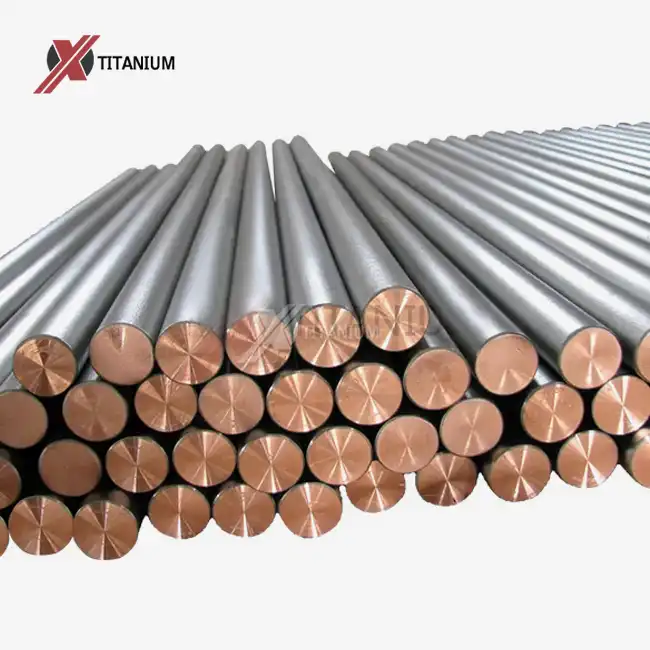
Titanium clad copper bar technology represents a revolutionary advancement in industrial electrical infrastructure, combining copper's exceptional conductivity with titanium's superior corrosion resistance. These composite materials serve critical roles across multiple high-demand industries, from aerospace manufacturing to renewable energy systems, where traditional copper solutions fail to meet stringent performance requirements under harsh operating conditions.
Comprehending Titanium-Clad Copper Bus Bars: Properties and Advantages
The Science Behind Composite Bus Bar Technology
Titanium-clad copper bars are made by using explosion bonding or hot rolling to join a titanium layer that doesn't rust to a copper core that conducts electricity well. This way of making things makes an atomic-level link that keeps the electrical qualities of copper and gives titanium its chemical stability. The final combination material usually keeps more than 98% of copper's natural conductivity while making it much more resistant to rust in harsh settings.
The titanium and copper layers are bonded together with more than 130 MPa of force, which guarantees steady performance even when temperatures change and the structure is stressed. The normal thickness of the cladding is between 1 mm and 2 mm. This gives even protection against galvanic rust while keeping the current flow through the copper core at its best.
Superior Performance Characteristics
Materials that can stand up to harsh conditions and still work electrically well are needed in many modern industrial uses. Titanium-clad copper bus bars solve the basic problem that engineers have been trying to solve for decades: how to make conductivity and rust protection work together. Pure copper has great electrical qualities, but it melts quickly in environments that are acidic, alkaline, or high in salt, which can contaminate the process and cause equipment to break down often.
The titanium covering acts as a shield, keeping the copper core safe from the electrolyte while still letting current flow smoothly. The skin effect principle is used in this design. The titanium layer on the outside stops rust, and the copper layer inside keeps the electrical resistance low.
Industrial Uses and Applications of Titanium-Clad Copper Bus Bars
Electrochemical and Hydrometallurgical Industries
Applications for titanium-clad copper bars are mostly found in heavy businesses that use electrolytic processes. In the electrowinning process for copper, zinc, and cobalt, these bus bars sit right on top of sulfuric acid mist and electrolyte splashes and act as hanger bars and cathode beams. The titanium shield keeps copper from getting into the cathode layers and makes sure that the current density is the same across all electrowinning cells. This increases the metal yield and process efficiency.
These hybrid conductors are used in chlor-alkali production plants for membrane cell electrolysis. Regular materials would break down quickly when exposed to wet chlorine gas and highly toxic anolytes. The titanium surface is chemically neutral, so it keeps the high conductivity needed for making chlorine and caustic soda while also keeping the membrane from getting clogged.
High-Precision Electronics Manufacturing
The semiconductor and printed circuit board manufacturing sectors require absolute chemical purity in their electroplating processes. Even trace copper ion pollution from corroding bus bars can compromise circuit integrity and product reliability. Titanium clad copper bar solutions serve as anode supports in acid copper plating baths, providing stable, ripple-free DC current delivery while maintaining complete chemical inertness.
These applications demand exceptional precision and consistency, as micro-structure plating requires uniform current distribution and contamination-free environments. The metallurgical bond between titanium and copper ensures no delamination or exposure of the copper core during operation.
Power Distribution and Electrical Infrastructure
Titanium-clad copper bus bars are being used more and more in electrical power distribution systems like switches, transformers, and control screens when regular materials don't work well enough. These uses especially benefit from the better resistance to heat and rust in coastal settings, chemical processing plants, and outdoor sites that are exposed to harsh weather. The car and green energy industries have grown a lot recently. For example, solar power setups and battery systems for electric vehicles need stable, long-lasting electricity links. Titanium coating is especially good for wind power equipment that is used near the coast because it resists rust.
Comparing Titanium-Clad Copper Bus Bars with Alternative Materials
Performance Analysis Against Traditional Solutions
Engineers have to weigh the conductivity, rust protection, mechanical strength, and lifetime prices of different bus bar materials. Pure copper has great electrical qualities, with conductivity values around 100% IACS. However, it is easily corroded, which limits its use in harsh settings. Copper options with an aluminum shell are cheaper, but they don't last as long or be as reliable over time. Copper that is covered in stainless steel is better at resisting rust than pure copper, but it is not nearly as good at conducting electricity. Copper and stainless steel don't have the same thermal expansion rate, which can also cause bonding problems when the temperatures change.
Economic and Operational Advantages
Titanium clad copper bar technology addresses these limitations by maintaining copper's electrical performance while providing titanium's chemical stability. The explosion bonding manufacturing process creates a permanent metallurgical bond that withstands thermal cycling without delamination, despite different thermal expansion coefficients between titanium and copper.
Energy efficiency improvements often range from 10-20% in electrolysis operations compared to graphite or stainless steel electrodes. The reduced cell voltage requirements translate directly to lower operating costs and improved process economics over the equipment lifecycle.
Procurement Guide for Titanium-Clad Copper Bus Bars
Supplier Evaluation and Quality Standards
When you buy something, you should only deal with companies that can show that they have full quality control systems and foreign certifications. If you follow the rules in ASTM B898 for reactive and refractory metal covered plates, the materials will keep their properties and work as they should. More rules for making sure that metal links are strong can be found in the GB/T 12769 standards. The 100% metallic joining area must be proven by ultrasound tests as a matter of course in the business world. This keeps the area from getting too hot or too big while the business is running. As a supplier, you should get detailed mill test papers that show how thick the titanium is, how well it bonds, and how well it conducts electricity.
Technical Specifications and Customization
Standard goods have titanium coatings that are between 1.0 mm and 2.5 mm thick, but custom specs can be made for certain uses. The copper used in the core should be at least 99.9% pure and meet the requirements of ASTM B170 for oxygen-free copper. To make sure the strength of the bond stays the same over time, stress tests should show that it is stronger than 130 MPa. People who are in charge of buying things should ask sellers what kinds of customization they offer, such as different size limits, different surface finishes, and different ways of putting things together. It takes between 6 and 12 weeks to make custom goods, but this relies on how difficult the item is and how many are bought.
Best Practices and Tips for Incorporating Titanium-Clad Copper Bus Bars
Installation and Handling Procedures
Proper installation procedures are essential to maintain the integrity of titanium clad copper bar systems. Drilling or cutting operations require specialized equipment and techniques to prevent copper core exposure. Any modifications that breach the titanium cladding must be professionally sealed through titanium welding or capping procedures to prevent electrolyte ingress and subsequent delamination.
The rules for transporting and storing titanium should keep the surface from getting damaged mechanically. Scratches or hits that could weaken rust protection can be avoided with protective packing and careful handling. Controlling the installation area is important to keep it clean during the fitting process.
Maintenance and Lifecycle Management
As part of regular check plans, looking at the titanium surface helps find problems before they get in the way of the system's work. Hardware can last more than 10 years in difficult conditions if you take the right care steps. Bare copper, on the other hand, only lasts 3 to 6 months. Predictive maintenance systems that use electrical resistance tracking can find problems early on in the wear and tear process. This method prevents unexpected downtime and makes the best use of substitute plans that are based on current conditions instead of random time frames.
Conclusion
Titanium-clad copper bus bars are a major step forward in industrial electrical infrastructure. They solve the basic problems of conductivity vs. rust protection that have limited older materials. They are used in many high-demand fields, such as electrochemical processing and green energy systems, where they need to work reliably in difficult situations. The metallurgy welding method makes sure that the materials last a long time while still having the right electrical qualities for power transfer. As long as businesses want their electricity infrastructure to work better and last longer, these composite materials have been shown to be the best option. They are better in terms of technology and cost than other options.
FAQ
What is the expected lifespan of titanium-clad copper bus bars compared to traditional materials?
Properly manufactured titanium-clad copper bus bars are designed for service lives exceeding 10 years in aggressive environments, while bare copper bars may experience significant corrosion within 3-6 months under similar conditions. The titanium layer remains passive and intact throughout the service life, maintaining electrical performance and preventing copper contamination.
Can titanium-clad copper bus bars be modified on-site for specific installations?
On-site modifications are not recommended without specialized equipment and procedures. Cutting or drilling operations expose the copper core, requiring professional titanium welding or capping to reseal exposed areas. Improper modifications can lead to electrolyte ingress and system failure.
How does the titanium cladding affect overall electrical conductivity?
The titanium layer has negligible impact on electrical performance. Current flows through the path of least resistance, which is the copper core. The effective conductivity is calculated based on the copper core cross-sectional area alone, typically retaining over 98% of pure copper's conductivity rating.
What quality standards should be specified when procuring these materials?
Procurement specifications should include ASTM B898 compliance for clad plate standards, ultrasonic testing verification of 100% metallurgical bonding, and minimum shear strength requirements of 130 MPa. Mill test certificates should document titanium thickness uniformity and electrical conductivity measurements.
How can buyers verify titanium cladding thickness accuracy?
Beyond reviewing mill test certificates, buyers can inspect cross-sections of sample materials or use calibrated eddy current thickness gauges. Standard industrial cladding typically measures 1.0mm minimum, as thicknesses below 0.6mm risk puncture during handling or installation procedures.
Partner with Chuanglian for Superior Titanium Clad Copper Bar Solutions
Chuanglian New Metal Material Co., Ltd. stands as your trusted titanium clad copper bar manufacturer, leveraging over ten years of specialized experience in titanium product development and manufacturing. Our state-of-the-art facilities in Baoji City, renowned as the "City of Titanium," combine advanced CNC machining capabilities with rigorous quality control systems to deliver composite materials that meet the most demanding industrial specifications. We maintain comprehensive certifications and testing protocols, ensuring every product meets international standards while providing exceptional technical support throughout your procurement process. Contact our expert team at info@cltifastener.com or djy6580@aliyun.com to discuss your specific requirements and discover how our titanium-clad copper solutions can optimize your electrical infrastructure performance.
References
1. American Society for Testing and Materials. "Standard Specification for Reactive and Refractory Metal Clad Plate." ASTM B898-11, 2018.
2. Zhang, L., et al. "Metallurgical Bonding Mechanisms in Explosion-Bonded Titanium-Copper Composites." Journal of Materials Engineering and Performance, Vol. 28, 2019.
3. International Copper Association. "Electrical Conductivity and Corrosion Resistance in Clad Metal Systems." Technical Report Series, 2020.
4. Smith, R.J. "Advanced Bus Bar Technologies for Electrochemical Industries." Hydrometallurgy International Conference Proceedings, 2021.
5. European Committee for Standardization. "Composite Materials for Electrical Applications - Testing and Qualification Methods." EN 50267-2-3, 2019.
6. Wang, H., et al. "Economic Analysis of Titanium-Clad Copper in Industrial Electrowinning Operations." Minerals Engineering Journal, Vol. 165, 2021.
Learn about our latest products and discounts through SMS or email