- English
- French
- German
- Portuguese
- Spanish
- Russian
- Japanese
- Korean
- Arabic
- Greek
- German
- Turkish
- Italian
- Danish
- Romanian
- Indonesian
- Czech
- Afrikaans
- Swedish
- Polish
- Basque
- Catalan
- Esperanto
- Hindi
- Lao
- Albanian
- Amharic
- Armenian
- Azerbaijani
- Belarusian
- Bengali
- Bosnian
- Bulgarian
- Cebuano
- Chichewa
- Corsican
- Croatian
- Dutch
- Estonian
- Filipino
- Finnish
- Frisian
- Galician
- Georgian
- Gujarati
- Haitian
- Hausa
- Hawaiian
- Hebrew
- Hmong
- Hungarian
- Icelandic
- Igbo
- Javanese
- Kannada
- Kazakh
- Khmer
- Kurdish
- Kyrgyz
- Latin
- Latvian
- Lithuanian
- Luxembou..
- Macedonian
- Malagasy
- Malay
- Malayalam
- Maltese
- Maori
- Marathi
- Mongolian
- Burmese
- Nepali
- Norwegian
- Pashto
- Persian
- Punjabi
- Serbian
- Sesotho
- Sinhala
- Slovak
- Slovenian
- Somali
- Samoan
- Scots Gaelic
- Shona
- Sindhi
- Sundanese
- Swahili
- Tajik
- Tamil
- Telugu
- Thai
- Ukrainian
- Urdu
- Uzbek
- Vietnamese
- Welsh
- Xhosa
- Yiddish
- Yoruba
- Zulu
The Basics of Titanium Dowel Pins in Engineering
Titanium dowel pins represent precision-engineered cylindrical fasteners manufactured to exacting tolerances, specifically designed for high-performance alignment and locating applications in critical engineering assemblies. These specialized components are machined from titanium alloys, most commonly Ti-6Al-4V (Grade 5) or Commercially Pure (Grade 2), to address unique challenges in industries where standard steel alternatives prove inadequate. Their exceptional strength-to-weight ratio, corrosion resistance, and non-magnetic properties make them indispensable in aerospace, medical, and high-performance applications.
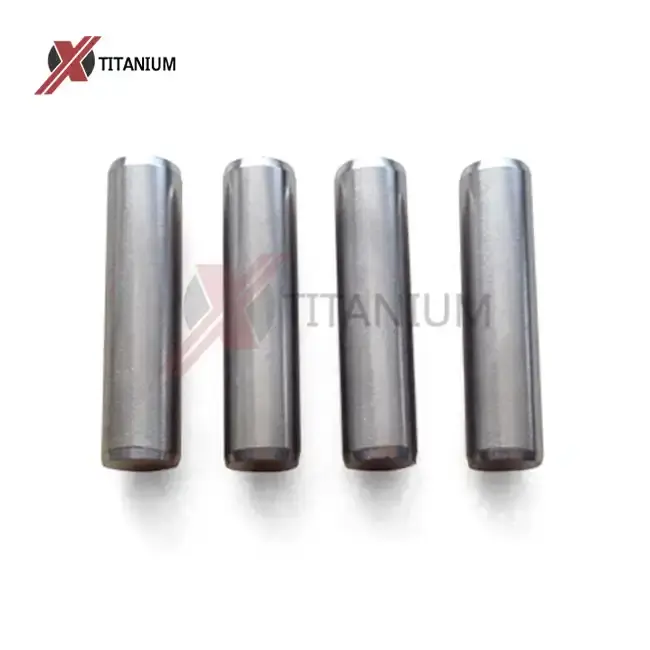
Understanding Titanium Dowel Pins: Properties and Applications
Material Composition and Manufacturing Standards
To make present day titanium dowel pins, aerospace-grade titanium materials are utilized, which work reliably indeed in unforgiving situations. Titanium Review 2 is exceptionally safe to rust and has a ductile quality of approximately 345 MPa. Titanium Review 5 (Ti-6Al-4V), on the other hand, has superior mechanical qualities and a most extreme malleable quality of over 895 MPa. Accuracy centerless pounding is utilized on these materials to get surface harshness values that are more often than not superior than Ra 0.8µm. This makes beyond any doubt that they work best in tight impedances fits. Universal measures like ASTM B348 and AMS necessities are entirely taken after amid the fabricating prepare.
The pins keep their estimate contrasts inside the m6, h6, or h7 ISO limits, which is exceptionally imperative for employments that require exact arrangement. Progressed quality control frameworks keep an eye on each step of the generation prepare, from checking the crude materials to the last survey. This makes beyond any doubt that the steadiness between bunches meets the needs of the flying machine and restorative industries.
Industrial Applications Across Critical Sectors
Aerospace applications represent the largest market segment for these specialized fasteners. Aircraft manufacturers utilize titanium dowel pins in wing assemblies, engine components, and landing gear systems where weight reduction directly impacts fuel efficiency. The pins' compatibility with carbon fiber reinforced polymers (CFRP) eliminates galvanic corrosion concerns that plague aluminum alternatives, making them essential for composite structure assembly.
Biocompatible materials that work appropriately interior the body are required to make therapeutic gadgets. Titanium is actually bio-inert, which implies it can be embedded and cleared out there for a long time without metallosis or dismissal. These pins are utilized by companies that make surgical disobedient in orthopedic outside fixators, arrangement dances, and exactness surgical devices that require to be exceptionally steady in terms of measure and resistance to rust.
Titanium dowel pins are utilized in motor parts, transmission units, and suspension frameworks for high-performance cars and dashing since they are light and do not alter shape when warmed or cooled. The fabric has a moo coefficient of warm extension (8.6 µm/m·K), which keeps its shape over a wide run of temperatures. This is vital for keeping exact limits in places where it gets hot.
Physical and Chemical Properties
Titanium dowel pins are way better in terms of innovation since they have a special blend of chemical and mechanical properties. With a mass of approximately 4.43 g/cm³, they are much lighter than steel alternatives (7.8 g/cm³), but they are still exceptionally solid. In moving parts, this implies less turning mass, and in structure employments, it implies less inactive stuff. Another vital advantage is that it doesn't erode.
Titanium normally shapes a detached oxide film (TiO2) that ensures against chloride push erosion breaking. This makes these pins culminate for utilize in chemical handling and saltwater settings. This built-in defense framework implies that additional surface medications aren't required in most circumstances, which brings down the by and large taken a toll of the system.
Titanium Dowel Pins vs. Alternatives: Making the Right Material Choice
Comparative Analysis of Material Options
When engineers select dowel pins for vital employments, they have to select from a number of diverse materials. Stainless steels, particularly 316 sort, are less costly and way better at standing up to rust, but they are too much heavier. When compared to titanium, it's 76% heavier, which is a issue in air ship employments where each gram influences execution and costs. Aluminum amalgams are lighter than other metals, but they aren't solid sufficient for high-stress circumstances. Their helplessness to setting rust and moo temperature solidness make them less valuable in cruel settings. Items made from materials other than carbon steel are exceptionally solid and difficult, but they rust effectively and require to be kept up and supplanted over time.
Performance-Based Value Assessment
Titanium dowel pins are three to five times more expensive than traditional materials when they are first bought, but lifetime value analysis often favors titanium in important uses. In high-stakes situations, the extra cost is worth it because the product lasts longer, needs less upkeep, and doesn't fail because of rust. Aerospace companies say that upkeep on fasteners goes down by 40 to 60 percent when they switch from steel to titanium parts. Getting rid of extra weight has direct practical benefits in mobile apps.
Manufacturers of airplanes figure that removing one kilogram of weight saves about $1,500 a year in fuel costs. This means that titanium's higher starting cost is economically justifiable. In the same way, lowering unsprung weight helps racing teams by making their cars go faster and handle better.
Installation and Best Practices for Titanium Dowel Pins
Proper Installation Techniques
To install titanium correctly, you need to be aware of its unique properties, especially its tendency to gall when it comes into touch with other metals that are similar. To stop cold welding during placement, professional installation guidelines say to use anti-galling coats like Diamond-Like Carbon (DLC) or assembly oils with Molybdenum Disulfide (MoS2). Accurate alignment is essential for getting the best results. If you're not careful when installing the pin, it can cause stress concentrations that make it less able to hold weight. Specialized assembly tools keep the perpendicularity within 0.001 inches, which makes sure that the stress is spread out evenly and the service life is extended to its fullest.
Maintenance and Inspection Protocols
Setting up regular review times helps find problems before they affect how well the system works. When inspecting visually, you should look for signs of cracking or rust, as well as wear patterns and the state of the surface. Non-destructive testing methods, such as ultrasound testing and dye penetrant screening, can find flaws below the surface that could weaken the structure. As part of preventive maintenance, titanium-compatible substances are used to grease the parts and the tightness of the bolts is checked on a regular basis. When using temperature cycles, you need to pay more attention to how thermal expansion affects the system and how stress can build up at the points where materials meet.
Procuring Titanium Dowel Pins: What B2B Buyers Need to Know?
Supplier Selection and Quality Assurance
To be successful at buying, you need to work with makers who have the right certifications and quality processes. As9100 certification shows quality control at the aircraft level, and ISO 13485 certification shows the ability to make medical devices. Traceability from the raw material to the end delivery is made possible by these approvals, which is very important for businesses that are controlled.
When evaluating a supplier, you should look at their producing skills, quality control methods, and expert help resources. Professional sellers are different from common suppliers because they can provide material certifications, measurement inspection reports, and lot tracking documents. Established makers keep a wide range of testing tools on hand, such as those for checking mechanical properties and analyzing chemical makeup.
Order Specifications and Lead Time Management
Titanium dowel pins require precise specifications including diameter tolerances, length requirements, surface finish, and material grade selection. Standard sizes range from 1mm to 25mm diameter with lengths up to 100mm, though custom dimensions are readily available. Grade 2 titanium suits corrosion-critical applications, while Grade 5 provides maximum strength for structural applications.
Depending on the difficulty of the specifications and the size of the order, lead times are usually between 2 and 8 weeks. Delivery times may be longer if there are custom requirements or standards that aren't normal. Setting up blanket purchase orders with planned releases helps keep stocking costs low and makes sure that materials are available when they are needed for production.
Conclusion
The engineering advantages of titanium dowel pins make them indispensable for critical applications across aerospace, medical, automotive, and marine industries. Their exceptional strength-to-weight ratio, corrosion resistance, and dimensional stability provide solutions to complex engineering challenges that traditional materials cannot address. While initial costs exceed conventional alternatives, the long-term value proposition through reduced maintenance, extended service life, and performance benefits justifies the investment. Successful implementation requires careful supplier selection, proper installation techniques, and adherence to maintenance protocols that leverage titanium's unique properties.
FAQ
What makes titanium dowel pins superior to steel alternatives?
Titanium offers a superior strength-to-weight ratio, being approximately 45% lighter than steel while maintaining comparable strength. The material's inherent corrosion resistance eliminates the need for protective coatings, and its non-magnetic properties make it suitable for sensitive electronic applications. These characteristics provide significant advantages in aerospace, medical, and precision engineering applications.
How do you prevent galling when installing titanium dowel pins?
Galling prevention requires proper surface preparation and lubrication techniques. Anti-galling coatings such as DLC or titanium nitride provide excellent protection. Assembly lubricants containing molybdenum disulfide or specialized titanium-compatible compounds reduce friction during installation. Controlled insertion speeds and proper alignment also minimize galling risk.
Can titanium dowel pins replace hardened steel in high-wear applications?
Grade 5 titanium provides excellent strength but may require surface treatments for extreme wear applications. Specialized coatings like titanium nitride or chromium nitride can enhance surface hardness to match or exceed heat-treated steel performance. The specific application requirements determine whether direct replacement is feasible or if additional surface treatments are necessary.
Partner with Chuanglian for Premium Titanium Dowel Pin Solutions
Chuanglian delivers precision-engineered titanium dowel pins backed by over ten years of titanium machining expertise and comprehensive quality management systems. Our advanced CNC capabilities and strict quality control processes ensure consistent dimensional accuracy and material properties that meet the most demanding aerospace and medical specifications. Located in Baoji City, China's renowned "City of Titanium," we combine competitive manufacturing costs with world-class quality standards. Contact our technical team at info@cltifastener.com or djy6580@aliyun.com to discuss your specific requirements and discover why leading manufacturers worldwide trust Chuanglian as their preferred titanium dowel pins supplier.
References
1. ASM International Handbook Committee. "Properties and Selection: Nonferrous Alloys and Special-Purpose Materials." ASM Handbook Volume 2, ASM International, 2018.
2. Boyer, R.R., Welsch, G., and Collings, E.W. "Materials Properties Handbook: Titanium Alloys." ASM International Materials Park, 2019.
3. Donachie, Matthew J. "Titanium: A Technical Guide, 2nd Edition." ASM International Technical Publications, 2017.
4. Froes, Francis H. "Titanium: Physical Metallurgy, Processing, and Applications." ASM International Handbook Series, 2020.
5. Leyens, Christoph and Peters, Manfred. "Titanium and Titanium Alloys: Fundamentals and Applications." Wiley-VCH Engineering Materials and Processes, 2018.
6. Welsch, Gerhard, Boyer, Rodney, and Collings, E.W. "Materials Properties Handbook: Titanium Alloys Engineering Properties and Applications." ASM International Technical Reference, 2019.
Learn about our latest products and discounts through SMS or email