The titanium clad copper bar speaks to one of the most imaginative composite materials in advanced building, combining titanium's uncommon erosion resistance with copper's predominant electrical conductivity. This comprehensive direct investigates everything you require to know approximately these progressive bimetallic bars, from their one of a kind fabricating forms to their extending applications over aviation, petrochemical, and marine businesses. As fabric advancement proceeds to drive mechanical headway, understanding the properties, benefits, and applications of titanium-copper composite materials gets to be vital for engineers, acquirement supervisors, and specialized experts looking for ideal arrangements for requesting environments.
What Is Titanium Clad Copper Bar?
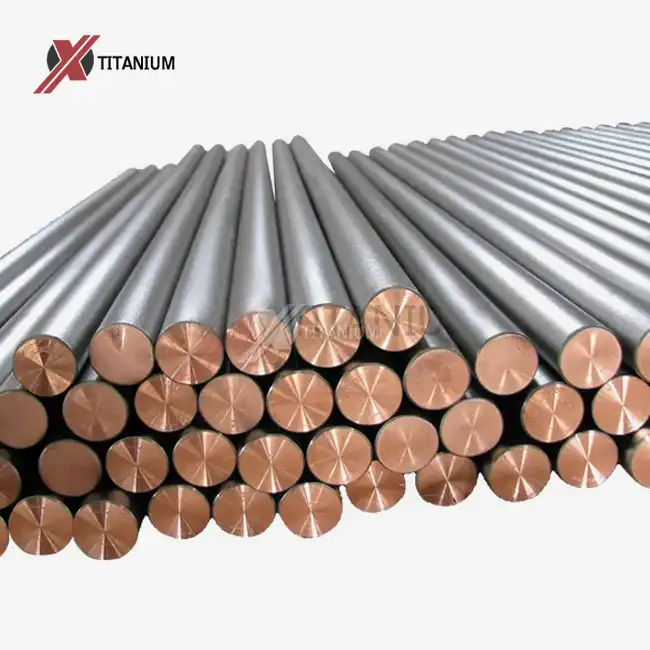
A titanium clad copper bar comprises of a copper center encompassed by a metallurgically fortified titanium external layer. This composite fabric leverages the best properties of both metals through progressed metal cladding innovation. The copper center gives amazing electrical conductivity and warm properties, whereas the titanium coating conveys unmatched erosion resistance and mechanical strength.
The fabricating handle includes specialized strategies counting unstable holding, roll holding, or dissemination welding. These strategies make a changeless metallurgical bond between the two materials, guaranteeing the composite bar performs as a bound together structure or maybe than partitioned layers. The coming about item shows properties that not one or the other metal seem accomplish independently.
Material composition shifts based on application necessities. Standard arrangements highlight unadulterated copper centers with Review 1 or Review 2 titanium cladding. The titanium thickness regularly ranges from 0.1mm to 2mm, depending on the particular erosion resistance and mechanical property prerequisites. This lightweight fabric offers noteworthy points of interest over conventional strong titanium or copper alternatives.
Manufacturing Processes and Techniques
Cold rolling speaks to one of the essential strategies for creating titanium-copper composite materials. This handle includes passing the reinforced materials through exactness rollers at room temperature, accomplishing tight dimensional resiliences and amazing surface wrap up. Cold rolled items show upgraded mechanical properties and progressed electrical conductivity all through the copper core. Hot rolling happens at lifted temperatures, ordinarily between 700°C and 900°C.
This procedure permits for more prominent thickness decrease and made strides holding between the titanium and copper layers. Hot rolled bars regularly require ensuing tempering medicines to optimize their microstructure and diminish inside stresses. Annealing medicines are basic for optimizing the material's properties. Controlled warming and cooling cycles dispense with work solidifying impacts and progress ductility.
The tempering temperature must be carefully controlled to avoid intermetallic compound arrangement at the titanium-copper interface, which seem compromise the bond integrity. Pickling forms expel surface oxides and contaminants from the titanium layer. Corrosive cleaning arrangements, regularly containing hydrofluoric and nitric acids, guarantee ideal surface quality for consequent preparing or coordinate application. These medicines are especially vital for applications requiring tall virtue or particular surface characteristics.
Surface Finishes and Quality Control
Bright wraps up are accomplished through exactness machining and cleaning operations. These surfaces give great appearance and ideal electrical contact properties. The shinning wrap up moreover encourages visual assessment for surface absconds or holding inconsistencies. Quality control measures incorporate dimensional confirmation and surface unpleasantness measurements. Polished surfaces experience extra wrapping up steps to accomplish mirror-like appearances.
This surface treatment is especially profitable for applications requiring negligible surface defilement or tasteful contemplations. Cleaning moreover decreases surface stretch concentrations that may lead to untimely disappointment beneath cyclic stacking conditions. Sandblasting makes uniform surface surfaces that upgrade grip for consequent coatings or medications. This handle evacuates surface contaminants and gives reliable surface profiles.
Controlled sandblasting parameters guarantee the titanium layer keenness whereas accomplishing craved surface characteristics. Comprehensive quality testing incorporates hardness tests over both materials, bowing tests to confirm bond judgment, and hydrostatic testing for weight vessel applications. These quality measures guarantee reliable execution and unwavering quality in requesting mechanical situations. Testing conventions take after universal guidelines counting ASTM and ISO specifications.
Key Properties and Performance Characteristics
High erosion resistance stems from the titanium external layer's common oxide film arrangement. This inactive layer gives remarkable assurance against chloride assault, acidic situations, and galvanic erosion. The strength of this assurance makes these bars perfect for marine and chemical preparing applications where conventional materials fail. Low thickness compared to strong titanium options diminishes generally framework weight whereas keeping up auxiliary astuteness.
The copper center contributes to weight lessening whereas giving fundamental conductive properties. This lightweight characteristic is especially profitable in aviation applications where weight investment funds decipher specifically to execution improvements. Good warm steadiness empowers operation over wide temperature ranges without property debasement. The warm development characteristics of both materials are carefully coordinated to avoid delamination amid warm cycling.
This solidness guarantees steady execution in applications encountering temperature fluctuations. Electrical conductivity approaches that of immaculate copper in spite of the titanium cladding. The lean titanium layer negligibly impacts current stream whereas giving fundamental assurance. This combination empowers electrical establishing applications in destructive situations where copper alone would endure quick degradation.
Industrial Applications Across Key Sectors
Chemical industry applications use the material's remarkable resistance to forceful chemicals and tall temperatures, making titanium clad copper bar an ideal choice for long-term corrosion-resistant performance. Warm exchangers, weight vessels, and prepare channeling advantage from the combination of erosion resistance and warm conductivity. The titanium surface stands up to assault from acids, bases, and chlorinated compounds that quickly corrupt conventional materials.
Aerospace applications center on weight-critical components requiring both electrical conductivity and erosion resistance. Landing adapt components, electrical establishing frameworks, and basic components in marine flying machine advantage from this fabric advancement. The tall strength-to-weight proportion bolsters requesting aviation execution requirements. Marine designing utilizes these conductive bars in seaward stages, transport frameworks, and submerged hardware.
The galvanic erosion resistance avoids corruption in seawater situations whereas keeping up electrical framework judgment. Vitality transmission frameworks in marine applications especially advantage from this erosion protection. Sports hardware producers join these materials in high-performance applications requiring lightweight, tough, and conductive properties. Golf club components, marine wear gear, and dashing applications utilize the one of a kind property combinations these composite materials provide.
Technical Specifications and Standards
Material composition details characterize the immaculateness necessities for both copper and titanium components. The copper center regularly meets C101 or C110 determinations, guaranteeing ideal electrical conductivity. Titanium cladding employments commercially unadulterated grades with oxygen substance underneath 0.25% to keep up ductility and erosion resistance. Diameter ranges from 10mm to 200mm suit different application prerequisites.
Length determinations expand from 500mm to 3000mm, with custom lengths accessible for particular extend needs. The titanium thickness detail of 0.1mm to 2mm permits optimization for particular erosion situations and mechanical requirements. Density estimations reflect the composite nature, with generally thickness roughly 4.5 g/cm³ depending on the titanium-to-copper proportion.
Dissolving point contemplations center on the titanium layer at 1,668°C, in spite of the fact that genuine preparing temperatures stay well underneath this edge to protect bond integrity. Mechanical properties incorporate pliable quality, surrender quality, and stretching values that reflect both materials' commitments. Bond quality testing guarantees the metallurgical interface meets application prerequisites. These details direct fabric determination for particular designing applications.
Advantages Over Traditional Materials
Cost-effectiveness develops from the specific utilize of costly titanium as it were where required for erosion protection, as seen in titanium clad copper bar designs. The copper center gives basic functionality at a fraction of strong titanium costs. This financial advantage makes progressed fabric properties available for broader mechanical applications. Performance optimization combines complementary fabric properties outlandish with single-metal arrangements.
The synergistic impact makes materials with property combinations inaccessible through conventional metallurgy. This advancement empowers unused application conceivable outcomes already considered in fact unfeasible. Maintenance lessening comes about from upgraded toughness and erosion resistance. Amplified benefit life decreases substitution recurrence and related downtime costs.
The long-term unwavering quality especially benefits basic applications where disappointment results are severe. Design adaptability permits engineers to optimize fabric dispersion inside components. The composite structure empowers custom fitted properties through thickness varieties and particular cladding designs. This customization capability underpins imaginative building solutions.
Selection Criteria for Your Application
Environmental evaluation decides the suitable titanium thickness and review determination. Chloride concentrations, temperature ranges, and pH levels direct fabric details. Understanding the particular erosion components makes a difference optimize the titanium cladding thickness for long-term protection. Electrical necessities impact the copper center determinations and by and large geometry. Current carrying capacity, voltage drop confinements, and establishing adequacy prerequisites decide the least copper cross-sectional range.
The adjust between electrical execution and erosion assurance drives plan optimization. Mechanical stacking conditions influence both fabric determination and geometric determinations. Malleable loads, bowing minutes, and weakness prerequisites impact the titanium cladding thickness and copper combination determination. Legitimate investigation guarantees satisfactory security edges for basic applications. Manufacturing contemplations incorporate machining necessities, joining strategies, and surface wrapping up needs. The composite nature requires specialized preparing procedures that protect bond judgment whereas accomplishing last details. Understanding these confinements guides plan choices and taken a toll optimization.
Quality Assurance and Certification Standards
AS9100 certification guarantees aviation quality administration frameworks for basic applications. This standard addresses hazard administration, arrangement control, and traceability prerequisites basic for aviation components. Providers must illustrate compliance with exacting documentation and testing protocols. ISO9001 quality administration frameworks give the establishment for steady fabricating forms. These frameworks guarantee recorded methods, ceaseless change, and client fulfillment center.
Customary reviews confirm continuous compliance and prepare effectiveness. Medical certifications address biocompatibility and virtue prerequisites for restorative applications. ISO13485 guidelines particularly administer therapeutic gadget fabricating quality frameworks. These prerequisites guarantee understanding security and administrative compliance for therapeutic applications. Material traceability frameworks track crude materials through generation and conveyance. Warm part following, chemical composition records, and mechanical property documentation give total fabric parentage. This traceability bolsters disappointment examination and quality advancement initiatives.
Conclusion
Titanium clad copper bars represent a significant advancement in composite material technology, offering unique property combinations that solve complex engineering challenges across multiple industries. The synergy between titanium's corrosion resistance and copper's electrical conductivity creates opportunities for innovative solutions in aerospace, chemical processing, marine engineering, and beyond. As material requirements continue to evolve toward higher performance and greater reliability, these composite materials provide proven pathways to enhanced system performance.
Understanding the manufacturing processes, quality standards, and application considerations enables informed material selection decisions that optimize both technical performance and economic value. The continued development of metal cladding technology promises even greater possibilities for material innovation in the years ahead.
Choose Chuanglian as Your Trusted Titanium Clad Copper Bar Manufacturer
Baoji Chuanglian New Metal Material Co., Ltd. stands as a leading titanium clad copper bar supplier with over ten years of specialized experience in advanced composite materials. Located in Baoji City, renowned as the "City of Titanium," our facility combines cutting-edge technology with deep metallurgical expertise to deliver superior bimetallic solutions.
Our comprehensive manufacturing capabilities include dozens of CNC machine tools and specialized processing equipment designed specifically for composite material production. We maintain strict quality control systems from raw material inspection through final product testing, ensuring every titanium clad copper bar meets international standards including AS9100, ISO9001, and medical certifications.
Quality assurance extends beyond manufacturing to include complete material traceability, batch consistency monitoring, and comprehensive testing protocols. Our products successfully serve aerospace manufacturers, chemical processing facilities, marine engineering companies, and medical device producers worldwide.
Ready to explore how our advanced titanium clad copper bar solutions can enhance your next project? Our technical team is prepared to discuss your specific requirements and provide detailed specifications. Contact us at info@cltifastener.com or djy6580@aliyun.com to begin your partnership with a trusted industry leader committed to material innovation and customer success.
References
1. ASM Handbook Volume 2: Properties and Selection: Nonferrous Alloys and Special-Purpose Materials. ASM International, 2024.
2. Davis, J.R. "Copper and Copper Alloys: Industrial Applications and Material Properties." Materials Engineering Handbook, 4th Edition, McGraw-Hill Professional, 2024.
3. Lutjering, G. and Williams, J.C. "Titanium Engineering Materials: Properties, Processing and Applications." Springer Materials Science Series, 2025.
4. International Journal of Composite Materials and Manufacturing. "Advances in Bimetallic Cladding Technology for Industrial Applications." Volume 15, Issue 3, 2024.
5. ASTM International. "Standard Specification for Titanium-Clad Copper Composite Materials." ASTM B898-24, 2024.
6. Materials Science and Engineering Reports. "Metallurgical Bonding Mechanisms in Titanium-Copper Composite Systems." Quarterly Review, Issue 2, 2024.