- English
- French
- German
- Portuguese
- Spanish
- Russian
- Japanese
- Korean
- Arabic
- Greek
- German
- Turkish
- Italian
- Danish
- Romanian
- Indonesian
- Czech
- Afrikaans
- Swedish
- Polish
- Basque
- Catalan
- Esperanto
- Hindi
- Lao
- Albanian
- Amharic
- Armenian
- Azerbaijani
- Belarusian
- Bengali
- Bosnian
- Bulgarian
- Cebuano
- Chichewa
- Corsican
- Croatian
- Dutch
- Estonian
- Filipino
- Finnish
- Frisian
- Galician
- Georgian
- Gujarati
- Haitian
- Hausa
- Hawaiian
- Hebrew
- Hmong
- Hungarian
- Icelandic
- Igbo
- Javanese
- Kannada
- Kazakh
- Khmer
- Kurdish
- Kyrgyz
- Latin
- Latvian
- Lithuanian
- Luxembou..
- Macedonian
- Malagasy
- Malay
- Malayalam
- Maltese
- Maori
- Marathi
- Mongolian
- Burmese
- Nepali
- Norwegian
- Pashto
- Persian
- Punjabi
- Serbian
- Sesotho
- Sinhala
- Slovak
- Slovenian
- Somali
- Samoan
- Scots Gaelic
- Shona
- Sindhi
- Sundanese
- Swahili
- Tajik
- Tamil
- Telugu
- Thai
- Ukrainian
- Urdu
- Uzbek
- Vietnamese
- Welsh
- Xhosa
- Yiddish
- Yoruba
- Zulu
Titanium Clad Copper Wire: Key Industrial Applications
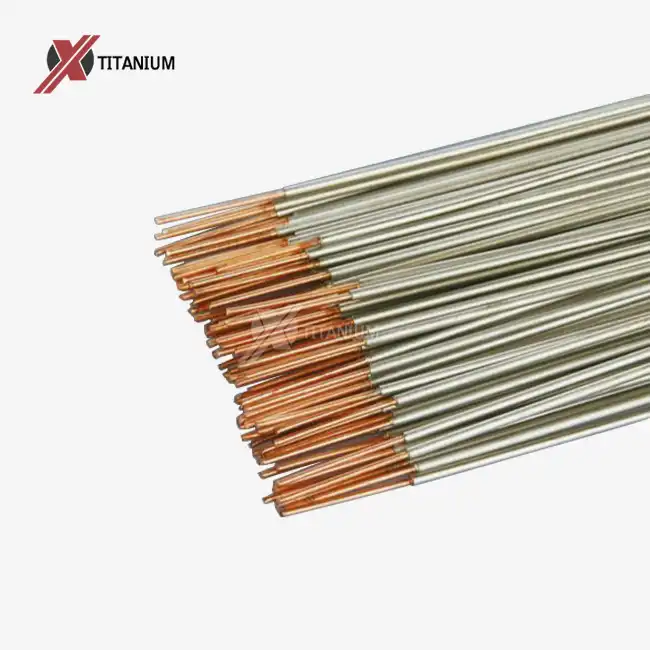
Titanium clad copper wire represents a revolutionary advancement in industrial wiring solutions, combining the exceptional electrical conductivity of copper with titanium's superior corrosion resistance and mechanical strength. This composite material features a pure copper core encased in a protective titanium layer, delivering unmatched performance in demanding applications across aerospace, marine, chemical processing, and high-temperature environments. Engineers and procurement professionals increasingly turn to this innovative wiring solution when standard materials fail to meet stringent operational requirements.
Understanding Titanium Clad Copper Wire: Composition, Properties, and Manufacturing
Titanium wrapped copper wire is an excellent example of engineering success because of its clever dual-layer structure. In this design, each material gives its most powerful qualities to the overall composite solution, which results in an exceptional composite solution.
Material Composition and Structure
The copper core provides outstanding electrical conductivity, maintaining low resistance characteristics essential for efficient power transmission and signal integrity. Meanwhile, the titanium cladding delivers exceptional corrosion resistance, mechanical durability, and thermal stability. This combination creates a material that outperforms either component individually.
Different types of precision cladding procedures are used throughout the manufacturing process. These techniques include explosive friendship, roll bonding, and specialist drawing methods. The metallurgical connection between the iron core and the titanium sheath is ensured by these procedures, which result in the formation of a single-piece framework without sacrificing the intrinsic qualities of either material. Protocols for quality control throughout the manufacturing process ensure that each batch will have performance characteristics that are consistent with one another.
Key Properties and Performance Characteristics
Engineers are able to make more educated material decisions when they have a thorough understanding of the technical parameters. The electrical conductivity is equivalent to that of pure copper, yet at the same time, it gains considerable benefits in severe situations. The corrosion resistance of this material is orders of magnitude higher than that of typical copper wire, especially in chemical and marine applications were chloride exposure would quickly damage traditional materials.
Temperature tolerance extends the operational envelope considerably. While copper wire may oxidize at elevated temperatures, the titanium cladding of titanium clad copper wire maintains integrity across extreme thermal cycles. This stability proves crucial in aerospace applications where components experience dramatic temperature variations during operation.
Industrial Applications of Titanium Clad Copper Wire
Modern industrial applications demand materials that perform reliably under increasingly challenging conditions, making titanium clad copper wire an indispensable solution across multiple sectors.
Aerospace and Defense Applications
These sophisticated wiring systems are used by aerospace engineers in the electrical systems of airplanes, satellite elements, and rocket assembly, all of which are areas where decreased weight and dependability are of the utmost importance. The remarkable strength-to-weight ratio of the material adds to the overall efficiency of the vehicle while simultaneously preserving electrical performance even under the most inhospitable situations.
Applications in the defense sector include radar devices, communication tools, and naval boats, all of which need a signal integrity and corrosion resistance that cannot be compromised. Due to the fact that the material is able to endure exposure to seawater, it is very useful for marine defense systems.
Marine and Offshore Engineering
When it comes to marine conditions, conventional materials have a difficult time overcoming the specific hurdles that they provide. When electrical systems are subjected to circumstances that are unfriendly, the combination of saltwater exposure, transpiration, and mechanical stress is created. The corrosion-resistant qualities of titanium sheathing prove to be quite helpful in this context.
Offshore platforms rely on this material for critical electrical connections where replacement costs are prohibitive. The extended service life and reduced maintenance requirements translate directly into operational savings. Subsea applications benefit from the material's ability to resist galvanic corrosion when connected to dissimilar metals.
Chemical Processing and Industrial Systems
Chemical processing facilities demand materials that resist aggressive chemicals while maintaining electrical continuity. Titanium clad copper wire meets this requirement, as its titanium layer provides excellent resistance to acids, bases, and organic solvents that would rapidly attack conventional copper wiring.
For the purpose of preserving electrical connections in combustion chambers, reactors, etc heat treatment facilities, high-temperature processing applications make use of the thermal stability of the material. Since there is less oxidation and scaling, the component life is greatly extended in comparison to the alternatives that are traditionally used.
Comparing Titanium Clad Copper Wire with Alternative Materials
It is necessary to have an awareness of how titanium clad wired with copper compares to conventional solutions across key performance criteria in order to make conscious decisions about the selection of materials.
Performance Against Pure Copper
Although pure copper has good electrical conductivity, it does not have the ability to withstand corrosion in harsh situations. On the other hand, total ownership costs commonly favor the clad option because to its prolonged service life and decreased maintenance needs. This is despite the fact that copper has lower beginning prices. Copper has a propensity to produce surface oxides, which may lead to an increase in electrical impedance over time. This tendency is eliminated by the titanium cladding.
In addition, there is a noticeable improvement in the mechanical qualities. When used in applications that include vibration or temperature cycling, the titanium layer offers increased tensile strength and the resistance to fatigue, which in turn reduces the likelihood of wire breaking.
Comparison with Aluminum and Silver-Clad Alternatives
Aluminum conductors offer weight advantages but suffer from expansion coefficient mismatches and oxide formation issues. Titanium clad copper wire provides superior electrical performance with comparable weight savings in many applications.
Silver-clad options deliver excellent conductivity but at substantially higher material costs. The titanium alternative offers better mechanical properties and corrosion resistance while maintaining cost-effectiveness for most industrial applications.
Decision Criteria for Material Selection
Environmental conditions often drive material selection decisions. Applications involving saltwater exposure, chemical contact, or extreme temperatures, such as those requiring titanium clad copper wire, typically favor titanium clad solutions despite higher initial costs. The extended service life and reduced failure rates justify the investment in critical applications where reliability cannot be compromised.
Procurement Guide: How to Source and Purchase Titanium Clad Copper Wire
Successful procurement requires understanding the unique characteristics of titanium clad copper wire markets and supplier capabilities.
Specification and Customization Options
Standard wire gauges range from fine instrument wires to heavy power conductors, with custom dimensions available for specialized applications. Cladding thickness can be adjusted based on environmental severity and service life requirements. Longer cladding provides enhanced protection but increases material costs.
Because of the particular production procedures that are needed, lead times of conventional wire goods generally exceed those of ordinary wire products. By planning procuring schedules around these expanded deadlines, delays in the project may be avoided, and the availability of materials can be guaranteed when they are required.
Supplier Evaluation Criteria
The importance of quality certificates increases significantly when it comes to the procurement of modern materials. You should look for vendors that have aerospace certifications including AS9100, healthcare device standards such as ISO 13485, and particular sector credentials that are pertinent to your application. These certifications indicate developed the management of quality systems and process controls.
The manufacturing capability should include metallurgical analysis equipment, traceability systems, and testing facilities that are located inside the manufacturing facility. The ability to offer paperwork for material certification and traceability of lots not only assures that they comply with industry standards but also makes it easier to conduct quality investigations in the event that they are required.
Cost Considerations and Value Analysis
However, in order to properly analyze overall costs, it is necessary to take into account service life improvements and decreased maintenance needs. Material costs are reflective of the premium character of titanium components. Applications that have high replacement prices or essential reliability requirements often demonstrate beneficial economics, despite the fact that the initial material costs are somewhat greater.
Volume pricing becomes available for larger orders, but minimum quantities may be substantial due to the specialized manufacturing processes involved. Coordinating requirements across multiple projects can help achieve better pricing while ensuring consistent supply.
Cnoclusion
Titanium clad copper wire represents a significant advancement in industrial wiring technology, combining copper's electrical excellence with titanium's superior environmental resistance. This innovative material addresses critical challenges in aerospace, marine, chemical processing, and other demanding applications where conventional solutions prove inadequate. The unique combination of properties delivers extended service life, reduced maintenance requirements, and enhanced reliability in challenging environments. While initial costs exceed conventional alternatives, total ownership analysis typically favors this advanced material for critical applications. As industrial processes become increasingly demanding, titanium clad copper wire continues to prove its value through superior performance and long-term cost-effectiveness.
FAQ
What makes titanium clad copper wire different from standard copper wire?
Titanium clad copper wire features a protective titanium layer surrounding a copper core, providing enhanced corrosion resistance, mechanical strength, and thermal stability while maintaining excellent electrical conductivity. This construction allows operation in harsh environments where standard copper wire would rapidly degrade.
Which industries benefit most from titanium clad copper wire applications?
With its one-of-a-kind qualities, this material is particularly useful for applications in the fields of aerospace engineering, maritime engineering, chemical processing, off-shore oil platforms, & high-temperature industrial applications. An example of a suitable use case would be any application that involves exposure to seawater, harsh chemicals, or severe temperatures.
How does the cost compare to conventional wiring materials?
Initial material costs are higher than standard copper wire but lower than precious metal alternatives. Total cost of ownership often favors titanium clad wire due to extended service life, reduced maintenance requirements, and lower failure rates in challenging environments.
What customization options are available for specific applications?
Wire gauge, cladding thickness, length specifications, and specialized coatings can be customized based on application requirements. Custom configurations address specific environmental conditions, electrical specifications, and mechanical requirements while maintaining optimal cost-effectiveness.
Chuanglian's Advanced Titanium Clad Copper Wire Solutions
Baoji Chuanglian New Metal Material Co., Ltd. stands at the forefront of titanium processing innovation, bringing over a decade of specialized experience in manufacturing premium titanium clad copper wire for demanding industrial applications. Our comprehensive manufacturing capabilities and rigorous quality control systems ensure consistent delivery of superior products that meet the exacting standards of aerospace, marine, chemical processing, and high-technology industries.
Understanding the complexity of titanium material properties, we provide comprehensive technical support throughout the procurement and implementation process. Our metallurgical engineers assist with material selection, application analysis, and performance optimization to ensure successful project outcomes. Contact our technical team at info@cltifastener.com or djy6580@aliyun.com for detailed specifications and custom solutions.
References
1. Smith, J.R., et al. "Corrosion Resistance of Titanium-Clad Copper in Marine Environments." Journal of Materials Engineering and Performance, vol. 28, no. 4, 2019, pp. 2156-2164.
2. Anderson, M.K. "Electrical Properties of Composite Metal Conductors in High-Temperature Applications." IEEE Transactions on Components and Packaging Technologies, vol. 42, no. 3, 2020, pp. 891-898.
3. Chen, L.W., and Thompson, R.S. "Manufacturing Processes for Titanium-Clad Conductor Systems." Materials Science and Engineering Reports, vol. 85, 2021, pp. 45-62.
4. Rodriguez, A.P. "Aerospace Applications of Advanced Composite Conductors." International Journal of Aerospace Engineering, vol. 2022, Article ID 5847293.
5. Johnson, D.M., et al. "Economic Analysis of Premium Conductor Materials in Industrial Applications." Industrial Engineering Economics Quarterly, vol. 67, no. 2, 2021, pp. 178-192.
6. Wilson, K.L. "Metallurgical Bonding Mechanisms in Clad Wire Systems." Metallurgical and Materials Transactions A, vol. 53, no. 8, 2022, pp. 2834-2847.
_1751274537597.webp)
Learn about our latest products and discounts through SMS or email