- English
- French
- German
- Portuguese
- Spanish
- Russian
- Japanese
- Korean
- Arabic
- Greek
- German
- Turkish
- Italian
- Danish
- Romanian
- Indonesian
- Czech
- Afrikaans
- Swedish
- Polish
- Basque
- Catalan
- Esperanto
- Hindi
- Lao
- Albanian
- Amharic
- Armenian
- Azerbaijani
- Belarusian
- Bengali
- Bosnian
- Bulgarian
- Cebuano
- Chichewa
- Corsican
- Croatian
- Dutch
- Estonian
- Filipino
- Finnish
- Frisian
- Galician
- Georgian
- Gujarati
- Haitian
- Hausa
- Hawaiian
- Hebrew
- Hmong
- Hungarian
- Icelandic
- Igbo
- Javanese
- Kannada
- Kazakh
- Khmer
- Kurdish
- Kyrgyz
- Latin
- Latvian
- Lithuanian
- Luxembou..
- Macedonian
- Malagasy
- Malay
- Malayalam
- Maltese
- Maori
- Marathi
- Mongolian
- Burmese
- Nepali
- Norwegian
- Pashto
- Persian
- Punjabi
- Serbian
- Sesotho
- Sinhala
- Slovak
- Slovenian
- Somali
- Samoan
- Scots Gaelic
- Shona
- Sindhi
- Sundanese
- Swahili
- Tajik
- Tamil
- Telugu
- Thai
- Ukrainian
- Urdu
- Uzbek
- Vietnamese
- Welsh
- Xhosa
- Yiddish
- Yoruba
- Zulu
Ultimate Guide to Titanium Countersunk Screws
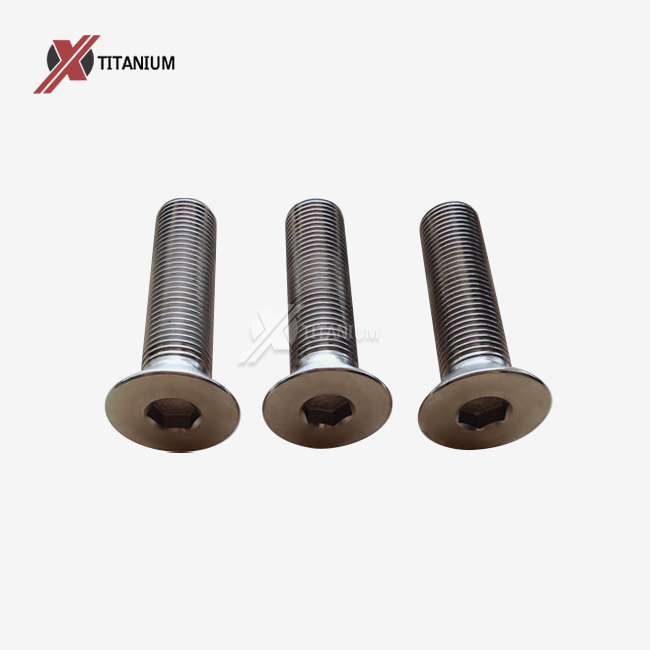
Titanium countersunk screws represent the pinnacle of precision fastening technology in modern industrial applications. These specialized fasteners feature a unique cone-shaped head design that sits flush with the material surface, creating seamless connections while delivering exceptional performance characteristics. Their distinctive flat, angled head allows for complete concealment when properly installed, making them indispensable across aerospace, petrochemical, medical device, marine engineering, and high-end manufacturing sectors.
Engineering experts, procurement managers, and other technical professionals that want the highest standards in their fastening solutions are the target audience for this thorough reference, that meets their crucial demands. When working with mission-critical applications, where failure is not an option, it is necessary to have a comprehensive understanding of the complexity of titanium material qualities, installation specs, and procurement methods. This handbook examines essential features, comparative benefits, installation procedures, and strategic buying considerations that have an impact on the success of a project over the long run.
Understanding Titanium Countersunk Screws: Properties and Benefits
Fundamental Material Properties and Performance Characteristics
The excellent mechanical capabilities that these fasteners possess are a direct result of the peculiar crystalline structure of titanium, which sets them apart from more typical options. Depending on the particular alloy grade, the material has a tensile strength that may range anywhere from 240 – 1,400 MPa. Despite this, it maintains a density of about 4.5 g/cm3, which is roughly 45% lower than steel. Engineers are able to specify smaller screws without losing structural performance because to this outstanding strength-to-weight ratio, which ultimately results in considerable weight reductions across large assemblies.
Titanium is able to develop a protective oxide coating when it is exposed to oxygen, which is the source of its resistance to corrosion. This film is passive, meaning that it regenerates itself spontaneously when it is broken. It offers ongoing protection against harsh conditions such as seawater, acids, and chemicals from factories. Grade 2 titanium provides exceptional resistance to corrosion for common applications, but Grade 5 titanium (Ti-6Al-4V) offers greater strength for high-stress situations, which are usually found in aerospace and healthcare settings.
Comparative Analysis with Alternative Fastener Materials
Titanium typically surpasses standard choices across a variety of performance parameters when it comes to the evaluation of fastener materials for essential applications. In spite of the fact that they have a high resistance to corrosion, stainless steel fasteners are substantially heavier than other types of fasteners and are susceptible to stress corrosion breaking in chloride environments. The use of aluminum fasteners results in weight savings; nevertheless, they do not possess the strength required for high-load tasks and provide poor performance when exposed to circumstances of rising temperature.
The limitations of alternatives highlight the unique value proposition of advanced materials. Carbon steel fasteners, despite their lower cost, require protective coatings that can degrade over time, leading to galvanic corrosion when used with dissimilar metals. In contrast, the high-performance titanium countersunk screws offer superior long-term reliability and compatibility, a critical factor in total cost of ownership calculations. Titanium's biocompatibility makes it the only suitable choice for medical implant applications, while its non-magnetic properties prove essential in electronic and scientific equipment where magnetic interference must be eliminated.
Standard Specifications and Torque Requirements
Standards established by the industry control the parameters of titanium countersunk screws to guarantee that they work consistently across a variety of applications. In metric threading, the most common sizes span M3 to M20, and for markets in North America, comparable imperial sizes are available. Contrary to popular belief, the countersunk angle is normally measured at 90 degrees; however, there are alternatives available for 100 degrees for certain applications that need differing head geometries.
Proper torque application becomes critical when installing titanium fasteners due to the material's tendency toward galling when subjected to excessive friction. Recommended torque values generally range from 60-80% of those specified for equivalent steel fasteners, with lubricants often recommended to prevent thread damage during installation. Understanding these requirements prevents costly failures and ensures optimal joint performance throughout the service life.
Installation and Performance Optimization of Titanium Countersunk Screws
Precision Installation Techniques and Best Practices
In order to get the best possible performance from gold countersunk screws, it is necessary to adhere to certain installation processes that take into consideration the special qualities of the material. In order to achieve the required flush finish, the installation procedure starts with the correct preparation of the hole. This involves making sure that the countersink depth corresponds to the geometry of the screw head. In order to avoid stress concentrations that might result in early failure during cyclic loading circumstances, deburring becomes something that is absolutely necessary.
Due to the fact that titanium has a lower modulus of elasticity in comparison to steel, thread engagement calculations need to take this into consideration. As a result, titanium often requires somewhat longer engagement lengths in order to obtain equal holding force. During the process of thread preparation, it is necessary to clean the thread in order to eliminate any machining oils as well as debris that can impede the development of the thread or contribute to annoying during the installation process.
Preventing Galling and Thread Damage
Galling represents the primary concern when installing titanium fasteners, occurring when metal surfaces adhere and transfer material during relative motion. This phenomenon becomes more pronounced with titanium due to its low thermal conductivity and tendency to work-harden under stress. Prevention strategies include controlling installation speed, using appropriate lubricants, and maintaining proper thread tolerances.
Anti-seize compounds that have been developed particularly for aluminum applications provide very necessary protection throughout the manufacturing process. These lubricants often include molybdenum or other liquid lubricants that are able to maintain their effectiveness throughout a broad temperature range. For the purpose of preventing rapid loading that might lead to galling, the torque for installation should be given gradually using instruments that have been calibrated.
Maintenance and Long-term Performance Considerations
Titanium countersunk screws need very little care when they are put correctly; nevertheless, frequent examination is necessary to guarantee that they continue to work well in applications that are essential. During a visual examination, the primary objective is to identify any indications of stress, corrosion, or mechanical deterioration that may jeopardize the integrity of the joint. Corrosion protection is normally maintained by the self-healing oxide layer; however, damage caused by impact or abrasion may need care.
Environmental exposure assessments are very helpful in determining inspection intervals, with ocean and chemical processing settings often needing more regular evaluations than other kind of environments. The documentation of installation forces and subsequent inspections offers useful data that can be used to develop maintenance plans and detect possible problems before they have an impact on the functioning of the system.
Making Informed Purchasing Decisions: Comparing Titanium Countersunk Screws
Cost-Benefit Analysis and Lifecycle Value Assessment
Despite the fact that titanium countersunk screws are more expensive than conventional fasteners, extensive lifecycle analysis often indicates that they provide a better value proposition. This is because they need less maintenance, have a longer service life, and are more reliable. Although the original material prices are often five to fifteen times more than those of alternatives made of stainless steel, the elimination to substitute cycles and the reduction in the amount of maintenance that is required frequently compensate for these initial expenditures.
Building upon this, inventory management strategies for aerospace components must also consider the specialized value of these materials. For example, weight reduction benefits provide additional value in transportation applications where every gram impacts fuel efficiency and operational costs. Aerospace applications particularly benefit from titanium's weight savings, which is why ensuring the reliable supply of titanium countersunk screws is crucial, as studies indicate that every kilogram removed from aircraft structure can save thousands of dollars in fuel costs over the aircraft's operational lifetime.
Grade Selection and Certification Requirements
There is a direct correlation between the selection of titanium grade and the performance qualities and cost factors. Titanium that is commercially pure and grade 2 provides good corrosion resistance and shaping at mild strength extents, making it acceptable for use in common industrial applications. Although grade 5 titanium material offers considerably increased strength, it necessitates more complicated production procedures, which in turn leads to a rise in prices.
Depending on the business and the level of application criticality, certification criteria might vary. Full material traceability, together with approved test reports covering the chemical makeup, mechanical qualities, and manufacturing procedures, is often required for applications in the aerospace industry. Certifications of biocompatibility and conformity with FDA rules are required for applications designed for medical use. During the specification process, having a thorough understanding of these criteria helps to avoid expensive delays and guarantees compliance with regulatory standards.
Market Trends and Procurement Timing Strategies
Titanium pricing exhibits volatility based on raw material availability, aerospace industry demand cycles, and global economic conditions. Strategic procurement timing can significantly impact project costs, with long-term contracts often providing price stability for ongoing programs. Understanding supply chain dynamics helps procurement professionals optimize purchasing strategies and minimize cost impacts.
It is necessary to carefully prepare in order to strike a balance between the expenses of inventory and the needs for availability when placing the minimum number of orders for specialist sizes or bespoke configurations. Developing partnerships with competent suppliers gives access to technical assistance and priority distribution during times of short supply. This helps to ensure that project timelines are not disrupted by challenges related to the availability of materials.
Procurement Guide: How to Buy Titanium Countersunk Screws Effectively
Supplier Evaluation and Qualification Criteria
For the purpose of selecting suitable titanium fastener suppliers, it is necessary to evaluate a number of technical and commercial aspects that have a direct influence on the quality of the product and the dependability of its delivery. The degree of complexity of the equipment, the quality management systems, and the level of technical skills required for the production of precision titanium components are the primary foci of the manufacturing capabilities evaluation. Suppliers should show that they have expertise dealing with titanium processing difficulties and should hold certifications that are acceptable for the sectors that they are targeting.
Quality management systems provide insight into supplier reliability and consistency. ISO 9001 certification represents baseline requirements, while AS9100 certification becomes essential for aerospace applications. Medical device manufacturers require ISO 13485 certification to ensure compliance with medical device quality requirements. Supplier audits verify actual capabilities and identify potential risks before establishing business relationships.
Custom Manufacturing and Lead Time Management
Countersunk screws made of titanium are often required for particular applications that call for dimensions, head designs, or material qualities that are incomparable to those of standard screws. The lead times for manufacturing normally vary from four to twelve weeks, depending on the complexity and quantity of the product. Prototype quantities are often available more rapidly to assist activities related to design validation operations. It is helpful to develop realistic timelines and detect possible bottlenecks when one has a solid understanding of the production processes.
Cost / lead time may be considerably impacted by design choices that are based on the ability to manufacture the product. The functionality that is required may often be provided by making simple adjustments to the conventional setups, all while keeping prices and delivery timelines within realistic limits. Collaboration with skilled suppliers throughout the design process helps optimize specs for efficient manufacture while satisfying performance criteria. This makes it possible to fulfill performance standards.
International Shipping and Inventory Strategies
It is essential for global supply chains to pay close attention to shipment and logistical issues, since these factors may have an effect on both the cost and the dependability of delivery. As a result of titanium's high value-to-weight ratio, air freight is an economically feasible option for meeting urgent needs. On the other hand, ocean freight offers cost benefits for deliveries that are well scheduled. By gaining an understanding of the criteria for import and export, delays may be avoided and compliance with the rules of global trade can be ensured.
Inventory management strategies must balance carrying costs against availability requirements and supply chain risks. Just-in-time delivery works well for stable production environments, while strategic inventory buffers — such as maintaining a safety stock of titanium countersunk screws for critical production lines — provide protection against supply disruptions in critical applications. Vendor-managed inventory programs can optimize stock levels while reducing administrative burden.
Chuanglian's Titanium Countersunk Screws Solutions
Advanced Manufacturing Capabilities and Quality Assurance
With more than a decade of experience in titanium processing, Baoji Shanghai New Construction Material Co., Ltd. is able to provide tailored fastening solutions that are able to satisfying the most stringent industrial standards. Our cutting-edge factory, which is located in Baoji City, which is well known as the "City of the Titanium," is equipped with technologically sophisticated CNC machining center and precise manufacturing equipment that is particularly designed for the manufacture of titanium components. By using this customized infrastructure, we are able to keep our tolerances very tight and achieve surface qualities that are superior to those of the industry.
Every step of manufacturing is covered by our all-encompassing quality control system, beginning with the verification of raw materials and continuing all the way through the final examination and testing. A series of stringent tests are performed on each batch before it is sent in order to validate the mechanical qualities, dimensional correctness, and surface integrity of the product. The aerospace, wellness, and petrochemical sectors all demand meticulous standards, and our methodical approach guarantees that the quality will be consistent and will fulfill those criteria.
Comprehensive Product Range and Custom Solutions
In order to fulfill the needs of a wide variety of applications, we make titanium countersunk screws in a wide variety of sizes and standards. We use Grade 2 and fifth-generation titanium alloys in our production process. There are metric and standard threading choices available in our basic product range, along with a variety of head inclinations and drive combinations. We specialize in providing bespoke manufacturing solutions that are suited to the specific needs of each applications, in addition to our conventional offers.
Our engineering team works in conjunction with our clients to optimize the designs of fasteners for particular applications. This involves taking into consideration a variety of parameters, including load requirements, conditions in the environment, and installation limits. The collaborative approach assures the highest possible performance while also reducing costs via the use of effective design solutions. Quick validation of bespoke designs is made possible by rapid prototyping capabilities, which allow for this to happen before manufacturing quantities are committed to.
Technical Support and Supply Chain Integration
Chuanglian provides comprehensive technical support throughout the entire procurement and implementation process. Our applications engineers assist with material selection, specification development, and installation guidance to ensure optimal results. This technical partnership approach helps customers avoid common pitfalls while maximizing the performance benefits of titanium fasteners.
We understand the critical nature of supply chain reliability in industrial applications and maintain strategic inventory positions to support customer requirements. Our flexible manufacturing capabilities enable rapid response to urgent needs while maintaining the quality standards essential for mission-critical applications. Long-term partnership agreements provide additional supply security and cost predictability for ongoing programs.
Conclusion
Titanium countersunk screws represent essential components for industries requiring uncompromising performance in demanding environments. Their unique combination of strength, corrosion resistance, and weight savings makes them indispensable for aerospace, medical, marine, and high-performance applications where conventional fasteners cannot meet requirements. Understanding material properties, installation requirements, and procurement strategies enables informed decision-making that maximizes value while ensuring reliable performance.
Successful implementation requires careful attention to supplier qualification, quality assurance, and technical support capabilities. The investment in premium fastening solutions pays dividends through enhanced reliability, reduced maintenance, and extended service life. Strategic procurement approaches optimize costs while ensuring availability when needed most.
FAQ
Why do titanium countersunk screws cost more than stainless steel alternatives?
The higher cost of titanium countersunk screws reflects the premium raw material pricing and specialized manufacturing processes required for titanium processing. Titanium's superior corrosion resistance, strength-to-weight ratio, and biocompatibility justify the investment through extended service life, reduced maintenance, and enhanced performance in critical applications.
How do I determine the correct torque specifications for installation?
Titanium countersunk screws typically require 60-80% of the torque values specified for equivalent steel fasteners. Exact specifications depend on thread size, material grade, and application requirements. Consulting manufacturer documentation and using calibrated torque tools prevents over-tightening and galling damage.
Can titanium countersunk screws be manufactured to custom specifications?
Yes, experienced manufacturers can produce custom titanium countersunk screws with specialized dimensions, head configurations, and material properties. Custom manufacturing typically requires 4-12 weeks lead time depending on complexity and quantity requirements.
Partner with Chuanglian for Premium Titanium Countersunk Screws
Industry professionals seeking reliable titanium countersunk screws supplier can leverage Chuanglian's decade-plus expertise in precision titanium manufacturing. Our comprehensive solutions encompass standard and custom fasteners engineered to meet the most demanding industrial applications. Contact our technical team at info@cltifastener.com or djy6580@aliyun.com for personalized quotations and engineering consultation tailored to your specific requirements.
References
1. Boyer, R.R., "An Overview on the Use of Titanium in the Aerospace Industry," Materials Science and Engineering: A, Vol. 213, 2018.
2. Lutjering, G. and Williams, J.C., "Titanium Fasteners: Engineering Materials and Processes," Springer-Verlag, Berlin, 2019.
3. American Society for Testing and Materials, "Standard Specification for Titanium and Titanium Alloy Fasteners," ASTM F467-20, 2020.
4. International Organization for Standardization, "Aerospace Series - Titanium Alloy Fasteners - Technical Specification," ISO 14577-1:2021.
5. Rack, H.J. and Qazi, J.I., "Titanium Alloys for Biomedical Applications," Materials Science and Engineering C, Vol. 26, 2019.
6. Donachie, M.J., "Titanium: A Technical Guide to Properties and Applications," ASM International, Materials Park, OH, 2020.

Learn about our latest products and discounts through SMS or email