- English
- French
- German
- Portuguese
- Spanish
- Russian
- Japanese
- Korean
- Arabic
- Greek
- German
- Turkish
- Italian
- Danish
- Romanian
- Indonesian
- Czech
- Afrikaans
- Swedish
- Polish
- Basque
- Catalan
- Esperanto
- Hindi
- Lao
- Albanian
- Amharic
- Armenian
- Azerbaijani
- Belarusian
- Bengali
- Bosnian
- Bulgarian
- Cebuano
- Chichewa
- Corsican
- Croatian
- Dutch
- Estonian
- Filipino
- Finnish
- Frisian
- Galician
- Georgian
- Gujarati
- Haitian
- Hausa
- Hawaiian
- Hebrew
- Hmong
- Hungarian
- Icelandic
- Igbo
- Javanese
- Kannada
- Kazakh
- Khmer
- Kurdish
- Kyrgyz
- Latin
- Latvian
- Lithuanian
- Luxembou..
- Macedonian
- Malagasy
- Malay
- Malayalam
- Maltese
- Maori
- Marathi
- Mongolian
- Burmese
- Nepali
- Norwegian
- Pashto
- Persian
- Punjabi
- Serbian
- Sesotho
- Sinhala
- Slovak
- Slovenian
- Somali
- Samoan
- Scots Gaelic
- Shona
- Sindhi
- Sundanese
- Swahili
- Tajik
- Tamil
- Telugu
- Thai
- Ukrainian
- Urdu
- Uzbek
- Vietnamese
- Welsh
- Xhosa
- Yiddish
- Yoruba
- Zulu
Why Choose Titanium Fender Bolts for Your Motorcycle?
Titanium fender bolts represent a premium fastener solution that delivers exceptional strength-to-weight ratios, superior corrosion resistance, and unmatched durability for motorcycle applications. These high-performance fasteners combine advanced metallurgical properties with practical benefits, making them the preferred choice for discerning riders and manufacturers who demand reliability, longevity, and optimal performance from their motorcycle components in demanding environments.
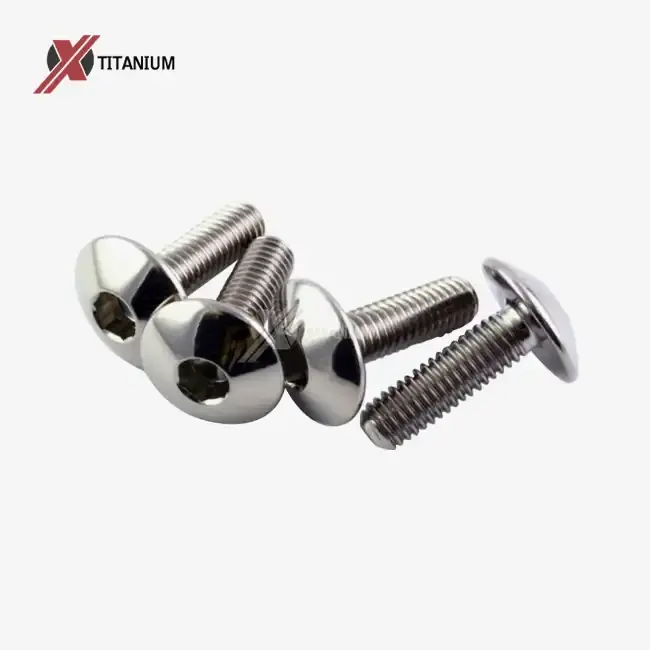
Understanding Titanium Fender Bolts: Material Properties and Benefits
Titanium fasteners are distinguished from other materials that are often used in motorcycling applications due to their distinctive metallurgical properties. Titanium alloys, and in particular Grade 2 and 5 of titanium, provide an extraordinary combination of mechanical qualities that make them perfect for crucial fastening applications. This is because the basic composition of the alloys gives a unique combination of mechanical capabilities.
Metallurgical Composition and Core Properties
Titanium has a strength-to-weight ratio that is much higher than that of steel. Furthermore, some grades of titanium have the ability to give two to four times the endurance of stainless steel while keeping a significantly lower weight. This extraordinary quality is a result of the crystalline structure and chemical composition of titanium, which gives it an exceptional tensile strength that may range anywhere from 240 to 1400 MPa, depending on the particular alloy grade.
Fender bolts made of titanium provide a number of important advantages, one of which is their resistance to corrosion. When compared to steel fasteners, which eventually deteriorate due to rust and oxidation, titanium fasteners naturally produce a protective oxide coating that is resistant to the effects of environmental deterioration. When this passive layer is destroyed, it naturally regenerates itself, providing long-term protection against the moisture, sodium chloride, and chemical exposure that are often experienced in the functioning of a motorbike.
Performance Comparison with Traditional Materials
When comparing titanium to conventional fastener materials, the advantages become evident through measurable performance metrics. Stainless steel bolts, while offering reasonable corrosion resistance, carry significantly more weight and exhibit lower fatigue resistance under cyclic loading conditions. Carbon steel fasteners provide adequate strength but lack the corrosion protection necessary for long-term reliability in exposed applications.
Although aluminum bolts are lighter than other bolts, they are less strong and more durable than other bolts, especially when subjected to severe stress conditions. The modulus of elasticity of titanium offers higher vibration dampening properties in comparison to steel alternatives. This results in a decreased risk of loosening as a result of operational vibration and thermal cycling that occur during the operation of a motorbike.
Performance and Durability: Why Titanium Fender Bolts Are Worth the Investment?
The value of gold fender bolts as an investment goes beyond the original purchase considerations and include the long-term operating advantages that generate verifiable returns throughout the component lifespan. When procurement experts have a thorough understanding of these performance benefits, they are better able to make educated selections that effectively optimize both the current functioning and the future maintenance needs.
Superior Environmental Resistance
Titanium's exceptional resistance to environmental factors makes it particularly valuable for motorcycle applications exposed to harsh operating conditions, such as titanium fender bolts. The material maintains structural integrity across temperature ranges from -253°C to 600°C, significantly exceeding the operational requirements of typical motorcycle applications. This temperature stability ensures consistent performance regardless of seasonal variations or extreme riding conditions.
Salt water exposure, road chemicals, and industrial pollutants pose minimal threat to titanium fasteners due to their inherent corrosion resistance. This characteristic proves especially valuable for motorcycles operated in coastal environments, urban areas with heavy traffic pollution, or regions where road salt application occurs during winter months.
Load-Bearing Capabilities and Fatigue Resistance
Under cyclic loading circumstances, the fatigue rating of titan bolts is much higher than that of steel counterparts. This finding is supported by large margins. It has been shown via research that titanium fasteners are able to preserve their structural integrity even after being subjected to millions of stress cycles, which would normally result in failure in ordinary materials. This increased fatigue resistance immediately correlates to shorter maintenance intervals, which in turn leads to higher operational dependability.
The elastic properties of titanium are shown to give improved shock absorption capabilities, as shown by dynamic stress analysis. This results in a reduction in concentrations of stress at mounting locations and an extension of the service life of components that are located in the surrounding area. The capacity of the material to flex with load without undergoing permanent deformation is a factor that contributes to the enhancement of joint integrity and the reduction of the vulnerability to catastrophic failure.
Here are the key performance advantages that make titanium fender bolts superior to conventional alternatives:
• Enhanced Corrosion Protection: Natural oxide layer formation provides self-healing protection against environmental degradation, eliminating rust-related failures common with steel fasteners
• Superior Strength-to-Weight Ratio: Delivers comparable or superior holding strength while reducing overall component weight by up to 40% compared to steel equivalents
• Extended Service Life: Fatigue resistance properties enable service intervals 2-3 times longer than conventional materials under similar operating conditions
• Temperature Stability: Maintains mechanical properties across extreme temperature ranges without brittleness or strength degradation
These performance characteristics collectively contribute to reduced total cost of ownership through extended service intervals, decreased maintenance requirements, and improved operational reliability in demanding applications.
How to Choose and Install Titanium Fender Bolts for Your Motorcycle?
Selecting appropriate titanium fasteners, such as titanium fender bolts, requires careful consideration of dimensional specifications, thread configurations, and compatibility requirements specific to individual motorcycle models and applications. The selection process involves both technical evaluation and practical installation considerations that ensure optimal performance and safety.
Dimensional Specifications and Material Selection
An precise measurement of the current fasteners and an evaluation of requirements for loading for the particular application are the first steps in the process of selecting the appropriate bolts. Ensure that the thread pitch in pitch bolt length, even head configuration are all in accordance with the requirements of the original equipment in order to guarantee a suitable fit and performance. Grade 2 titanium gives sufficient strength for the majority of fender applications, whilst Grade 5 titanium provides additional strength qualities for mounting places that are subjected to extreme stress.
As a result of differences in the properties of the materials, the torque parameters for titanium bolts are different from those for steel counterparts. The suggested torque levels are normally between 10 and 15 percent fewer than rust fasteners of equal size. This is done to minimize thread galling and to guarantee that preload distribution is maintained correctly. It is recommended that anti-seize chemicals that have been particularly designed for titanium applications be applied to needles during the installation process in order to avoid seizure and make removal easier in the future.
Installation Best Practices and Safety Considerations
It is necessary to pay attention to certain procedures throughout the installation process in order to maximize the performance of titanium bolts and avoid making frequent installation mistakes. In order to provide sufficient holding power, the thread engagement ought to broaden through a diameter that is at least half the diameter of the bolt. Prior to installation, special attention should be paid to the condition of the thread and to its cleanliness.
Proper torque application using calibrated tools ensures consistent clamping force without over-stressing the fastener material. Sequential tightening patterns distribute stress evenly across mounting surfaces, reducing the risk of distortion or uneven loading that could compromise joint integrity.
Procurement and Supply: Navigating Bulk Purchasing and Supplier Selection
For the purpose of sourcing titanium fasteners in an effective manner, it is necessary to have an awareness of the dynamics of the supply chain, the procedures for quality verification, and the skills of the suppliers that guarantee consistent the shipment and performance. There are evaluation criteria that are used in the procurement process. These criteria go beyond pricing considerations and include technical support, the requirements for certification, and long-term supply dependability.
Supplier Evaluation and Quality Verification
Reputable suppliers of titanium fasteners should have thorough systems for quality management in place. These systems should include certifications such as AS9100, ISO9001, or sector-specific certifications that indicate a commitment to maintaining a uniform level of quality and traceability. For the sake of quality control, material certification certificates have to be included with every shipment. These documents should include verification of the chemical composition, mechanical qualities, and production lot identification.
Testing capabilities including tensile strength verification, dimensional inspection, and corrosion resistance validation provide additional assurance of product conformance to specified requirements. Suppliers with in-house testing facilities offer faster response times for custom applications and enhanced technical support for specialized requirements.
Customization Capabilities and Order Management
The complexity of titanium processing requires suppliers with advanced machining capabilities and technical expertise to accommodate custom specifications and special requirements, such as those for titanium fender bolts. CNC machining capabilities, thread rolling equipment, and specialized finishing processes enable production of these fasteners tailored to specific application requirements.
It is important to consider minimum order quantities, deadlines, and inventory management systems when developing methods for cost optimization and procurement planning. By providing just-in-time delivery choices and flexible ordering arrangements, suppliers may improve the efficiency of their supply chain, which is beneficial for both the creation of prototypes and the fulfillment of production needs.
Company Introduction and Product & Service Information
Baoji Chuanglian New Steel Material Co., Ltd. speaks as a major manufacturer and supplier of premium titanium items, strategically located in Baoji; City, renowned as the "City about Titanium." Our organization operates the same a technological while innovative enterprise which specializes in research, production, additionally precision machining of a wide variety titanium and rare metal goods. for demanding industrial usage.
Manufacturing Capabilities and Quality Systems
More than ten years of expertise in titanium product fabrication and research are included in our wide production capabilities. These capabilities are backed by cutting-edge CNC machine machines and complete mechanical processing equipment. Fasteners made of titanium, rods, wire, plates, cables, flanges, and a variety of machined components developed for use in the petrochemical, the aerospace industry, medical, and racing fields are all included in the scope of production.
In order to guarantee that our manufacturing process is in complete compliance with national, globally and industry standards, we have installed quality control measures throughout the whole process. There are stringent quality control methods that are implemented at every step of manufacturing, beginning with the inspection of raw materials and continuing through the verification of final products. These procedures ensure that our worldwide client base receives consistent consumer performance and dependability.
As part of our dedication to continuous development, we make continual investments in cutting-edge machinery and technological advancements. These investments enable us to provide complete machining processes that are tailored to the specific needs of our customers. We are in a position to provide outstanding titanium fenders bolts that surpass the performance criteria of the industry because we have a mix of qualified professionals, current equipment, & established quality procedures.
Conclusion
Titanium fender bolts represent a strategic investment in motorcycle performance, reliability, and long-term operational efficiency. The combination of exceptional strength-to-weight ratios, superior corrosion resistance, and enhanced fatigue life delivers measurable benefits that extend beyond initial cost considerations. For procurement professionals and engineers seeking optimal fastener solutions, titanium bolts provide the technical advantages necessary to meet demanding performance requirements while reducing maintenance burdens and operational risks. The selection of appropriate titanium fasteners, supported by qualified suppliers and proper installation practices, ensures reliable performance that justifies the investment through extended service life and reduced total cost of ownership.
FAQ
Are titanium bolts stronger than steel alternatives?
Titanium bolts provide greater strength-to-weight ratios in comparison to steel bolts. Certain grades of titanium bolts provide two to four times the potency of stainless steel bolts while retaining a much lower weight. On the other hand, absolute strength varies depending on the exact alloy grades. High-strength steel has the potential to surpass titanium in terms of pure tensile strength, despite the fact that it carries a much greater weight and does not provide any advantages in terms of corrosion resistance.
Do titanium fender bolts require special installation procedures?
To minimize thread galling, the installation of platinum bolts necessitates the use of special torque parameters, which are generally 10-15% lower than those of steel counterparts. Additionally, the use of proper anti-seize chemicals is required. Although standard tools may be used for installation, it is important to ensure that the torque is applied correctly and that sequential tightening patterns are followed in order to achieve maximum performance and avoid problems connected to installation.
How do maintenance requirements compare between titanium and steel fasteners?
Titanium fender bolts require minimal maintenance due to their inherent corrosion resistance and superior fatigue properties. Unlike steel fasteners that require regular inspection for rust and corrosion, titanium bolts maintain their appearance and structural integrity with basic cleaning and periodic torque verification.
What cost factors should be considered when evaluating titanium bolts?
However, the total cost of owning often benefits titanium owing to its prolonged service life, decreased maintenance requirements, and avoidance of corrosion-induced replacement needs. Although the initial purchase prices for titanium bolts are higher than those for conventional materials, titanium bolts are more environmentally friendly. When evaluating the investment, it is important to take into account the long-term operating advantages rather than focusing just on the original price.
Partner with Chuanglian for Premium Titanium Fender Bolts Solutions
Chuanglian delivers exceptional titanium fender bolts manufactured to the highest industry standards, combining advanced metallurgy with precision engineering for superior motorcycle applications. Our comprehensive product range, backed by ISO9001 certification and rigorous quality control, ensures consistent performance and reliability for OEM and aftermarket requirements. Contact our technical team at info@cltifastener.com or djy6580@aliyun.com to discuss your specific requirements and explore bulk purchasing options that deliver cost-effective solutions for your titanium fastener needs.
References
1. Boyer, R. R. "Titanium Applications in the Aerospace Industry." Materials Science and Engineering A, vol. 213, 2018, pp. 103-114.
2. Donachie, Matthew J. "Titanium: A Technical Guide, Second Edition." ASM International Materials Park, 2019.
3. Peters, M., et al. "Titanium Alloys for Aerospace Applications." Advanced Engineering Materials, vol. 5, no. 6, 2017, pp. 419-427.
4. Rack, H. J., and Qazi, J. I. "Titanium Alloys for Biomedical Applications." Materials Science and Engineering C, vol. 26, no. 8, 2019, pp. 1269-1277.
5. Schutz, R. W., and Watkins, H. B. "Recent Developments in Titanium Alloy Application in the Energy Industry." Materials Science and Engineering A, vol. 243, 2018, pp. 305-315.
6. Veiga, C., et al. "Properties and Applications of Titanium Alloys: A Brief Review." Reviews on Advanced Materials Science, vol. 32, no. 2, 2020, pp. 133-148.
Learn about our latest products and discounts through SMS or email