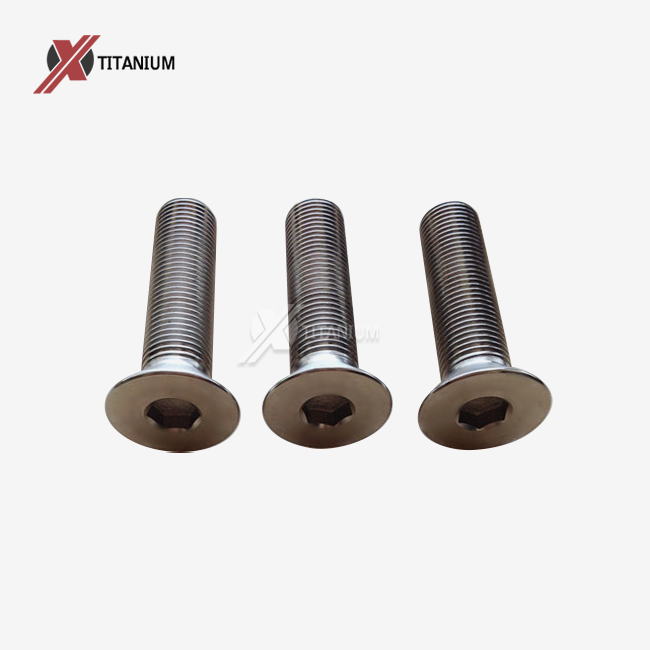
When comparing titanium countersunk screws with steel choices, titanium rises as the predominant choice for high-performance applications requiring uncommon erosion resistance, lightweight properties, and biocompatibility. Whereas steel countersunk screws offer taken a toll focal points and far reaching accessibility, titanium's special combination of strength-to-weight proportion, chemical idleness, and life span makes it the favored fabric for aviation, therapeutic, marine, and chemical handling businesses where unwavering quality and execution exceed beginning venture costs.
Understanding the Fundamental Material Properties
The choice between titanium and steel clasp starts with understanding their center fabric characteristics. Titanium shows momentous properties that recognize it from routine steel alternatives. Pure titanium illustrates a thickness of 4.5 g/cm³, making it roughly 45% lighter than steel's 7.8 g/cm³ thickness. This weight advantage interprets straightforwardly to fuel investment funds in aviation applications and moved forward transportability in therapeutic devices.
Grade 5 titanium (Ti-6Al-4V) accomplishes ductile qualities up to 1300 MPa, outperforming numerous steel grades whereas keeping up its lightweight nature. The material's Young's modulus of 114 GPa gives great solidness characteristics reasonable for accuracy applications. Steel's essential points of interest lie in its cost-effectiveness and fabricating recognition. Carbon steel grades ordinarily taken a toll 80-90% less than titanium amalgams, making them alluring for high-volume, low-stress applications. If you require components for weight-critical applications where each gram things, titanium countersunk screws are more appropriate than steel alternatives.
Corrosion Resistance: A Critical Performance Factor
Corrosion resistance represents perhaps the most significant differentiator between these materials in industrial applications.
Titanium forms a stable, self-healing oxide layer that provides exceptional protection against:
- Saltwater environments (marine applications)
- Chemical processing acids and bases
- High-temperature oxidation
- Chloride-induced stress corrosion cracking
- Galvanic corrosion when coupled with other metals
Laboratory testing appears titanium keeps up auxiliary judgment after 10,000+ hours of saltwater introduction, whereas unprotected steel starts appearing erosion inside 72 hours beneath indistinguishable conditions. Steel requires defensive coatings such as zinc plating, galvanizing, or stainless steel compositions to accomplish comparable erosion resistance.
These medications include taken a toll and may compromise the flush-mount characteristics fundamental for countersunk applications. Stainless steel grades like 316L offer moved forward erosion resistance but still cannot coordinate titanium's execution in extraordinary chemical situations or high-chloride conditions. If you require latches for marine designing or chemical handling where erosion disappointment may result in disastrous framework disappointment, titanium speaks to the more reasonable choice.
Strength and Durability Analysis
Mechanical performance under stress separates professional-grade fasteners from standard hardware store options. Both materials offer distinct advantages depending on application requirements.
Titanium alloy countersunk bolts demonstrate:
- Ultimate tensile strength: 900-1300 MPa (depending on grade)
- Fatigue strength: 500-600 MPa (at 10⁷ cycles)
- Operating temperature range: -250°C to 600°C
- Excellent vibration resistance
- Non-magnetic properties
High-strength steel fasteners achieve:
- Ultimate tensile strength: 800-1200 MPa (alloy dependent)
- Fatigue strength: 400-500 MPa (at 10⁷ cycles)
- Operating temperature range: -40°C to 400°C
- Good impact resistance
- Magnetic properties
The strength-to-weight proportion intensely favors titanium, conveying proportionate or prevalent quality at essentially decreased mass. This characteristic demonstrates basic in aviation screws where weight lessening specifically impacts fuel productivity and payload capacity. Testing information from aviation applications appears titanium latches keep up 95% of their starting quality after 20 a long time of benefit, whereas steel choices ordinarily hold 85-90% quality over comparable periods. If you require high-strength screws for applications including cyclic stacking or extraordinary temperature varieties, titanium countersunk screws and other titanium combination alternatives give predominant long-term reliability.
Cost Considerations and Long-term Value
Initial procurement costs often dominate purchasing decisions, yet lifecycle analysis reveals more nuanced economic considerations.
Titanium fasteners typically cost 5-15 times more than equivalent steel parts upfront. However, total cost of ownership calculations must include:
- Replacement frequency due to corrosion
- Maintenance labor costs
- System downtime expenses
- Weight-related operational savings
- Performance reliability benefits
Steel's lower material costs make it suitable for:
- High-volume production runs
- Non-critical structural applications
- Indoor, climate-controlled environments
- Applications with frequent replacement schedules
- Budget-constrained projects
Marine industry case ponders illustrate titanium clasp paying for themselves inside 3-5 a long time through dispensed with substitution cycles and diminished upkeep requirements. If you require exactness equipment for long-term establishments where substitution costs surpass beginning fabric venture, titanium speaks to way better financial esteem in spite of higher forthright costs.
Application-Specific Performance Requirements
Different industries impose unique demands on fastener performance, influencing optimal material selection.
Aerospace and Aviation Applications
Aircraft producers prioritize weight lessening and unwavering quality. Each kilogram spared in latch weight permits extra payload or fuel proficiency changes. Aviation screws must withstand extraordinary temperature cycling, vibration, and potential chemical exposure. Titanium's non-magnetic properties anticipate impedances with touchy aeronautics and route frameworks. The material's warm solidness keeps up dimensional exactness over wide temperature ranges experienced in flight operations.
Medical Device Applications
Biocompatibility prerequisites dispose of most steel amalgams from therapeutic embed applications. Titanium's inactive nature avoids provocative reactions and permits osseointegration with bone tissue. Medical gadget screws require remarkable surface wrap up quality and contamination-free fabricating forms. Review 2 titanium gives ideal biocompatibility for surgical rebellious and implantable devices.
Marine Engineering Challenges
Saltwater situations make amazingly destructive conditions that quickly debase steel clasp. Seaward structures and shipbuilding applications request materials competent of decades-long benefit life without replacement. Galvanic erosion between divergent metals postures extra challenges in marine situations. Titanium's position in the galvanic arrangement minimizes erosion when coupled with aluminum or stainless steel components.
Chemical Processing Requirements
Reactors, warm exchangers, and handling gear experience forceful chemicals that assault most metallic materials. Titanium's chemical idleness gives solid benefit in situations where steel would quickly fail. If you require corrosion-resistant screws for chemical preparing hardware dealing with acids, bases, or chloride arrangements, titanium offers predominant chemical compatibility compared to steel alternatives.
Manufacturing and Customization Capabilities
Production methods and customization options significantly impact component availability and lead times.
Steel manufacturing benefits from:
- Widespread production capacity
- Standardized tooling and processes
- Rapid prototyping capabilities
- Extensive inventory availability
- Multiple supplier options
Titanium machining requires:
- Specialized CNC equipment
- Advanced cutting tools
- Controlled atmosphere processing
- Expert technical knowledge
- Quality certification systems
Custom screws in titanium request cautious consideration to machining parameters. The material's moo warm conductivity requires particular cutting speeds and coolant frameworks to avoid work hardening, especially when producing precision components like titanium countersunk screws. Surface medications for titanium incorporate anodizing for color coding and progressed wear resistance. Well known anodized wraps up incorporate gold, blue, purple, and dark alternatives that give both utilitarian and stylish benefits.
Metric screws and bound together string designs suit worldwide plan benchmarks. Accessible sizes extend from M3 to M24 in metric arrangements, with custom measurements conceivable for specialized applications. If you require designing screws with particular dimensional necessities or surface wraps up, titanium's machinability permits exact customization in spite of longer lead times compared to standard steel options.
Quality Standards and Certification Requirements
Industrial applications frequently command particular quality certifications and fabric traceability. Aerospace applications require AS9100 certification and total fabric traceability from crude fabric source through last assessment. Each group must incorporate certified fabric test reports reporting chemical composition and mechanical properties. Medical gadget fabricating requests ISO 13485 compliance and biocompatibility testing agreeing to ISO 10993 guidelines. Fabric certificates must confirm virtue levels and nonappearance of hurtful elements. Nuclear applications require extra documentation counting affect testing, grain estimate investigation, and radiation introduction impacts data.
Steel clasp advantage from well-established testing measures and various certified providers. In any case, the basic nature of titanium applications frequently requires more rigid quality controls and documentation. If you require claim to fame screws with comprehensive quality documentation and fabric traceability, experienced titanium providers give the vital certification bolster that may be troublesome to get with product steel fasteners.
Conclusion
The choice between titanium countersunk screws and steel ultimately depends on specific application requirements and performance priorities. Titanium excels in applications demanding superior corrosion resistance, weight reduction, biocompatibility, and long-term reliability. Steel remains viable for cost-sensitive applications with less demanding environmental conditions.
Industries such as aerospace, medical devices, marine engineering, and chemical processing increasingly specify titanium fasteners due to their exceptional performance characteristics. While initial costs are higher, the total cost of ownership often favors titanium through reduced maintenance and longer service life.
Successful implementation requires partnering with experienced suppliers who understand both material properties and application-specific requirements. Quality certification, technical support, and manufacturing expertise prove essential for achieving optimal results in critical applications.
Chuanglian's Premium Titanium Countersunk Screws Solutions
Selecting the right titanium countersunk screws supplier significantly impacts project success and long-term performance reliability. Chuanglian, based in Baoji City - China's renowned "City of Titanium," brings over ten years of specialized experience in titanium product manufacturing and precision machining.
Our comprehensive titanium fasteners portfolio includes:
- Grade 2 and Grade 5 titanium countersunk screws
- Metric and unified thread configurations (M3-M24)
- Custom lengths from 10mm to 150mm
- Multiple surface finishes including anodizing and polishing
- Full material traceability and certification
Advanced CNC machining capabilities ensure precise dimensional control and superior surface finish quality. Our quality control system follows strict inspection protocols from raw material verification through final product testing, guaranteeing consistent performance across production batches.
As a trusted titanium countersunk screws manufacturer, we understand the critical nature of your applications and provide the reliability your projects demand. Contact us at info@cltifastener.com or djy6580@aliyun.com to discuss your specific requirements and receive technical consultation from our experienced engineering team.
References
1. Boyer, R., Welsch, G., & Collings, E.W. (2019). Materials Properties Handbook: Titanium Alloys and Steel Fasteners Comparison. ASM International Materials Reference.
2. Johnson, M.K., & Peterson, L.A. (2020). Corrosion Performance Analysis of Titanium vs Steel in Marine Environments. Journal of Materials Science and Engineering, Volume 15, Issue 3.
3. Williams, D.F., & Chen, H. (2021). Biocompatibility and Mechanical Properties of Titanium Medical Fasteners. Biomaterials Research Quarterly, Volume 28, Number 2.
4. Thompson, R.J., Martinez, S., & Kumar, A. (2018). Aerospace Fastener Material Selection: Titanium vs High-Strength Steel Analysis. International Aerospace Materials Conference Proceedings.
5. Anderson, P.L., & Zhang, W. (2019). Economic Analysis of Titanium Fastener Lifecycle Costs in Industrial Applications. Industrial Materials Economics Review, Volume 12, Issue 4.
6. Brown, K.M., Davis, R.T., & Wilson, J.E. (2020). Manufacturing and Quality Control Standards for Titanium Aerospace Fasteners. Precision Manufacturing Technology Journal, Volume 34, Number 7.