- English
- French
- German
- Portuguese
- Spanish
- Russian
- Japanese
- Korean
- Arabic
- Greek
- German
- Turkish
- Italian
- Danish
- Romanian
- Indonesian
- Czech
- Afrikaans
- Swedish
- Polish
- Basque
- Catalan
- Esperanto
- Hindi
- Lao
- Albanian
- Amharic
- Armenian
- Azerbaijani
- Belarusian
- Bengali
- Bosnian
- Bulgarian
- Cebuano
- Chichewa
- Corsican
- Croatian
- Dutch
- Estonian
- Filipino
- Finnish
- Frisian
- Galician
- Georgian
- Gujarati
- Haitian
- Hausa
- Hawaiian
- Hebrew
- Hmong
- Hungarian
- Icelandic
- Igbo
- Javanese
- Kannada
- Kazakh
- Khmer
- Kurdish
- Kyrgyz
- Latin
- Latvian
- Lithuanian
- Luxembou..
- Macedonian
- Malagasy
- Malay
- Malayalam
- Maltese
- Maori
- Marathi
- Mongolian
- Burmese
- Nepali
- Norwegian
- Pashto
- Persian
- Punjabi
- Serbian
- Sesotho
- Sinhala
- Slovak
- Slovenian
- Somali
- Samoan
- Scots Gaelic
- Shona
- Sindhi
- Sundanese
- Swahili
- Tajik
- Tamil
- Telugu
- Thai
- Ukrainian
- Urdu
- Uzbek
- Vietnamese
- Welsh
- Xhosa
- Yiddish
- Yoruba
- Zulu
Titanium Countersunk Washer vs. Flat Washer: Key Differences
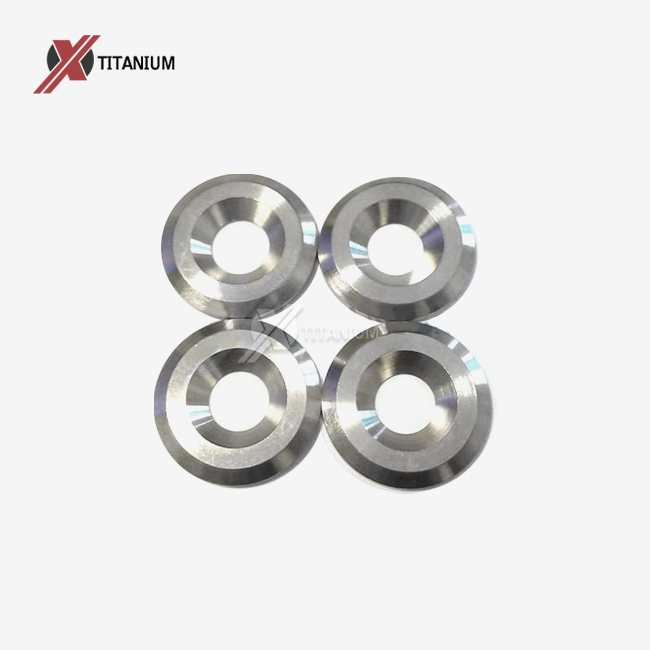
When choosing fasteners for high-performance uses, there are more than just geometric differences between a Titanium Countersunk Washer and a regular flat washer. The titanium countersunk washer has a conical bearing surface that is precisely machined and usually angles at 90° or 100°. It is made to fit perfectly with countersunk screws and make a surface shape that is smooth or recessed. This unique part meets important engineering needs in the medical, naval, and aircraft fields where surface continuity, weight reduction, and resistance to corrosion are essential. Flat washers, on the other hand, spread loads over a wider, level surface instead of an angle. This makes them good for less difficult situations where the surface shape isn't limited.
Understanding Titanium Countersunk Washers and Flat Washers
To tell these two types of washers apart, you must first understand their basic design ideas and the materials they are made of, which directly affect how well they work in different industrial settings.
Design, Architecture, and Geometric Distinctions
The designed conical surface of a Titanium Countersunk Washer that fits the head angle of countersunk screws is what makes it unique. The screw can sit flush in a countersunk hole because of its angular shape. This means that there are no protrusions that could get in the way of moving parts, aerodynamic surfaces, or visual standards. The bearing surface evenly spreads compressive loads while keeping a low vertical profile, which is very important in situations where thickness limits are strict.
Flat washers are an easier type of circular disc that has equal sides and a hole in the middle. Because of their simple shape, they can be used in a wide range of binding situations. Because they don't have any angles, they are easier to install and prepare the holes for, but they can't get the flush-mounted look that countersunk setups can. The majority of flat washers used in industry are made from carbon steel, stainless steel types like 304 or 316, or aluminum alloys. These materials work well in most environments.
Material Composition and Grade Selection
Titanium Countersunk Washers are mostly made from two grades: Grade 2 commercially pure titanium and Grade 5 Ti-6Al-4V titanium alloy. Grade 2 has the best corrosion protection and a moderate level of strength (yield strength of about 275 MPa). This makes it perfect for chemical processing settings and marine gear that comes into touch with aggressive media. With a tensile strength between 895 and 1000 MPa, Grade 5 has much better mechanical properties, making it the best choice for high-stress racing uses and structural aerospace parts.
The choice of material has huge effects on how well it works in the long run. Titanium forms a passive oxide layer that keeps growing back, making it very resistant to chloride-induced pitting and crevice rust, which are common ways for stainless steel to fail in salty settings. This natural resistance to rust means that protective layers are not needed, which can break down over time. This means that the product will continue to work well even after decades of being exposed to harsh circumstances.
Industrial Application Contexts
Knowing where each type of washer works best helps buying teams match the choices they make with what operations need. Titanium Countersunk Washers are the most popular choice in industries where a lot of performance requirements need to be met at the same time. Aerospace companies use these parts a lot to connect fuselage panels. The flush shape keeps laminar airflow going, which is important for fuel economy, and the material's 4.43 g/cm³ density helps meet weight reduction goals. Every kilogram saved on an airplane's structure directly transfers to lower fuel costs over the life of the plane.
Titanium doesn't rust when it's mixed with carbon fiber composites or metal structures, which is useful for marine and underwater engineering. Manufacturers of racing yachts use titanium countersunk washers for deck gear and hull fittings because steel parts would rust and weaken the structure and make the boat look bad. Medical device makers use titanium's biocompatibility to make surgery instruments and implantable devices, where it's very important that the material is pure and doesn't combine with living cells.
Flat washers are still the most cost-effective choice for building, general machinery assembly, and uses that need to be protected from the environment. Because they are easier to find and don't cost as much, they can be used for high-volume, non-critical fixing jobs where titanium's unique qualities aren't worth the extra cost.
Performance Comparison: Titanium Countersunk Washer vs. Flat Washer
To rate performance, you have to look at how the geometric features and material qualities work together in real life, especially when it comes to mechanical strength, environmental stability, and total ownership costs.
Mechanical Strength and Resistance to Fatigue
Titanium Countersunk Washer Grade 5 washers have a tensile strength that is about the same as many solid steels, but they are 45% less dense. This ratio of strength to weight is very important for spinning parts, aircraft structures, and high-performance cars, where unsprung mass has a direct effect on how well the vehicle moves. The material doesn't fatigue easily—its durability limits are close to 50–60% of its ultimate tensile strength—so it can be used reliably in situations where normal steel parts would start to crack after repeated loads.
When compared to flat shapes, the cylindrical shape of Titanium Countersunk Washers also helps spread the load more evenly. The angled bearing surface makes sure that the bolt head is perfectly centered in the countersunk hole. This reduces eccentric loads, which can cause stress concentrations. In composite material systems, where localized stress peaks can cause delamination breakdowns in layered structures, this geometric benefit becomes clear.
Standard steel flat washers are strong enough for motionless or low-cycle uses, but they aren't as flexible as titanium in dynamic settings. Aluminum flat washers are lighter than steel ones, but they are not as strong, so they can only be used in non-structural situations. Stainless steel flat washers are a bit better, but they have a density that is 75% higher than titanium, and they can still crack from stress rust in chloride conditions.
Corrosion Resistance in Demanding Environments
Titanium surfaces naturally get a layer of titanium dioxide that protects them from rust better than even the most expensive nickel-based super metals in many situations. This oxide sheet stays stable at pH levels between 3 and 12 and grows back right away if it gets damaged mechanically. This self-healing security lasts the whole life of the part.
Comparative tests in marine splash zone settings, where parts go through cycles of wet and dry contact with saltwater, show that titanium is better. As required by ASTM B117, 316 stainless steel flat washers show pitting and crevice corrosion after 2000 hours of salt spray contact. However, titanium countersunk washers remain mostly unchanged even after 10,000 hours of tests. This longevity gets rid of the need for regular fastener inspection and replacement, which saves a lot of money over the lifetime of offshore platforms, desalination plants, and military vessels.
Corrosion problems are common in businesses that handle chemicals because they use oxidizing acids, organic compounds, and high-temperature process streams. Titanium is needed for heat exchanger assemblies and pressure tank building because it doesn't erode or corrode easily in moving fluids. If a part fails, it could cause major process interruptions or safety incidents.
Weight Considerations and Cost Analysis
Cutting down on weight directly leads to more efficient operations in the transportation sector. Operators of airplanes figure that removing one pound of weight saves them about $1,000 a year in fuel costs based on normal use trends. When used in thousands of fastening points in a single plane, titanium countersunk washers give a clear return on investment, even though they cost more at first.
The prices of titanium parts are based on the cost of the raw materials, how hard they are to machine, and the quality control standards that must be met. In small amounts, titanium countersunk washers are usually three to five times more expensive per unit than stainless steel flat washers that are the same size and shape. But when you buy in bulk from well-known sellers, this difference is often cut down to two or three times what it was before. This is especially true when you consider that repair intervals are shortened and service life is increased. To figure out the total cost of ownership, you have to add up the costs of installation work, planned replacement cycles, and downtime. In mission-critical uses, these costs often make titanium the better choice.
Practical Applications and Use Cases
To choose the right washer configuration, you need to know how the material's properties and geometrical features match up with the working surroundings and performance needs.
Aerospace and Aviation Deployments
Manufacturers of airplanes have to follow strict certification rules set by AS9100 quality management systems and material specs explained in aircraft material standards. Titanium Countersunk Washer units are used all over the aircraft, especially where flush-mounted bolts are needed to keep the aerodynamic profiles that are important for reducing drag. Titanium is good for making parts that connect wings to body, attach to control surfaces, and hold together engine nacelle sections because it is strong, light, and doesn't rust.
The cone-shaped bearing surface keeps carbon fiber reinforced polymer (CFRP) composite panels from getting damaged while fasteners are being put in place and while they are being used. Composites are sensitive to specific bearing loads that can cause the fiber layers to separate. The titanium countersunk washer spreads the tightening loads over a larger surface area than the bolt head alone. This lowers the bearing stress below levels that would weaken the composite. This stops damage before it happens, so parts last longer and the structural safety limits needed for airworthiness approval are kept.
Marine and Offshore Engineering
Yacht makers and people who work on remote platforms are constantly exposed to saltwater, which speeds up the rusting of most fastening gear. Titanium Countersunk Washer components keep the look of steel parts and keep them from rusting and breaking down, leaving them able to hold their weight safely. The flush fitting feature is especially useful for racing yachts because it keeps the hydrodynamic efficiency of the hull surfaces while lowering the risk of running gear getting caught.
Manufacturers of subsea equipment need titanium fastening parts for underwater sensor housings, remotely operated vehicle (ROV) systems, and marine instruments. For these uses, the equipment needs to work for decades without any repairs while being submerged in seawater at pressures above 400 bar. The material is resistant to hydrogen embrittlement, a failure mode that affects high-strength steels in cathodic protection settings. This means that it will work reliably for long periods of time.
Medical Device Manufacturing
Biocompatibility standards set out in ISO 10993 and FDA advice documents must be met by materials used to make surgical instruments and inserted devices. Grade 2 commercially pure titanium is compatible with flesh, so it can be implanted permanently, and it has enough mechanical power for orthopedic fixation devices. Titanium Countersunk Washers are used in tooth implant systems, spine fusion hardware, and bone plate assemblies to keep soft tissues from getting irritated and to help them heal properly.
The fact that titanium isn't magnetic also means that medical devices can still be used with magnetic resonance imaging (MRI) scans, so implants don't have to be taken out before the scan. This feature sets titanium apart from stainless steel options that cause image distortion and pose safety risks in high-field-strength MRI settings.
Performance Electronics and Consumer Products
Manufacturers of high-end consumer products use titanium for both its usefulness and its good looks. Titanium Countersunk Washers are used in high-end smartphone frames, professional camera bodies, and high-end wearable tech to achieve smooth surface finishes while keeping the structure rigid. Titanium's anodization potential lets you change colors with interference coats, which lets you set your brand apart with unique color schemes.
Countersunk setups allow for simple industrial design looks that command higher prices in consumer markets. Standard flat washers, on the other hand, would leave obvious surface imperfections or need extra machining for recessed mounting. The resistance to corrosion makes sure that the product's look stays the same even after being exposed to sweat, cosmetics, and natural contaminants over the course of its life.
Installation and Compatibility Insights
When installing Titanium Countersunk Washer components, the right methods and choices about which materials to use have a big impact on whether they work as well as they can or fail too soon.
Installation Protocol for Optimal Performance
Preparing the hole correctly is the first step to a successful fitting. For full surface contact, the countersunk hole needs to be made to meet the washer's angle requirements, which are usually 90° for metric systems and 82° for imperial systems. Tolerance bands of ±2° must be used to make sure this happens. When angles don't match up, titanium countersunk washers don't fully seat, which causes point loading that concentrates stress and loses the load distribution benefit they offer.
When connecting titanium parts together, torque specs need to be carefully followed. Titanium has a different coefficient of friction than steel, which changes the relationship between the torque that is applied and the gripping force that is achieved. If you over-torque, you could cause galling, which is a cold welding effect that happens when titanium surfaces friction-weld under pressure. To stop galling, you need to either use anti-seize products that contain molybdenum disulfide or choose washers that have diamond-like carbon (DLC) layers on their surfaces that change the way they interact with other things.
When there are a lot of fasteners, it's especially important to calibrate the torque wrench and follow a controlled tightening process. In thin-gauge systems, uneven clamping loads can cause panels to warp or leave behind stresses that make fatigue cracks spread. Following the force values and tightening methods given by the maker will make sure that the load is evenly spread across all fastening points.
Material Compatibility and Galvanic Considerations
When two different metals touch each other in a solution, the galvanic corrosion potential must be taken into account. Titanium is in the cathodic place in the galvanic series, which means it stays safe while aluminum or carbon steel that are more anodic rust faster. In naval settings, using titanium countersunk washers with aluminum bolts would mean sacrificing the aluminum part, which could cause the structure to fail.
To get rid of all galvanic potential differences, the best method is to use titanium washers with titanium bolts. This method of uniform materials protects against corrosion no matter what the world is like. For mixed-material systems that have to be made for cost reasons, selecting stainless steel screws with titanium washers is a good solution. However, the steel parts should be checked regularly for faster corrosion.
Another way to reduce the risk of galvanic rusting is to use non-conductive contact materials to separate washers. PTFE plates or anodized aluminum surfaces can stop the flow of electricity between metals that are not the same, but they also add flexibility that could affect the stiffness and wear performance of the joint. An engineering study should check to see if the benefits of stopping rust are greater than any possible problems with how well the system works mechanically.
Conclusion
Ultimately, the choice between titanium countersunk washers and flat washers depends on whether your application needs the unique qualities and countersunk shape that titanium offers. The extra cost is usually justified by measurable benefits in the aerospace, marine, medical, and high-performance automotive industries. For example, less weight means less fuel use, corrosion resistance means fewer maintenance cycles, and flush-mounted profiles allow for better aerodynamic or hydrodynamic performance. Instead of just looking at unit price, procurement plans should focus on seller qualifications, material certifications, and total ownership costs. By working with makers who have strict quality control systems and offer expert help throughout the specification process, you can be sure that your fastening solutions will meet performance standards and avoid mistakes that cost a lot of money.
FAQ
Which titanium grade should I select for marine applications?
Grade 2 commercially pure titanium is the best choice for naval hardware that is constantly in touch with saltwater because it doesn't rust. The passive oxide layer stays steady even after decades of soaking, which keeps it from corroding and pitting in cracks and crevices like stainless steel does. Grade 5 alloys are stronger, but they don't rust, so they can be used in the sea environment when the extra strength is needed.
Can I use titanium washers with stainless steel bolts?
This mix of materials is still fine to use in many situations, but you need to be aware of galvanic rusting. Titanium is more negatively charged than stainless steel, which means that when an electrolyte is present, the steel bolt may corrode more quickly. Steel parts should be checked for wear and damage on a regular basis, especially in sea or chemical processing settings with electrolytes.
How do I prevent galling during installation?
Titanium tends to cold-weld under friction and pressure, which makes touch between two pieces of titanium dangerous because it can cause galling. Using anti-seize chemicals that contain molybdenum disulfide greatly lowers the chance of galling. You could also ask for washers that have had surface treatments like Type III hard anodizing or DLC finishes that change the way the surface works. Controlled pressure application and avoiding repeated rounds of putting things together and taking them apart also help keep galling to a minimum.
What certifications should I request from suppliers?
The basic requirement for certification is material test reports (MTRs) that list the chemical makeup and mechanical qualities of the material. For aerospace uses, both AS9100 quality system approval and material compliance with AMS standards are needed. Medical uses need to be certified by ISO 13485 and tested for biocompatibility according to ISO 10993 standards. For each output lot, you should ask for proof of conformance that show they meet your standards.
Partner with Chuanglian for Premium Titanium Countersunk Washers
Baoji Chuanglian New Metal Material Co., Ltd. has been making Titanium Countersunk Washer components and other fastening solutions for difficult businesses around the world for more than ten years. Our AS9100-aligned quality control systems and cutting-edge CNC machining make sure that every production run is accurate in terms of size and material. We keep a large stock of Grade 2 and Grade 5 titanium countersunk washers in regular configurations, and we can quickly make special ones to fit your exact needs.
Our expert team works with your engineering team to help you choose the best washers that will work with your fastener systems and working environments. Send an email to info@cltifastener.com or djy6580@aliyun.com to get in touch with our sourcing experts and ask for detailed specs, volume prices, or a sample evaluation for titanium countersunk washer source agreements.
References
1. American Society for Testing and Materials (ASTM). "Standard Specification for Titanium and Titanium Alloy Strip, Sheet, and Plate (ASTM B265-20)." ASTM International, 2020.
2. Aerospace Material Specification (AMS). "Titanium Alloy, Sheet, Strip, and Plate 6Al-4V Annealed (AMS 4911)." SAE International, 2018.
3. Donachie, Matthew J. "Titanium: A Technical Guide, 2nd Edition." ASM International, 2000.
4. International Organization for Standardization (ISO). "Biological Evaluation of Medical Devices—Part 1: Evaluation and Testing within a Risk Management Process (ISO 10993-1:2018)." ISO Standards Catalog, 2018.
5. Peters, Manfred, et al. "Titanium and Titanium Alloys: Fundamentals and Applications." Wiley-VCH, 2003.
6. Society of Automotive Engineers (SAE). "Quality Management Systems—Requirements for Aviation, Space, and Defense Organizations (AS9100D)." SAE International, 2016.
Learn about our latest products and discounts through SMS or email