Engineers and procurement workers need to know the difference between titanium eye bolts and anchor bolts when choosing fixing solutions for important purposes. Anchor bolts connect structures by drilling into concrete or brickwork, while titanium eye bolts have a round eye shape that makes anchoring places for moving and secure tasks. The main difference is what they are used for: anchor bolts are great for making lasting structural links in building and infrastructure projects, while eye bolts are best for dynamic lifting tasks that need high strength-to-weight ratios.
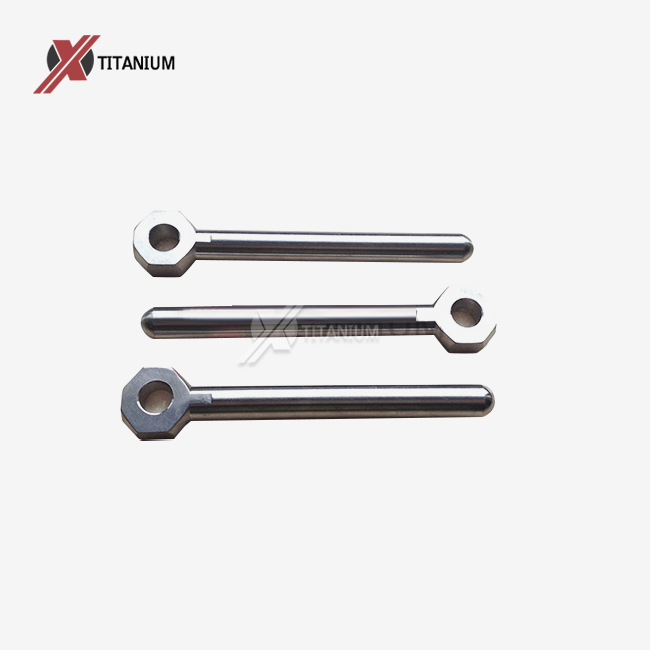
Understanding Titanium Eye Bolts: Design and Applications
Eye bolts made of titanium are a special kind of moving hardware that is designed for tough industrial uses. The better material qualities of titanium metals are combined with precisely cut eye shapes in these screws. One of the unique design features is a threaded shank that ends in a closed-loop eye. This set-up makes it possible to connect wires, chains, or hanging gear securely. Asme B18.15 guidelines are usually followed when making things, which makes sure that the dimensions are correct and the load-bearing is consistent.
These parts are often used in aerospace uses for putting together and maintaining airplanes. The aircraft business needs bolts that can handle big changes in temperature while still holding the structure together. Titanium eye bolts keep 95% of their strength at 300°C, according to test results from aircraft makers. Titanium is very resistant to rust, which is good for marine building projects. Testing in salt water shows that titanium eye bolts keep their mechanical properties after being exposed to a 3.5% sodium chloride solution nonstop for 5,000 hours.
Key advantages include:
- Superior strength-to-weight ratio (specific strength of 274 kN·m/kg)
- Excellent corrosion resistance in aggressive environments
- Biocompatibility for medical device applications
- Temperature stability from -253°C to 600°C
- Non-magnetic properties for sensitive equipment
If you need lifting solutions for aerospace or marine applications where weight reduction and corrosion resistance are critical, then titanium eye bolts are more suitable than conventional steel alternatives.
Anchor Bolts: Structural Foundation Elements
Anchor bolts are important parts of building and structural engineering projects because they hold things together. These fasteners make links between solid steel parts and concrete supports that last. Anchor bolts usually come in three different shapes: straight, bent, and headed. Cast-in-place systems are installed while the concrete is being poured, while post-installed systems are put after the concrete is set. The design standards usually follow the rules in the ACI 318 building code for concrete constructions.
Several things affect the load capacity estimate, such as the strength of the concrete, the depth of the embedment, and the lengths between the edges. When anchor bolts are placed correctly, they can reach final tensile strengths that are higher than 80% of the bolt's material yield strength. In construction, it is used for things like building supports, bridge frames, and placing industrial equipment. Anchor bolts are often used to secure heavy processing equipment in petrochemical plants, where base loads can be more than 500 kN per connection point.
Performance characteristics include:
- High pullout resistance through mechanical or adhesive bonding
- Permanent installation with minimal maintenance requirements
- Versatile sizing options from M12 to M72 diameters
- Compatibility with various concrete grades and densities
- Seismic resistance when properly designed and installed
If you need permanent structural connections for buildings or infrastructure where load transfer to foundations is essential, then anchor bolts are more suitable than temporary fastening solutions.
Material Properties Comparison: Performance Under Stress
Performance Under Stress The choice of material has a big effect on how well fasteners work in tough situations. Titanium alloys are clearly better than regular steel anchor nuts in certain working conditions. Titanium Grade 5 (Ti-6Al-4V) has maximum strengths of 895 to 930 MPa, while high-strength steel anchor bolts usually have strengths between 620 and 830 MPa. However, titanium's higher mass (4.43 g/cm³ vs. 7.85 g/cm³ for steel) makes it stronger in specific ways. Corrosion protection tests show that titanium works very well in salt settings.
Accelerated corrosion tests show that titanium screws rust at rates lower than 0.025 mm/year, while steel in marine settings rusts at rates between 0.5 and 2.5 mm/year. According to research on fatigue performance, titanium eye bolts keep their structural integrity after 10 load cycles at 60% of their maximum tensile strength. Because they don't wear down easily, they are perfect for dynamic pulling jobs on offshore sites and in mobile equipment. Testing for temperature stability shows that titanium keeps its mechanical qualities even when the temperature goes from very low to very high.
At very low temperatures (-196°C), titanium metals get stronger while still being able to bend. A study of costs shows that titanium screws are more expensive than steel ones, usually 8 to 15 times more. Lifecycle cost estimates, on the other hand, tend to support titanium in situations where the cost of repair or system downtime has a big effect on the economy. Titanium eye bolts are more expensive at first, but they are worth it in the long run if you need screws for harsh settings where material degradation could put people's safety or the business at risk.
Application-Specific Selection Criteria
Selecting appropriate fastening solutions requires careful consideration of operational requirements, environmental conditions, and performance expectations.
Aerospace applications typically mandate titanium eye bolts for aircraft structural connections and ground support equipment. Weight reduction requirements often justify the material cost premium. A single titanium eye bolt can reduce aircraft weight by 0.2-0.5 kg compared to steel equivalents.
Medical device manufacturing requires biocompatible materials meeting FDA regulations. Titanium Grade 2 and Grade 23 alloys provide the necessary biocompatibility for surgical instruments and implantable devices. Cytotoxicity testing confirms titanium's excellent tissue compatibility.
Petrochemical processing environments expose fasteners to aggressive chemicals and high temperatures. Titanium's resistance to chlorine, sulfuric acid, and other process chemicals makes it ideal for reactor vessel connections and piping systems.
Construction projects typically utilize anchor bolts for foundation connections due to cost considerations and adequate performance in standard building applications. Galvanized steel anchor bolts provide sufficient corrosion protection for most construction environments.
Marine engineering applications benefit from titanium's seawater resistance. Offshore platforms and shipbuilding operations often specify titanium eye bolts for critical lifting points and structural connections exposed to salt spray.
Selection considerations include:
- Environmental exposure conditions and required service life
- Load requirements including static, dynamic, and cyclic loading
- Installation constraints and accessibility for maintenance
- Regulatory compliance requirements for specific industries
- Economic factors including initial cost and lifecycle expenses
If you need fasteners for chemical processing or marine applications where corrosion poses significant operational risks, then titanium eye bolts offer superior performance and reliability.
Installation Considerations and Best Practices
Proper installation techniques ensure optimal performance and safety margins for both titanium eye bolts and anchor bolts. Titanium eye bolt installation requires specific torque specifications to prevent galling or thread seizure. Recommended torque values typically range from 60-80% of those used for equivalent steel fasteners due to titanium's lower modulus of elasticity.
Thread engagement calculations show titanium eye bolts require minimum engagement lengths of 1.5 times the nominal diameter for full strength development. This differs from steel fasteners which typically require 1.0-1.25 times nominal diameter.
Anti-seize compound application becomes critical when installing titanium fasteners into steel or aluminum substrates. Proper lubrication prevents galvanic corrosion and facilitates future removal if necessary.
Anchor bolt installation demands precise positioning and embedment depth control. Construction tolerance analysis indicates position accuracy within ±6mm ensures proper structural load transfer without inducing secondary stresses.
Quality control procedures include visual inspection, dimensional verification, and load testing where applicable. Non-destructive testing methods such as magnetic particle inspection or ultrasonic testing may be specified for critical applications.
Installation best practices encompass:
- Verification of material certificates and traceability documentation
- Proper tool selection and calibration for torque-controlled assembly
- Environmental protection during installation and curing periods
- Documentation of installation parameters for future reference
- Post-installation inspection and acceptance criteria verification
If you need guidance on proper installation techniques for critical applications, then consulting with experienced titanium fastener suppliers ensures optimal results.
Conclusion
The choice between titanium eye bolts and anchor bolts ultimately depends on specific application requirements, environmental conditions, and performance expectations. Titanium eye bolts excel in demanding applications requiring superior corrosion resistance, exceptional strength-to-weight ratios, and long-term reliability in aggressive environments. Anchor bolts serve essential roles in structural connections where permanent installation and high load capacity take precedence over weight considerations. Understanding these fundamental differences enables informed decision-making for optimal fastening solutions in critical industrial applications. Professional consultation with experienced suppliers ensures proper material selection and installation practices for maximum performance and safety.
Chuanglian's Premium Titanium Eye Bolts: Your Trusted Manufacturing Partner
Baoji Chuanglian New Metal Material Co., Ltd. stands as a leading titanium eye bolts manufacturer with over ten years of specialized experience in precision titanium machining and processing. Our comprehensive manufacturing capabilities and strict quality control systems deliver exceptional fastening solutions for demanding industrial applications.
Located in Baoji City, known as the "City of Titanium," our facility benefits from proximity to premium raw material sources and established titanium processing infrastructure. This strategic location enables us to maintain consistent material quality while optimizing production efficiency and delivery schedules.
Our advanced manufacturing capabilities include:
- Dozen CNC machine tools for precision machining operations
- Complete quality control system from raw materials to finished products
- AS9100 and ISO9001 certified quality management systems
- Comprehensive testing facilities for material verification and performance validation
- Traceable production processes ensuring full documentation and certification
Technical expertise encompasses titanium alloy selection, custom design engineering, and application-specific optimization. Our engineering team collaborates with customers to develop tailored solutions meeting exact performance requirements and industry specifications.
Quality assurance protocols include incoming material inspection, in-process monitoring, and final product verification. Every titanium eye bolt undergoes dimensional inspection, surface finish evaluation, and mechanical property confirmation before shipment.
Global customer base includes aerospace manufacturers, petrochemical processors, marine engineering companies, and medical device producers. Our products successfully operate in critical applications worldwide, demonstrating consistent performance and reliability.
Partner with Chuanglian for your titanium fastener requirements and experience the difference that decade-long expertise and unwavering quality commitment make in your critical applications. Contact us at info@cltifastener.com or djy6580@aliyun.com to discuss your specific titanium eye bolt needs and discover how our manufacturing excellence can enhance your project success.
References
1. American Society of Mechanical Engineers. "ASME B18.15 - Forged Eyebolts and Screw Eyes." ASME International, 2018.
2. Boyer, Rodney R., and Harold L. Gegel. "Materials Properties Handbook: Titanium Alloys." ASM International, 1994.
3. American Concrete Institute. "ACI 318-19: Building Code Requirements for Structural Concrete and Commentary." ACI Committee 318, 2019.
4. Donachie, Matthew J. "Titanium: A Technical Guide, 2nd Edition." ASM International, 2000.
5. Kulak, Geoffrey L., John W. Fisher, and John H. A. Struik. "Guide to Design Criteria for Bolted and Riveted Joints, 2nd Edition." American Institute of Steel Construction, 2001.
6. Schutz, Richard W., and David E. Thomas. "Corrosion of Titanium and Titanium Alloys in Marine Environments." Journal of Materials Engineering and Performance, Vol. 6, No. 6, 1997.