- English
- French
- German
- Portuguese
- Spanish
- Russian
- Japanese
- Korean
- Arabic
- Greek
- German
- Turkish
- Italian
- Danish
- Romanian
- Indonesian
- Czech
- Afrikaans
- Swedish
- Polish
- Basque
- Catalan
- Esperanto
- Hindi
- Lao
- Albanian
- Amharic
- Armenian
- Azerbaijani
- Belarusian
- Bengali
- Bosnian
- Bulgarian
- Cebuano
- Chichewa
- Corsican
- Croatian
- Dutch
- Estonian
- Filipino
- Finnish
- Frisian
- Galician
- Georgian
- Gujarati
- Haitian
- Hausa
- Hawaiian
- Hebrew
- Hmong
- Hungarian
- Icelandic
- Igbo
- Javanese
- Kannada
- Kazakh
- Khmer
- Kurdish
- Kyrgyz
- Latin
- Latvian
- Lithuanian
- Luxembou..
- Macedonian
- Malagasy
- Malay
- Malayalam
- Maltese
- Maori
- Marathi
- Mongolian
- Burmese
- Nepali
- Norwegian
- Pashto
- Persian
- Punjabi
- Serbian
- Sesotho
- Sinhala
- Slovak
- Slovenian
- Somali
- Samoan
- Scots Gaelic
- Shona
- Sindhi
- Sundanese
- Swahili
- Tajik
- Tamil
- Telugu
- Thai
- Ukrainian
- Urdu
- Uzbek
- Vietnamese
- Welsh
- Xhosa
- Yiddish
- Yoruba
- Zulu
Titanium Slider Pin Uses in Aerospace and Automation Systems
Moving parts are guided, lined up, and found by a titanium slider pin that keeps the weight low. It can be found in latches, hinges, access panels, seat mechanisms, and actuator linkages in airplanes. It helps grippers, tool changers, indexing fixtures, and pick-and-place units work better because the lighter parts make them less likely to move. Grade 5 titanium (Ti-6Al-4V) is about 44% lighter than carbon steel and has a density of 4.43 g/cm³. It also doesn't rust. I talk about tolerances, surface treatments, selection, and buying steps in this guide so that you can get the right part.
Titanium Slider Pin Basics: Function, Material, and Fit
How a Titanium Slider Pin Works?
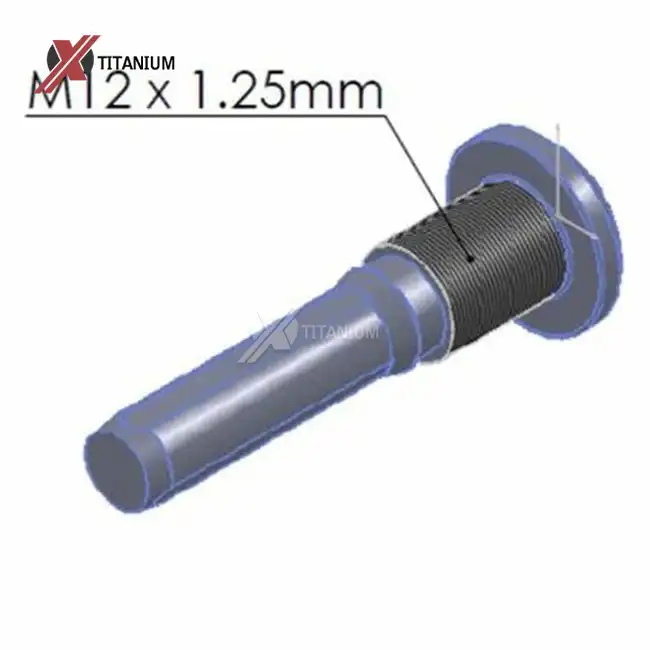
A titanium slider pin is a round part that holds something in place, moves with the part, or keeps it in place between two parts that fit together. It could be a plain pin, a shoulder pin, a guide pin, a dowel, or a threaded retaining pin, depending on the part. Different types with grooves, flanges, and slots are common. OEM drawings often include extra shoulders or cross-holes. Performance is affected by the diameter, working length, fit, accuracy of the bore, lubrication, direction of load, and the material that fits. When the fit or finish changes, a pin that slides easily in one bore might get stuck in another. That's why I always tell people to look at the whole assembly. Based on your needs, we can make pins that are 5 mm to 20 mm across and 10 mm to 200 mm long.
Grade 5 Ti-6Al-4V Material Properties
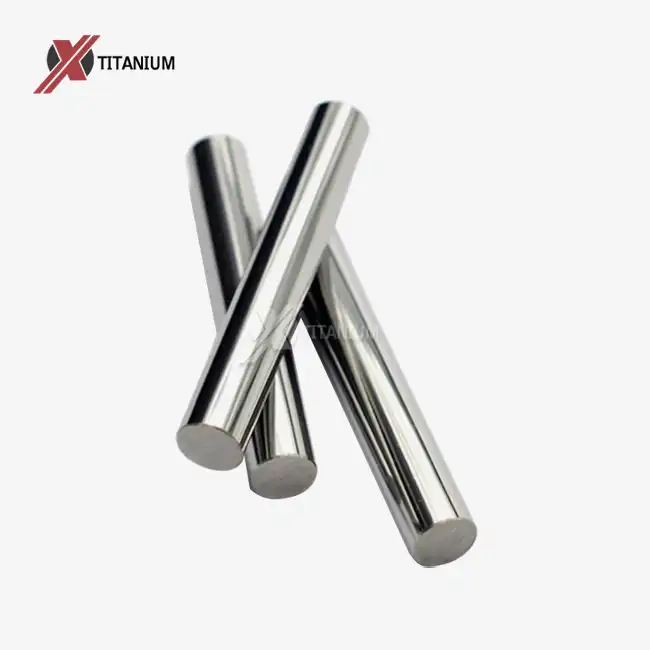
Steel Grade 5 (also known as Ti-6Al-4V) is what we use to make our titanium slider pin. As per ASTM B348 standards, titanium bars and billets must have a minimum tensile strength of 895 MPa. Grade 5 bar meets this requirement. Its density is about 4.43 g/cm³, while carbon steel's is about 7.85 g/cm³. This means that a pin of the same size weighs 44% less. The surface is protected from water, salt, and many acids and bases by a thin, stable oxide film. It's not very good at conducting heat—about 6.7 W/m·K—so heat moves slowly through the pin. The standards we use for this product are ASTM B348 and ISO 5832.
Dimensions, Tolerances, and Surface Finish
There are threads, grooves, chamfers, radii, shoulder size, overall length, working length, and a full drawing for a slider pin. Most important is the fit. A transition or interference fit keeps the pin in place, while a clearance fit lets it move. Whether the pin moves smoothly or gets stuck is controlled by geometric factors like how round, straight, or coaxial it is. Because surface roughness affects wear, friction, and lubricant retention, I think you should say what Ra value you need. A lot of people who buy brakes and automation ask for Ra values of 0.4 µm or less and tolerances of about ±0.01 mm. Before you order, send us the drawing and we'll let you know what the part and process can hold. The print should also have deburring and breaking of the edges.
Titanium Slider Pin Uses in Aerospace, Automation, and Other Industries
Aerospace Applications
Titanium slider pin components are used in aerospace because titanium is strong, doesn't rust, and is light. A slider pin is often used in latches, hinges, access panels, control linkages, actuator assemblies, UAV mechanisms, sensor mounts, and seat mechanisms. It is easier to drive small mechanisms when they have less moving mass, and they don't rust when they're used in salty or humid conditions. Titanium is used in many commercial airplanes and engines. The Boeing 787's airframe is made of it, and it makes up about 15% of its weight. Material certificates, lot traceability, and first-article inspection are often needed for flight-critical programs. Let us know what records your program needs, and before you place an order, we'll make sure we have what you need.
Automation and Robotics Systems
When automation is used, a lighter slider pin means that the actuator has less inertia to fight. These are the kinds of parts that you can find in pick-and-place machines, tool changers, indexing mechanisms, conveyor tooling, positioning fixtures, and grippers. If you can cut down on the mass of moving parts in fast machines that run all day, you can speed up response time and lower motor demand.
Clearance, bore alignment, sliding speed, contact pressure, and lubrication are also things that are important for high-cycle service. For example, medical, lab, food, packaging, and semiconductor equipment may need surfaces and edges that are clean and free of burrs. Titanium is also not magnetic, which is helpful for sensors that are close to it. It's not always the best solution for wear points, so check both the mating material and the surface treatment at the same time.
Brake, Marine, Chemical, and Energy Uses
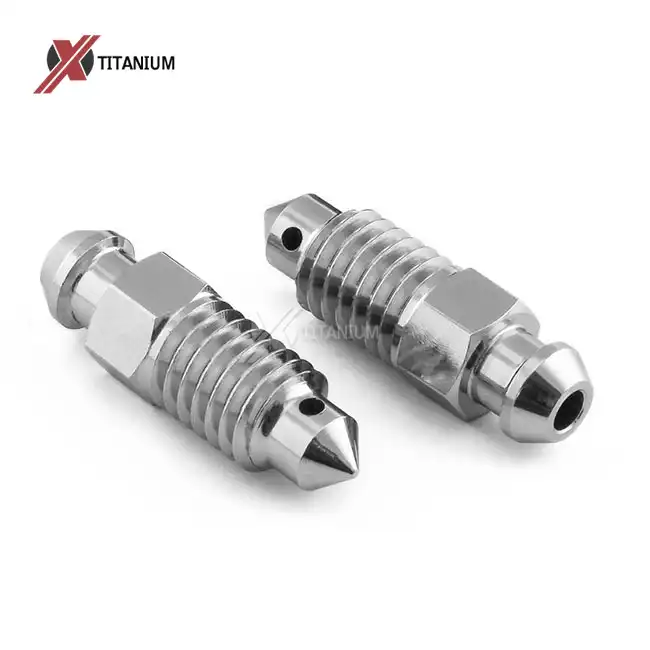
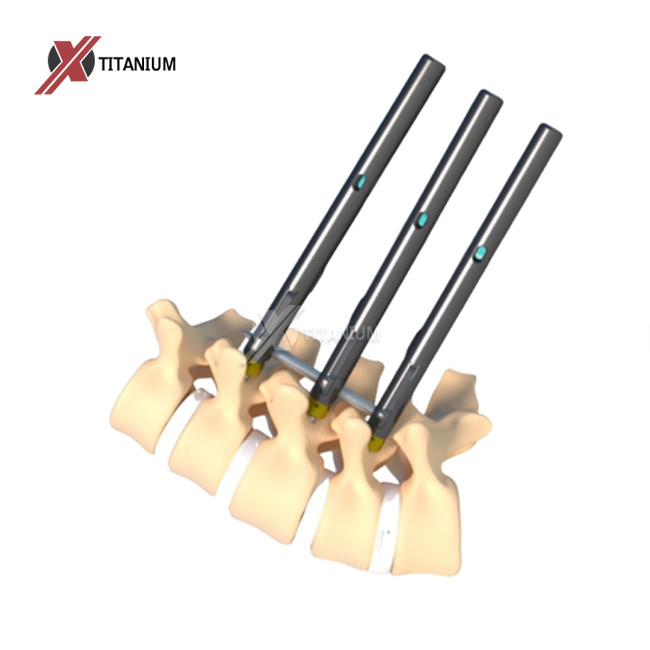
Different fields use the same part design. Sticky pins on floating brake calipers move the caliper across the disk. A titanium pin doesn't rust like steel pins do, and it also cuts down on weight that isn't being used. Titanium is resistant to seawater, which is good for marine and offshore equipment. It is also used in chemical processing for corrosive media. Titanium is also used in harsh environments for energy equipment like nuclear, wind, and solar systems. Biocompatibility is important for medical devices. It's still important to lubricate and treat the surface of brake parts made of titanium because it can stick to itself. During the drawing review process, we talk to buyers about these conditions so that the finish matches the service.
How to Choose the Right Material and Grade?
Titanium Compared With Steel, Stainless Steel, and Aluminum
Not just the unit price, but also how the materials will be used in the end. Titanium has a high strength-to-weight ratio, low density, and strong resistance to corrosion. However, it costs more to get the raw material and machine it. For parts that get worn out a lot and are made in large quantities, stainless steel is often cheaper, stiffer, and easier to find. The elastic modulus of titanium is about 114 GPa, while steel's is about 200 GPa. This means that when the same load is put on a titanium pin, it bends more. Aluminum is about 2.7 g/cm³ lighter than titanium, but it is softer and threads don't last as long when made of it. In rough sliding contact, hardened steel can last longer than titanium that hasn't been treated. If the extra cost is worth it because of weight, corrosion, or not being magnetic, titanium is the best choice.
Grade 2 Versus Grade 5
Grade 2 titanium is pure enough for business use. It doesn't rust and can be shaped easily. According to ASTM B348 standards, its minimum tensile strength is 345 MPa. It's good for light loads and everyday use. It gets stronger by 895 MPa when aluminum and vanadium are added in Grade 5. Grade 5 titanium slider pins are usually used for heavy loads, and that's what we offer for this product. Don't just look at the tensile strength of your load case; also check its bending, shear, bearing stress, and fatigue. Grade 5 is also more expensive to machine, so think about how much weight your design needs to carry.
A Practical Selection Checklist
The loads, cycle count, sliding speed, temperature, contamination, humidity, chemicals, and lubrication should all be checked first. Next, confirm the grade and make sure the galvanic compatibility is good. Titanium is good in most conditions, but when it comes in contact with wet or salty aluminum, it can speed up the corrosion process. It helps to use an insulating washer, coating, or sealant.
Then, on the drawing, write down the sizes, fits, retention method, and tolerances. Check suppliers' titanium machining experience, their ability to inspect, their ability to help with prototypes, and how they package their goods for export. Not just the unit price, but also the tooling, paperwork, freight, lead time, and minimum order quantity should be added up. The first thing that should happen is for your engineer and our team to talk for a short time.
Manufacturing, Finishing, and Quality Control
CNC Machining Process
Baoji is known as the "City of Titanium," and our team has been making things out of titanium for more than ten years. First, the drawings are looked over, and Grade 5 bar that meets ASTM B348 is chosen. Then, the pin body, shoulders, threads, grooves, slots, or cross-holes are cut on our CNC lathes and mills. Titanium doesn't move heat very well, so it builds up at the cutting edge. Dimensions and surface quality are kept safe by using sharp tools, careful cutting parameters, coolant, and chip control. The pins are finished, cleaned, and inspected after they are machined. We have a dozen CNC machines and other machining tools, so we can handle both small batches of prototypes and large orders.
Polishing, Anodizing, Nitriding, and Color Options
How a titanium slider pin works depends on how the surface is treated. Polishing smooths out surfaces and makes them less slippery. Anodizing makes the oxide layer thicker, and since light can't pass through that film, the thickness gives the metal color. We have natural finishes in gold, blue, green, purple, black, and rainbow. Color is mostly for looks, so I tell buyers not to use it to solve problems with wear. Nitriding makes a tough layer on the surface that doesn't wear down or gall, which makes it a good choice for sliding contact. Passivation cleans the surface and makes it more resistant to corrosion. Let us know the sliding load, the mating material, and the look you want, and we'll suggest a finish that fits.
Inspection and Documentation
Our system for quality control checks the whole process, from the raw materials to the finished product. When people buy these kinds of pins, they usually ask to see proof that they are made of the right material, measurements of the diameter and length, checks for straightness, tests for surface roughness, and a visual look for cracks or burrs.
People who buy things in the aerospace and automation industries may also ask for material certificates, conformity certificates, lot traceability reports, or first-article reports. Because each program has its own requirements, I suggest writing down your acceptance criteria on the purchase order or drawing. During the quotation process, we look over that list and make sure we know which checks and records we can provide. Well-known companies around the world have bought our titanium products and used them in the field for years.
Avoiding Problems and Buying Titanium Slider Pins
Galling, Wear, and Fit Problems
A few things can lead to failures in the field: the wrong grade, galling, early wear, or a fit that won't let go. Titanium tends to gall when it slides along a hard surface or against other metals that are similar to it. That risk is lower when nitriding, using a material that fits well, and using the right lubricant. If the fit is too tight, the part can get stuck when the temperature or level of contamination changes. If the fit is too loose, the part can move around and wear out. Before putting prototypes on the market, I think they should go through load and fatigue calculations, tolerance stack-up analyzes, and cycle tests. Early on, set the standards for acceptance so that every batch meets the same level.
What to Include in Your RFQ
Getting quotes faster with a clear RFQ. Add the drawing or CAD file, the titanium grade, the size, the tolerances, the surface finish, the color, the operating environment, the number of items you want to order, how often you need to inspect them, how they will be packed, and where they will be delivered. Technical review, prototype samples, a small trial batch, and then regular repeat orders are the steps that are usually taken when someone buys something. Full size, fit in the mating part, and wear behavior should all be checked on samples. Send us a sample of the worn part if you don't have a drawing. We'll then see if we can make it. The fewer changes you have to make later, the more information you give in the first request.
Custom Orders With Chuanglian
Since our titanium slider pin is made to order, the length, diameter, shoulder style, finish, and color will all be based on the drawing you send us. OEM equipment, aerospace mechanisms, special retention features, and tight-tolerance automation assemblies can all be made to order. You can get related parts from the same company as Baoji Chuanglian New Metal Material Co., Ltd., which also makes titanium fasteners, rods, wire, plates, tubes, flanges, and other machined titanium parts. Our goods are used in the medical, aerospace, marine, petrochemical, and racing industries. We use drawings, samples, and clear instructions to work with buyers from other countries by email. When we make things, we put quality first.
Conclusion
A titanium slider pin keeps moving parts in place while keeping their weight low. Grade 5 Ti-6Al-4V gives aerospace, automation, brake, marine, and medical equipment the strength and corrosion resistance they need. Titanium is more expensive than steel, stainless steel, and aluminum, but it is lighter, doesn't rust, and isn't magnetic. The choice depends on the load, wear, and environment. How smoothly a pin moves is determined by its fit, tolerance, and surface finish. Nitriding, polishing, and anodizing are used to get rid of galling and improve the look. Results are the same from prototypes to repeat orders thanks to CNC machining, documented inspection, and a full RFQ. The most important thing to remember is that grade, fit, finish, and verification must all match the actual application.
FAQ
Q1: Is a titanium slider pin lighter than steel?
A: Yes. Carbon steel is about 7.85 g/cm³ dense, while Grade 5 titanium is about 4.43 g/cm³ dense. Because of this, a pin of the same size weighs 44% less, which helps with moving parts and brake mass that isn't sprung.
Q2: Does a titanium slider pin need lubrication?
A: Yes. Titanium can scratch other metals and itself, so use a lubricant that works with the parts that will be touching. You are also less likely to get galling on a hard surface like nitriding. Both surface treatment and lubrication work together, so pick both based on the load and slides speed.
Q3: What should I send to get a quote?
A: You need to send your drawing or CAD file along with the quantity, grade, tolerances, color, surface finish, and operating conditions. Tell us about any records you need for an inspection. You can choose from lengths between 10 mm and 200 mm and diameters between 5 mm and 20 mm.
Request a Custom Titanium Slider Pin Quote From Chuanglian
Chuanglian is interested in seeing your drawings for a unique titanium slider pin. We make titanium slider pins in Baoji, which is known as the "City of Titanium." Our Grade 5 (Ti-6Al-4V) pins are 10 to 200 mm long and 5 to 20 mm in diameter. They are light, corrosion-resistant, and can be polished, anodized, or nitrided. For more information, email info@cltifastener.com or djy6580@aliyun.com.
References
1. ASTM International, Standard Specification for Titanium and Titanium Alloy Bars and Billets (ASTM B348), 2019
2. Boyer, R. R., "An Overview on the Use of Titanium in the Aerospace Industry," Materials Science and Engineering: A, 1996
3. Donachie, M. J., Titanium: A Technical Guide, 2nd Edition, ASM International, 2000
4. Leyens, C. and Peters, M., Titanium and Titanium Alloys: Fundamentals and Applications, Wiley-VCH, 2003
5. Boyer, R., Welsch, G., and Collings, E. W., Materials Properties Handbook: Titanium Alloys, ASM International, 1994
6. Lütjering, G. and Williams, J. C., Titanium, 2nd Edition, Springer, 2007
_1747708576205.webp)
Learn about our latest products and discounts through SMS or email