- English
- French
- German
- Portuguese
- Spanish
- Russian
- Japanese
- Korean
- Arabic
- Greek
- German
- Turkish
- Italian
- Danish
- Romanian
- Indonesian
- Czech
- Afrikaans
- Swedish
- Polish
- Basque
- Catalan
- Esperanto
- Hindi
- Lao
- Albanian
- Amharic
- Armenian
- Azerbaijani
- Belarusian
- Bengali
- Bosnian
- Bulgarian
- Cebuano
- Chichewa
- Corsican
- Croatian
- Dutch
- Estonian
- Filipino
- Finnish
- Frisian
- Galician
- Georgian
- Gujarati
- Haitian
- Hausa
- Hawaiian
- Hebrew
- Hmong
- Hungarian
- Icelandic
- Igbo
- Javanese
- Kannada
- Kazakh
- Khmer
- Kurdish
- Kyrgyz
- Latin
- Latvian
- Lithuanian
- Luxembou..
- Macedonian
- Malagasy
- Malay
- Malayalam
- Maltese
- Maori
- Marathi
- Mongolian
- Burmese
- Nepali
- Norwegian
- Pashto
- Persian
- Punjabi
- Serbian
- Sesotho
- Sinhala
- Slovak
- Slovenian
- Somali
- Samoan
- Scots Gaelic
- Shona
- Sindhi
- Sundanese
- Swahili
- Tajik
- Tamil
- Telugu
- Thai
- Ukrainian
- Urdu
- Uzbek
- Vietnamese
- Welsh
- Xhosa
- Yiddish
- Yoruba
- Zulu
Top 5 Applications for ISO 7043 Titanium Nylock Nuts
ISO 7043 Titanium Nylock Nuts are a special type of threaded fastener that combines the great qualities of titanium with a nylon plug that locks itself in place. These precision-engineered parts are very important in the electronics, chemical processing, aerospace, and automobile businesses. As a result of the ISO 7043 standard, torque-type hexagon nuts with non-metallic inserts must meet certain performance and size tolerances. This makes sure that quality is uniform across global supply lines. Manufacturers like Chuanglian make these screws mostly out of Ti-6Al-4V (Grade 5) titanium metal, which has a tensile strength of 895–1000 MPa and a density of only 4.43 g/cm³. This makes them very strong for their weight, which is something that regular steel bolts can't do. This makes them essential in places where weight is important and dependability is a must.
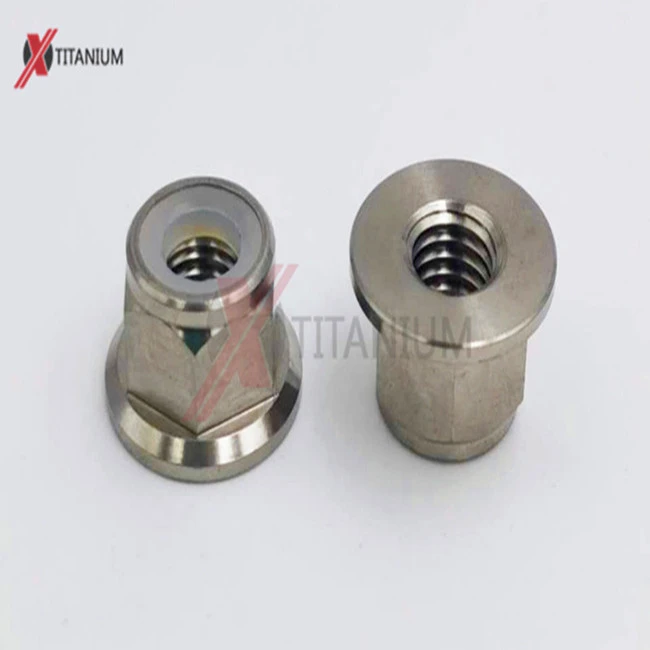
Aerospace Industry Applications
Why Aerospace Engineers Specify Titanium Nylock Nuts?
Manufacturers of airplanes and sellers of engine parts have to follow strict certification systems like AS9100. A fastener gets qualification if it can trace its materials and be consistent across batches. Working with aircraft research centers has shown us that ISO 7043 Titanium Nylock Nuts work very well in turbine assemblies, landing gear systems, and connecting the body of an airplane to its wings. The inactive titanium oxide layer forms on the surface on its own, protecting it from corrosion even when it's exposed to jet fuel fumes, hydraulic fluids, and huge changes in temperature at high altitudes, from -55°C at cruise altitude to 400°C close to engine parts.
Performance Comparison With Traditional Materials
When used with aluminum or composite aircraft materials, traditional steel screws will rust, even if they are cadmium-plated. Alternatives made of stainless steel are heavier than they need to be, which hurts fuel economy measures that airlines carefully watch. Titanium screws get rid of these trade-offs by not corroding and not adding extra weight. Comparative vibration testing shows that ISO 7043 Titanium Nylock Nuts keep their initial torque for 500,000 load cycles, while normal steel nuts lose 15 to 20 percent of their torque after 200,000 cycles. This longer service life means that repair needs to be done less often, which has a direct effect on how often airplanes are available and how much they cost to run.
Certification Requirements for Aerospace Procurement
When buying things for commercial flight projects, procurement managers need to make sure that suppliers keep material certifications that can be linked to mill test reports, dimensional inspection records that meet AS9100D standards, and written heat treatment processes. Chuanglian's quality system meets these needs by sending batch-specific paperwork with every package. This paperwork includes reports on chemical makeup analysis, mechanical property verification, and thread gauge inspections. As part of its testing services, the company can use spectrometry to prove the alloy and tensile testing to make sure that Grade 5 titanium meets the 828 MPa minimum yield strength requirement for aircraft uses.
Automotive and Motorsport Applications
High-Performance Engine Assembly Demands
When fasteners fail at 15,000 RPM engine speeds, causing shaking rates that would loosen regular nuts in minutes, the engineering teams in motorsport face unique problems. For Formula One races and endurance events like Le Mans, racing engines need screws that can handle these harsh conditions while adding little to the spinning mass. Each gram of lighter fasteners lowers spinning friction, which lets the engine respond faster and go up to higher rev limits. ISO 7043 Titanium Nylock Nuts meet both needs at the same time because they are 60% lighter than steel versions and last longer when loaded and unloaded many times.
The nylon insert mechanism in ISO 7043 nuts makes expected friction that keeps the nuts from coming loose without the need for extra safety wire or lock washers. This makes putting things together easier and cuts down on mistakes made by people during pit stops, when workers are working very quickly. When installing a turbocharger, where exhaust fumes can heat fasteners to 300°C, temperature stability is very important. Standard nylon inserts break down at 120°C, but high-temperature versions keep their locking force up to 260°C, which is enough for most hot-zone vehicle uses.
Sourcing Strategies for Volume Production
Automotive procurement offices usually work with contracts that last a year and have supply plans that are every three months to match production runs. When looking for titanium fasteners, buyers should set minimum order amounts that strike a balance between the cost of keeping the product and the price per unit. From working with companies that make fast cars, we know that minimum order quantities (MOQs) of 5,000 to 10,000 pieces per size get the best prices and keep wait times at a reasonable 8 to 12 weeks. With an accelerated 4-6 week turnaround, smaller custom orders for prototype development can be met, but unit costs may go up 30–40% compared to volume prices.
Since global transportation problems brought to light single-source risks, supply chain robustness has become very important. Getting a backup provider like Chuanglian, which is known to be able to make more than 50,000 titanium fasteners every month, gives procurement teams bargaining power and peace of mind that the supply chain will stay up and running. Technical talks should include thread-forming methods, nylon insert source requirements, and quality hold places where measurements are checked before plating or sealing.
Chemical and Process Industry Applications
Corrosion Resistance in Aggressive Environments
Chemical processing plants use sulfuric acid, chlorine solvents, sodium hydroxide solutions, and other things that can quickly damage carbon steel and even 316 stainless steel bolts. When fasteners need to be replaced on equipment in these settings, it causes production loses that are much higher than the cost of the gear itself. Titanium has amazing corrosion resistance thanks to its self-passivating oxide layer, which forms back right away if it gets scratched. This protects it even in places with a lot of oxidizing acids and chlorides, which are bad for stainless steel because they cause pitting and crevice corrosion.
Process engineers use ISO 7043 Titanium Nylock Nuts for flange connections in heat exchangers, reactor vessels, and pipe systems where different amounts of thermal expansion happen during starting and shutdown. Critical seals stay in good shape at temperatures ranging from -50°C for cryogenic use to 400°C for distillation column use because they are both mechanically strong and thermally stable. Titanium nuts don't need to be re-torqued as often as regular screws do because the preload stays the same. This cuts down on maintenance work and unscheduled shutdowns.
Procurement Considerations for Custom Requirements
Buying things in the chemical business is different from buying things for consumers because buying is based on projects, and each installation has different requirements. It's possible that a chlor-alkali plant would need M12x1.5 nuts with certain thread engagement lengths, while a pharmaceutical reactor would need M8 nuts with electropolished surfaces that meet FDA material contact rules. Suppliers who can handle unique requirements without charging too much for tools are very valuable. Chuanglian can do machining tasks like CNC threading with non-standard thread sizes and special surface treatments like anodizing to make parts less likely to galle.
For projects in the chemical business, volume price usually includes negotiating quotes based on the total needs of the project rather than per-piece catalogs. When making RFQs, make sure they have full details about the material grade (Grade 2 for the best corrosion resistance, Grade 5 for uses that need maximum strength), the surface finish that needs to be used, the certification paperwork that needs to be included, and delivery dates that are in line with building milestones. During the specification phase, reputable providers offer expert advice that helps engineers choose the right materials that meet performance needs and stay within budget.
Marine and Offshore Applications
Saltwater Corrosion Challenges
Marine settings are probably the roughest on bolts when it comes to corrosion. Being exposed to saltwater all the time, along with the mechanical stress from waves and the temperature cycling from the sun, makes for a perfect storm for material breakdown. Offshore platform owners say that normal stainless steel fasteners in deck equipment rust within 18 months and need to be replaced every 3 to 5 years. Titanium bolts, on the other hand, don't corrode even after decades of being submerged in saltwater nonstop, so they last as long as the building does.
If you look at lifetime costs instead of the original purchase price, the economic case for titanium becomes stronger. ISO 7043 Titanium Nylock Nuts are 4–6 times more expensive than marine-grade stainless steel versions, but they pay for themselves in 8–12 years because they don't need to be replaced as often and don't require as much work. For new building projects with design lives of 30 years, choosing titanium fasteners for important structural links is a smart way to save money. More and more, naval engineers are using these parts in propulsion system bolts, rudder hinges, and mast hardware, where failure could mean losing the ship.
Regulatory Compliance and Certification
Maritime classification groups, such as Lloyd's Register, DNV-GL, and the American Bureau of Shipping, have rules that suppliers must follow before screws can be used on approved ships. Teams in charge of buying things should make sure that the company selling titanium fasteners has the right marine approvals and can show proof that their products meet ASTM B348 standards for titanium bar stock and ASTM F467 standards for titanium nuts. Chuanglian keeps records that make it easier for the classification society to look over things. These records include data on heat lot tracking and mechanical testing that inspectors need for vessel certification checks.
When marine procurement managers have to balance MOQ needs with project needs, they can often buy fasteners in bulk for multiple parts of a vessel or work with other port projects to reach volume goals. Lead time planning should take into account how long it takes to get materials, since the supply of titanium alloy can change depending on demand in the aircraft business. Setting up framework deals with delivery schedules every six months lets sellers plan their purchases of raw materials well, and it gives shipyards the freedom to cancel certain amounts as the building process goes on.
Electronics and Precision Machinery
Thermal Stability in Sensitive Applications
Manufacturers of electronic equipment have specific needs for fasteners. When choosing a material, magnetic permeability, temperature expansion coefficients, and shaking resistance must all be taken into account. Titanium is used in MRI equipment housings, precision measurement tools, and telecoms equipment where magnetic interference would make the equipment less useful because it is not magnetic. Titanium's thermal expansion coefficient (8.6 × 10⁻⁶/°C) is very close to that of many aluminum metals used in electrical enclosures. This means that fasteners won't come away when the temperature changes from working to standby.
Equipment used to make semiconductors works in cleanrooms where fastener outgassing and dust generation must be kept to a minimum. When ISO 7043 Titanium Nylock Nuts are made with the right surface processes, they produce fewer particles than zinc-plated steel nuts. Specifications must be followed for the nylon filler material to make sure it works with vacuum processing equipment and plasma etching tanks. In these very clean production settings, contamination is kept at bay by high-purity polyamide inserts that don't contain zinc stearate mold release agents.
Ordering Considerations for OEM Integration
OEMs that want to use titanium screws in their designs should talk to providers early on in the development process. Design for Manufacturing talks can help find ways to share bolt sizes across all platforms, which will cut down on the number of SKUs and make inventory management easier. The technical support team at Chuanglian looks over assembly plans and suggests the best bolt specs, thread engagement depths, and pressure values that balance the strength of the joint with the time it takes to put it together.
When it comes to medical devices and consumer gadgets, the certification standards are very different. Medical equipment makers need providers who follow ISO 13485 quality standards and can show proof that their materials are biocompatible according to ISO 10993 guidelines. Standard ISO 7043 nuts work well for most electrical tasks, but putting together medical devices might need extra proof testing. Custom medical-grade screws usually have longer lead times (12–16 weeks) because they need more paperwork and inspections. This is why planning to buy them shouldn't wait until production starts, but should start during the design approval phase.
Conclusion
In industries like aircraft, automotive, chemicals, marine, and electronics, where material dependability has a direct effect on safety at work and costs over the product's lifetime, ISO 7043 Titanium Nylock Nuts provide measurable performance benefits. These fasteners are essential for tough industrial uses because they have high strength-to-weight ratios, great corrosion protection, and self-locking systems. To be good at buying, you need to know how material grades, certification standards, volume agreements, and lead time planning all work together. Working with qualified manufacturers who have strong quality systems and expert support will make sure that the fastener specs you need match the needs of the application and that shipping times don't interfere with project deadlines.
FAQ
Q1: What makes ISO 7043 specs different from other nylock nut rules?
A: ISO 7043 sets the standards for prevailing torque-type hexagon nuts with non-metallic inserts in terms of size tolerances, thread specs, and performance requirements. This worldwide standard tells suppliers around the world how to place nylon inserts, what thread fit classes to use, and how big hexagons should be. Compared to national standards like DIN 985, ISO 7043 is recognized more widely around the world. This makes it easier to buy things from different countries and makes it easier to get qualified people when buying from different areas.
Q2: How do I figure out what torque values are right for titanium nylock nuts in my situation?
A: The torque limits depend on the thread size, the grade of the material, how well it is oiled, and the form of the joint. Because they have lower friction coefficients, ISO 7043 Titanium Nylock Nuts usually need 15-20% less force than steel ones of the same size. Look at pressure charts from the fastener maker that are made for your individual bolt material, nut material, and lubrication conditions. For important uses, try the joint under typical conditions to make sure that the torque applied meets the goal preload without thread galling.
Q3: When titanium nylock nuts are taken apart, can they be used again?
A: Each time it is installed, the nylon insert gets a little worse, which lowers the general power performance. The best practice in the industry says that it should only be used three to five times, and the pressure should be checked after each use. Critical uses in aircraft or medical systems usually don't allow reuse at all, so these ISO 7043 Titanium Nylock Nuts are thought of as one-time uses. When the cost of replacement over time makes it worth it, keep track of installation steps and set up inspection processes to make sure locking torque stays within the limits set by the manufacturer.
Partner With Chuanglian for Your Titanium Fastener Needs
Baoji Chuanglian New Metal Material Co., Ltd. has been making titanium fasteners for more than ten years and can help you with your buying needs. Our factory in Baoji, which is known around the world as the "City of Titanium," has a wide range of machining tools, such as CNC threading machines, heat treatment ovens, and testing tools that make sure products meet AS9100, ISO9001, and other industry standards. As a company that makes and sells ISO 7043 Titanium Nylock Nuts, we know how important it is for B2B procurement teams to find the right mix between material performance, delivery reliability, and expert support.
Our quality control system keeps track of every batch from the time the raw materials are certified until the final inspection. This gives your engineering and quality teams the proof they need to qualify the provider. Whether you need a small number of prototypes delivered quickly or a large number of production units released on time, our team at info@cltifastener.com and djy6580@aliyun.com is available to help you with your project.
References
1. American Society for Testing and Materials. (2021). ASTM F467: Standard Specification for Nonferrous Nuts for General Use. ASTM International.
2. International Organization for Standardization. (2019). ISO 7043: Prevailing Torque Type Hexagon Nuts with Non-Metallic Insert - Property Classes 5, 8, and 10. ISO Standards Catalogue.
3. Boyer, R., Welsch, G., & Collings, E.W. (2020). Materials Properties Handbook: Titanium Alloys. ASM International.
4. Society of Automotive Engineers. (2022). AS9100D: Quality Management Systems - Requirements for Aviation, Space, and Defense Organizations. SAE International.
5. Donachie, M.J. (2018). Titanium: A Technical Guide, 2nd Edition. ASM International Materials Engineering.
6. Marine Technology Society. (2021). Corrosion Resistance of Titanium Alloys in Marine Environments: Engineering Guidelines. MTS Journal of Ocean Engineering.
Learn about our latest products and discounts through SMS or email