- English
- French
- German
- Portuguese
- Spanish
- Russian
- Japanese
- Korean
- Arabic
- Greek
- German
- Turkish
- Italian
- Danish
- Romanian
- Indonesian
- Czech
- Afrikaans
- Swedish
- Polish
- Basque
- Catalan
- Esperanto
- Hindi
- Lao
- Albanian
- Amharic
- Armenian
- Azerbaijani
- Belarusian
- Bengali
- Bosnian
- Bulgarian
- Cebuano
- Chichewa
- Corsican
- Croatian
- Dutch
- Estonian
- Filipino
- Finnish
- Frisian
- Galician
- Georgian
- Gujarati
- Haitian
- Hausa
- Hawaiian
- Hebrew
- Hmong
- Hungarian
- Icelandic
- Igbo
- Javanese
- Kannada
- Kazakh
- Khmer
- Kurdish
- Kyrgyz
- Latin
- Latvian
- Lithuanian
- Luxembou..
- Macedonian
- Malagasy
- Malay
- Malayalam
- Maltese
- Maori
- Marathi
- Mongolian
- Burmese
- Nepali
- Norwegian
- Pashto
- Persian
- Punjabi
- Serbian
- Sesotho
- Sinhala
- Slovak
- Slovenian
- Somali
- Samoan
- Scots Gaelic
- Shona
- Sindhi
- Sundanese
- Swahili
- Tajik
- Tamil
- Telugu
- Thai
- Ukrainian
- Urdu
- Uzbek
- Vietnamese
- Welsh
- Xhosa
- Yiddish
- Yoruba
- Zulu
Top Reasons to Upgrade to Gr5 Titanium Bicycle Bolts Today
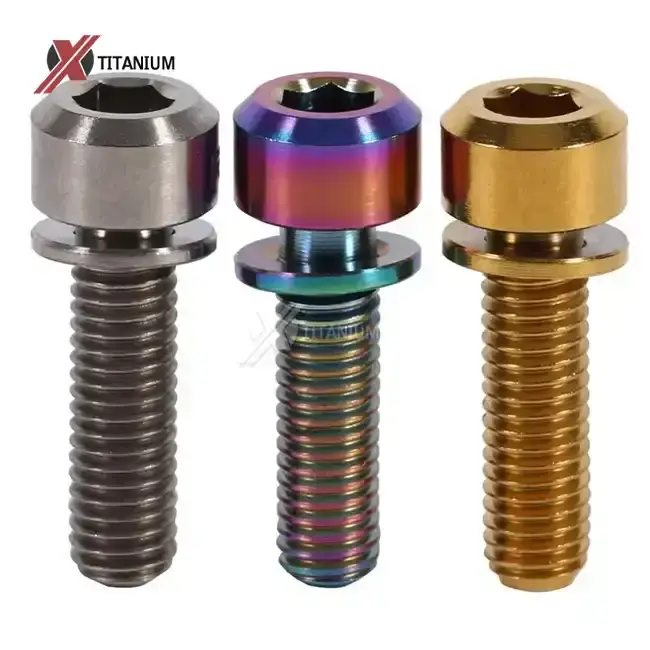
Manufacturers and wholesalers who want better performance in high-demand uses can measure the benefits of upgrading to Gr5 Titanium Bicycle Bolts. These precision screws are made of a Ti-6Al-4V alloy, which is about 45% lighter than chromoly steel while still having a tensile strength of over 900 MPa. The material's natural resistance to corrosion gets rid of the galvanic reactions that happen a lot when going near the coast or in the winter. This lowers the cost of long-term upkeep. When purchasing managers look at how reliable a part is, Gr5 bolts address important issues like thermal stability during heavy braking, vibration-induced loosening in cockpit assemblies, and the shear failure risks that come with softer aluminum alternatives. This makes them a smart investment for differentiating products and making customers happy.
Understanding GR5 Titanium Bicycle Bolts: Material Properties and Benefits
Ti-6Al-4V alloy screws (commonly referred to as Gr5 Titanium Bicycle Bolts) have a lot of technical benefits. They are made of an exact mix of materials that give them unique mechanical properties that solve problems in the industry. This part talks about how the alpha-beta phase structure improves the success of tasks like putting together bicycles.
Composition and Strength Characteristics
Ti-6Al-4V is made up of 90% titanium, 6% aluminum, and 4% vanadium. It has a tensile strength of 900 to 950 MPa, which is almost twice as high as the 500 MPa strength of 316 stainless steel rivals. Because the metal can be heated, makers can make it harder or softer depending on the thread engagement. This lowers the chance of thread stripping during high-torque setups like those used in stem clamps and brake caliper mountings. With a density of 4.43 g/cm³, it has a strength-to-weight ratio that lowers unsprung mass in important spinning parts. This is especially important in rotor mounting uses, where every gram changes how the wheel stops and speeds up. Engineers use this trait to help them make lightweight race frames that meet strict safety standards without losing their strength when they are loaded and unloaded over and over again.
Corrosion Resistance in Demanding Environments
The protective oxide layer that forms naturally on Ti-6Al-4V surfaces makes them very resistant to chemical attacks from brake fluid, road salts, and sea air. Unlike carbon steel fasteners that rust-weld into aluminum wheels within months of being exposed to salt water, these bolts stay removable for years. This saves money on upkeep work and gets rid of the need for destructive removal methods. When purchasing managers switch to corrosion-resistant fastening systems for their fleets that operate in humid or cold areas, they report big savings in the money they spend on yearly upkeep. When mixed with different metals, the material doesn't corrode galvanically, but it's still important to follow the right installation steps and use anti-seize chemicals to keep the titanium-on-titanium threads from galling during assembly.
Thermal Management Advantages
Because titanium metals don't carry heat well, brake rotors don't lose too much heat to hub bearings during long descents. This keeps sensitive sealed bearing assemblies from breaking down too quickly. Downhill racing teams and brake system OEMs like this feature because it keeps hub performance stable at all temperatures. The material stays structurally sound at temperatures up to 400°C, which is much higher than what hydraulic disc brake systems need to work. This means that bolt tensioning stays stable even when temperatures change quickly, which would normally cause steel fasteners to creep relax and eventually come loose.
GR5 Titanium Bicycle Bolts vs Alternatives: Making an Informed Decision
Comparing performance traits, lifecycle costs, and application-specific needs is necessary to choose the best fastening options for Gr5 Titanium Bicycle Bolts. This study helps procurement teams show why material changes are worth the money by giving them measurable benefits.
Comparison with Stainless Steel Fasteners
Standard 316 stainless steel bolts offer good rust resistance at lower starting costs, but they are heavy, which becomes a big problem in performance settings. A high-end mountain bike's bolt set that is made of stainless steel weighs about 45% more than one made of Ti-6Al-4V. This has a direct effect on how the product is positioned in weight-sensitive market groups. Because stainless steel has a higher modulus of elasticity, its joints are stronger and transfer more vibration to carbon fiber parts. This could cause expensive frame sections to wear out faster. Engineering proof tests show that Ti-6Al-4V screws keep their clamp load more consistently when exposed to vibration. This means that end users don't have to do as many retorque repair times, which lowers their overall ownership costs.
Advantages Over Lower Titanium Grades
Grade 2 commercially pure titanium is very resistant to corrosion and has a middling amount of strength, but it doesn't have the tensile strength needed for brake and turning uses that need to be safe. Grade 2 can only be used for non-structural tasks, like fitting bottle cages or fender bolts, because its tensile strength is only 345 MPa. Ti-6Al-4V gives stress-bearing joints the extra safety they need while still being resistant to rust, which is why it costs more in key fixing locations. Cost control and liability reduction are usually taken into account when purchasing things. Grade 2 is usually chosen for low-stress accessories, while Ti-6Al-4V is saved for structural and brake system uses where failure could cause major injuries and guarantee issues.
Performance Against Aluminum and Carbon Fiber Options
Extreme weight reduction projects like aluminum fasteners, but they pose too high of a risk of shear failure in threaded joints that are torque-cycled. Racing teams say that aluminum bolts often break in stem faceplate uses because the threads get worn out after a while of handlebar changes. Carbon fiber bolts are still being tested in bicycle applications because they tend to creep and fail in unpredictable ways that make safety approval harder. Ti-6Al-4V has consistent mechanical behavior over its entire service life. This gives engineering teams accurate design data for finite element analysis and warranty prediction models, which helps them make product liability plans that can be defended.
Installation and Compatibility: Seamless Integration of GR5 Titanium Bicycle Bolts
The performance benefits of advanced Gr5 Titanium Bicycle Bolts are maximized when they are installed correctly. Common installation mistakes that weaken joints and shorten the life of components are avoided.
Torque Specifications and Installation Tools
To properly tighten Ti-6Al-4V fasteners, you must follow the manufacturer's instructions. For rotor bolts, the torque should be between 4 and 6 Nm, and for stem hardware, it should be between 5 and 8 Nm, depending on the thread diameter and contact length. To make sure the clamp load is right, torque wrenches that are calibrated to within ±4% of the true value make sure the load doesn't go over the fastener's yield strength or crush carbon fiber parts. Titanium bolts achieve the right preload through greater elastic extension than steel bolts because titanium has a lower modulus of elasticity. This means that techs need to know that the "feel" of tightening titanium bolts is different from tightening steel bolts. Installing torque verification methods in assembly operations can help lower field failures caused by bad installation. This protects the brand's image and lowers the number of warranty claims that cut into profit margins in competitive markets.
Preventing Galling and Thread Damage
Titanium screws are hard to install because they tend to cold-weld when there is too much contact pressure and not enough grease. This is called thread galling. Putting molybdenum disulfide or copper-based anti-seize chemicals on male threads before installing them lowers the friction coefficient and stops glue wear between the surfaces that are mating. To avoid cross-threading, the threads must be carefully lined up when they are first engaged. This is especially important when using fine-pitch metric threads that are popular in European bicycle standards. Manufacturing quality control that makes sures class 6g thread standards are met reduces contact resistance, which is what makes techs force misaligned screws into place. This damages the threads, which weakens the joint and costs a lot to fix during production assembly.
Frame Material Compatibility
Ti-6Al-4V bolts work well with carbon fiber, aluminum, and steel frame materials as long as the right fitting steps are taken to account for galvanic potential and compression limits. For carbon fiber connections, torque values need to be on the low end of the standard ranges to keep the fibers from crushing, which weakens the clamp load over time. Aluminum frames benefit from titanium's high place in the galvanic series, which protects them from corrosion. However, different metal surfaces still need anti-seize application to make sure they will work in the future. Steel frame makers like titanium because it looks good, is light, and doesn't cause galvanic incompatibility issues. However, because of its high cost, titanium fasteners are usually only used on high-end products where the target market can afford them.
Procurement Insights: Sourcing GR5 Titanium Bicycle Bolts Efficiently
Making strategic choices about where to get Gr5 Titanium Bicycle Bolts lowers costs while also making sure that the supply chain is reliable and that quality standards are always met. This protects production plans and reduces the risk of product liability.
Evaluating Manufacturing Standards and Certifications
Qualified providers keep written quality management systems that are in line with ISO 9001 standards. This way, everything can be tracked from the mill certificates for the raw materials to the records of the final inspection. Material test results that show the chemical makeup is within the specs for Ti-6Al-4V and the mechanical properties meet the minimum strength requirements protect OEMs from getting fake materials that put them at huge risk of liability. Dimensional inspection reports that check thread specs, head shape, and length standards make sure that the parts work with production tools and keep the assembly line running smoothly. Purchasing departments lower the risk in the supply chain by checking the certifications of suppliers and setting up backup sources that keep production going when there aren't enough raw materials or when global issues affect the availability of titanium sponge from the main producing areas.
Bulk Purchasing and Pricing Strategies
Negotiated pricing systems that lower per-unit costs are possible when volume promises are made. This is because inventory levels are kept at a level that allows for flexible production planning. Annual purchase deals with tiered prices based on quarterly offtake amounts balance the cost-effectiveness of buying with the risks of obsolescence and the costs of keeping inventory. Price changes in the titanium raw material market are caused by cycles in aircraft demand and limits on the production capacity of sponges. Because of this, price increase clauses are popular in long-term supply contracts. Finance and procurement teams work together to make deals that split commodity risk between the buyer and the supplier. This way, both parties can protect their profit margins during price spikes and keep the supplier's business going during drops in demand that could affect the supply of key materials.
International Shipping and Quality Assurance
Buying things across international borders can be tricky because of things like customs classification, import taxes, and shipping wait times that affect production schedules. Suppliers who have dealt with foreign trade before can provide paperwork that supports standardized tariff code classification and country-of-origin certification, which makes clearing customs faster. Clearing up Incoterms determines who is responsible for what costs and where the risk lies. FOB and CIF terms are popular in deals involving titanium fasteners. Quality hold points at supplier facilities let a third party check the goods before they are shipped. This lowers the chance of getting non-conforming materials that throw off production plans and need expensive, fast replacement shipments that affect project deadlines and customer delivery promises.
Real-World Applications and User Feedback
Performance that has been documented in demanding applications helps buying decision-makers back material upgrades for Gr5 Titanium Bicycle Bolts and defend higher prices to internal stakeholders who are trying to cut costs.
Applications for Competitive Racing
Professional downhill racing teams say that since moving rotor bolt specs from stainless steel to Ti-6Al-4V, there have been no fastener failures during the entire race season. This has eliminated a common cause of technical DNF results. The 15-20 grams of weight savings per wheelset at the hub's outer radius lead to measurable gains in acceleration metrics during timed runs where podium places are decided by hundredths of seconds. When fitting a brake caliper, the vibration damping properties help keep judder from traveling through the handlebar-stem contact, which makes it easier for the rider to control the bike during fast tricky parts. These improvements in performance give factory racing teams a competitive edge, which they use to get sponsorships and get feedback on product development that helps them make better products for customers.
Case Studies of OEM Integration
Leading mountain bike makers say that guarantee claims about brake system parts have gone down since they switched to using heat-treated titanium alloy screws. By getting rid of corrosion-related rotor bolt seizure, store repair labor reimbursement costs go down, and customer satisfaction goes up, which makes people more likely to buy from them again. Proper lubrication methods provide galling resistance, which lowers installation quality issues in production assembly operations. This cuts down on repair costs and increases line speed, which lowers the cost of making a single unit. Total cost of ownership analysis takes into account warranty reserves, customer retention value, and factory efficiency gains tracked over multi-year product lifecycles to show that these operational changes are worth the extra material cost.
Feedback on Fleet and Rental Operations
High-volume bike sharing programs in coastal towns report big drops in repair costs after adding corrosion-resistant fastening systems to their fleets. By extending the time between service intervals for brake system maintenance, the amount of work that needs to be done by mechanics is cut down, and fleet utilization rates are raised, which increases rental income. Getting rid of seized bolts that need to be taken out destructively saves expensive hub assemblies from damage during regular rotor replacement. This increases the service life of parts and lowers the amount of money needed to update the fleet. These economic benefits show a clear return on investment for fleet owners who are in charge of thousands of bikes, since lower maintenance costs per bike add up to big practical savings every year.
Conclusion
Bicycle makers and component providers are making a long-term investment in product performance, customer happiness, and operating efficiency by switching to Ti-6Al-4V fastening systems. Material benefits like higher strength-to-weight ratios, better corrosion resistance, and the ability to control heat effectively solve important problems in race, leisure, and business bicycle settings. When making purchasing decisions, people should look at the total cost of ownership instead of just the original purchase price. This is because lower warranty claims, longer service intervals, and a better image for the brand all support higher material costs. For example, Gr5 Titanium Bicycle Bolts offer superior performance, ensuring durability and reliability. To make implementation work, it's important to follow the right installation steps, make sure the provider has good quality control systems, and use application-specific engineering to get the most out of advanced titanium alloys in tough binding situations.
FAQ
Q1: What advantages do Ti-6Al-4V bolts offer for different bicycle types?
A: For road racing, the weight savings are important. A full Ti-6Al-4V bolt set can save between 40 and 60 grams compared to stainless steel equivalents, which is a big deal for UCI weight limit compliance plans. When used for mountain biking, the focus is on toughness under impact loads and corrosion resistance in dirty, wet situations that speed up the breakdown of steel fasteners. Touring and commuting bikes benefit from being reliable over time and needing less upkeep, which is in line with expected high-mileage sturdiness and exposure to weather all year.
Q2: How do I ensure proper fitment for various frame designs?
A: Standard metric threading (M5, M6, and M8) keeps most current bicycle platforms compatible, with length specs that match torque suggestions and component stack heights from the maker. Custom sizing works for unique frame designs and sample development projects where normal catalog items need to be changed. Talking to technical support teams while making specifications makes sure that the right contact length estimates are made, taking into account the frame material, insert reinforcement, and safety factor requirements set by internal engineering standards.
Q3: What are typical lead times for bulk orders?
A: Standard stock items ship within 7–14 business days for orders of less than 1,000 pieces. Orders of more than 5,000 pieces take 4-6 weeks to schedule production and make sure the quality is good. Custom specs require more time to prepare the tools and get approval for the first check, which usually adds two to three weeks to normal delivery times. There are expedited production choices that can meet pressing needs, but they cost more. Planning ahead to avoid rush situations lowers total purchase costs and makes sure there are enough inventory buffers against supply chain disruptions.
Partner with Chuanglian for Your Ti-6Al-4V Fastener Requirements
Baoji Chuanglian New Metal Material Co., Ltd. makes precision-engineered titanium fastening solutions for OEMs, wholesalers, and sourcing workers who want high-quality materials that work well and a reliable supply chain. Our factory in Baoji City, which is known around the world as the "City of Titanium", has more than ten years of experience making and cutting titanium alloys. For all of our fasteners, we have complete CNC cutting and quality control systems that make sure they all meet strict material and size requirements.
We sell standard and unique Ti-6Al-4V bicycle bolts, rotor hardware, and other fastening solutions that are made to fit the needs of your particular purpose. You can email our expert team at info@cltifastener.com or djy6580@aliyun.com to talk about the details of your project and get full quotes for large orders. As a reliable provider of Gr5 Titanium Bicycle Bolts, we offer full material tracking paperwork, reasonable bulk pricing, and quick customer service during the entire development and production processes of your product.
References
1. Boyer, R., Welsch, G., and Collings, E.W., "Materials Properties Handbook: Titanium Alloys," ASM International, 1994.
2. Donachie, M.J., "Titanium: A Technical Guide, Second Edition," ASM International, 2000.
3. Schutz, R.W., and Watkins, H.B., "Recent Developments in Titanium Alloy Application in the Energy Industry," Materials Science and Engineering A, Volume 243, 1998.
4. Lutjering, G., and Williams, J.C., "Titanium: Engineering Materials and Processes," Springer-Verlag Berlin Heidelberg, 2007.
5. Peters, M., Kumpfert, J., Ward, C.H., and Leyens, C., "Titanium Alloys for Aerospace Applications," Advanced Engineering Materials, Volume 5, Issue 6, 2003.
6. Veiga, C., Davim, J.P., and Loureiro, A.J.R., "Properties and Applications of Titanium Alloys: A Brief Review," Reviews on Advanced Materials Science, Volume 32, 2012.
Learn about our latest products and discounts through SMS or email