- English
- French
- German
- Portuguese
- Spanish
- Russian
- Japanese
- Korean
- Arabic
- Greek
- German
- Turkish
- Italian
- Danish
- Romanian
- Indonesian
- Czech
- Afrikaans
- Swedish
- Polish
- Basque
- Catalan
- Esperanto
- Hindi
- Lao
- Albanian
- Amharic
- Armenian
- Azerbaijani
- Belarusian
- Bengali
- Bosnian
- Bulgarian
- Cebuano
- Chichewa
- Corsican
- Croatian
- Dutch
- Estonian
- Filipino
- Finnish
- Frisian
- Galician
- Georgian
- Gujarati
- Haitian
- Hausa
- Hawaiian
- Hebrew
- Hmong
- Hungarian
- Icelandic
- Igbo
- Javanese
- Kannada
- Kazakh
- Khmer
- Kurdish
- Kyrgyz
- Latin
- Latvian
- Lithuanian
- Luxembou..
- Macedonian
- Malagasy
- Malay
- Malayalam
- Maltese
- Maori
- Marathi
- Mongolian
- Burmese
- Nepali
- Norwegian
- Pashto
- Persian
- Punjabi
- Serbian
- Sesotho
- Sinhala
- Slovak
- Slovenian
- Somali
- Samoan
- Scots Gaelic
- Shona
- Sindhi
- Sundanese
- Swahili
- Tajik
- Tamil
- Telugu
- Thai
- Ukrainian
- Urdu
- Uzbek
- Vietnamese
- Welsh
- Xhosa
- Yiddish
- Yoruba
- Zulu
What are the different types of spring washers?
In tough industrial settings, spring washers are very important for making sure that fixed systems stay together and work properly. These parts support the load along the axis and keep the bolts tight, so they don't come away from shaking, temperature changes, or mechanical stress. Split lock washers are still the most popular choice. They have a spiral cut that creates spring force when they are squeezed. Wave washers have a flatter shape and many waves around the outside, which spreads the load more widely in low-clearance systems. Conical or Belleville washers are great for heavy-duty tools because they can hold a lot of weight in a small space. When manufactured from titanium alloys, particularly Grade 5 Ti-6Al-4V, titanium spring washer deliver exceptional performance in aerospace, marine, medical, and petrochemical environments where corrosion resistance and weight reduction are paramount.
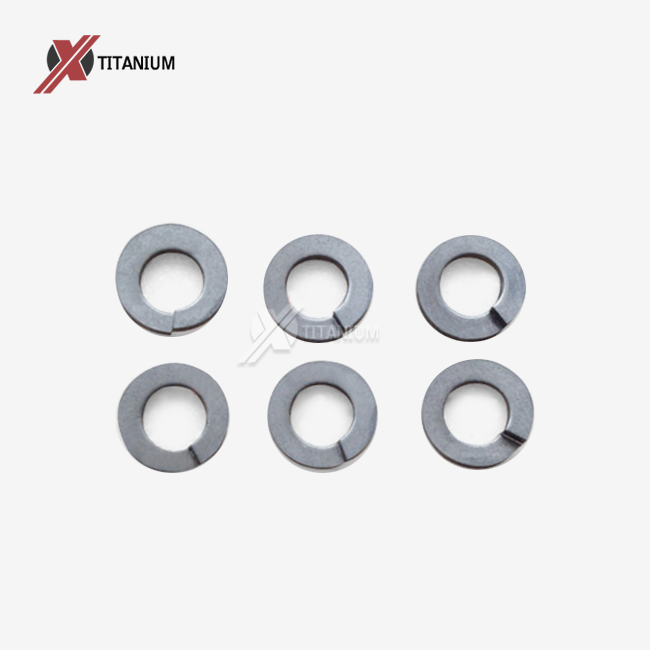
Understanding Spring Washers: Types and Functions
Spring washers are dynamic fastening parts that are made to absorb pressure, account for temperature expansion, and keep the preload on bolted joints. Because of the way they are shaped, when they are squeezed, they have a restoring force that keeps the bolts tight even when there is constant vibration or stress from the surroundings.
Common Types of Spring Washers
There are different types of spring washers used in the mechanical binding business. Each type is best for a certain type of load and assembly needs. Split lock washers have a single cut around the outside of the washer, which makes a spiral spring that bites into both the bolt head and the connecting surface. This design makes friction and strain, which stop the wheel from turning. Wave washers have many bumps all around their circle, which cushions and makes up for differences in stacking without needing a lot of extra room along the axis. Conical washers, which are also sometimes called Belleville washers, have a cone shape that flattens out when they're loaded. They offer high spring rates and a lot of force in a small package.
Titanium Variants and Their Classifications
When we look at titanium-based possibilities, the choice of material greatly improves performance metrics. Because the alloy has a yield strength of more than 828 MPa, split lock screws made from Ti-6Al-4V metal keep their spring memory even after being compressed many times. Wave-type titanium spring washer variants work great in situations where saving weight has a direct effect on how well the system works. For example, the 45% mass reduction compared to steel versions makes a big difference in aircraft landing gear assemblies and racing suspension components. Titanium washers that are cupped or conical can handle very heavy loads in places like chemical processing equipment and underwater drilling platforms, where corrosion resistance and mechanical strength cannot be reduced.
Operating Principles and Load Distribution
How well spring washers work depends on how well they can turn deflection into long-lasting binding force. The value of elasticity of titanium is about 113 GPa, while steel's is 200 GPa. This means that titanium can bend more when the loads are the same. Because of this feature, titanium screws can keep their tightness more consistently even when the temperature changes. This fixes a common problem that happens in high-temperature situations. The washer spreads the load of the bolt over a bigger surface area. This lowers the stress concentration and keeps the base materials from getting damaged. When the joint vibrates, the spring action constantly replaces tension that would have been lost due to tiny movements in the joint.
Properties and Benefits of Titanium Spring Washers
When commercially pure titanium or Ti-6Al-4V alloy is used to make a titanium spring washer, the material has properties that make them useful in high-performance industrial settings. When procurement teams know about these technology benefits, they can make choices that are in line with business needs and total cost of ownership.
Key Physical and Chemical Properties
It is known that Ti-6Al-4V washers have a tensile strength of at least 895 MPa and a mass of only 4.43 g/cm³. Corrosion resistance comes from a solid oxide layer that forms on titanium surfaces naturally. This layer protects against attacks from chloride, oxidizing acids, and saltwater. The material's shape stays the same at temperatures ranging from very cold (-196°C) to around 400°C. It also keeps its mechanical qualities when steel or stainless steel options would start to creep or oxidize. The coefficient of thermal expansion is very close to that of aluminum surfaces, which lowers the stress caused by differences in the expansion of mixed-material systems.
Enhanced Durability and Service Life
Industrial case data from oil production in the ocean shows that titanium washers last longer than fifteen years in high-pressure seawater, where SS316 parts usually break after three years. Fatigue resistance that can handle millions of vibration cycles without stress breaking is useful in aerospace uses. When something is both light and strong, it means that it has less inertial loads on moving parts, which means that nearby parts wear out less quickly. Titanium is biocompatible, which means that medical device makers can use it to make screws that can stay in place without causing tissue reactions or needing to be replaced during the device's lifetime.
Cost-Effectiveness Through Reduced Maintenance
Titanium washers are more expensive to buy at first than steel options, but a lifecycle study shows that they save a lot of money over time. When chemical processing plants switched to titanium fixing systems in corrosive service, they cut down on unplanned repair by 70%. Getting rid of protection layers that wear off and need to be reapplied lowers the total cost of ownership even more. Longer replacement times cut down on production downtime, which is very important in industries like petrochemical processing and semiconductor manufacturing, where hourly shutdown costs can reach tens of thousands of dollars.
Comparing Titanium Spring Washers with Other Materials
Choosing the right material has a big effect on how well and how often a bolt system works. Procurement experts can defend specs during cross-functional review processes when they understand comparative benefits of the titanium spring washer against traditional alloys.
Titanium Versus Stainless Steel
316-grade stainless steel spring washers are usually the best choice for uses that need to be immune to corrosion. Even though 316 stainless steel has chromium in it, it is not as strong as titanium in chloride and marine settings, where pitting and crevice rust are common. The strength-to-weight advantage is very important in aircraft and racing, where titanium has the same mechanical ability but half the weight. Because stainless steel has a higher modulus, its spring properties are stronger. This may be better for steady uses but not so good when thermal cycling is important. Titanium is needed for MRI machines and electrical parts that are sensitive to magnetic radiation because it is not magnetic.
Performance Against Standard Spring Steel
Carbon spring steel has a higher stiffness and is cheaper, but it doesn't prevent rust at all. In coastal, chemical, or outdoor environments, spring steel breaks down quickly, even if it has a zinc covering or coating to protect it. Coatings change the width of things, which can affect how well tolerances stack up in precision systems. Titanium's natural oxide layer doesn't need any extra treatment, so the dimensions stay the same and coating failure doesn't become a way for the material to break down. Above 200°C, spring steel starts to lose its toughness and flexible properties. Titanium, on the other hand, keeps its qualities up to 400°C.
How to Choose and Procure Titanium Spring Washers for Your Projects?
To get a titanium spring washer that works well, you need to carefully look over the technical details, the supplier's skills, and their quality control methods. The way the decision is made should be in line with the performance needs of the project and the organization's standards for buying things.
Critical Selection Parameters
The qualities of the load determine which washer to buy. Engineers have to figure out how much spring force is needed to keep the joint preload throughout its service life. They have to take into account the range of vibrations, the temperature changes, and the possible relaxing. An operating environment review looks at things like the chance of contamination, exposure to certain chemicals, and extremes of temperature and humidity.
To make sure that the dimensions match up with current fastener systems, they must be based on industry standards like DIN 127 for split lock nuts or DIN 2093 for disc springs. In businesses that are controlled, compliance paperwork is very important. For example, aerospace uses need AS9100 certification, medical devices need ISO 13485 certification, and pressure vessel parts need ASME verification.
Customization Options and MOQ Considerations
Standard catalog sizes work for many uses, but custom solutions are often needed for high-performance projects. Customization includes changing the thickness to meet specific spring rate needs, changing the inner and outer diameters to make sure the fit is perfect, and treating the surface in ways like anodizing for extra strength or color coding for easy identification. CNC cutting lets you make complicated shapes with tabs, notches, or built-in features that make assembly easier.
Minimum order numbers vary a lot from one provider to the next. For example, setup fees may apply to sample quantities of 50 to 100 pieces, while volume price benefits are more common for production runs of 1,000 or more units. Long-term supply deals with blanket orders make costs predictable and make sure that materials are available on time for projects.
Supplier Evaluation Best Practices
Checking out possible titanium washer manufacturers takes more than one step. For material approval, there should be mill test records that prove the alloy makeup through spectroscopic analysis. In Grade 5 material, the aluminum and vanadium contents should be paid special attention to. Transparency in the manufacturing process shows whether washers are stamped from sheet stock or CNC made from bar. Made parts usually have better grain structure and stability of size. Certifications for quality systems show that you care about process control and being able to track down problems. References from customers in related industries can give you an idea of how well shipping works, how quickly technical help responds, and how well you can solve problems. When it's possible, plant audits check the powers of tools and the way inspections are done.
Installation and Maintenance Best Practices for Titanium Spring Washers
Installing and maintaining a titanium spring washer correctly will extend its useful life and make it more reliable. To avoid common problems during these processes, you need to know how titanium works because it is a unique material.
Installation Guidelines and Torque Specifications
The first step in the fitting process is to prepare the surface. The matching surfaces must be clean, free of burrs, and the right level to make sure the load is spread evenly. When metals rub against each other, titanium tends to gall and become very hard. This makes lubrication very important. On the washer edges and threads, you should use molybdenum disulfide (MoS2) or titanium assembly lubricants. Because titanium has a lower modulus than steel, torque numbers need to be changed from steel alternatives. As a general rule, goal torque should be lowered by 10 to 15 percent compared to steel bolts of the same size. If the application requires it, the preload should then be checked using a calibrated tension measurement. Impact wrenches can cause shock loads that damage washer shape, but pneumatic or electric torque tools are easier to control.
Inspection Protocols and Wear Assessment
How often routine inspections are done depends on how bad the application is. In rotating machines with a lot of vibration, eye checks should be done every three months. In static structural uses, an annual review may be enough. Inspectors should look for lasting distortion. If a washer has lost its spring height, it means that it was either overloaded or the wrong material grade was chosen.
Surface changes in color can mean that something has been exposed to too much heat or a chemical attack, but titanium's color change from anodizing is not the same thing as deterioration. Fretting lines appear where the washer touches neighboring parts, which could mean that there isn't enough preload or there is too much movement. Using micrometers or calipers to measure the dimensions confirms that the thickness is maintained, and a 10% deviation from the standard specification is usually used as a rejection threshold.
Extending Service Life Through Preventive Maintenance
Strategies for prevention focus on keeping the settings that allow washers to work at their best. Maintaining the right torque by re-tightening joints every so often can make up for joint relaxing, but too much retorquing can cause stress damage. Environmental controls that lower corrosive exposure, like safe shelters in marine applications or inert gas cleaning in chemical systems, make it possible for parts to last longer before they need to be replaced.
Monitoring vibrations finds problems before they become too big to fix, so regular maintenance can be done instead of emergency fixes. Documentation systems that keep track of installation dates, torque values, and inspection results make it possible for predictive maintenance programs to find the best time to replace something based on its real state instead of a plan.
Conclusion
Engineering-based solutions for the toughest fastening tasks in the aircraft, marine, medical, industrial, and advanced production fields include titanium spring washer components. The material is very resistant to rust, has a high strength-to-weight ratio, and stays stable at high temperatures. These are important performance standards that regular materials can't meet. When deciding what to buy, people should compare the original costs to the long-term value of the item, keeping in mind that titanium's longer life and lower maintenance needs often result in appealing total cost of ownership benefits. To make implementation work, you need to pay close attention to choosing the right material grade, making sure the seller is qualified, using the right installation methods, and following the upkeep rules. It is better for organizations to use these best practices in their engineering and buying processes so that key parts are more reliable, have less downtime, and are safer.
FAQ
Q1: Can titanium spring washers be used instead of stainless steel washers?
A: There is physical interchangeability, but technical research needs to take into account that titanium has a lower modulus of elasticity (113 GPa vs. 200 GPa for steel). This difference changes the load-deflection curve, which might mean that the thickness or grade needs to be changed to meet the binding force profile of the original steel part. Talking to application experts about the repair makes sure that the joint stays intact.
Q2: Why choose Grade 5 Ti-6Al-4V for spring washers instead of commercially pure titanium?
A: Grades 1-4 of commercially pure titanium don't have enough yield strength to work well as spring elements. When these lighter materials are loaded, they distort permanently instead of returning to their original shape. The alpha-beta lattice in Grade 5 can be heated to change its properties. This gives the spring the memory it needs to keep its tension over many loading cycles.
Q3: Do titanium screws need to be handled in a certain way to keep them from galling?
A: Titanium is easy to gall when it is being installed because it has a low work hardening rate. This risk can be reduced by coating contact areas with molybdenum disulfide or other anti-seize chemicals. Anodized surface processes also lower friction and stop metals from sticking to each other. When titanium screws are used with titanium or stainless steel bolts, these safety measures become even more important.
Q4: In what temperature range do titanium spring washers work reliably?
A: Grade 5 titanium spring washers work effectively from very cold temperatures (-196°C) to about 400°C. If you go above this point, creep and stress reduction make the spring less useful. To keep the preload, applications that involve higher temperatures need different materials or changes to the design.
Partner with Chuanglian for Premium Titanium Spring Washer Solutions
Baoji Chuanglian New Metal Material Co., Ltd. has been making titanium parts for over ten years and can meet the exact needs of the aircraft, petroleum, medical device, and marine engineering industries. Our titanium spring washers are carefully CNC-machined from Grade 5 Ti-6Al-4V alloy that has been confirmed. The materials used can be tracked back to their source, and we have compliance paperwork that supports both the AS9100 and ISO9001 quality systems. We offer full customization options that include exact size requirements, surface processes like anodizing in different colors, and sanding or nitriding to improve performance.
As a company that makes titanium spring washers in Baoji, which is known around the world as the "City of Titanium," we have direct access to high-quality raw materials and highly skilled processing experts. During the design, prototyping, and production phases, our technical support team works with your experts to make sure that the part works perfectly in your application. You can talk to our procurement experts about your project needs and ask for specific technical paperwork by emailing info@cltifastener.com or djy6580@aliyun.com.
References
1. Boyer, R., Welsch, G., & Collings, E.W. (1994). Materials Properties Handbook: Titanium Alloys. ASM International.
2. Bickford, J.H. (2008). Introduction to the Design and Behavior of Bolted Joints: Non-Gasketed Joints (4th ed.). CRC Press.
3. Donachie, M.J. (2000). Titanium: A Technical Guide (2nd ed.). ASM International.
4. American Society of Mechanical Engineers. (2020). ASME B18.21.1: Lock Washers (Inch Series). ASME Standards.
5. Deutsches Institut für Normung. (2012). DIN 2093: Disc Springs - Quality Specifications - Dimensions. DIN Standards.
6. Schutz, R.W., & Watkins, H.B. (1998). Recent Developments in Titanium Alloy Application in the Energy Industry. Materials Science and Engineering: A, 243(1-2), 305-315.
Learn about our latest products and discounts through SMS or email