- English
- French
- German
- Portuguese
- Spanish
- Russian
- Japanese
- Korean
- Arabic
- Greek
- German
- Turkish
- Italian
- Danish
- Romanian
- Indonesian
- Czech
- Afrikaans
- Swedish
- Polish
- Basque
- Catalan
- Esperanto
- Hindi
- Lao
- Albanian
- Amharic
- Armenian
- Azerbaijani
- Belarusian
- Bengali
- Bosnian
- Bulgarian
- Cebuano
- Chichewa
- Corsican
- Croatian
- Dutch
- Estonian
- Filipino
- Finnish
- Frisian
- Galician
- Georgian
- Gujarati
- Haitian
- Hausa
- Hawaiian
- Hebrew
- Hmong
- Hungarian
- Icelandic
- Igbo
- Javanese
- Kannada
- Kazakh
- Khmer
- Kurdish
- Kyrgyz
- Latin
- Latvian
- Lithuanian
- Luxembou..
- Macedonian
- Malagasy
- Malay
- Malayalam
- Maltese
- Maori
- Marathi
- Mongolian
- Burmese
- Nepali
- Norwegian
- Pashto
- Persian
- Punjabi
- Serbian
- Sesotho
- Sinhala
- Slovak
- Slovenian
- Somali
- Samoan
- Scots Gaelic
- Shona
- Sindhi
- Sundanese
- Swahili
- Tajik
- Tamil
- Telugu
- Thai
- Ukrainian
- Urdu
- Uzbek
- Vietnamese
- Welsh
- Xhosa
- Yiddish
- Yoruba
- Zulu
What Are Titanium Nylock Nuts? Full Guide
When you combine the amazing qualities of titanium with advanced locking mechanisms, ISO 7043 Titanium Nylock Nuts are a huge step forward in threaded fastener technology. These special nuts have nylon cores or all-metal twisted thread designs that keep them from coming loose when vibrations and dynamic loads happen. They are mostly made from Ti-6Al-4V (Grade 5) titanium metal and have a maximum tensile strength of 895–1000 MPa while still being very light at 4.43 g/cm³. They have an amazing strength-to-weight ratio and are biocompatible and resistant to corrosion. Because of these qualities, they are essential for high-performance automobile, aircraft, medical, and naval uses where regular fasteners can't meet the strict needs.
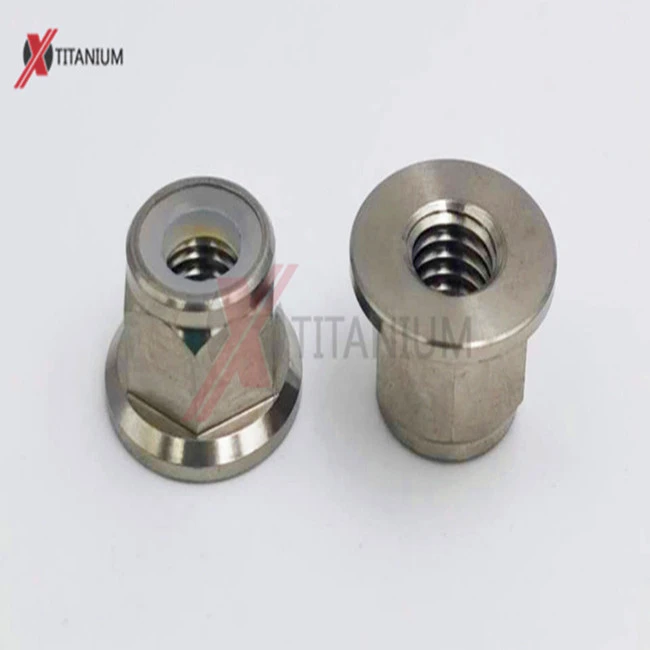
Understanding ISO 7043 Titanium Nylock Nuts
Titanium nylock nuts are the best way to fasten things together for important jobs because of their high-tech features. Advanced titanium alloys are used in these parts because they have better mechanical qualities than standard steel options.
Material Composition and Properties
Titanium nylock nuts are mostly made of Ti-6Al-4V (Grade 5) titanium metal, which has 6% aluminum and 4% vanadium in it. These ingredients give the mixture great strength while keeping the natural benefits of pure titanium. The maximum tensile strength of the material is between 895 and 1000 MPa, which is about the same as Property Class 8.8 or 10.9 steel screws but about 45% lighter.
The density of 4.43 g/cm³ makes it possible to reduce weight by a lot, which is useful in aerospace and automotive uses where mass optimization directly affects speed and fuel economy. Because titanium isn't magnetic, these nuts can be used in places with sensitive electronics and MRI machines that need to get rid of magnetic disturbance.
Locking Mechanisms and Standards Compliance
Knowing about the different locking systems helps people who work in buying choose the right fasteners for each job. The polyamide 6.6 ring used in nylon insert types works well in temperatures ranging from -50°C to +120°C. This polymer plug creates controlled pressure that keeps things from coming loose while still letting you install and remove it many times.
All-metal locking designs use thread deformation methods that work consistently in high-temperature settings above 300°C, where polymer inserts would break down. These designs keep the closing torque by carefully controlling thread interference patterns that meet the requirements of DIN 980 or ISO 7042.
Tolerances used in manufacturing usually meet or go beyond DIN 985, ISO 7040, or specific aircraft standards like MS and NAS. Thread fits usually follow Class 6H/2B standards, which makes sure that the assembly properties and joint stability stay the same from one production batch to the next.
Benefits and Applications of ISO 7043 Titanium Nylock Nuts
When titanium's natural properties are combined with modern locking systems, they create big practical benefits in a wide range of industries. These benefits directly lead to lower costs for upkeep and higher stability of the system.
Superior Environmental Performance
Titanium is very resistant to weathering because stable titanium dioxide (TiO2) oxide films form on open surfaces on their own. Chlorides, salt spray, and oxidizing acids are common in sea and chemical processing settings, but this passive layer protects against them almost completely. Titanium nylock nuts will always be structurally sound if they are used correctly, unlike stainless steel screws that can pit and corrode in harsh settings.
Because the material is biocompatible, it can be used to make medical devices that need to be chemically inert for a long time. Medical-grade titanium nuts go through extra cleaning steps to get rid of small amounts of contaminants that could cause bad biological reactions.
Weight Reduction and Performance Enhancement
Titanium screws are used by aerospace makers to cut down on weight without affecting the performance of the structure. There are thousands of fasteners in a normal commercial airplane. Changing steel parts with titanium ones can make the whole aircraft hundreds of pounds lighter. This decrease in weight immediately leads to lower fuel costs and more cargo space over the course of the plane's useful life.
Titanium's lighter weight also makes it useful for high-performance car uses, especially in the motorsports and luxury vehicle segments. Getting rid of extra weight in suspension systems makes the car go faster and handle better while still keeping the necessary strength margins.
Industrial Application Sectors
Manufacturing sectors with demanding operational requirements have embraced titanium nylock nuts for critical applications. Petrochemical facilities utilize these fasteners in equipment exposed to corrosive process fluids and elevated temperatures. Offshore drilling platforms rely on titanium's corrosion resistance to maintain structural integrity in harsh marine environments.
Aerospace engine makers use ISO 7043 Titanium Nylock Nuts for turbine systems that need to work well at high temperatures and not shake when they're in use. Titanium's high-temperature properties and effective locking systems work together to keep the unit together during engine runs.
How to Choose and Install ISO 7043 Titanium Nylock Nuts?
When choosing the right titanium fasteners, you need to carefully think about the performance standards, working factors, and environmental conditions. This technical review method makes sure that the best parts are chosen and that the system will work well for a long time.
Material Grade Selection Criteria
Grade 2 commercially pure titanium offers excellent corrosion resistance and moderate strength characteristics suitable for low-stress applications in aggressive environments. This grade provides ultimate tensile strength of approximately 345 MPa and excellent formability for complex shapes.
Ti-6Al-4V (Grade 5) has great mechanical qualities and can withstand tensile loads of up to 1000 MPa, so it can be used in high-stress structural uses. This grade of alloy keeps its strength better at high temperatures than widely pure grades, which means it can be used in engine rooms and exhaust systems.
Specialized types, like Ti-6Al-2Sn-4Zr-6Mo, offer better resistance to creep for long-term use in high-temperature situations. These high-tech metals cost a lot, but they have performance benefits that you can't get with regular materials.
Installation Procedures and Torque Specifications
Installing titanium screws correctly is important for getting the best performance and avoiding common failure modes. Preparing for installation includes cleaning the threads and using the right anti-seize chemicals to keep them from galling during assembly.
Depending on the thread size and form of the nut, the torque requirements for titanium nylock nuts are usually between 60% and 80% of the values for steel fasteners that are the same. For M6 titanium nylock nuts, the recommended fitting force is 8–12 Nm, and for M12 sizes, it's 45–65 Nm. These numbers need to be compared to the manufacturer's suggestions and changed to account for the lubricant situation.
To avoid cross-threading or stress amounts that are too high, installation tools should accurately measure force and run smoothly. Calibrated torque tools with the right socket designs make sure that the quality of the piece stays the same across all production runs.
Comparing Titanium Nylock Nuts with Other Locking Nuts
Technical performance studies show that titanium is better than other materials in tough situations. These comparisons help procurement workers make decisions about what materials to buy based on performance measures that can be measured.
Mechanical Property Analysis
Titanium is definitely stronger than stainless steel options when looking at strength-to-weight ratios. 316 stainless steel is good at resisting corrosion in many situations, but its density of 8.0 g/cm³ makes it heavier, which is a big problem in aircraft and car uses. Titanium is about half the weight of stainless steel versions while still having similar strong properties.
Another important benefit of titanium screws is that they don't wear down easily. The material is great for spinning machinery and places where vibrations are common because it doesn't wear down easily even when loaded and unloaded many times. Titanium screws have been tested and found to be much more durable than other materials. They can handle millions of load cycles without cracking.
Cost-Performance Optimization
Titanium materials are more expensive than steel options, but lifetime cost analysis often suggests that titanium is the better choice. The total cost of ownership is lower in important uses because upkeep needs are lower, service gaps are longer, and failures caused by corrosion are eliminated.
Aerospace makers often choose titanium screws, even though they cost more at first, because they save weight, which lowers the cost of fuel over the life of an aircraft. Titanium is also resistant to rust, which makes it useful in naval uses where expensive repair processes for corroded steel fasteners are not needed.
ISO 7043 Titanium Nylock Nuts certification provides additional value through standardized quality assurance and tracking standards. Certified parts go through strict testing procedures that check their mechanical qualities, correctness in measurements, and compliance with the material makeup.
Procurement and Supplier Guide for ISO 7043 Titanium Nylock Nuts
To successfully buy titanium screws, you need to carefully evaluate suppliers and know how the market works. Because handling titanium is so specialized, there aren't many suppliers, and the standard of their products varies a lot.
Supplier Qualification Criteria
Titanium fastener sources with a good reputation have complete quality management systems that include AS9100 aerospace approval, ISO 9001 quality standards, and paperwork that shows how materials can be tracked. These approvals make sure that the quality of the products is always the same and provide check trails for important uses.
Precision cutting tools, controlled atmosphere processing facilities, and full testing labs should all be part of a manufacturer's arsenal. Suppliers who have spectrographic analysis tools on hand can check the make-up of materials and find small amounts of contaminants that could affect how well they work.
Superior suppliers are different from basic suppliers in that they can offer technical help. An engineering team that knows a lot about titanium can help with choosing the right material, making changes that fit the purpose, and fixing problems that come up during installation.
Procurement Considerations and Logistics
Custom titanium screws usually have a minimum order quantity of 100 to 1000 pieces, but this can change based on how complicated the design is and how many tools are needed. Standard setups might have cheaper minimums, but they only come in a few sizes and specs.
Lead times are very different depending on how hard the making is and how readily available the materials are. Standard ISO 7043 Titanium Nylock Nuts configurations usually take 6 to 12 weeks to deliver, while special specs can take up to 16 to 20 weeks, which includes the time it takes to get the materials and process them.
Concerns for global shipping include the right packing to keep items from getting damaged and the paperwork needed to get goods through customs. Titanium is a strategic material, which means that it might need export licenses for some uses and places.
Conclusion
When it comes to tough industrial uses, titanium nylock nuts are the best fastener technology available. Their unique mix of light weight strength, resistance to corrosion, and reliable locking mechanisms meets the most stringent performance standards in the medical, marine, aircraft, and high-performance car industries. The starting costs are higher than other options, but the long-term benefits of less upkeep, less weight, and a longer service life make the investment worth it for important uses. Choosing the right provider and following the right fitting steps will ensure that the part works well and is reliable for its whole life.
FAQ
What temperature ranges can titanium nylock nuts withstand?
Titanium nylock nuts with nylon plates work reliably from -50°C to +120°C, while locking designs made of metal only work well at temperatures above 400°C. The titanium base material stays strong at temperatures up to 600°C, which means these screws can be used in engine rooms and exhaust systems.
Can titanium nylock nuts be reused after removal?
Most of the time, nylon inserts can be used three to five times before the polymer insert stops closing properly. Most all-metal locking systems can be used more than once, sometimes up to 10 times, based on the fitting conditions and the amount of torque needed. Before using it again in important situations, locking force should be checked.
How do ISO 7043 standards ensure quality and performance?
For threaded screws, ISO 7043 approval sets standard deviations in sizes, requirements for materials, and testing methods. This approval makes sure that the threads always fit, that the mechanical properties are correct, and that the material makeup can be tracked. Parts that meet this standard are tested in groups to see how strong they are, how hard they are, and how accurate their measurements are.
Are titanium nylock nuts suitable for medical implant applications?
Certified safe titanium alloys are used to make medical-grade titanium nylock nuts that can be used in implants. These parts go through more cleaning steps and tests to make sure they are biocompatible and don't contain any harmful trace elements. Medical devices may need to be marked with an FDA or CE mark, based on the rules that apply.
Partner with Chuanglian for Premium Titanium Fastening Solutions
You can trust Chuanglian to be your ISO 7043 Titanium Nylock Nuts seller because they only sell precision-engineered parts that meet the strictest industrial standards. Our complete quality control system makes sure that every batch of products has the same material traits and measurements. We have been processing titanium in a specific way for over ten years and are certified by AS9100 for aircraft use. This gives us the technical know-how and production skills needed for important uses. Get in touch with our engineering team at info@cltifastener.com or djy6580@aliyun.com to talk about your unique fastener needs and get full technical specs.
References
1. Boyer, Welsch, and Collings. (2019). Titanium Alloys from the Materials Properties Handbook. Technical Publications from ASM International on Materials Engineering.
2. The ISO is the International Organization for Standardization. (2018). ISO 7043:2018: Prevailing torque type hexagon nuts with flange - Class 8, Class 10, and Class 12. Geneva: Publications of the ISO.
3. The Lutjering, G. & Williams, J.C. (2020). Titanium: Materials and methods used in engineering. Springer Series in Materials Science and Engineering.
4. There is an American Society for Testing and Materials. (2021). ASTM F467-21 is a standard for nonferrous nuts that are used with fasteners that have threads on the outside. International Standards from ASTM.
5. Donachie, M.J. (2017). The third edition of Titanium: A Technical Guide. Publications from the ASM International Handbook Committee.
6. The Society of Automotive Engineers (SAE). (2019). SAE AMS 4928N: Titanium alloy nuts that are resistant to corrosion and heat and can lock themselves. International Aerospace Standards from SAE.
Learn about our latest products and discounts through SMS or email