- English
- French
- German
- Portuguese
- Spanish
- Russian
- Japanese
- Korean
- Arabic
- Greek
- German
- Turkish
- Italian
- Danish
- Romanian
- Indonesian
- Czech
- Afrikaans
- Swedish
- Polish
- Basque
- Catalan
- Esperanto
- Hindi
- Lao
- Albanian
- Amharic
- Armenian
- Azerbaijani
- Belarusian
- Bengali
- Bosnian
- Bulgarian
- Cebuano
- Chichewa
- Corsican
- Croatian
- Dutch
- Estonian
- Filipino
- Finnish
- Frisian
- Galician
- Georgian
- Gujarati
- Haitian
- Hausa
- Hawaiian
- Hebrew
- Hmong
- Hungarian
- Icelandic
- Igbo
- Javanese
- Kannada
- Kazakh
- Khmer
- Kurdish
- Kyrgyz
- Latin
- Latvian
- Lithuanian
- Luxembou..
- Macedonian
- Malagasy
- Malay
- Malayalam
- Maltese
- Maori
- Marathi
- Mongolian
- Burmese
- Nepali
- Norwegian
- Pashto
- Persian
- Punjabi
- Serbian
- Sesotho
- Sinhala
- Slovak
- Slovenian
- Somali
- Samoan
- Scots Gaelic
- Shona
- Sindhi
- Sundanese
- Swahili
- Tajik
- Tamil
- Telugu
- Thai
- Ukrainian
- Urdu
- Uzbek
- Vietnamese
- Welsh
- Xhosa
- Yiddish
- Yoruba
- Zulu
What Makes Titanium Ideal for Industrial Applications?
The amazing mix of strength, light weight, and resistance to corrosion makes titanium stand out in industrial manufacturing. These are all traits that are very important when engineering mistakes are not an option. Titanium forgings, in particular, solve problems that procurement teams keep having: getting rid of internal porosity that weakens structures; making parts last longer under repeated loads; and getting the most out of expensive raw materials in terms of material efficiency. When a turbine disc or ocean riser joint needs to work perfectly for decades in harsh conditions, forged titanium parts provide the dependability that casting or machining alone can't offer.
Understanding Titanium Forgings: Properties and Manufacturing Process
What Defines Titanium Forgings in Industrial Manufacturing?
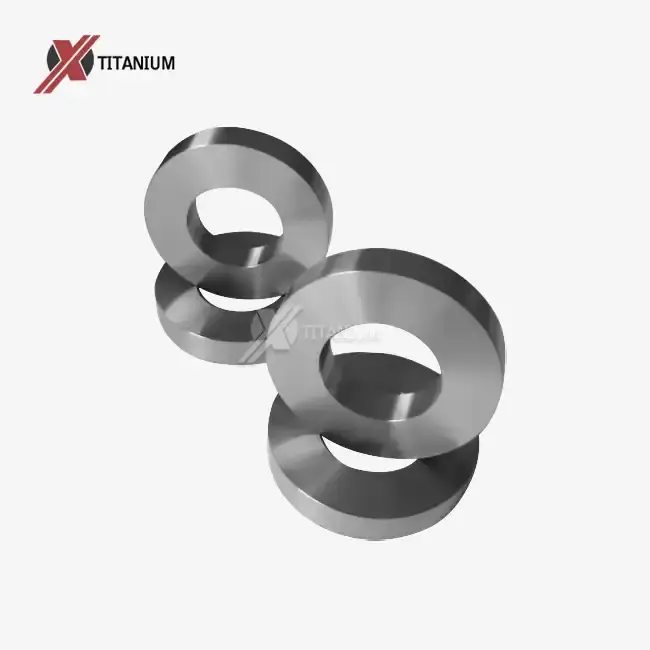
Titanium forgings represent components manufactured through controlled plastic deformation under extreme compressive forces. Forging is a way to work with titanium alloys (most often Ti-6Al-4V (Grade 5) or commercially pure titanium) at high temperatures instead of casting, which pours liquid metal into shapes. This process lines up the internal grain structure along the shape of the part, which makes the strength traits reliable. Forging solves three major problems: it fills in internal gaps that are a problem with castings; it makes it harder for cracks to spread by improving grain flow; and it maximizes the buy-to-fly ratio by making near-net-shape parts that require less expensive raw material to be machined later on.
Key Material Properties That Drive Industrial Adoption
Titanium forgings are stronger than most construction metals when it comes to weight. Grade 5 titanium metal, which is made up of 6% aluminum and 4% vanadium, has a tensile strength of over 130 ksi and weighs about 60% less than steel. This advantage in density directly saves fuel in aerospace uses and lowers the load on structures in marine sites. Titanium doesn't rust because it naturally creates a protective oxide layer that heals itself right away if it gets damaged. This keeps it stable over time in salty ocean and acidic chemical environments where stainless steel rusts in pits and cracks.
The Forging Process and Its Technical Advantages
The first step in the forging process is to heat titanium billets to temperatures close to or above the beta transus point, which is approximately 1,830°F for Ti-6Al-4V and is the temperature at which the phases change. Forging below this level (alpha-beta forging) keeps the flexibility while keeping the strength strong. Processing above the beta transus makes the material more resistant to breaking, but it may make it less flexible. Which die to use (open or closed) relies on how complicated the part is and how much is being made. Closed-die forging pushes metal into exact cavity shapes, which makes it possible to get tighter tolerances on dimensions that are good for making a lot of aircraft fasteners or medical implant stems. Open-die forging lets metal run side to side, which makes it possible to make bigger structural forms like rings and blocks that are used in chemical pressure tanks.
Managing the alpha case, a layer of oxygen-rich, weak metal that forms when titanium is heated, is a very important part of casting titanium. If this layer is left alone, it can cause cracks to start, which greatly shortens the wear life of the component. The alpha case has to be chemically milled or machined away by the manufacturer. This adds more steps to the process but makes sure the casting meets strict safety standards. Protective atmospheres or vacuum conditions are needed for the whole process to keep air and nitrogen from getting into the finished part and making it weaker.
Applications and Benefits of Titanium Forgings in Industrial Sectors
Forgings made of titanium are used in many businesses where failure of the material would have very bad results. Knowing how different industries use titanium's special qualities helps purchasing teams match the needs of the business with the right materials.
Aerospace and Aviation Applications
Titanium parts that have been made are used to make landing gear pistons, engine bulkheads, and turbine discs. These parts are subject to high-cycle wear because the landing gear is repeatedly compressed during takeoffs and landings. On the other hand, turbine parts are subject to thermal differences that range from temperatures below zero in the stratosphere to over 1,500°F in the combustion chamber. Forging creates a directed grain structure that makes the mechanical behavior predictable in these complex stress states. Because titanium has a low thermal expansion rate, it also keeps precision-fit parts from changing their clearance when temperatures change during flight cycles.
Offshore Oil and Gas Installations
For stress joints, riser parts, and blowout preventer stacks that work in high-pressure, high-temperature seawater, makers of subsea equipment use cast titanium. In these conditions, steel alternatives can crack and stress corrosion can happen in crevices, which can cause major breakdowns and expensive fixes abroad. Titanium forgings are resistant to these ways of breaking down, and their structure stays strong at ocean depths of more than 10,000 feet. The material works better in sour gas settings with hydrogen sulfide, which makes it last longer than regular metals that weaken when exposed to sulfide.
Medical Device Manufacturing
For hip stems and knee joint parts where biocompatibility and mechanical compatibility are both important, orthopedic implant makers use cast titanium. The casting process makes sure that there are no metallurgical flaws that could cause stress cracks to form inside the body. Titanium has an elastic rigidity that is about half that of stainless steel. This makes it more similar to bone stiffness, which lowers the stress buffering effects that cause bone to break down around implants. Commercially pure titanium grades are better for direct tissue contact because they are more biocompatible. Grade 5 is stronger for uses that need to hold weight in younger, more active patients.
Chemical Processing Equipment
For heat exchanger tubes, reactor tanks, and valve parts that deal with corrosive substances like chlorine, nitric acid, and organic chlorides, process engineers choose cast titanium. The structure stays the same in liquids with pH levels ranging from very acidic to very basic, which is where stainless steel and nickel metals break down. Forged flanges and pressure tank heads have better fatigue resistance, which lowers the risk of leaks in systems that are used in batch processing and are subject to repeated pressure loading.
Titanium Forgings Versus Other Materials: In-Depth Comparison for B2B Buyers
Performance Against Aluminum Alloys
However, forged titanium performs better in challenging situations, even though aluminum is cheaper and easy to work with. Titanium stays strong at temperatures above 600°F, while aluminum metals weaken at those temps. In marine settings, the difference in corrosion protection is very important. Aluminum corrodes when mixed with different metals in salt water, but titanium doesn't react. Titanium is better for uses where strength needs determine cross-sectional measurements because it is lighter. Even though a titanium part may weigh more per unit volume than an aluminum part, the finished part usually weighs less because titanium is stronger and thinner parts can be made of it.
Comparison with Steel and Stainless Steel
Forgings made of steel are cheaper at first, but they have secret costs over their lifetime. Titanium forgings don't need a protection covering, so they don't need to be maintained as often and don't have to be taken apart for coating. In some places, stainless steel is almost as resistant to rust as titanium. However, it fails in situations where chlorides, high temperatures, and mechanical stress are all present at the same time. When it comes to spinning equipment, the difference in density is very important. Titanium turbine blades lower the centrifugal pressure on hubs, which lets the equipment spin faster or last longer because the stress levels are lower.
Advantages Over Cast Titanium Components
Casting makes parts that are almost perfectly round with little to no cutting needed, but it adds holes and directional weakness that forging gets rid of. Due to microstructural flaws, cast titanium has lower wear strength and fracture behavior that is hard to predict. Applications that need to be safe, like medical implants and structural parts for airplanes, can't handle the statistical variation that comes with casts. Forging raises the cost of production but provides the dependability and accountability that controlled businesses need. Because casts have more complicated shapes and internal structures, non-destructive testing is better at finding flaws in forgings.
Pricing and Lead Time Considerations
Titanium forgings are very expensive because they require a lot of energy to make, the raw materials are expensive, and they need special tools to handle them. Lead times range from 8 to 16 weeks for normal shapes and longer for making special tools. Buyers should look at more than just the buying price when deciding what to buy. Longer service life, less upkeep, and fewer failures often make the original investment worth it. Long-term ties with suppliers allow for better price through volume agreements and better delivery schedules through better insight into production planning.
How to Choose the Right Titanium Forging Supplier for Your Business Needs?
Certification and Quality System Requirements
Before evaluating a supplier, the right certificates must be checked. AS9100 certification shows that you know how to handle quality in flight, while ISO 13485 certification shows that you know how to make medical devices. It's even safer when special methods like heat treatment and non-destructive tests are approved by NADCAP. Check with the big OEMs in your business to see if the supplier is on their approved manufacturer list. The years of checks and good service performance show in these approvals. Ask for proof that all the materials can be tracked back to the ingot that they came from and all the way through to the final inspection reports. This should include records of chemistry checks, mechanical property tests, and ultrasound examinations.
Manufacturing Capabilities and Technical Support
During the specification step, find out if the provider can help with the creation of the custom forging. Forging makers with a lot of experience can find the best part shape to get the most out of grain flow and reduce the amount of machining that needs to be done. Find out if they offer in-house testing services like metallography, scanning electron microscopy, and checking the dynamic properties. Suppliers who put money into complete quality systems show that they are dedicated to delivering consistent results. Check your production capacity and the variety of your equipment. Having more than one forging press and heat treatment furnace gives you scheduling freedom and production support that keeps your delivery dates.
Geographic Sourcing Strategy
Being close to domestic sources has benefits like faster contact, easier transportation, and lower geopolitical risk. But for some unique geometries or high-volume needs, global sources may be necessary. When looking at foreign providers, you should think about the total landed costs, which include freight, duties, and any possible problems in the supply chain. Different places have very different rules about protecting intellectual property and keeping technical data safe. For example, when sourcing titanium forgings, it’s crucial to set up clear rules about who owns the drawings, how process paperwork should be kept secret, and how many rival customers can be served.
Future Trends and Innovations in Titanium Forging Technology
Digital Manufacturing and Process Control
Modern forging shops have temperature sensors that work all the time and automatic systems that move the dies in ways that make the metal flow better and keep the same dimensions. Digital twin technology mimics the forging process before it is made, which lets engineers guess how the grain structure will turn out and find any problems that might happen. This feature cuts down on trial-and-error iterations when a new product is first introduced, which shortens the time it takes to create. Supply chain tools let you see what raw materials are available, when production will happen, and how the processes are going. This helps you plan your purchases better and keep track of your inventory better. Blockchain-based material approval could make it easier to track down and stop fakes in the supply lines for medical and aerospace products.
Sustainability and Circular Economy Initiatives
Titanium can be recycled over and over again, which is in line with companies' sustainable goals. Modern vacuum arc remelting methods can use titanium scrap, which means they don't need as much newly removed sponge material. Older gas-fired stoves are being replaced with more energy-efficient induction heating systems. These systems lower carbon emissions and make temperature control more accurate. Some companies use closed-loop systems to recycle coolant and recover heat from trash, which cut costs and are better for the earth. These changes help buyers by keeping prices stable even when the market for raw materials changes, and they also help meet the standards for supply chain sustainability reports.
Advanced Alloy Development
Metallurgical study is still going on to make titanium alloys with better qualities that can be used in certain situations. Beta titanium alloys are better at being cold shaped into complicated shapes, while near-alpha compositions are better at resisting creep in high-temperature turbine uses. When additive manufacturing is mixed with forging, hybrid parts are made that make the best use of material placement. For example, printed cooling channels inside forged structural shells are one example. These new ideas will make titanium useful in more situations and may lower costs by reducing trash and making assembly easier.
Conclusion
Titanium forgings work better than any other material in industry settings where dependability, durability, and ability to withstand harsh conditions make the higher cost worth it. Forging gives structures benefits that casting and cutting can't match. It makes parts that are strong in one direction, don't wear down easily, and stay the same size. These qualities are important for the aerospace, marine, medical, and chemical processing industries to meet safety standards and run their businesses. For successful procurement, you need to look at more than just price when deciding which providers to work with. You should look at their certifications, technical skills, and possibilities for a long-term relationship. When engineering and procurement teams know how to compare materials, how to make things, and about new technologies, they can safely select titanium forgings in situations where performance can't be compromised.
FAQ
Q1: What advantages do titanium forgings offer over cast components?
A: When titanium is forged, the internal holes and microstructural flaws that come with casting are taken care of. The mechanical working lines the grain structure in a way that makes it much stronger and longer-lasting. Due to shrinkage gaps and dendritic structures, cast parts fail in unpredictable ways. This means they can't be used in safety-critical situations like medical implants or structural parts of airplanes where statistical dependability is important.
Q2: How does Grade 5 titanium differ from commercially pure grades?
A: Grade 5 titanium alloy (Ti-6Al-4V) has extra aluminum and vanadium added to it, which makes it much stronger than widely pure grades. It keeps its tensile strength above 130 ksi, while Grade 2 pure titanium only keeps its strength around 70 ksi. Pure grades, on the other hand, are better at resisting rust and can be shaped into more complex forms. Pure titanium is often better for direct tissue touch in medical uses, even though it is weaker.
Q3: What factors influence lead times for custom titanium forgings?
A: Lead times depend on whether or not tools are already made for your shape. Standard forms ship in 8 to 12 weeks, but it takes an extra 12 to 16 weeks for special dies to be made. Scheduling is affected by the supply of raw materials, especially for complex alloy mixtures. Length of the production queue depends on the demand cycle of the industry. For example, output spikes in aircraft can make lead times longer across all industries. For certifications needed in controlled businesses, the time it takes for heat treatment and testing is an extra two to four weeks.
Partner with Chuanglian for High-Quality Titanium Forgings Supplier
We have been forging and machining titanium for more than ten years. Our factory is in Baoji City, which is known around the world as the "City of Titanium." We have CNC machining centers and quality control systems that make sure every forging meets international standards, such as AS9100 and ISO9001 certifications. Our technical team is here to help you through the whole process of specifying and buying precision titanium forgings for aircraft structure parts, corrosion-resistant parts for chemical processing, or biocompatible parts for medical devices. You can email us at info@cltifastener.com or djy6580@aliyun.com to talk about your unique needs and get thorough technical ideas backed by strict documentation for material traceability.
References
1. Boyer, R., Welsch, G., & Collings, E.W. (1994). Materials Properties Handbook: Titanium Alloys. ASM International, Materials Park, Ohio.
2. Donachie, M.J. (2000). Titanium: A Technical Guide, 2nd Edition. ASM International, Materials Park, Ohio.
3. Lutjering, G., & Williams, J.C. (2007). Titanium, 2nd Edition. Springer-Verlag, Berlin Heidelberg.
4. Semiatin, S.L., Seetharaman, V., & Weiss, I. (1999). "Flow Behavior and Microstructure Evolution During Hot Working of Ti-6Al-4V with a Colony Alpha Microstructure." Materials Science and Engineering A, Volume 263, pp. 257-271.
5. Cotton, J.D., Briggs, R.D., Boyer, R.R., Tamirisakandala, S., Russo, P., Shchetnikov, N., & Fanning, J.C. (2015). "State of the Art in Beta Titanium Alloys for Airframe Applications." JOM Journal of the Minerals, Metals and Materials Society, Volume 67, Issue 6, pp. 1281-1303.
6. Schutz, R.W., & Watkins, H.B. (1998). "Recent Developments in Titanium Alloy Application in the Energy Industry." Materials Science and Engineering A, Volume 243, Issues 1-2, pp. 305-315.
Learn about our latest products and discounts through SMS or email