- English
- French
- German
- Portuguese
- Spanish
- Russian
- Japanese
- Korean
- Arabic
- Greek
- German
- Turkish
- Italian
- Danish
- Romanian
- Indonesian
- Czech
- Afrikaans
- Swedish
- Polish
- Basque
- Catalan
- Esperanto
- Hindi
- Lao
- Albanian
- Amharic
- Armenian
- Azerbaijani
- Belarusian
- Bengali
- Bosnian
- Bulgarian
- Cebuano
- Chichewa
- Corsican
- Croatian
- Dutch
- Estonian
- Filipino
- Finnish
- Frisian
- Galician
- Georgian
- Gujarati
- Haitian
- Hausa
- Hawaiian
- Hebrew
- Hmong
- Hungarian
- Icelandic
- Igbo
- Javanese
- Kannada
- Kazakh
- Khmer
- Kurdish
- Kyrgyz
- Latin
- Latvian
- Lithuanian
- Luxembou..
- Macedonian
- Malagasy
- Malay
- Malayalam
- Maltese
- Maori
- Marathi
- Mongolian
- Burmese
- Nepali
- Norwegian
- Pashto
- Persian
- Punjabi
- Serbian
- Sesotho
- Sinhala
- Slovak
- Slovenian
- Somali
- Samoan
- Scots Gaelic
- Shona
- Sindhi
- Sundanese
- Swahili
- Tajik
- Tamil
- Telugu
- Thai
- Ukrainian
- Urdu
- Uzbek
- Vietnamese
- Welsh
- Xhosa
- Yiddish
- Yoruba
- Zulu
What is a Titanium Capillary Tube? Material, Structure and Applications Explained
A Titanium Capillary Tube is a high-precision, hollow cylindrical component engineered with exceptional dimensional accuracy and superior material properties. These specialized tubes feature outer diameters typically ranging from 0.8mm to 20mm, with wall thicknesses controlled to tolerances as tight as ±0.005mm. Pure titanium grades or titanium alloys that are sold in stores are used to make these tubes. They solve big problems in lots of different areas, like corrosion in harsh settings, biocompatibility needs in medical uses, and weight loss needs in flight systems. They are strong, light, and can stand up to poisons better than any other material. They are needed in high-performance settings where other materials don't work because of this.
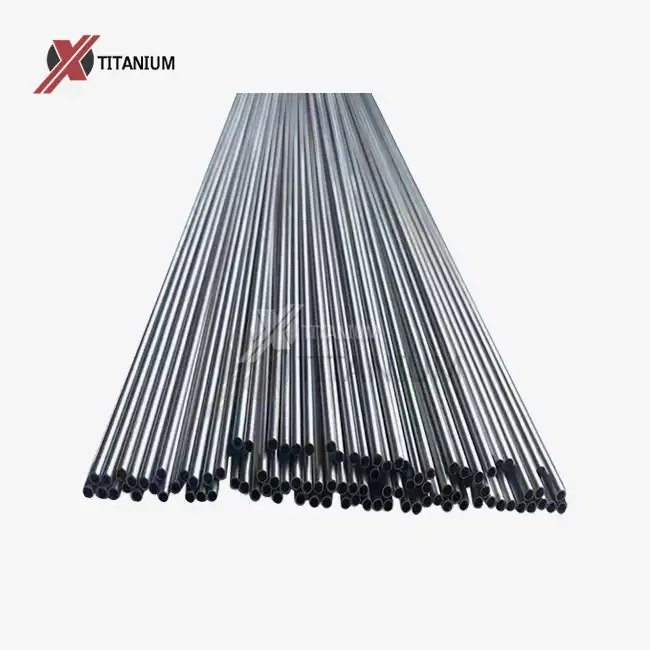
Introducing Titanium Capillary Tubes: Material and Structure
Titanium's unique atomic structure makes a stable oxide layer that is very resistant to weathering. This is what gives titanium capillary tubes their basic shape. With a density of 4.51 g/cm³, these tubes are about 40% lighter than similar ones made of stainless steel, but they can still be pulled apart more easily.
Material Properties and Characteristics
Titanium capillary tubes are not like other pipe materials because of the way they are made and how they react with chemicals. This stuff is very safe, which means it won't hurt live things if it comes into contact with them. Because it isn't magnetic, it can be used with delicate electronics and in MRI machines. Plus, it stays the same shape in temperatures from very cold (-600°C) to very hot (-1000°C).
Titanium is great because it is strong for how light it is. Pure titanium grade 2 that is sold in stores has a shear strength of up to 345 MPa and is much lighter than steel versions. Builders can make systems lighter with this mix without dropping the standards for safety or performance.
Structural Design Features
Because of how carefully they are made, the tubes are very closely centered and have a very smooth surface. The internal surface roughness can be less than 0.4µm, which makes sure that there is smooth flow, which is important for science and medical equipment. For uses that put pressure on something, even wall thickness is still very important, and for most uses, manufacturing margins are kept to within ±0.01mm. For some uses, they are even smaller.
Grade Specifications and Standards
Different kinds of titanium work better for different tasks because of how they are made. Grade 1 is great for making complex forms because it is easy to shape and doesn't rust. Grade 2 is stronger, but it's still easy to make. It is stronger and better for tough building jobs because grade 9 titanium metal has more aluminum and vanadium added to it. All of the types meet the ASTM standards that are needed, like B338, B861, and medical-grade F67/F136.
Manufacturing Process of Titanium Capillary Tubes
Titanium capillary tubes that are very precise in their sizes and made of great material are made using advanced metalworking methods. There are high-purity titanium raw materials that are carefully checked for their chemical make-up before they are used to make something.
Raw Material Processing and Preparation
As the first step in the process, vacuum arc burners melt titanium sponge or reclaimed titanium to get rid of any impurities and make the chemical make-up even. When this is done, the ingots are melted and shaped and rolled to break up the cast structures and give them the right grain characteristics. Tracking the materials is still very important at this stage, and each batch is given a unique ID code that links it to the materials it came from and the settings it was processed in.
Tube Formation and Dimensional Control
Most of the time, they start with cut billets or gun-drilled bars and use smooth manufacturing methods to make tubes. The outside width and wall thickness get smaller as the cold drawing process goes on, but the tube's length gets longer. For exact measures, the drawing has to be done many times through precise dies. Between drawing rounds, the material is annealed to keep it from getting too hard and to keep it bendable.
Two different kinds of quality control measures are statistical process control methods and continuous dimensional tracking with laser measurement tools. There are many tests that are done on each lot of output, such as measuring, characterizing, and checking the quality of the surface. Other non-destructive testing methods, like eddy current inspection, can find cracks inside or changes in wall thickness that might affect how well something works.
Finishing Operations and Quality Assurance
There are ways to clean surfaces that get rid of scale and improve their finish. Using acid to pickle metal gets rid of the rust while keeping its shape. When surfaces in a hospital need to be very smooth so that germs don't stick to them, electropolishing can be used. When surfaces are bright-annealed in controlled atmospheres, they look good and their mechanical properties get better.
Applications of Titanium Capillary Tubes Across Industries
Titanium Capillary Tube technology can be used in a lot of different fields because it has certain benefits. This is because how well the material works has a direct effect on how safe and reliable the system is. Titanium is used in these ways to solve scientific problems that other materials can't, because it is biocompatible, doesn't rust, and is very strong.
Medical Device Applications
The medical field is one of the hardest places for capillary tubes to work well. Tools used in surgery use these tubes as cannulas for minimally invasive treatments. Biocompatibility keeps people safe by stopping responses between tissues. Due to its high resistance to wear, titanium can be used for pacemaker lead systems that can go through millions of heart cycles without breaking.
Capillary tubes are used to keep dental implant systems moist. These systems use titanium's osseointegration properties to help the bone join. The material is radiolucent, which means that x-ray pictures are clear and don't show any artifacts. This makes it possible to get accurate tracking after surgery.
High-Performance Analytical Instrumentation
People who make lab tools use titanium capillary tubes in high-performance liquid chromatography machines to keep chemicals from getting into samples. Titanium stays chemically accurate in a lot of different fluid systems, while stainless steel can let metal ions into sensitive samples.
So it can be used in mass spectrometry because it stays steady at high pressure and doesn't mix with sample media. Although the material doesn't release many gases, it lasts a long time, which means that it doesn't need as much maintenance and costs less.
Aerospace and Defense Systems
Titanium is used in aircraft for hydraulic systems that have to work in difficult conditions because it is strong for its weight. It is possible to make airplane hydraulic lines that are lighter overall while still meeting the pressure needs of flight control systems with titanium capillary tubes.
It is possible to lower the cost of flight by making these tubes lighter. They move heat around in satellite temperature control systems. For a long time, the material will not break down because it stays solid even when temperatures change a lot in circling settings.
How to Choose the Right Titanium Capillary Tube for Your Needs?
You need to carefully consider the performance standards, the environment, and the application needs in order to pick the right titanium capillary tube. If you know how the properties of a material relate to what it's used for, you can pick the best parts without over-specifying, which adds costs without adding value.
Material Grade Selection Criteria
You should pick either available pure titanium grades or alloy mixtures based on how strong the titanium needs to be and how it will be used. Grade 1 doesn't rust and can be shaped the best, so it can be used in places with lots of weathering and difficult forms. Standardization says that Grade 2 is the best grade for most uses because it has better mechanical qualities and better defense against corrosion.
It is stronger than grade 8 titanium metal, which is needed for uses that need to keep the wall thickness as thin as possible. But because the material is stronger, it costs more and is harder to make. The benefits of being more efficient must be weighed against these costs.
Dimensional Specifications and Tolerances
For systems to work together and combine properly, they need to have clear definitions of measurements. The flow characteristics and pressure rates are changed by the choice of outside width. On the other hand, the load capacity and flexibility are determined by the wall thickness. Most of the time, standard range grades are fine, but if you need accuracy, you may need stricter rules that affect how much it costs to make and how long it takes to deliver.
How and how much something is made depend on its length. For example, bigger continuous lengths need special tools for processing. Custom cutting and end finishing methods that keep the sizes correct can be used to meet specific fitting needs.
Supplier Evaluation and Quality Assurance
It is best to give more weight to suppliers that have a history of doing a good job with titanium and quality control systems that meet standards for medical devices or airplanes. By getting AS9100, ISO 13485, or FDA approval, you can prove that you can consistently meet high quality standards.
The materials can be tracked and made sure to meet standards with certificates that list their confirmed chemical make-up, mechanical property data, and test results for size. When a supplier can do custom manufacturing, they can make products that meet quality standards and meet the needs of a certain application.
Maintenance and Longevity of Titanium Capillary Tubes
Maintenance practices that are done right can make Titanium Capillary Tube setups last a lot longer and keep them running at their best. By knowing what makes titanium special, you can make maintenance plans that keep it in good shape and keep it from breaking down too quickly.
Cleaning and Surface Care Procedures
The dormant oxide layer on titanium does a great job of keeping rust away, but it needs to be cleaned properly for it to keep working well. Alkaline cleaners are good at getting rid of organic dirt and don't hurt the protective oxide film. You shouldn't use cleaners that contain hydrofluoric acid on titanium because they can damage it and make it less immune to rust.
For mechanical cleaning, soft brushes or plastic scrapers get rid of buildups without hurting surfaces. Cleaning with high-pressure water gets rid of particles well while keeping the structure of the surface. The best way to get rid of all germs in hospital settings that need to be clean is to steam clean.
Environmental Protection Strategies
Titanium doesn't rust easily, but there are some things that can make it break down faster. When temperatures are above 300°C and salt is present, stress corrosion breaking can happen. This should be avoided at all costs. In places with a lot of hydrogen, things can weaken, but this can be lessened by picking the right metal and treating the surface correctly.
As part of regular inspections, you should look at the surface to see if it's damaged, check the measurements to see if there is wear or rust, and test for leaks when the pressure is on. Records from inspections can be used to find trends and make plans for repairs.
Performance Optimization Techniques
You avoid stress points that could cause something to break too soon when you put it in the right way. The right amount of support room keeps things from moving too much while still letting heat spread. It is best to keep stress concentration factors as low as possible when building a joint while still making sure that pressure stability is maintained.
Conditions must stay within the limits of the design, which is done by keeping an eye on the working factors. Pressure cycling analysis helps figure out how long something will last and plan for replacements before they break. Tracking the temperature of materials keeps them from being in situations that could damage them or speed up the rusting process.
Conclusion
Titanium Capillary Tube technology is a valuable part of modern industries that need strong materials to do their jobs well. When other materials fail in difficult circumstances, titanium is the best choice because it is biocompatible, resistant to corrosion, and strong. These carefully designed tubes always work, whether they're in a medical gadget that needs to keep people safe or a flight system that needs to cut weight. You can buy things that are better for both technology and the economy if you know what they are made of, how they are made, and what they are supposed to be used for. You should buy good titanium capillary tube because it lasts longer, needs less maintenance, and makes the system more reliable.
FAQ
What dimensional tolerances can be achieved with titanium capillary tubes?
Titanium capillary tubes are generally made with 0.05 mm of error for everyday use and 0.005 mm of error for high-precision medical and aerospace uses. When limits are this strict, they make sure that systems that depend on correct readings work right.
How does titanium compare to stainless steel for capillary tube applications?
Titanium doesn't rust as easily as stainless steel 316L does, especially when it comes to chlorides and strong acids, which rust by making pits and fissures. Titanium also has benefits, such as being hypoallergenic and 40% lighter. These facts often make up for its higher initial cost by providing better performance and a longer useful life.
Can titanium capillary tubes be formed into complex shapes?
Yes, particularly tubes manufactured from Grade 1 or Grade 2 commercially pure titanium demonstrate excellent formability for coiling and bending operations. But minimum bend radii must be met so that the material doesn't crack or kink as it is being made.
What surface finishes are available for specialized applications?
Acid-pickled, manually polished, and bright annealed are some of the surface techniques that can be used. In medicine, surfaces that have been electropolished and have a hardness value below 0.4µm are often needed to keep germs from sticking and to make sure the materials are safe.
Are titanium capillary tubes suitable for hydrogen service environments?
It's important to be careful around hydrogen because it can make titanium weak in some temperature and pressure conditions. Some metals and protection coatings might be suggested after a close look at the working conditions and safety standards.
Partner with Chuanglian for Premium Titanium Capillary Tube Solutions
Chuanglian stands as your trusted titanium capillary tube manufacturer, delivering precision-engineered solutions that meet the most demanding industrial specifications. Our facility in Baoji, China's "City of Titanium," combines advanced manufacturing capabilities with rigorous quality control systems ensuring consistent product performance. We specialize in custom Titanium Capillary Tube forms that are accurate to within 0.005mm, these tubes are used in a lot of different places, from medical devices to spaceships. When you work with us, you can be sure that your projects will be finished on time and to the standards that other countries require. Email our team at info@cltifastener.com or djy6580@aliyun.com to talk about your specific needs and get correct prices.
References
1. Boyer, R., Welsch, G., & Collings, E.W. "Materials Properties Handbook: Titanium Alloys." ASM International Materials Park, Ohio, 1994.
2. Donachie, Matthew J. "Titanium: A Technical Guide, 2nd Edition." ASM International Technical Books, 2000.
3. Lutjering, Gerd & Williams, James C. "Titanium Engineering Materials and Processes." Springer-Verlag Berlin Heidelberg, 2007.
4. Rack, H.J. & Qazi, J.I. "Titanium Alloys for Biomedical Applications." Materials Science and Engineering Reports, Volume 26, Issue 6, 1999.
5. Schutz, R.W. & Thomas, D.E. "Corrosion of Titanium and Titanium Alloys." ASM Handbook Volume 13: Corrosion, ASM International, 1987.
6. Peters, M., Kumpfert, J., Ward, C.H. & Leyens, C. "Titanium Alloys for Aerospace Applications." Advanced Engineering Materials, Volume 5, Issue 6, 2003.
Learn about our latest products and discounts through SMS or email