- English
- French
- German
- Portuguese
- Spanish
- Russian
- Japanese
- Korean
- Arabic
- Greek
- German
- Turkish
- Italian
- Danish
- Romanian
- Indonesian
- Czech
- Afrikaans
- Swedish
- Polish
- Basque
- Catalan
- Esperanto
- Hindi
- Lao
- Albanian
- Amharic
- Armenian
- Azerbaijani
- Belarusian
- Bengali
- Bosnian
- Bulgarian
- Cebuano
- Chichewa
- Corsican
- Croatian
- Dutch
- Estonian
- Filipino
- Finnish
- Frisian
- Galician
- Georgian
- Gujarati
- Haitian
- Hausa
- Hawaiian
- Hebrew
- Hmong
- Hungarian
- Icelandic
- Igbo
- Javanese
- Kannada
- Kazakh
- Khmer
- Kurdish
- Kyrgyz
- Latin
- Latvian
- Lithuanian
- Luxembou..
- Macedonian
- Malagasy
- Malay
- Malayalam
- Maltese
- Maori
- Marathi
- Mongolian
- Burmese
- Nepali
- Norwegian
- Pashto
- Persian
- Punjabi
- Serbian
- Sesotho
- Sinhala
- Slovak
- Slovenian
- Somali
- Samoan
- Scots Gaelic
- Shona
- Sindhi
- Sundanese
- Swahili
- Tajik
- Tamil
- Telugu
- Thai
- Ukrainian
- Urdu
- Uzbek
- Vietnamese
- Welsh
- Xhosa
- Yiddish
- Yoruba
- Zulu
What is the application of titanium clad copper bars?
Titanium clad copper bars are a big step forward in the making of hybrid materials. They combine copper's great electrical and heat conductivity with titanium's great resistance to corrosion and strength. Using advanced joining methods, like explosion welding or hot rolling, these bars are made. They have a core made of pure copper and an upper layer made of titanium that protects it. Because of its special structure, the material can safely work in places where pure copper or titanium would not be enough, like those with harsh chemicals, high currents, or tough mechanical conditions. It is important for procurement managers, process engineers, and expert decision-makers in many industries to know how these composite bars can be used in a variety of ways. They need to find solutions that balance performance, durability, and lifetime cost-effectiveness.
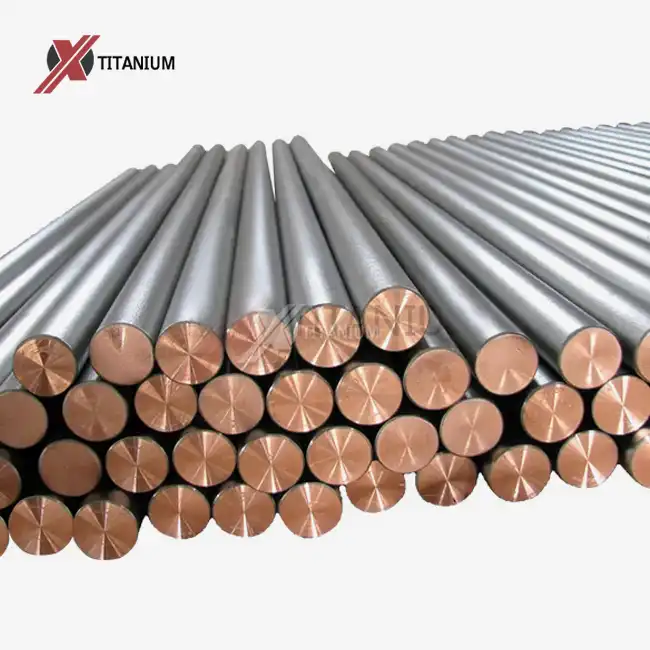
Overview of Titanium Clad Copper Bars
At Chuanglian, our titanium clad copper bars are carefully made with pure titanium (usually ASTM B265 Gr1 or Gr2) that is attached to high-conductivity copper cores that don't contain any oxygen (ASTM B170 C10200 or C11000). The process of making the covering includes cold rolling, hot rolling, annealing, and pickling. These steps make sure that the thickness is the same from 0.1 mm to 2 mm across widths of 10 mm to 200 mm and lengths of up to 3000 mm. This combined structure solves a basic engineering problem: copper is a great conductor of electricity (about 90–98% IACS), but it corrodes quickly in acidic, alkaline, or chloride-rich environments. Titanium, on the other hand, doesn't corrode but doesn't conduct electricity well.
When you put titanium on top of something else, it creates a stable, self-healing oxide film (TiO₂) that protects the copper from chemical attack and contamination. At the same time, the copper core sends the main current while reducing heat production and resistive losses. Surface finishing choices, such as bright, polished, acid cleaning, and sandblasting, let you make the product fit your fitting needs. Unlike stainless steel-clad copper, nickel-clad copper, or aluminum-clad conductors, titanium clad copper bars have a low density (4.5 g/cm³), excellent thermal stability, and superior electrochemical compatibility. This makes them essential for tasks that need to be both electrically efficient and resistant to environmental damage.
Primary Applications of Titanium Clad Copper Bars
Electrochemical and Electroplating Industries
The electroplating and surface cleaning processes are two of the most important uses. In automatic plating lines where parts are bathed in acidic or alkaline solutions containing copper, nickel, chromium, or zinc salts, titanium clad copper bars are used as hangers, busbars, and contact points. Copper busbars from the past dissolve quickly in these solutions, polluting the bath and making the plate thickness uneven, which causes a lot of rejects. The titanium lining completely stops this breakdown while still delivering current to the workpieces efficiently. This material is very important for keeping the bath clean and making sure that the finishing quality stays the same across production cycles in places that make printed circuit boards, auto trim parts, and decorative hardware.
Chlor-Alkali and Hydrometallurgical Processing
In chlor-alkali electrolysis plants that make hydrogen, chlorine, and caustic soda, titanium clad copper bars act as lead-in conductors and distribution bars, sending current to anodes that are solid in terms of their shape. The climate is very harsh, with high temperatures, concentrated salt, and chlorine gas rising into the air. Under these conditions, pure copper would rust quickly, breaking down equipment and letting dangerous gases out.
The titanium covering can stand up to chlorine attacks, and the copper core moves high-amperage loads quickly and efficiently, keeping energy efficiency and working safety high. These composite bars are also used in electrowinning and electrorefining cells where acidic sulfate solutions would normally damage copper wires that are not protected. These cells are used in hydrometallurgical operations that remove copper, nickel, cobalt, and rare earth elements.
Marine and Offshore Engineering
Marine settings are very difficult because people are constantly exposed to salty water, air, and organisms that build up biofouling. Impressed current cathodic protection (ICCP) anodes are fed by titanium clad copper wires and are used to protect offshore platforms, ship hulls, pipelines, and port facilities. These bars don't rust or pit when exposed to chloride, so they will last for decades without any repairs in buried or splash-zone placements. These materials are used in heat exchangers and electrical transport systems in desalination plants that use thermal or reverse osmosis processes. These systems are exposed to both salt water and electricity at the same time.
Power Generation and Electrical Distribution
Facilities that use thermal, nuclear, or green energy often work in places where chemical fumes, moisture, or humidity make the air around electrical equipment corrosive. In switchgear, transformer stations, and generator connections, titanium clad copper bars act as connectors, busbars, and grounding wires. Because they can keep their low electrical resistance and prevent corrosion, they save energy, keep technology from breaking down, and make it last longer. Corrosion-resistant wires keep working even in salty air, which is especially helpful for solar and wind systems near the coast.
Aerospace and Automotive Components
In aircraft and automobile engineering, reducing weight and making sure things work are the most important things. Titanium clad copper bars are used in specific electrical connections, battery management systems for electric cars, and electronics where a lot of current needs to be sent through thin, corrosion-resistant wires. The low density of the material compared to solid copper or steel options helps the car weigh less while keeping its electrical performance. Grounding straps, radar system links, and auxiliary power transfer are all examples of aerospace uses that need to be strong mechanically and resistant to the environment.
Why Titanium Clad Copper Bars Are Preferred in Procurement?
When purchasing conductor materials, procurement professionals know that titanium clad copper bars offer big total cost of ownership benefits, even though they cost more at first than bare copper or covered options. The long service life—often more than 20 years in acidic conditions where bare copper would break in months—removes the need for frequent replacements, production stops, and quality problems caused by contamination. The inactive titanium oxide layer doesn't need to be painted, coated, or cathodic protection adjusted, so it requires a lot less maintenance.
In order to get these benefits, you must choose a skilled seller. Manufacturers who follow the ASTM B898 and GB/T 12769 standards make sure that the metals are properly bonded. This is confirmed by acoustic testing, which finds gaps or delamination between the surfaces. Chuanglian uses a lot of different quality control methods, such as hardness testing, bend testing, shear strength testing (usually above 130–140 MPa), and using micro-ohmmeters to measure electrical resistance. Our production methods are ISO9001-certified, which means that they are consistent from batch to batch, which is important for long-term business relationships.
The ability to customize also affects choices about what to buy. Chuanglian provides custom cladding thickness ratios that are best for different corrosion rates and estimated service lives. They also offer custom lengths to keep field joints to a minimum and surface finishes that match installation requirements. Bulk order fulfillment with known lead times helps with project timing for big installations like new electrolysis plants or marine infrastructure projects, where shipping delays can cause costs to go up by a lot.
How the Unique Properties Drive the Applications?
Superior Electrical Conductivity
The thin titanium layer doesn't change the conductivity of the copper core; it keeps about 90–98% IACS, based on the titanium-to-copper cross-sectional ratio. This means that titanium clad copper bars can handle current levels that are 4–5 times higher than solid titanium conductors without getting too hot. In electrochemical uses, this efficiency directly leads to lower running costs because the voltage drop is less and less power is used per ton of product output.
Exceptional Corrosion and Chemical Resistance
Data from chemical processing plants in the field shows that titanium clad copper bars keep their shape and electrical performance in places where bare copper corrodes at rates higher than 1 mm/year. Between 3 and 12 pH, the inactive TiO₂ film stays solid. Oxidizing acids, chlorides, hypochlorites, and organic solvents can't damage it. It has been shown that titanium clad copper busbars have been used regularly for over 15 years in marine sites in the Persian Gulf, where the temperature and salinity of the water are very harsh.
Mechanical Toughness and Fatigue Resistance
The metal bond between titanium and copper, which can be made by explosive welding or diffusion bonding at high temperatures, has fracture forces greater than 130 MPa. This strong link doesn't delaminate when the temperature changes from -40°C to +200°C. Its mechanical qualities include being very flexible, which lets it be bent and formed in the field, and not easily worn down by vibrations that happen in connections for spinning machinery. Bend tests show that bars that were made correctly can be shaped to radii that are up to three times the width of the bar without cracking or the contact coming apart.
Considerations When Selecting Titanium Clad Copper Bars
Matching Material Specifications to Operational Requirements
When engineers define composite wires, they have to think about a number of things. Based on the allowed current density (usually 2 to 4 A/mm² for continuous duty), the current load figures out how much copper cross-sectional area is needed. The climate determines the thinnest layer of titanium that can be used. Mild atmospheric rust may only need 0.5 mm, but places with chlorine evolution need 1.5–2.0 mm for good service life. Material grade choice and joint design are affected by mechanical pressures caused by heat expansion, vibration, or the way the joint is installed.
Comparative Analysis with Alternative Claddings
Copper covered in stainless steel is less expensive and less likely to rust, but it has higher electrical resistance at the contact, which can cause heat to build up. Nickel-clad copper is very resistant to alkaline environments, but it's not as good as titanium when it comes to salt and acidic acid environments. Aluminum-clad copper is light, but it can't be used in acidic or marine settings. Titanium cladding is the best option when it comes to demanding rust and heavy electrical loads happening at the same time. Its higher cost is justified by its better dependability.
Procurement Best Practices
According to the appropriate ASTM standards, buyers should ask for third-party test results that show the bond strength, electrical conductivity, and corrosion resistance. Consistent product quality is guaranteed by supplier standards such as production certifications, quality management systems, and traceability methods. Deployment risk can be reduced by testing samples in simulated working situations before committing to big orders. Setting up long-term supply deals with qualified makers like Chuanglian guarantees stable prices, priority production scheduling, and quick expert help for the entire lifecycle of the equipment.
Conclusion
Titanium clad copper bars are a great way to solve important technical problems in the marine, power generation, advanced manufacturing, and electrochemical industries. They do this by mixing the electrical performance of copper with the environmental resistance of titanium. Their track record in harsh working conditions, which has been proven by decades of field experience, makes them the best material for situations where dependability, efficiency, and lifetime cost-effectiveness are very important. Buying from approved sources, making sure the right materials are used, and checking the quality of the finished product are all important parts of making sure that investments in titanium clad copper technology pay off over time and give businesses a competitive edge in tough industrial settings.
FAQ
What industries benefit most from titanium clad copper bars?
The biggest group of users are electrochemical processing centers, which do things like electroplating, chlor-alkali production, and hydrometallurgical extraction. These materials are very important for marine and offshore building projects, especially desalination plants and cathodic protection systems. Power plants and companies that make electric cars are using composite wires more and more for uses that need to be resistant to corrosion or light weight.
How does the titanium cladding improve performance compared to bare copper?
The titanium layer on the outside creates a passive oxide film that keeps the copper from dissolving in environments that are acidic, alkaline, or contain salt. This keeps the electrical resistance the same throughout the service life, increases the life of the wire from months to decades, and keeps electrolytic processes clean. The combination lowers the cost of upkeep and raises the standard of the process at the same time.
What quality certifications should buyers verify when sourcing suppliers?
Manufacturers with a good reputation keep their ISO9001 quality management certification and follow the rules set out in ASTM B898 for reactive metal clad plate. Ultrasonic test reports should show that the bond is solid, electrical conductivity measurements should confirm that the performance specs are met, and mechanical test results should show that the shear strength and flexibility are good.
Partner with Chuanglian for Reliable Titanium Clad Copper Bar Solutions
Chinese company Chuanglian has been making titanium clad copper bars for over ten years and is based in Baoji City, which is known as the "City of Titanium" in China. They have a lot of experience with making hybrid conductors and designing them for use. Our cutting-edge CNC machines and strict quality control procedures make sure that every bar meets the highest standards for electrical performance, bond integrity, and precision in size. Whether your project needs standard configurations or special specs that are made to fit specific working conditions, our technical team can help you with everything, from choosing the right materials to installing them.
Connect with our engineering specialists to discuss your specific requirements and request detailed specifications for our full product range. Contact us via email at info@cltifastener.com or djy6580@aliyun.com to explore how partnering with a certified titanium clad copper bar supplier can enhance your operational reliability and reduce total cost of ownership.
References
1. American Society for Testing and Materials. (2016). ASTM B898-11: Standard Specification for Reactive and Refractory Metal Clad Plate. West Conshohocken, PA: ASTM International.
2. Boyer, R., Welsch, G., & Collings, E.W. (1994). Materials Properties Handbook: Titanium Alloys. Materials Park, OH: ASM International.
3. Fontana, M.G. (1986). Corrosion Engineering (3rd ed.). New York: McGraw-Hill Book Company.
4. Lide, D.R. (Ed.). (2005). CRC Handbook of Chemistry and Physics (86th ed.). Boca Raton, FL: CRC Press.
5. Pourbaix, M. (1974). Atlas of Electrochemical Equilibria in Aqueous Solutions (2nd English ed.). Houston, TX: National Association of Corrosion Engineers.
6. Schutz, R.W., & Thomas, D.E. (1987). Corrosion of titanium and titanium alloys. In Metals Handbook (9th ed., Vol. 13, pp. 669-706). Materials Park, OH: ASM International.
Learn about our latest products and discounts through SMS or email