- English
- French
- German
- Portuguese
- Spanish
- Russian
- Japanese
- Korean
- Arabic
- Greek
- German
- Turkish
- Italian
- Danish
- Romanian
- Indonesian
- Czech
- Afrikaans
- Swedish
- Polish
- Basque
- Catalan
- Esperanto
- Hindi
- Lao
- Albanian
- Amharic
- Armenian
- Azerbaijani
- Belarusian
- Bengali
- Bosnian
- Bulgarian
- Cebuano
- Chichewa
- Corsican
- Croatian
- Dutch
- Estonian
- Filipino
- Finnish
- Frisian
- Galician
- Georgian
- Gujarati
- Haitian
- Hausa
- Hawaiian
- Hebrew
- Hmong
- Hungarian
- Icelandic
- Igbo
- Javanese
- Kannada
- Kazakh
- Khmer
- Kurdish
- Kyrgyz
- Latin
- Latvian
- Lithuanian
- Luxembou..
- Macedonian
- Malagasy
- Malay
- Malayalam
- Maltese
- Maori
- Marathi
- Mongolian
- Burmese
- Nepali
- Norwegian
- Pashto
- Persian
- Punjabi
- Serbian
- Sesotho
- Sinhala
- Slovak
- Slovenian
- Somali
- Samoan
- Scots Gaelic
- Shona
- Sindhi
- Sundanese
- Swahili
- Tajik
- Tamil
- Telugu
- Thai
- Ukrainian
- Urdu
- Uzbek
- Vietnamese
- Welsh
- Xhosa
- Yiddish
- Yoruba
- Zulu
Where to buy high-quality GR5 titanium rear axle nuts online
Procurement professionals and technical experts usually look for direct maker channels and verified B2B platforms as the most reliable places to buy high-quality Gr5 Titanium Rear Axle Nut parts. Specialized titanium makers, such as Baoji Chuanglian New Metal Material Co., Ltd., which is in China's "City of Titanium," make precise CNC-machined Ti-6Al-4V fasteners that come with full approvals and material tracking. B2B marketplaces like Alibaba and Made-in-China also offer supplier networks that have been checked out. However, direct OEM partnerships often offer better customization options, batch consistency, and quick technical support, which is important for aerospace, racing, and marine applications that need to be sure of the material's integrity.
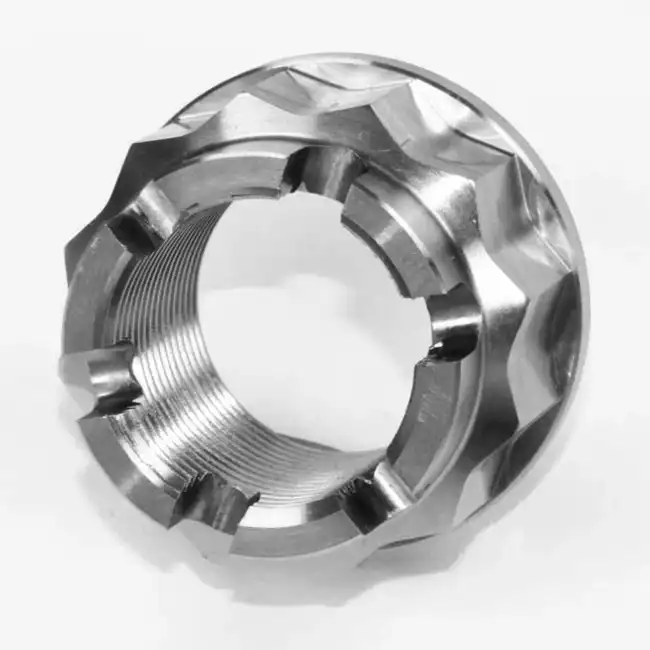
Understanding GR5 Titanium Rear Axle Nuts – Key Features and Benefits
Ti-6Al-4V, which is the formal name for grade 5 titanium metal, is the most common type of titanium used in industrial settings around the world. The alloy's make-up of 90% titanium, 6% aluminum, and 4% vanadium forms a metallurgical balance that solves the main problems that buying teams in high-performance sectors face.
The Material Science Behind Performance
Ti-6Al-4V has a minimum tensile strength of 895 MPa and a yield strength of more than 830 MPa. The material's mechanical features make it similar to Grade 10.9 high-tensile steel fasteners. However, its density of 4.43 g/cm³ makes it about 45% lighter than steel alternatives. It's not just a number edge on the standard sheets. Getting rid of unsprung mass, or parts that aren't supported by the suspension, directly improves the dynamics of a vehicle, the responsiveness of the suspension, and the energy economy of aircraft and automobile units.
The aluminum presence makes it stronger and less dense, and the vanadium stabilizes the beta phase structure, which makes it more resistant to heat and easier to shape during CNC cutting. The resulting hardness of about 36 HRC makes sure that the thread won't deform under the repeated loading conditions that are common in axle uses. Pure industrial titanium types (Gr1–Gr4) are very resistant to corrosion but not strong enough for structural fastening. Gr5 Titanium Rear Axle Nut components are both strong and stable in all environments.
Corrosion Resistance in Demanding Environments
Titanium is naturally resistant to corrosion because when it comes in contact with air, a steady layer of titanium dioxide (TiO₂) forms right away. This oxide film is only a few nanometers thick, but it can fix itself when it gets scratched and stays stable in pH levels ranging from very acidic to very basic. This property is especially useful for marine engineering projects and offshore platform systems because titanium metals don't fail through chloride-induced stress corrosion cracking like stainless steel screws do. Chemical processing plants that use Gr5 Titanium Rear Axle Nut components in their material handling tools say that their repair intervals are much longer. By getting rid of rust-related seizure between nut and bolt threads, downtime for planned maintenance and emergency repairs is cut down, which leads to lower running costs over longer service periods.
Surface Treatment Options for Enhanced Functionality
Today's CNC-machined titanium screws get different surface treatments to make them work better. Polishing smooths out surfaces, which lowers friction and makes them look better for uses that can be seen, like in high-end car builds and consumer gadgets. By using electrical ways to control the thickness of the oxide layer, anodizing processes can give metals bright colors like gold, blue, green, purple, black, and rainbow. These colored surfaces are used for both marking and finding things in complicated setups. Nitriding processes move nitrogen into the top layer, making titanium nitride compounds that raise the hardness of the surface to about 70 HRC while keeping the core's flexibility. This treatment helps parts last longer without giving up their lightweight edge in situations where they are subjected to rough wear or repeated assembly rounds.
How to Evaluate and Choose High-Quality GR5 Titanium Rear Axle Nuts?
When buying important fixing parts, you need to follow a set of evaluation rules that go beyond just comparing prices. Technical engineers, quality inspection teams, procurement managers, and project leaders are all cross-department stakeholders who bring their own evaluation factors to the process of choosing a provider.
Technical Specification Verification
Material verification is what quality security is built on. Material Test Reports (MTRs) from reputable makers show the chemical makeup of the product, which is checked by optical emission spectrometry or X-ray fluorescence analysis. The results should show that the Ti-6Al-4V makeup is within the limits set by ASTM B348. They should include exact percentages for titanium, aluminum, vanadium, and trace elements like iron, oxygen, nitrogen, carbon, and hydrogen. For a Gr5 Titanium Rear Axle Nut, the thread specs must be exactly the same as what the program needs. Metric threading (M20x1.5, M24x1.5) and Imperial threading (1"-14 UNF, 1⅛"-12 UNF) are made according to different rules. Precision thread rolling, instead of thread cutting, creates compressive residue stresses and continuous grain flow along thread profiles, which makes the resistance to wear higher. Go/no-go thread gauge verification and coordinate measuring machine (CMM) paperwork showing dimensional limits within ±0.05mm for key dimensions should be part of quality checking procedures.
Supplier Qualification Assessment
The ability to manufacture directly affects how consistent the product is from one production batch to the next. When compared to hand lathe processes, facilities with multi-axis CNC machining centers can keep limits more tight. Companies that have their own material testing labs with tensile testing tools, hardness testers, and metallographic analysis equipment show that they are committed to process control and don't just rely on third-party approval. Quality management system badges show how disciplined a company is. ISO 9001 certification sets the standard for quality management, while AS9100 certification meets the needs of the aerospace industry by covering things like risk assessment processes, traceability, and configuration management. Medical-grade apps might need ISO 13485 approval to show that they follow the rules for medical devices.
For project-based buying processes, supply chain stability is very important. Manufacturers who keep enough raw materials on hand to cover three to six months of production can better meet pressing orders and protect themselves from changes in the price of titanium sponge on global commodity markets. Technical support services, such as metallurgy advice, application engineering, and failure analysis, are very helpful when making new parts or fixing problems with how they work in the field.
Customization and Compatibility Considerations
Standard stock parts work well for many uses, but high-performance projects often need to be customized. Manufacturers need to be able to adapt to different thread lengths, locking mechanisms (with nylon inserts, metal prevailing torque features, or castellated designs for cotter pins), and special finishes. When you work with suppliers who have low minimum order amounts for custom specifications, you can make prototypes and try them without having to buy a lot of inventory. Verification of compatibility goes beyond checking the sizes of the threads and includes checking the torque-tension relationships that are unique to titanium's friction properties. Titanium-on-steel interfaces have different friction coefficients than steel-on-steel surfaces. This changes how pressure is applied and how much preload is achieved. Quality providers give advice on torque specifications and suggest the right anti-seize materials to stop galling, which happens when titanium surfaces stick together under pressure during cold welding without any lubrication.
Where to Buy GR5 Titanium Rear Axle Nuts Online – Trusted Platforms and Suppliers
To find trustworthy sourcing outlets, you need to know the pros and cons of the different purchase platforms offered in the digital market today.
Direct Manufacturer Partnerships
Working directly with specialized titanium makers has a number of strategic benefits for buying things over and over again. This direct-source method is shown by Baoji Chuanglian New Metal Material Co., Ltd., which is located in Baoji City, known around the world as the "City of Titanium." With more than ten years of experience machining titanium, these companies have a wide range of production skills, from processing raw materials to delivering produced parts, including components like the Gr5 Titanium Rear Axle Nut.
Direct ties with manufacturers allow for in-depth technical talks about the needs of particular applications. Engineering teams can work together to find the best dimensions, choose the best surface treatment, and make sure that quality testing procedures are in line with how the parts will be used. When you work with makers who use statistical process control and keep written production methods, batch-to-batch consistency gets better. Manufacturers give priority to long-term customers during times of high market demand, which makes lead times more predictable. Another important benefit is traceability. Reputable makers use lot tracking systems that connect finished parts back to records of heat treatment, machining settings, and approvals for raw materials. This paperwork is very important for aircraft and medical uses that need to keep track of a lot of information about a material's history in order to follow rules and look into problems.
B2B Marketplace Platforms
Alibaba and Made-in-China are finding tools that let you compare products from many sellers at the same time. These platforms bring together makers of all sizes, from small workshops to large-scale industrial producers, so users can get access to reasonable prices and a wide range of capabilities. But for successful usage, suppliers need to be carefully checked out. Out of the thousands of listings, transaction history, customer reviews, third-party verification badges (like Alibaba's Gold Supplier status or Made-in-China's Verified Manufacturer name), and response time measures can help you find trustworthy partners. Amazon Business is for purchase teams that want to make buying things easier by using a familiar interface and well-established delivery infrastructure. The platform works well for small orders and fast shipping needs, but there aren't as many customization choices or technical help as there would be if you worked directly with the manufacturer.
Evaluation Criteria for Online Sourcing
Minimum order amounts (MOQs) have a big effect on how easily you can buy things and how much it costs to keep supplies on hand. Large manufacturers usually set higher MOQs (500–1000 pieces) to cover setting costs. Specialty shops, on the other hand, may be able to handle orders as little as 50–100 pieces. To find the right balance between MOQ, expected consumption rates, and inventory turnover goals, the buying and production planning units need to work together.
Shipping operations need to be carefully thought out, especially when dealing with other countries. Titanium parts are very light, but they need to be carefully packed to keep the surface from getting damaged during shipping. Shipping goods abroad takes 4 to 8 weeks, so you need to plan ahead and keep a safety stock on hand. When figuring out freight costs, you should take into account dimensional weight numbers, which may be higher than the real weight for bulkier packing. Product documentation available shows how smart the maker is. Users can effectively put things together with the help of detailed datasheets that include dimension drawings, material specs, torque suggestions, and installation directions. When manufacturers give you CAD models in standard forms like STEP and IGES, it's easier to use them in digital assembly designs and finite element analysis processes.
Installation & Maintenance: Ensuring Optimal Performance of GR5 Titanium Rear Axle Nuts
When you install something correctly, you protect the purity of the parts and make sure that the planned preload levels lead to reliable service performance. Installing a Gr5 Titanium Rear Axle Nut requires different methods compared to standard steel fasteners because of the unique properties of the material.
Installation Best Practices
The first step in thread preparation is to clean it well to get rid of any dirt, metal bits, or protection oils. Cleaning with compressed air or a cleaner makes sure that the thread sides touch each other closely. When putting titanium nuts on steel or titanium shafts, anti-seize material must be used, not can be used. Copper- or nickel-based anti-seize products make a sacrifice barrier that stops threads from galling (cold welding) when they are under a lot of pressure.
Adherence to the torque standard tells us if the bolt gets the right preload without going over its yield strength. The torque numbers given by the manufacturer take into account the unique friction coefficient that is caused by anti-seize application. According to ISO 6789 standards, torque wrench testing should be kept up to date every 12 months. Most of the time, click-type or beam-style torque wrenches are accurate enough for the job. However, for very precise setups, digital torque-angle instruments may be needed to keep track of both torque and rotational angle during the tightening process. Vibrations don't affect retention because the locking device is checked. Nylon-insert lock nuts work by interfering between the polymer insert and the male threads. A visual check shows that the nylon element is still in place and not destroyed. When the threads are first engaged, prevailing-torque lock nuts should show visible resistance, usually between 30 and 50 percent of the final torque standard.
Maintenance and Inspection Protocols
The length of time between inspections depends on how the machine is being used. Applications in racing that are subject to a lot of shaking and temperature changes may need to be checked after every race. As part of regular upkeep, marine equipment that are submerged in saltwater usually need to be inspected once a year. Based on practical experience, industrial machinery that works in controlled settings may need to be inspected more often, up to once every two years.
Damage that can be seen, like thread deformation, crack start-up, or loss of locking element integrity, is easy to spot. Using measured tools to check the torque proves that the preload is still there; significant torque loss (>20% of specification) means that the bolt is coming loose and needs to be looked into to find out why. This could be because the locking mechanism wasn't chosen correctly or there were problems with the surface being prepared. Thanks to titanium's ability to fight corrosion, nuts usually don't rust or galvanic rusting even after being used for a long time. This feature makes removal during maintenance activities very reliable, which is very different from steel bolts that need to be cut or destroyed in order to be removed because of seizure caused by rust.
Conclusion
To find good Ti-6Al-4V rear axle nuts, you have to carefully check the properties of the material, the skills of the seller, and the best ways to buy them based on the needs of the application. Gr5 Titanium Rear Axle Nut components have a great strength-to-weight ratio, are resistant to corrosion, and work well even after a lot of use. This makes it useful in aircraft, racing, naval, and industrial settings. When compared to marketplaces that are good for exploratory shopping, direct maker partnerships offer the best customizing, technical support, and tracking. The life of components and the dependability of the system are both increased by following the right installation and repair procedures. When procurement professionals put long-term supplier relationships, detailed paperwork, and approved quality systems at the top of their list of priorities, they get better results than when they focus on price.
FAQ
Q1: How can I verify the authenticity of Ti-6Al-4V material when purchasing online?
A: Genuine sellers of Grade 5 titanium give Material Test Reports (MTRs) that show the chemical makeup of the titanium, which is checked by spectrometry. Ask for certifications that show the amount of titanium (89–91%), aluminum (5.5–6.75%), and vanadium (3.5–4.5%) that are within the limits set by ASTM B348. Reputable makers are happy to have third-party inspections done by companies like SGS or Bureau Veritas before their products are shipped.
Q2: What lead times should I expect for bulk orders of titanium fasteners?
A: Standard standards usually ship within 2 to 4 weeks for orders of less than 500 pieces. Larger orders or special configurations take 6 to 8 weeks, which includes getting the raw materials, CNC milling, heat treating, and inspecting for quality. Setting up blanket purchase orders with planned releases helps makers plan their production better and cut down on lead times for needs that come up again and again.
Q3: Are custom thread sizes and surface finishes available for OEM applications?
A: Yes, titanium makers that specialize can make threads with custom sizes (both metric and imperial), different lengths, locking mechanisms that are integrated, and surface treatments like certain anodized colors or nitriding processes. Custom setups usually have a minimum order quantity of 100 to 200 pieces, but this can be higher or lower based on the complexity and tooling needs.
Partner with Chuanglian for Your Titanium Fastener Requirements
Baoji Chuanglian New Metal Material Co., Ltd. has been making precise titanium parts for over ten years and works with companies in the aerospace, naval engineering, racing, and industrial equipment industries. We always deliver approved Ti-6Al-4V rear axle nuts that meet the strictest technical requirements thanks to our extensive CNC machining capabilities, strict quality control systems, and large store of raw materials. As a specialized Gr5 Titanium Rear Axle Nut maker, we offer full material traceability, customization services, and expert support to help you reach your engineering goals. You can email our procurement team at info@cltifastener.com or djy6580@aliyun.com to talk about your unique needs, get full product specs, or set up an evaluation sample.
References
1. Boyer, R., Welsch, G., & Collings, E.W. (1994). Materials Properties Handbook: Titanium Alloys. ASM International, Materials Park, Ohio.
2. Donachie, M.J. (2000). Titanium: A Technical Guide, 2nd Edition. ASM International, Materials Park, Ohio.
3. Lutjering, G., & Williams, J.C. (2007). Titanium, 2nd Edition. Springer-Verlag, Berlin Heidelberg.
4. Peters, M., Kumpfert, J., Ward, C.H., & Leyens, C. (2003). Titanium Alloys for Aerospace Applications. Advanced Engineering Materials, Volume 5, Issue 6.
5. Schutz, R.W., & Watkins, H.B. (1998). Recent Developments in Titanium Alloy Application in the Energy Industry. Materials Science and Engineering: A, Volume 243, Issues 1-2.
6. Veiga, C., Davim, J.P., & Loureiro, A.J.R. (2012). Properties and Applications of Titanium Alloys: A Brief Review. Reviews on Advanced Materials Science, Volume 32, Number 2.
Learn about our latest products and discounts through SMS or email