- English
- French
- German
- Portuguese
- Spanish
- Russian
- Japanese
- Korean
- Arabic
- Greek
- German
- Turkish
- Italian
- Danish
- Romanian
- Indonesian
- Czech
- Afrikaans
- Swedish
- Polish
- Basque
- Catalan
- Esperanto
- Hindi
- Lao
- Albanian
- Amharic
- Armenian
- Azerbaijani
- Belarusian
- Bengali
- Bosnian
- Bulgarian
- Cebuano
- Chichewa
- Corsican
- Croatian
- Dutch
- Estonian
- Filipino
- Finnish
- Frisian
- Galician
- Georgian
- Gujarati
- Haitian
- Hausa
- Hawaiian
- Hebrew
- Hmong
- Hungarian
- Icelandic
- Igbo
- Javanese
- Kannada
- Kazakh
- Khmer
- Kurdish
- Kyrgyz
- Latin
- Latvian
- Lithuanian
- Luxembou..
- Macedonian
- Malagasy
- Malay
- Malayalam
- Maltese
- Maori
- Marathi
- Mongolian
- Burmese
- Nepali
- Norwegian
- Pashto
- Persian
- Punjabi
- Serbian
- Sesotho
- Sinhala
- Slovak
- Slovenian
- Somali
- Samoan
- Scots Gaelic
- Shona
- Sindhi
- Sundanese
- Swahili
- Tajik
- Tamil
- Telugu
- Thai
- Ukrainian
- Urdu
- Uzbek
- Vietnamese
- Welsh
- Xhosa
- Yiddish
- Yoruba
- Zulu
Best Titanium Disc Bolts for Racing Motorcycles in 2026
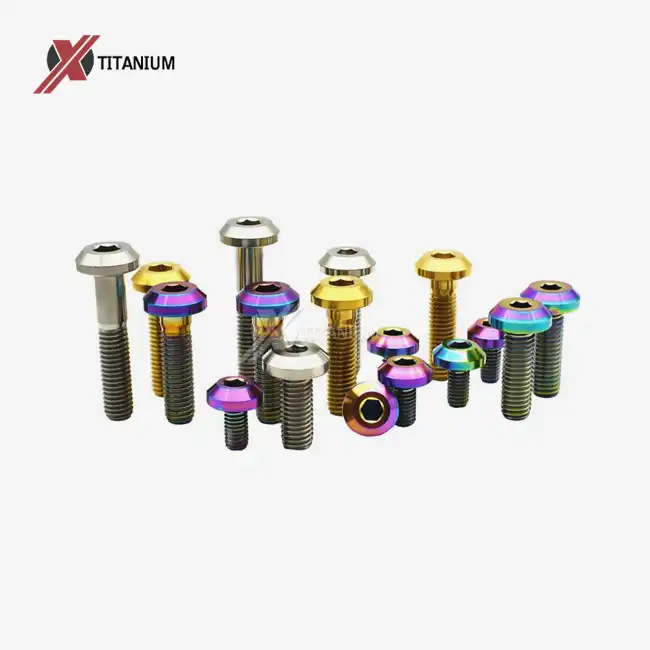
When looking at brake system fasteners for high-performance uses, titanium motorcycle disc bolts stand out as the best choice for racing that needs to reduce weight and ensure structural stability. These precisely designed parts are usually made from Ti-6Al-4V (Grade 5) titanium alloy. They have a tensile strength of around 950–1050 MPa and a lower unsprung rotating mass by about 45% compared to steel options. More and more, racing teams and OEM partners are choosing titanium motorcycle disc bolts because they reduce the gyroscopic effect during sharp turns and improve thermal stability under repeated heavy braking cycles. This keeps performance consistent over long track sessions.
Understanding Titanium Motorcycle Disc Bolts
Titanium motorcycle disc bolts are special fasteners made to meet the needs of race bikes' great performance. These parts hold brake rotors to wheel hubs. They are safety-critical parts of the braking system that can have terrible results if they fail. Unlike most hardware store fasteners, racing-grade titanium motorcycle disc bolts are made according to strict rules. For example, the threads are formed by rolling them instead of cutting them. This keeps the alloy's grain structure intact so that it can fight fatigue better when the car brakes hard.
Material Composition and Structural Advantages
The most common material standard is for Ti-6Al-4V (Grade 5 titanium), an alloy that comes from aircraft and has about 6% aluminum and 4% vanadium in it. This mixture has great mechanical properties, like a density of 4.43 g/cm³, which is much lower than steel's 7.85 g/cm³, but it still has similar strength qualities. The aluminum content makes the material stronger at room temperature and less dense. The vanadium content stabilizes the beta phase at high temperatures, which is very important for brake disc uses that have to go from room temperature to temperatures over 300°C during race conditions.
Corrosion Resistance and Long-Term Reliability
On titanium surfaces, a natural oxide film forms on its own, protecting these titanium motorcycle disc bolts from rusting in the air and from harsh chemicals like road salts, brake dust particles, and galvanic reactions with metals that are not the same. This passivation layer grows back on its own when it gets scratched. This stops the stopping and rust-welding that can happen to steel bolts that are exposed to salty environments or winter road treatments. This feature is very useful for racing teams that have to change their rotors often because titanium motorcycle disc bolts can be removed even after long periods of time without needing to be soaked in oil or heated.
Titanium vs Other Materials: Making the Right Choice for Racing Motorcycles
Choosing the right material for titanium motorcycle disc bolts has a big impact on how well they work and how long they last. To get the best value without sacrificing safety margins, procurement teams have to compare different material choices based on specific performance standards, cost parameters, and supply chain factors.
Even though steel bolts have a good tensile strength and are cheaper to buy at first, they have big problems when used in racing. Because they are much denser, there is more rotational inertia at the ends of the wheels. This means that the engine needs more power to speed up and slow down the rolling unit. Because of its tendency to corrosion, things need to be replaced often, which can lead to secret costs and safety risks if inspections aren't done on time. Stainless steel types are better at resisting rust, but they lose some of their tensile strength and can burn when they are installed, which makes it harder to stick to torque specifications.
While aluminum alloy bolts do a good job of reducing weight, they are not strong enough for fixing brake discs in situations where clamping force upkeep is required. Because aluminum doesn't hold up as well against fatigue under repeated loads, it's not a good choice for safety-critical bolts that are subject to vibration and changes in temperature. The fact that the material tends to bend threads when properly torqued makes it even less suitable for professional racing.
Titanium motorcycle disc bolts are better than both options because they reduce weight to the same level as aluminum while also being stronger than steel in terms of strength-to-weight ratios. Total ownership economics must be included in the cost-to-performance analysis. Titanium fasteners are more expensive to buy, but their longer service life, lack of corrosion-related replacements, and better performance make the investment worthwhile for tasks where improved lap times and reliability can be measured. When you buy in bulk from well-known sellers of titanium motorcycle disc bolts, you can usually get big savings that make the price difference much smaller.
How to Choose the Best Titanium Disc Bolts for Racing Motorcycles?
During the selection process, procurement managers and engineers should focus on specific factors that make sure compatibility, performance, and legal compliance. The framework for specifications starts with verifying the material's certification. This is done by using X-ray fluorescence spectroscopy and mill test results from the seller to prove the real Ti-6Al-4V (Grade 5) composition. This certification stops the use of lower-quality Grade 2 commercial pure titanium that doesn't have the right tensile strength for brake fitting uses.
Critical Specification Parameters
The thread size has to be exactly the same as the original equipment. For example, M6, M8, or M10 metric threads that meet 6g tolerance class standards are popular in racing uses. Customizing the shank length allows for different rotor hat thicknesses and hub fitting depths across motorcycle brands and aftermarket wheel combinations. Head drive setups, which are usually Torx or hexagonal sockets, must provide enough contact to reach the torque values stated by the maker without cam-out or head deformation. Regulations for racing often require drilled heads for installing safety wires, which must be made clear when the parts are bought.
Verification of tensile strength through destructive testing of sample batches proves performance limits of at least 950 MPa. This means bolts won't deform or break completely under the highest tightening loads. Surface processes like anodizing or Physical Vapor Deposition (PVD) coating make the surface harder and make it easier to identify by giving it different colors like natural titanium finish, gold, blue, purple, black, and colorful variations. These coats do two things: they make the product look different so that people can recognize it, and they make it more resistant to fretting wear in places with a lot of vibration.
Supplier Evaluation and Quality Assurance
Global providers that can be trusted have quality management systems that can be checked. These systems should include AS9100 aerospace certification, ISO9001 compliance, and recorded tracking methods that connect lot numbers of finished fasteners to lot numbers of source materials. The warranty should spell out how to get a repair for problems with the way the product was made and make sure that the performance is guaranteed. Premium providers are different from commodity vendors because they offer technical support services like application engineering advice and custom specification development. This is especially helpful when adapting fastener specifications to new race platforms or experimental brake system setups.
Installation and Maintenance of Titanium Motorcycle Disc Bolts
To get the most out of titanium motorcycle disc bolts and keep them from breaking down in ways that put people in danger, it's important to follow the right fitting steps. To start the fitting process, the mounting surfaces must be carefully cleaned. This includes getting rid of brake dust, corrosion products, and thread contamination from both the bolt holes and the mounting sides of the rotor. A small amount of thread lubricants made just for titanium motorcycle disc bolts, usually anti-seize mixtures with copper or nickel, should be used to keep the torque-to-preload ratios correct and stop galling.
Torque Specifications and Tool Selection
To make sure you follow the torque values given by the manufacturer, you must use certified torque wrenches that are accurate to within ±3% of reading. Because titanium motorcycle disc bolts have a lower modulus of elasticity than steel, it is important to be careful when applying torque. If you over-tighten, the threads in the aluminum hubs could strip, and if you under-tighten, the bolt could come loose during shaking. A star-shaped tightening process makes sure that the clamping force is spread evenly across the rotor bearing interface. This stops distortion that shows up as brake pulsation or uneven pad wear. When race rules require it, installing safety wires should use 0.032-inch stainless steel wire with the right braid formation and tension to keep the wires from pulling out and to keep drilled heads from having too much preload.
As part of regular maintenance, the bolt heads are visually checked before every race weekend for strange wear patterns, color changes that could mean the engine is overheated, or cracks coming from the drill holes. Verifying the thread contact after changing the rotor makes sure that everything fits properly and shows any cross-threading damage that needs to be fixed right away. Titanium motorcycle disc bolts need a more complex evaluation based on operational hours, thermal cycle accumulation, and regular tensile testing of retired samples to set replacement intervals that are in line with specific racing conditions and risk tolerance parameters. This is because steel fasteners have clear signs of rust that can be used to figure out how long they will last.
Where and How to Procure Titanium Motorcycle Disc Bolts in 2026?
When buying titanium motorcycle disc bolts for their businesses, they have to go through a number of different methods to find the best prices, delivery times, and technical help that fits their needs. Direct connections with manufacturers have benefits, such as the ability to make custom specifications, set prices based on volume, and get materials first during times when materials are in short supply, which affects titanium supply lines around the world.
Wholesale wholesalers act as middlemen, making sure that businesses that buy a lot of different kinds of products can get the products they need and ship them all at once. OEM partnerships let motorbike makers and race team organizations with steady demand work together to create specifications and handle their supply chains more efficiently. When normal stock items can't meet the specific thread lengths, head styles, or coating needs of proprietary brake system designs, the ability to place a custom order becomes necessary.
Prices drop by 15–30% compared to small-lot buys when volume discount structures are activated at threshold amounts of 500 to 2,000 pieces per SKU. Long-term supply deals that include blanket purchase orders with planned releases keep costs stable and make sure that capacity is allocated correctly. This is especially helpful during busy racing seasons when production backlogs cause lead times to grow. Strategies for negotiations should focus on the total value of the relationship, such as access to expert help, faster prototype development, and flexible minimum order quantities for validating new parts.
To handle logistics for the biggest markets in North America and Europe, you need to know about import taxes, customs classification codes, and the paperwork that titanium goods need. Established titanium motorcycle disc bolts makers with global distribution networks offer delivered duty paid (DDP) prices, which takes the hassle out of customs for buyers. Lead times are usually between 4 and 8 weeks for standard configurations and 8 to 12 weeks for custom configurations. This means that buying planning has to be in sync with the race season and prototype development plans.
Conclusion
Titanium motorcycle disc bolts are a smart investment for race teams that want to improve speed, keep riders safe, and run their businesses more efficiently. The material's high strength-to-weight ratio, resistance to rust, and resistance to wear all make it better in terms of reducing lap times, extending maintenance intervals, and staying reliable over time even in harsh conditions. To make a good purchase, you need to look at more than just the unit price. You need to look at the material's certifications, its dimensions, the supplier's skills, and the total cost of ownership. Companies that work with reliable titanium motorcycle disc bolts providers can get access to technical know-how, help with custom engineering, and a stable supply chain, all of which are important for staying ahead of the competition in professional race settings.
FAQ
Q1: What weight savings can racing teams expect from titanium disc bolts?
A: Titanium motorcycle disc bolts are about 40–45% lighter than steel nuts that do the same job. For a normal racing motorbike with twelve disc bolts per wheel assembly, the total weight loss is about 150 to 200 grams per bike. This is a big chunk of unsprung rotating mass that is directly related to better acceleration and suspension reaction. There is less spinning friction, which is especially helpful when changing directions or stopping quickly.
Q2: How do I verify authentic Grade 5 titanium material?
A: Reliable sources give mill test reports that show the chemical makeup and are backed up by spectroscopic analysis. Purchasing teams should ask for Positive Material Identification (PMI) proof using X-Ray Fluorescence tests to prove that the Ti-6Al-4V alloy has about 6% aluminum and 4% vanadium. Visual inspection is not enough to tell the difference between Grade 5 and Grade 2 titanium, so material approval is needed for uses that need to be safe.
Q3: Are titanium bolts compatible with aluminum brake disc hubs?
A: Titanium motorcycle disc bolts are very good at galvanic compatibility with aluminum metals, so they don't form the rust cells that happen when steel fasteners touch aluminum parts that are wet. The natural oxide layers on both materials stop electrical processes, which means that the materials don't seize up or corrode like they do when two metals that are not compatible usually do. Correctly applying anti-seize during installation further guarantees that it can be removed at any time during service life.
Partner with Chuanglian for Premium Titanium Fastener Solutions
The Baoji Chuanglian New Metal Material Co., Ltd. has been working with titanium for over ten years and makes precision-engineered titanium motorcycle disc bolts from Grade 5 (Ti-6Al-4V) metal using advanced CNC machining techniques. As part of our quality control procedures, we check the material's optical quality, make sure it meets international standards for size, and test it under heavy loads to make sure it meets strict performance requirements. Custom thread size, length optimization, and surface treatment choices, such as polishing, anodizing, and nitriding in different color finishes, let you use them for a wide range of race tasks.
As a well-known company that makes titanium motorcycle disc bolts for the aerospace, racing, and high-performance industries around the world, we offer procurement teams looking for reliable supply partnerships detailed technical datasheets, sample evaluation programs, and bulk prices. Get in touch with our tech team at info@cltifastener.com or djy6580@aliyun.com to talk about your unique needs and get custom quotes. We offer fast shipping and helpful customer service.
References
1. Boyer, R., Welsch, G., & Collings, E.W. (2022). Materials Properties Handbook: Titanium Alloys for Aerospace Applications. ASM International Technical Publications.
2. Donachie, M.J. (2021). Titanium: A Technical Guide for Racing and High-Performance Engineering. Advanced Materials Press.
3. Society of Automotive Engineers (2025). SAE AMS 4928: Titanium Alloy Bars, Wire, and Fasteners for Motorsport Applications. SAE International Standards.
4. International Titanium Association (2024). Quality Control Standards for Safety-Critical Titanium Fasteners in Racing Applications. ITA Technical Report Series.
5. Lutjering, G. & Williams, J.C. (2023). Engineering Materials and Processes: Titanium Alloys in Motorsport. Springer Materials Science Division.
6. American Society for Testing and Materials (2025). ASTM F136-25: Standard Specification for Wrought Titanium Alloy for Surgical Implant and Racing Applications. ASTM International.
Learn about our latest products and discounts through SMS or email