- English
- French
- German
- Portuguese
- Spanish
- Russian
- Japanese
- Korean
- Arabic
- Greek
- German
- Turkish
- Italian
- Danish
- Romanian
- Indonesian
- Czech
- Afrikaans
- Swedish
- Polish
- Basque
- Catalan
- Esperanto
- Hindi
- Lao
- Albanian
- Amharic
- Armenian
- Azerbaijani
- Belarusian
- Bengali
- Bosnian
- Bulgarian
- Cebuano
- Chichewa
- Corsican
- Croatian
- Dutch
- Estonian
- Filipino
- Finnish
- Frisian
- Galician
- Georgian
- Gujarati
- Haitian
- Hausa
- Hawaiian
- Hebrew
- Hmong
- Hungarian
- Icelandic
- Igbo
- Javanese
- Kannada
- Kazakh
- Khmer
- Kurdish
- Kyrgyz
- Latin
- Latvian
- Lithuanian
- Luxembou..
- Macedonian
- Malagasy
- Malay
- Malayalam
- Maltese
- Maori
- Marathi
- Mongolian
- Burmese
- Nepali
- Norwegian
- Pashto
- Persian
- Punjabi
- Serbian
- Sesotho
- Sinhala
- Slovak
- Slovenian
- Somali
- Samoan
- Scots Gaelic
- Shona
- Sindhi
- Sundanese
- Swahili
- Tajik
- Tamil
- Telugu
- Thai
- Ukrainian
- Urdu
- Uzbek
- Vietnamese
- Welsh
- Xhosa
- Yiddish
- Yoruba
- Zulu
Which bicycle components benefit most from GR5 titanium screws?
Gr5 titanium bicycle screws represent a strategic upgrade for components where weight reduction, corrosion immunity, and mechanical reliability converge. The most substantial benefits emerge in disc brake rotor bolts, chainring fasteners, stem and handlebar clamps, seatpost collars, and derailleur hanger assemblies. These fasteners experience cyclical loading, thermal stress, and environmental exposure that demand exceptional material properties. Unlike steel alternatives prone to rust-induced seizure or aluminum bolts susceptible to thread stripping, Ti-6Al-4V alloy screws maintain structural integrity across temperature extremes while reducing rotational and non-sprung mass—critical factors for competitive cycling and high-end OEM applications.
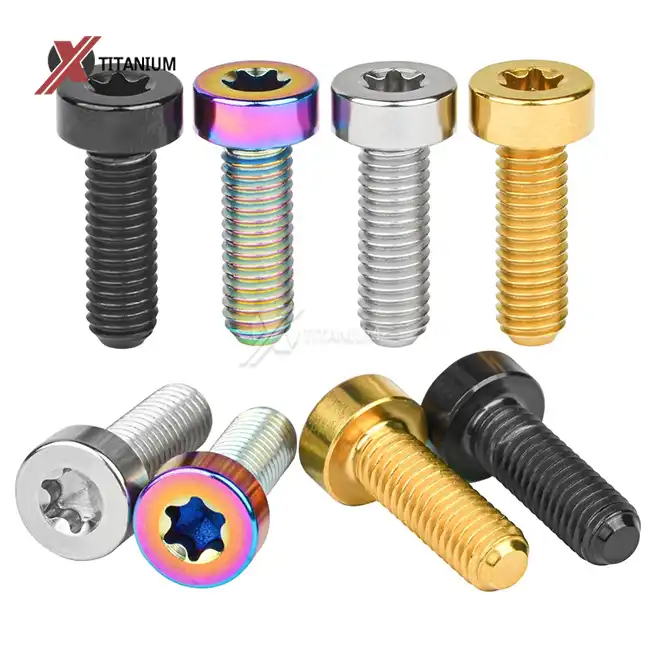
Understanding GR5 Titanium Screws and Their Key Advantages
Learn about Gr5 titanium bicycle screws and the best things about them. Gr5 titanium is different from other fastener materials because it has a carefully balanced alloy system that makes it unique. Ti-6Al-4V has about 6% aluminum in it to make it stronger and less dense, and 4% vanadium to make it easier to work with and keep the right temperature. The maximum tensile strength of this aerospace-grade standard is between 895 MPa and 1050 MPa, and it has a density of only 4.43 g/cm³, which is almost half that of austenitic stainless steel.
Material Science Behind Performance Gains
When you compare Gr5 to other choices, you can see how much better it is. Screws made of stainless steel have better thread contact, but they are much heavier. Aluminum 7075-T6 bolts have thin shapes and are light, but they don't have the yield strength needed for high-torque tasks like stem face plate holding. Commercially pure titanium (Gr2) of a lower grade can resist corrosion well enough, but it can't handle the shear forces that are found in drivetrain assemblies. Gr5 fills in these gaps with its two-phase microstructure, which stops cracks from spreading during fatigue cycling. This is a phenomenon that has been studied in several aerospace testing protocols that have been adapted for bicycle component validation.
Long-term dependability is helped by the surface chemistry of Ti-6Al-4V screws. When paired with carbon fiber, aluminum, or magnesium parts, a titanium dioxide passivation layer that forms on its own and is about 2 to 5 nanometers thick stops galvanic corrosion. Because of this electrochemical stability, there is no need for coatings that wear off over time, which is a typical way for things to fail in sea and winter ride conditions where road salts speed up material breakdown.
Manufacturing Standards That Ensure Consistency
Quality-approved Gr5 fasteners are CNC machined from forged bar stock instead of being cast, which keeps the grain flow patterns that make the mechanical properties better. When you roll threads, you cold-work the surface, which creates leftover compressive forces that make the fatigue life up to 30% longer than with cut threads. Dimensional limits held to ISO 4762 or DIN 912 standards make sure that bikes made by different companies can be used interchangeably. Also, following ASTM B348 and AMS 4928 standards makes sure that materials can be tracked, which is a key part of managing risk in OEM supply chains.
Bicycle Components That Benefit Most from GR5 Titanium Screws
Strategically choosing which fasteners to use affects the general performance of a bicycle by having effects that build up across many different systems. When engineers try to reduce the weight of something, they need to focus on the areas where less mass will have the most positive effects on the way it moves, while still keeping the safety gaps required by cycle loading conditions.
Disc Brake Systems and Rotor Attachment
During long descents, the temperature of the rotor bearing nuts goes from room temperature to over 300°C at its highest point. Differential expansion coefficients make steel fasteners risk thermal seizure in this situation, while aluminum fasteners become brittle at high temperatures. Gr5 titanium rotor bolts keep their mechanical qualities across the working temperature range. They also stop torque drift caused by corrosion, which is what rubs against the rotor and wears pads unevenly. Titanium has a lower thermal conductivity than steel, which is another benefit because it stops heat from moving into the hub assembly.
Extreme shear loads are put on these fasteners during hard stopping events in competitive downhill and enduro races. Ti-6Al-4V has a high shear strength—usually more than 550 MPa—which stops it from breaking in ways that are very bad for softer materials. When compared to stainless steel, a set of twelve rotor nuts made from Gr5 titanium weighs about 18 grams less. This small advantage adds up to a big difference in the wheel's outer radius rotating mass budget.
Drivetrain Components and Chainring Hardware
Chainring bolts connect the front sprockets to the crankset spider and transfer torque while fighting sideways displacement forces during power stroke changes. For this job, you need screws that can hold up against 10–12 Nm of tightening torques without giving way, keep their preload even when they're vibrating, and keep fretting rust from happening at the point where the bolt meets the chainring. When standard steel hardware is paired with aluminum cranksets, it often creates galvanic cells that cause oxide to form, which stops the assembly from being taken apart again.
Through their passive surface chemistry, Gr5 titanium chainring bolts and nuts get rid of these electrical problems. The material has an elastic modulus of about 113 GPa, which means it can slightly deform when load is applied. This helps keep the clamping force constant while the chainring materials settle during the initial break-in periods. 8–12 grams of weight savings per crankset may not seem like much, but they make a big difference in how well you can climb and accelerate in competitive situations.
Cockpit Assembly and Stem Hardware
Handlebar clamps and stem face plates depend on holding forces that are spread out evenly to keep the handlebars from slipping. This way, stress concentrations don't happen, which would cause carbon parts to crack. When aluminum bolts are over-tightened in these places, the threads often get stripped, and steel fixings add extra weight to a high-risk safety area. Gr5 titanium is perfect for these important holding places because it is light and has a high tensile strength.
High-frequency vibrations travel through the fork and steering system and affect stem nuts. This can loosen screws that aren't properly preloaded. Titanium's tribological qualities, especially when handled with anti-seize compounds made for reactive metals, help keep torque without galling, which can happen when titanium threads contact aluminum or other titanium parts. Engineers say that the torque value for M5 stem bolts should be between 4 and 6 Nm, which is well within the yield strength of Gr5 fasteners that are made correctly.
Seatpost and Saddle Attachment Points
The weight of the rider puts static loads on the seatpost collar bolts and saddle rail clamps, and the uneven road surface puts dynamic loads on them. These fasteners must not come loose when the machine is vibrating, but they must also be able to be precisely adjusted during setup. Ti-6Al-4V is biocompatible, which makes it useful in situations where riders touch or sweat the material. This is because it doesn't cause allergic reactions and doesn't rust from sweat salts.
More and more, companies that make lightweight saddles choose titanium hardware to go with carbon-railed designs. This makes weight-optimized systems where every gram gives you a competitive edge. A full set of saddle hardware with Gr5 screws usually weighs 6–8 grams less than similar sets made of stainless steel. They also look better because they come in anodized colors like natural titanium, gold, blue, purple, and rainbow.
Accessory Mounts and Bottle Cage Bosses
Bottle cage screws, fender mounting gear, and rack connection bolts are all made of Gr5 titanium, which doesn't rust and can be used all year for travel and commuting. A lot of the time, these screws stay in place for years, being exposed to road spray, salt, and water, all of which quickly break down steel hardware. Long-term cost savings from not having to repair or maintain parts explain the higher original material cost, especially for fleet operators and rental services that work near the coast.
The mounting bolts for derailleur hangers are another important use where titanium's features meet useful needs. During normal operation, these screws must hold things securely, but they must also be able to fail or loosen in a controlled way during impacts to keep the frame from getting damaged. Because Gr5 alloy's mechanical behavior can be predicted, engineers can make sacrifice mechanisms that protect more valuable parts while keeping the bike rideable after small accidents.
Performance and Durability: GR5 Titanium vs Other Common Screw Materials
Comparing the amounts of different fastener materials shows the engineering trade-offs that affect buying decisions. Procurement managers need to do more than just figure out the weight of an item; they also need to look at the total cost of ownership, which includes upkeep intervals, replacement frequency, and downtime caused by failure.
Mechanical Property Analysis
Ultimate tensile strength is only one aspect of how well a fastener works. Gr5 titanium bicycle screws are better at resisting wear than both stainless steel and aluminum metals. It can keep 50% of its ultimate tensile strength even after being loaded and unloaded over and over again 10^7 times. This quality is very important for parts like stem bolts and brake mounts that are constantly being loaded with vibrations over the course of their life.
The difference in modulus of elasticity between materials changes how joints behave when they are loaded. Titanium is less stiff than steel (113 GPa vs. 210 GPa), which means it can stretch more when it's being tightened. This makes the clamping forces more evenly distributed across the joint surfaces. This feature lowers localized stress levels that could break carbon fiber parts, which is a big plus in current bicycle design where composite materials are used for most structural purposes.
Corrosion Resistance in Real World Conditions
Accelerated salt spray testing according to ASTM B117 shows that Ti-6Al-4V is much better than other fastener materials. After 1000 hours of contact, stainless steel samples show pitting and crevice corrosion at the thread roots. Aluminum samples show oxide growth that needs to be removed chemically, while titanium surfaces stay chemically the same except for light discoloration that can be removed by polishing.
Coastal riding conditions and winter road salt exposure make the conditions harsh, and steel fasteners only last 12 to 18 months before corrosion bonding makes them impossible to remove without damaging the metal. Even though aluminum gear doesn't rust, it can get oxide jacking, which makes joints weak and causes fretting wear. When put through the same conditions, titanium fasteners can usually go 5 to 7 years without breaking down. This changes the economics of care for expensive bicycle parts in a big way.
Weight Optimization and Cost-Benefit Analysis
A high-end road bike's complete Ti-6Al-4V screw kit usually has 40 to 60 fasteners and weighs 45 to 50 grams, which is 60 to 75 grams less than stainless steel hardware. A 300–400% increase in the cost of titanium compared to steel means that each bike costs about $80–$150 more, which is less than 2% of the selling price for high-end models where weight loss is important for placement in the market.
The longer service life and lack of upkeep linked to corrosion produce value that goes beyond the original cost. When fleet managers switch to titanium hardware in key fastener sites, upkeep labor costs drop by 40 to 60 percent, according to fleet managers who run rental or demo fleets. Because of these operational savings and lower inventory needs for replacement parts, commercial operations usually get their money back in 18 to 24 months.
Procurement and Specification Guide for GR5 Titanium Bicycle Screws
For Gr5 titanium bicycle screws to be successfully integrated, technical specifications, supplier qualification, and quality verification processes must be carefully thought out so that they work with manufacturing tolerance requirements and liability management protocols.
Technical Specification Parameters
The thread specs must follow ISO metric rules, with a class 6g tolerance for external threads and a class 6H tolerance for internal threads. This makes sure that the new parts can be used with the old ones. Common sizes are M4 × 0.7, M5 × 0.8, M6 × 1.0, and M8 × 1.25. Lengths range from 8mm to 40mm, depending on the needs of the application. Specialized designs can work with custom lengths and head styles, but standard measurements are more cost-effective for production runs below 10,000 units because they don't require as much equipment.
The choice of drive system affects both how well the assembly works and how long it will last. When compared to hex socket designs, torque gearbox is better with Torx drives (T20, T25, T30), and cam-out damage during installation is less likely to happen. Because Torx geometry has a wider engagement surface, it lowers localized stresses on the drive recess. This keeps the drive recess from rounding out, which can happen with socket head cap screws that are torqued too hard or that get rust buildup.
Supplier Selection and Quality Assurance
As a minimum, qualified suppliers must have ISO 9001 certification. Manufacturers that work with aircraft should also have AS9100 certification, which gives customers even more trust in process controls and material traceability. The paperwork for batch certification should include spectroscopy results for material composition analysis, dimensional inspection records that show the product meets drawing limits, and mechanical testing results that prove the tensile strength, yield strength, and hardness values.
The titanium processing industry focuses its production on a few key areas where experts in the material and quality control systems can meet the needs of high-demand applications. The technical support needed for OEM qualification processes comes from suppliers who offer a wide range of testing options, such as X-ray fluorescence for checking the composition, coordinate measuring machine inspection for checking the accuracy of the dimensions, and tensile test equipment for checking the mechanical integrity.
Logistics and Supply Chain Management
When compared to buying common hardware, global titanium fastener supply chains have their own set of problems. Since a lot of raw material production happens in a few places, supply problems are possible and need to be planned for. This is why inventory holding techniques are needed. Having relationships with more than one qualified provider gives you extra security, but you have to do quality system audits and material tests again for each source to keep things consistent.
The way things are packed and handled keeps surfaces from getting damaged while they are being shipped or stored. Individual poly bagging or foam cavity trays keep anodized finishes from getting scratched, and desiccant packets keep sealed containers dry. Shipments should come with material approvals that can be linked to heat lot numbers, measurement inspection reports, and handling directions that are specific to titanium's reactive nature when it is being machined or installed.
Maintenance and Long-Term Care of GR5 Titanium Bicycle Screws
Understanding titanium's unique tribological properties and following the right maintenance procedures that stop common failure modes are needed to keep Gr5 titanium bicycle screws working well throughout their service life.
Installation Best Practices
Thread engagement depth has a big effect on joint strength and the chance of galling. For titanium-to-aluminum joints, the minimum thread engagement should be 1.5 times the nominal diameter. For titanium-to-steel joints, 1.0 times the nominal diameter is enough. Under-engaged threads put more of the load on a smaller area of the thread sides, which raises the risk of stripping. On the other hand, over-engagement doesn't help mechanically and may raise the risk of galling.
Bicycle workers still have mixed feelings about using anti-seize compounds, but they are necessary for titanium screws. Galvanic cells can be made from compounds containing copper or aluminum particles; nickel-based or ceramic-filled lubricants made especially for reacting metals should be asked for. Putting a thin film on male threads lowers the fitting torque by about 20 to 30 percent while keeping the same clamping force and making it much easier to remove after long use.
Inspection and Preventive Maintenance
Titanium screws should be checked for signs of galling, thread damage, or rust at metal-to-metal contacts on a regular basis. When you look closely, you can see patterns of discoloration that show incorrect torque or fretting wear. When you loosen something, you can feel more friction, which means that galling is starting to form. To avoid failures while they are still in use, fasteners that show these signs should be thrown away and replaced.
When cleaning, harsh agents that damage the inactive oxide layer must not be used. Neutral pH soaps and soft brushes get rid of road grime and salt residues well without making the metal less resistant to rust. Anodized surfaces need extra care because rough cleaners can remove the decorative coating and make the surface less resistant to wear. Titanium-safe protective sprays should be used on a regular basis to keep the look good in high-exposure situations.
Troubleshooting Common Issues
Galling is the most common way that titanium fasteners break. It happens when the adhesive forces between threads that are mated are stronger than the shear strengths, which causes the material to move and seize. Some ways to stop this from happening are to install things more slowly (no more than 15 RPM), keep them well oiled, and keep them from getting dirty with rough particles. When bolts get stuck, they often need to be carefully removed with left-handed drill bits or screw extractors and penetrating oil applied.
All threaded screws can loosen when they are vibrated, but this can be lessened by using the right amount of force and thread-locking compounds. Medium-strength anaerobic sealants that are compatible with titanium hold things together well enough for most bicycle uses while still letting you take them apart with hand tools. In places with a lot of vibration, like mountain bike suspension pivots, locking mechanisms like safety wire or lock washers may be needed instead of thread friction alone.
Conclusion
In conclusion. When choosing Gr5 titanium bicycle screws, you have to weigh the immediate cost against the long-term performance benefits in key component locations. The material's high strength-to-weight ratio, resistance to corrosion, and resistance to fatigue make it useful in brake systems, engine parts, and cockpit gear where stability and weight reduction are key to staying ahead of the competition. Instead of just looking at the initial purchase price, procurement professionals should look at the total ownership costs, which include maintenance labor, replacement frequency, and downtime caused by failure. For integration to go well, suppliers must be qualified, materials must be certified, and installation procedures must be followed that are specific to titanium's tribological properties.
FAQ
Are GR5 titanium screws compatible with all bicycle frame materials?
It has been shown that Ti-6Al-4V screws work well with aluminum, steel, carbon fiber, and titanium frame elements. Galvanic corrosion can't happen with aluminum and carbon alloys because of the passive oxide surface. However, proper anti-seize treatment is still needed for titanium-into-titanium joints to stop galling. The manufacturer's instructions for thread engagement depth and torque should be followed, taking into account the hardness of the base material.
How much weight can be saved by converting to titanium hardware?
When you switch from stainless steel gear to Gr5 titanium bicycle screws on all of your brake mounts, stem, seatpost, bottle cages, and engine parts, you can save between 60 and 90 grams. The exact reduction depends on the original hardware's specs and the number of parts used. Saving weight on the wheels and crankset through rotation has a bigger effect on performance than saving weight by keeping it still.
What certifications should buyers verify when sourcing titanium fasteners?
Buyers who care about quality should ask for material certifications that show it meets the requirements of ASTM B348 or AMS 4928 titanium, as well as physical inspection reports that show it meets tolerances and mechanical test data that shows it meets tensile strength values. Suppliers with ISO 9001 certification can be sure of their quality system at a basic level, while those with AS9100 certification can be sure that their processes are controlled and tracked at an aircraft level.
Partner with Chuanglian for Reliable GR5 Titanium Bicycle Screws
Chuanglian is a good place to get reliable Gr5 titanium bicycle screws. For OEMs, wholesalers, and high-performance riding uses, Chuanglian makes Gr5 titanium bicycle screws that are precisely designed and made to exacting standards. Our CNC milling skills allow us to make fasteners that meet the requirements of ASTM B348 and AMS 4928. These fasteners have rolled threads for better wear resistance and can have different surface treatments, such as polishing, anodizing in different colors, and nitriding for extra durability.
As a company that makes titanium screws in Baoji, which is known around the world as the "City of Titanium," we have strict quality control measures in place, such as batch tracking and 100% inspection protocols. Get in touch with our expert team at info@cltifastener.com or djy6580@aliyun.com to talk about your unique needs and get accurate quotes for large orders.
References
1. Boyer, R., Welsch, G., & Collings, E.W. (1994). Materials Properties Handbook: Titanium Alloys. ASM International, Materials Park, Ohio.
2. Donachie, M.J. (2000). Titanium: A Technical Guide, 2nd Edition. ASM International, Materials Park, Ohio.
3. Budinski, K.G. (1991). Tribological Properties of Titanium Alloys. Wear, Volume 151, Issue 2, Pages 203-217.
4. Schutz, R.W. & Thomas, D.E. (1987). Corrosion of Titanium and Titanium Alloys. Metals Handbook, Volume 13: Corrosion, ASM International.
5. Peters, M., Kumpfert, J., Ward, C.H., & Leyens, C. (2003). Titanium Alloys for Aerospace Applications. Advanced Engineering Materials, Volume 5, Issue 6.
6. Lutjering, G. & Williams, J.C. (2007). Titanium, 2nd Edition. Springer-Verlag, Berlin Heidelberg.
Learn about our latest products and discounts through SMS or email