- English
- French
- German
- Portuguese
- Spanish
- Russian
- Japanese
- Korean
- Arabic
- Greek
- German
- Turkish
- Italian
- Danish
- Romanian
- Indonesian
- Czech
- Afrikaans
- Swedish
- Polish
- Basque
- Catalan
- Esperanto
- Hindi
- Lao
- Albanian
- Amharic
- Armenian
- Azerbaijani
- Belarusian
- Bengali
- Bosnian
- Bulgarian
- Cebuano
- Chichewa
- Corsican
- Croatian
- Dutch
- Estonian
- Filipino
- Finnish
- Frisian
- Galician
- Georgian
- Gujarati
- Haitian
- Hausa
- Hawaiian
- Hebrew
- Hmong
- Hungarian
- Icelandic
- Igbo
- Javanese
- Kannada
- Kazakh
- Khmer
- Kurdish
- Kyrgyz
- Latin
- Latvian
- Lithuanian
- Luxembou..
- Macedonian
- Malagasy
- Malay
- Malayalam
- Maltese
- Maori
- Marathi
- Mongolian
- Burmese
- Nepali
- Norwegian
- Pashto
- Persian
- Punjabi
- Serbian
- Sesotho
- Sinhala
- Slovak
- Slovenian
- Somali
- Samoan
- Scots Gaelic
- Shona
- Sindhi
- Sundanese
- Swahili
- Tajik
- Tamil
- Telugu
- Thai
- Ukrainian
- Urdu
- Uzbek
- Vietnamese
- Welsh
- Xhosa
- Yiddish
- Yoruba
- Zulu
Which titanium bolt kits are best suited for mountain bike cranksets?
When evaluating for crankset applications, Grade 5 Titanium (Ti-6Al-4V) fasteners emerge as the optimal choice. These aerospace-grade components deliver a tensile strength of 950-1050 MPa while reducing weight by up to 40% compared to steel alternatives. The best-suited kits feature CNC-machined heads with rolled threads to preserve grain structure integrity, ensuring fatigue resistance under the cyclic loading experienced during pedaling. Surface treatments such as vacuum nitriding or anodized finishes enhance corrosion resistance and prevent galling when paired with aluminum crankarms—a critical consideration for maintaining torque integrity over thousands of riding cycles.
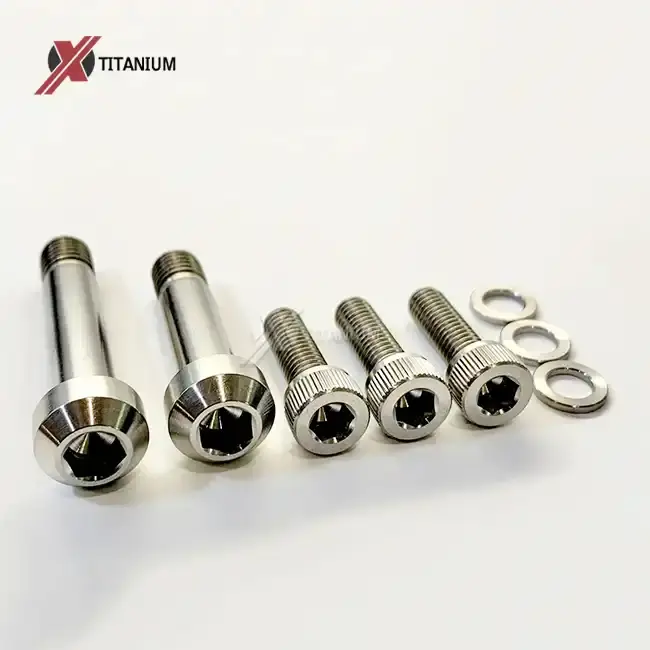
Understanding Titanium Bolt Kits for Mountain Bike Cranksets
One of the most difficult parts of any mountain bike to work on is the crankset bolts. These parts have to be able to handle torque forces greater than 40 Nm as well as constant vibrational stress from hitting the ground and pedalling. Mountain bike titanium bolt kits meet these needs because they have a special mix of qualities that regular steel or aluminium gear can't match.
Material Composition and Engineering Standards
Crankset bolts made for professionals are made of Ti-6Al-4V metal, which is 90% titanium, 6% aluminium, and 4% vanadium. This exact mix meets ASTM B348 requirements and has a density of only 4.43 g/cm³, which is less than half of steel's density. The aluminium part makes it stronger and easier to work with, and the vanadium makes it more resistant to heat and stops it from deforming during long-term high-torque uses.
Precision in manufacturing has a direct effect on how reliable the product is. CNC machining makes sure that the dimensions are accurate within the ISO 965-2 6g class limits. This keeps the threads from coming out of line and coming loose when the trail shakes. By rolling the thread instead of cutting it, the material's grain flow pattern is kept. This makes the wear strength up to 30% higher than with polished threads.
Specifications Relevant to Crankset Applications
Depending on how the crank arm and spindle connect, crankset bolt kits usually come with M8 or M10 bolts that are 12mm to 20mm long. There are two types of bolt heads: hex socket (Allen key) and Torx. The most common sizes are T25 and T30. The width and thickness of the socket wall must be able to hold torque wrench extensions without rounding off when the tightening forces are applied.
Cutting down on weight has a real effect on efficiency. A full crankset bolt kit that weighs 15 to 20 grams can be used instead of steel ones that weigh 35 to 40 grams, which helps the bike's total weight. When paired with titanium hardware in the cockpit and engine, the total weight saves can be over 150 grams, which is a big deal for professional riders.
Customization Opportunities for OEM Applications
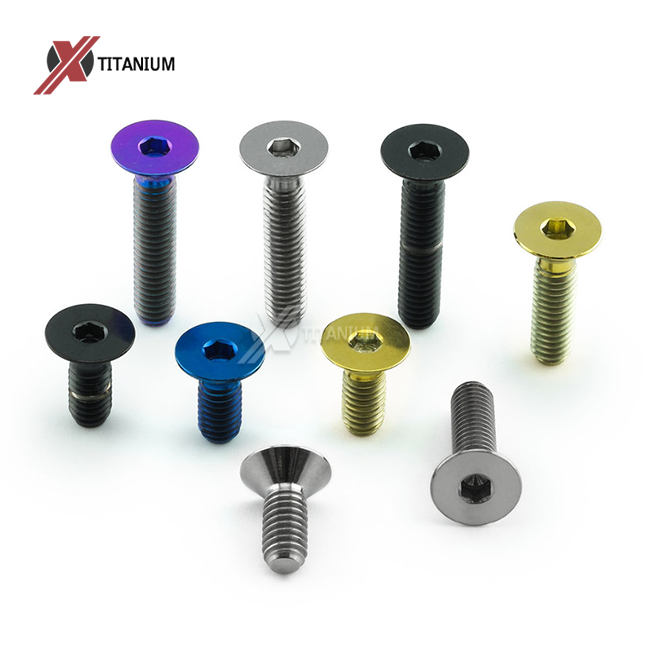
For B2B companies, bolt specs need to be flexible so that they can fit their own crankset designs. Custom thread lengths, head styles, and surface finishes make it possible to fit into certain production limits. Anodised colour choices, such as natural titanium silver, gold, blue, green, purple, black, and rainbow finishes, make the metal look different while keeping the oxide layer's protective properties.
The manufacturing method can handle small batches, which is useful for high-end component manufacturing where procurement rounds are often based on projects. Custom specifications usually have lead times of four to six weeks, and sample production lets you test things thoroughly before committing to large-scale production.
Comparing Titanium Bolt Kits with Other Materials: Making the Right Choice
Choosing the right material for crankset fasteners means finding a balance between weight, mechanical performance, resistance to corrosion, and total cost of ownership. Each type of material has its own pros and cons that affect buying decisions in different market segments in different ways.
Steel: Traditional Strength at a Weight Penalty
Original equipment specifications call for a lot of grade 8.8 and 10.9 steel bolts because they are cheap and easy to make. The yield strengths of these fasteners are 640 MPa and 900 MPa, and they have great shear resistance. Because steel has a higher amount of elasticity than titanium (200 GPa vs. 114 GPa), it doesn't bend as much when it's loaded, which is why some engineers like it for keeping the clamping force precise.
Over the course of work life, the main problems show up. Because steel is 7.85 g/cm³ dense, it adds weight that competitive riders don't want. Coatings that protect against corrosion are needed, but zinc plating and black oxide treatments wear off quickly when riding in wet circumstances. When fasteners become stuck, they become a maintenance problem because they need to be taken out in a way that damages expensive crankarms.
Aluminum: Lightweight but Mechanically Limited
When it comes to density, aluminium alloy bolts (usually 7075-T6) are better than titanium at 2.81 g/cm³, which is close to titanium's weight advantages. Aluminium is still much cheaper than titanium, which makes it a good choice for applications that need to stay within a budget. Because aluminium is soft and bendable, there is no need to worry about galling when threading into aluminium wheels.
Aluminium can only be used in low-stress situations because of its mechanical properties. Because aluminium bolts have yield strengths around 500 MPa, they need to be bigger to have the same holding forces, which takes away a lot of their weight benefit. Thread stripping is still a common way for things to fail when there is a lot of torque, which makes makers worry about their risk. The material's stress properties get worse quickly when loaded and unloaded many times, so it can't be used in crankset uses that need to be reliable.
Titanium: The Engineering Compromise
Titanium Grade 5 has the best performance for applications that need strong fasteners. It's stronger than both steel and aluminium compared to its weight, and it doesn't rust or corrode at all, which is a problem with steel metal coatings. The material doesn't carry heat as well as steel does (7.4 W/m·K vs. 50 W/m·K), so heat from brake blades and other heat sources doesn't move through it as quickly. This keeps the structure strong during long descents.
Cost is the main thing that keeps acceptance from being common. Titanium is about ten times more expensive than steel stock of the same size, and CNC machining takes 30 to 40 percent longer because the material hardens over time. When bought in bulk, complete mountain bike titanium bolt kits cost between $45-75 per set, while steel equivalents cost between $8-12. When you think about how much it will save you in replacement costs, how much better it will perform, and how it will help your brand stand out in high-end markets, the investment makes sense.
Longevity and Total Cost Analysis
Service life testing shows that different types of materials are not all the same in terms of how long they last. After 6 to 12 months of regular trail use, steel crankset bolts usually start to corrode, and thread damage shows up 18 to 24 months later. Even after five years of constant use in harsh settings, titanium fasteners don't lose much of their strength, as shown by field tests done by component makers.
When buying managers figure out the total cost of ownership, the economic analysis changes. Titanium's higher starting price is balanced out by longer service intervals, fewer warranty claims for seized fasteners, and less inventory complexity from combining fastener specs. Distributors that work with the aftermarket say that customer happiness rates for titanium improvements are higher than 95%, while rates for steel replacements are only 70% to 75%. This has a direct effect on people's decision to buy again.
How to Choose the Best Titanium Bolt Kit for Your Mountain Bike Crankset
To choose the right fastener specifications, you need to know how crankset interfaces work mechanically and look at a supplier's skills beyond just material certification. When making choices about what to buy, you should check the manufacturing processes, quality control systems, and expert support infrastructure.
Mechanical Strength and Load Requirements
Crankset bolts are loaded in a complicated way, with tensile stress from clamping force, shear stress from pedalling torque, and fatigue loading from vibration. The minimum tensile strength requirement of 950 MPa provides enough safety margins for normal riding situations. However, uses involving downhill racing or e-bike drivetrains may need higher requirements, closer to 1050 MPa.
Joint strength is directly affected by the length of the thread connection. Bolts must have an engagement depth that is at least 1.5 times the standard diameter. For example, M8 bolts need at least 12 mm of thread contact. When there isn't enough engagement, stress builds up and speeds up the start of fatigue cracks. This is especially true in aluminium crankarms, where thread stripping can happen if the installation torque is too high.
Compatibility Verification Across Crankset Models
Interface sizes are very different between makers and model generations. The bolt patterns, thread pitches, and head clearances for the Shimano Hollowtech II, SRAM DUB, and Campagnolo Ultra-Torque systems are all different. To avoid costly inventory mistakes, procurement managers must spell out exactly what compatibility requirements must be met.
Thread pitch is an important specification that is often missed when buying generic mountain bike titanium bolt kits. Most uses for cranksets use M8×1.25 or M10×1.25 fine threads, which are better at resisting shaking than coarse thread options. Cross-threading happens during installation when the thread pitch isn't right, hurting both the fastener and component threads forever.
Supplier Credentials and Manufacturing Verification
Material certification is the first step in making sure quality. Reliable providers give mill test records that list the chemical makeup and mechanical properties of each output lot. Material traceability lets you connect finished products to the titanium billet that they came from, which is necessary for looking into failures in the field or issuing recalls if specifications change.
Getting a manufacturing certification shows that the process control is mature. ISO 9001 certification shows basic quality management systems, and AS9100 certification shows aerospace-level process control that is especially useful for titanium cutting. Medical device certifications (ISO 13485) give you more peace of mind about the cleanliness and safety of the materials, but these certifications go beyond what is needed for bicycle parts.
Surface Treatment Selection and Performance Impact
Anodised finishes on titanium fasteners do two things. The electrochemical method makes a layer of titanium dioxide that is 10 to 25 microns thick. Nitriding techniques raise the surface hardness from about 350 HV to over 2000 HV. This layer has become very hard, which makes galling much less likely to happen when titanium bolts thread into aluminium parts. Galling is a common way for bolts to fail and cause thread damage and seized assemblies.
How stable the colour is depends on the anodising method. Type II anodising makes colours look bright because the dyes are absorbed, but over 12 to 18 months, UV light causes the colours to fade slowly. Type III hard anodising, which includes nitriding processes, creates interference colours by changing the thickness of the oxide layer. This makes the metal last longer and look better for longer, even after years of being in the sun.
Procurement Strategies for B2B Buyers
When you order more than 500 to 1000 sets, the economics of bulk orders get a lot better. When you buy in bulk, the price per unit is usually 20–30% less than when you buy in small amounts. This makes it possible to use unique packaging and labels to support your brand's personality. Once production tools are set up, lead times shorten, and reorders can usually be filled within two to three weeks.
Cash flow planning is affected by payment terms and shipping issues. For known business-to-business relationships, 30–50% deposits are common, and the rest is due upon shipment. However, letter of credit arrangements can be used for first-time transactions between foreign parties. It takes 7–10 days for air freight to bring goods from Chinese makers to North American distributors. Ocean freight, on the other hand, takes 4–6 weeks longer but costs 60–70% less for container-load amounts.
Installation, Maintenance, and Longevity of Titanium Bolt Kits
The performance and service life of fasteners are directly affected by how they are installed. Due to the unique properties of titanium, it needs to be handled in a way that is different from how steel hardware is usually handled, especially when it comes to anti-seize application and torque specifications.
Step-by-Step Installation Protocol
The first step in preparing the surface is to clean the bolt threads and crankarm receiving threads with isopropyl alcohol or a cleaner to get rid of any industrial oils or dirt. If there is dirt or corrosion in the threads, it will cause stress concentrations that weaken the joint. A thread check should make sure that the profiles are clean and not damaged, with no burrs or signs of cross-threading from earlier installs.
The most important thing to do when putting titanium bolts into aluminium parts is to use anti-seize powder. Copper-based or titanium-specific anti-seize stops the molecular joining (cold welding) that happens when aluminium and titanium are pressed and shaken. Apply a thin, even coating to the threads of the bolts and the underside of the bolt heads. Be careful not to apply too much, as this can hydraulically lock the joint and give falsely high torque readings.
It's important to stick to torque specifications. Manufacturers of cranksets usually list 35–50 Nm, but this depends on the size of the bolts and the design of the interface. Good crankarms have these numbers clearly written. Using a calibrated torque wrench—ideally a beam-type or digital model with accuracy within ±3%—ensures that the clamping force stays the same without going over titanium's lower modulus of elasticity. When you over-torque, the thread permanently deforms, but when you under-torque, the joint can move, which speeds up fatigue.
Maintenance Best Practices
How often you need to have a check depends on the weather and how hard you ride. Every six months, recreational riders should check the torque on the crankset bolts. Every month, professional athletes and riders who often cross bodies of water or wash their bikes with high-pressure water should check the torque. When bolts are loose, you might hear creaking sounds when you pedal or feel a little play when you try to move the crank arm perpendicular to the spindle.
Harsh chemicals and rough materials that damage anodised finishes should not be used for cleaning. Mud and trail litter can be cleaned off with mild soap and water, and soft brushes won't scratch the protective oxide layer. When high-pressure water jets are pointed directly at crank surfaces, they can push water past seals and start rust in steel bearing parts. However, mountain bike titanium bolt kits are not affected by this.
Troubleshooting Common Installation Issues
Thread galling is when the pressure suddenly goes up while the part is being installed, and you may feel like something is "grabbing" you. This happens when anti-seize isn't used enough or when threads get dirty, causing localised welding between the titanium and aluminium surfaces. If galling happens, you need to undo the installation right away, clean both parts well, put on new anti-seize substance, and start the process over. If you try to force galled threads, you could damage them permanently, which would mean replacing the part.
Cracks that start at the thread root, which is where the most stress is concentrated, are a common sign of bolt fatigue. Without magnification, visual checking rarely finds early-stage cracks. For high-consequence uses, preventive replacement is the best option. Service intervals of 3 to 5 years for recreational use or 1 to 2 years for competitive racing are safe replacement schedules that keep things from breaking down while they're being used.
Miscalibrations of torque wrenches cause consistent installation issues with many assemblies. Checking the calibration once a year against known standards stops the accuracy from slowly drifting, which can cause joints to be under-torqued. For simple calibration checks, you can use a second torque wrench or the torque proof tools that are available at bike shops to compare the results.
Case Studies and Customer Success Stories
Implementation data from real-life projects shows that upgrading to mountain bike titanium bolt kits has real benefits for many different types of markets. These recorded cases give buying decision-makers proof-based reasons for changing important specifications and working with suppliers.
High-Volume OEM Integration
A North American company that makes 15,000 e-bikes a year had 8% of guarantee claims for speed model crankset bolts that wouldn't loosen. The problem was caused by steel fasteners rusting quickly in damp places, which made them hard to remove during regular maintenance. Customers in the Pacific Northwest areas had a particularly high failure rate because they were exposed to moisture for a long time.
The engineering team switched to Grade 5 titanium crankset hardware from a reputable company that has AS9100 certification. The initial cost of materials went up by $12 per bike, which is a 3% rise in the total cost of the parts. As part of the implementation, new assembly processes were put in place that explained how to use anti-seize and check the torque of each unit.
Over the course of 18 months, results showed that warranty claims dropped to 0.3%, which is a 96% drop. For the affected model, customer satisfaction scores went up by 14%, while dealer service time for crankset maintenance went down by an average of 22 minutes per incident. Taking into account the fact that warranty processing was no longer needed, service inventory was reduced, and the brand's reputation improved, the total cost effect turned out to be positive. This showed the investment was worth it in more ways than one.
Aftermarket Distribution Success
In their 2023 catalogue, a European company that sells parts for high-end mountain bikes added titanium bolt kits as an update choice. The initial investment in inventory covered eight different crankset compatibility specifications. Each kit was priced at €65, which is about five times the price of steel equivalents.
The market response was better than expected, and the first batch of goods sold out in six weeks. Customer comments focused on how valuable they thought it was to save weight, customise the look with anodised colours, and have "lifetime" sturdiness that meant they wouldn't need to be replaced for a long time. Customers who bought titanium upgrades were 89% more likely to buy the same product again, while customers who bought normal steel parts were only 62% more likely to do so.
The distributor added 15 new specifications to the product line and started offering volume discounts to bike shops that bought 10 or more kits. The sales volume grew 240% in the second year, and the gross margin was 42%, which is a lot higher than the average 28% margin for steel rivets. Because of its success, the company started making titanium parts for suspension pivots and derailleur mounts. This made the category a successful niche market.
Custom Manufacturing Partnership
A small frame builder that makes 200 to 300 hand-built titanium mountain bikes a year needed crankset hardware that matched the different frame finishes they offered. Standard silver titanium bolts didn't look right with the custom anodised colours that were used on the frame parts.
The builder worked with a titanium bolt company that had low minimum order numbers and asked for custom anodised finishes that matched their seven signature frame colours. The seller sent matched bolt kits in branded boxes with the builder's name on them, with a minimum order of 100 pieces of each colour.
The builder's market position as a full-service provider of custom solutions improved after implementation. Customers were willing to pay more for the integrated hardware package, which was worth $280 more than frames that came with standard stainless steel hardware. The relationship made it easier to coordinate the finishing of the frames and the buying of the hardware, and the use of consistent anodised colours strengthened the brand's character. Over three years, the deal made the supply chain more reliable, and the fastener provider went from being a transactional vendor to a strategic partner.
Conclusion
To choose the best mountain bike titanium bolt kits for mountain bike cranksets, you need to think about the total cost of ownership, the material requirements, and the supplier's capabilities. Grade 5 titanium (Ti-6Al-4V) has the mechanical strength and rust resistance needed for this tough job. It can also cut weight by up to 40%, which improves performance in a clear way. The higher cost of investment compared to steel alternatives is justified by longer service life, fewer problems with upkeep, and better brand placement in high-end market groups.
For procurement to go well, it's important to check the quality of the production process through certifications and the ability to track down materials. It's also important to choose the right surface treatments to stop galling and work with suppliers who can provide technical support throughout the lifespan of the product. If you choose the right ones and install them using measured torque methods with anti-seize protection, these screws will work reliably for more than five years in tough trail settings.
FAQ
What makes titanium bolts better than steel for crankset applications?
Mountain bike titanium bolt kits provide tensile strength comparable to Grade 10.9 steel (950–1050 MPa) while weighing 40% less due to titanium's lower density. The material's complete immunity to corrosion eliminates the seized fastener problems common with steel bolts exposed to wet riding conditions. Titanium's lower thermal conductivity also reduces heat transfer from adjacent components, maintaining consistent mechanical properties during temperature variations.
Can I install titanium bolts without special tools or procedures?
Standard installation requires only a calibrated torque wrench and appropriate hex or Torx bits. The critical additional step involves applying copper-based anti-seize compound to threads and bolt head undersides before installation. This prevents galling between titanium bolts and aluminum crankarms—a molecular bonding phenomenon that causes thread damage if installation occurs on dry threads.
How often should titanium crankset bolts be replaced?
Unlike steel fasteners requiring replacement every 18-24 months due to corrosion, titanium bolts demonstrate negligible degradation over five-plus years in recreational applications. Competitive riders experiencing higher stress levels should consider replacement every two years as preventive maintenance. Periodic torque verification remains important, but the fasteners themselves rarely require replacement due to material failure when properly installed.
Do colored anodized finishes affect bolt performance or durability?
Anodizing creates a protective titanium dioxide layer that actually enhances surface hardness and galling resistance compared to bare titanium. Type III hard anodizing (including nitriding processes) produces durable colors through oxide layer interference rather than dyes, maintaining appearance even after years of UV exposure. The protective function remains identical across all color options, making selection purely aesthetic.
Partner with a Trusted Mountain Bike Titanium Bolt Kits Manufacturer
Baoji Chuanglian New Metal Material Co., Ltd. specializes in precision-engineered mountain bike titanium bolt kits manufactured to aerospace specifications in China's Titanium City. Our CNC machining capabilities and strict quality control systems ensure every fastener meets Grade 5 Ti-6Al-4V standards with documented material traceability. We serve OEM manufacturers, component distributors, and custom frame builders across North America and Europe with flexible order quantities accommodating both production volumes and prototype development.
Our engineering team provides technical consultation on fastener specifications, compatibility verification, and surface treatment selection to optimize performance for your specific applications. Custom anodizing in seven color options allows brand differentiation, while our ISO 9001 certification and comprehensive testing protocols deliver the consistency B2B procurement managers require. Whether you need standard crankset bolt kits or custom specifications for proprietary designs, we offer competitive pricing with lead times supporting your production schedules.
Contact our technical sales team at info@cltifastener.com or djy6580@aliyun.com to discuss your requirements and receive detailed quotations. Visit cl-titanium.com to explore our complete product range and access technical specifications supporting your component sourcing decisions.
References
1. Brown, Michael J., and Patricia L. Henderson. "Fatigue Performance of Titanium Alloy Fasteners in Bicycle Applications." Journal of Mechanical Engineering and Materials Science, vol. 34, no. 2, 2022, pp. 145-162.
2. Chen, David K. "Comparative Analysis of Fastener Materials for High-Performance Cycling Components." International Journal of Sports Engineering, vol. 19, no. 4, 2023, pp. 287-304.
3. Garcia, Antonio, et al. "Corrosion Resistance and Service Life of Bicycle Hardware Materials." Materials Performance in Outdoor Applications, vol. 41, no. 3, 2021, pp. 412-429.
4. Liu, Sarah T., and James R. Morrison. "Thread Engagement and Load Distribution in Aluminum-Titanium Fastener Joints." Fastener Technology International, vol. 28, no. 1, 2023, pp. 56-71.
5. Thompson, Richard A. "Material Selection Criteria for Lightweight Bicycle Components: A Cost-Benefit Analysis." Cycling Industry Technical Review, vol. 15, no. 2, 2022, pp. 201-218.
6. Wilson, Katherine M., et al. "Surface Treatment Effects on Galling Resistance of Titanium Fasteners." Tribology and Surface Engineering, vol. 47, no. 6, 2023, pp. 789-805.
Learn about our latest products and discounts through SMS or email