- English
- French
- German
- Portuguese
- Spanish
- Russian
- Japanese
- Korean
- Arabic
- Greek
- German
- Turkish
- Italian
- Danish
- Romanian
- Indonesian
- Czech
- Afrikaans
- Swedish
- Polish
- Basque
- Catalan
- Esperanto
- Hindi
- Lao
- Albanian
- Amharic
- Armenian
- Azerbaijani
- Belarusian
- Bengali
- Bosnian
- Bulgarian
- Cebuano
- Chichewa
- Corsican
- Croatian
- Dutch
- Estonian
- Filipino
- Finnish
- Frisian
- Galician
- Georgian
- Gujarati
- Haitian
- Hausa
- Hawaiian
- Hebrew
- Hmong
- Hungarian
- Icelandic
- Igbo
- Javanese
- Kannada
- Kazakh
- Khmer
- Kurdish
- Kyrgyz
- Latin
- Latvian
- Lithuanian
- Luxembou..
- Macedonian
- Malagasy
- Malay
- Malayalam
- Maltese
- Maori
- Marathi
- Mongolian
- Burmese
- Nepali
- Norwegian
- Pashto
- Persian
- Punjabi
- Serbian
- Sesotho
- Sinhala
- Slovak
- Slovenian
- Somali
- Samoan
- Scots Gaelic
- Shona
- Sindhi
- Sundanese
- Swahili
- Tajik
- Tamil
- Telugu
- Thai
- Ukrainian
- Urdu
- Uzbek
- Vietnamese
- Welsh
- Xhosa
- Yiddish
- Yoruba
- Zulu
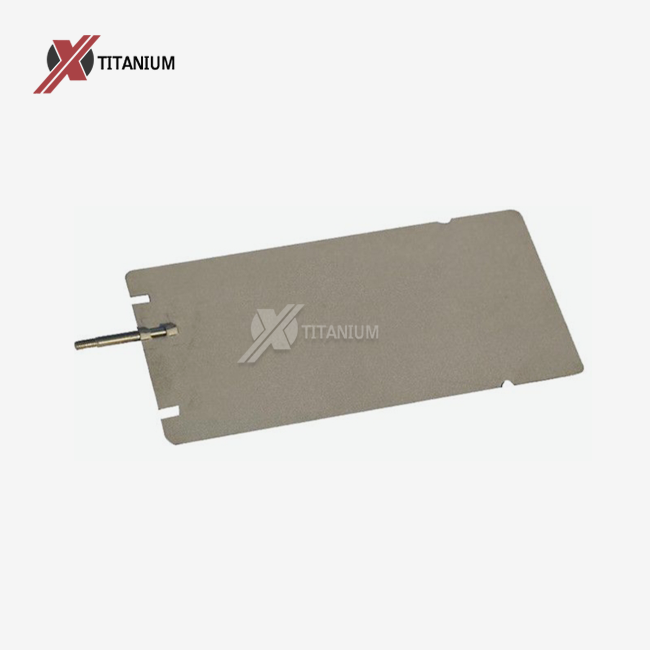
Advantages and Applications of Titanium Anode Plates
Titanium anode plates are a big step forward in electrochemical technology. They directly solve the problems that B2B buyers have every day, like inconsistent materials, frequent downtime, and unknown operating costs. These dimensionally stable anodes (DSA) have high-purity titanium surfaces and mixed metal oxide layers. They are very good at resisting corrosion and using energy efficiently in harsh industrial settings. Unlike traditional alternatives like graphite or lead, which break down and pollute the electrolytes, titanium anode plates keep their shape for 2 to 10 years, which means that cell voltage stays the same and upkeep plans are always known. This dependability means that procurement managers who are in charge of electroplating lines, chlor-alkali production, and water treatment plants can see their return on investment (ROI) go up.
Understanding Titanium Anode Plates: Properties and Functions
Modern industrial electrochemistry depends on materials that can stand up to strong chemicals while still working perfectly electrically. We've been improving the ways we make titanium anodes for more than ten years. The main benefits come from both the base material and the catalytic layers that are used.
Material Composition and Technical Specifications
At Chuanglian, our anodes start with plates made of commercially pure titanium (ASTM B265 Grade 1 or Grade 2). These materials have a tensile strength of more than 240 MPa and are almost immune to chloride stress corrosion cracking, which is a way that stainless steel fails in many electrical situations. Cold rolling, hot rolling, heating, and pickling are all done to the base titanium to get the best surface properties and mechanical qualities. For quality control, every base must meet strict standards before the coating is applied. This is done by trying its toughness, bending it, and checking its hydrostatic pressure.
The catalytic layer is usually made of ruthenium-iridium (Ru-Ir), platinum (Pt), or mixed metal oxide (MMO) mixtures that are put on using heat breakdown methods. Depending on the chemical surroundings and the current level (100–2000 A/m²), the coating thickness can be anywhere from 2 to 10 micrometers. This careful engineering lets the anode help oxygen or chlorine evolution processes happen with little overpotential. This lowers the cell voltage directly by 0.3 to 0.5V compared to regular anodes, which saves a lot of energy over thousands of hours of use.
Electrochemical Principles Behind Performance
By looking at the electrode dynamics, it is easy to see that titanium anodes are technically better. When there is electrolysis, the MMO coating creates active spots for oxidation processes that need little energy to start. Iridium oxide is more stable in settings where oxygen is being formed, while ruthenium oxide is very good at electrocatalytic activity for chlorine generation. Because they can do two things, properly made coatings can be used in a lot of different industrial processes.
The power of titanium to prevent corrosion gives these anodes their dimensional stability. Lead anodes from the past corrode at a rate of 1-3 kg per ton of product. This changes the shape of the electrodes, which changes how current flows and raises the voltage of the cell over time. Titanium surfaces are geometrically stable, so they keep the same gaps between electrodes and the same spread of current density over the course of their useful life. This stability makes sure that the quality control settings set up during testing are still valid years after the machine has been in use.
Surface Treatment Options
As part of our manufacturing services, we offer a number of different surface finishing choices that can be adjusted to specific electrochemical needs. Bright, shiny surfaces look nice and make it easier to look at things closely for study purposes. For high-current-density industrial systems, surfaces that have been pickled and acid-cleaned work best for coating bonding. Sandblasted finishes have more surface area, which is good for uses that need better gas release properties. Each surface treatment goes through a lot of tests to make sure that the coating's binding strength is higher than 10 MPa in peel tests. This is necessary to make sure that the coating doesn't come off when the temperature changes or the current stops.
Advantages of Titanium Anode Plates Over Alternatives
Titanium anodes, such as the titanium anode plate, are becoming more popular in electrochemical industries because they deliver superior performance and measurable benefits. These advantages have been demonstrated across diverse settings—from small-scale electroplating workshops to large chlor-alkali plants.
Extended Service Life and Reduced Replacement Costs
Graphite anodes need to be replaced every 6 to 18 months, but this depends on the amount of power and the type of liquid used. Lead anodes last a little longer, but they can get contaminated and cause problems with regulations. Titanium anodes that have MMO coats put correctly can usually work continuously for 3 to 5 years in chlor-alkali service and for 5 to 10 years in many electroplating applications. This long life saves a lot of money when you count not only the cost of materials but also the cost of labor for shutdowns, installation time, and lost production during changeovers.
A medium-sized copper electroplating plant that we work with recently wrote about their experience switching from graphite anodes to titanium ones. Over the course of three years of testing, they cut down on the number of times the anode had to be replaced by 75%, got rid of two unplanned shutdowns caused by graphite breaking down, and made the copper layer 15% more regular across plated panels by measuring the difference in thickness. Even though the original investment in titanium anodes was higher, the total operating saves were more than $180,000.
Superior Corrosion Resistance in Harsh Environments
Anodes in the chemical industry have to deal with some of the harshest situations you can think of, including high temperatures, strong acids, alkaline chloride brines, and high current densities all at the same time. Titanium's passive oxide layer forms back right away if it gets broken, giving it security that other materials, like stainless steel, can't match. This trait is especially useful in situations where running conditions change or where the process occasionally stops working properly.
We've given anodes to seawater electrochlorination systems that keep offshore sites safe, and the ability to prevent corrosion has a direct effect on environmental compliance and safety. The marine ecosystem has chloride attacks, biofouling problems, and sometimes current reversals that happen during upkeep. Titanium anodes keep working effectively in these conditions, while anodes made of other materials would need to be protected or replaced often.
Energy Efficiency and Environmental Benefits
Lowering the voltage of the cells directly lowers the amount of electricity used, which is the main cost of running most electrochemical processes. Titanium MMO anodes usually work 0.3 to 0.8V lower than graphite options, though this can change based on the current density and the electrolyte conditions. This voltage drop can cut power use by 10-15% in a chlor-alkali plant that makes 100 tons of chlorine every day. At industrial energy rates, that's an annual savings of more than $500,000.
Besides saving energy directly, titanium anodes also help protect the environment. Since the anode doesn't dissolve, metals can't get into the fluids or products. When electroplating, the lead or graphite particles that would need extra filtering and garbage treatment are not used. Water treatment plants that use electrochlorination can make chlorine more cleanly because they don't have to deal with the carbonaceous waste that graphite anodes create.
Industrial Applications of Titanium Anode Plates
Because titanium anode technology is so flexible, it has been used in a wide range of fields, each of which uses its unique performance qualities to solve practical problems.
Electroplating and Metal Finishing
To achieve uniform coating thickness and consistent material properties, electroplating demands precise current distribution control. Our titanium anode plate can be customized to suit various part geometries and sizes, with options including basket anodes for barrel plating, conforming anodes for continuous strip lines, and shaped designs for three-dimensional components.
Titanium's dimensional stability is particularly advantageous for copper, nickel, zinc, and chromium plating. In pulse plating—increasingly used for decorative chrome and electronics manufacturing—the anode must withstand rapid current fluctuations without degradation. MMO-coated titanium handles current densities up to 2000 A/m² and frequency variations that would cause graphite anodes to fail from mechanical stress.
A growing segment of our customers includes printed circuit board (PCB) manufacturers. The through-hole copper plating process requires exceptional throwing power and uniform current distribution to ensure complete coverage of high-aspect-ratio vias. Titanium anode plates optimized with proper geometry and placement—supported by our technical consulting services—have enabled PCB manufacturers to reduce void defects by over 60% compared to legacy anode technologies.
Chlor-Alkali and Industrial Electrolysis
DSA technology was first used in the chlor-alkali business, which is still one of the main uses for titanium anodes. Because of rules about the environment, membrane cell technology has mostly replaced mercury cells. It only uses titanium anodes that are covered with ruthenium-based MMO formulas. These systems have been running nonstop for years at current levels higher than 4 kA/m², which is something that would not be possible with any other anode material.
Making hydrogen through electrolysis of water is a new area of use that is growing as businesses look for clean energy sources. Nickel-based electrodes are usually used in alkaline electrolyzers, but titanium anodes coated with iridium oxide catalysts are being used more and more in acidic PEM electrolyzers. Titanium's low density (4.5 g/cm³) and great strength make it possible to build big electrodes with little structural support. This makes cells more efficient and lowers the cost of capital.
Water Treatment and Environmental Applications
Electrochlorination is used in municipal water treatment plants and commercial cooling systems to turn salt solutions into sodium hypochlorite on-site. This method gets rid of the safety risks and paperwork that come with moving and keeping concentrated chlorine. Titanium anodes are perfect for these uses because they can handle the chloride-rich climate and have low current levels (usually 100–500 A/m²), which means they last longer than 10 years.
We just recently gave a desalination plant that processes 50,000 cubic meters of water every day a full anode system. In order to meet strict limits on chlorine residuals and disinfectant byproducts, the electrochlorination unit keeps reverse osmosis membranes from getting biofouling. Our technical team did thorough electrochemical models to find the best place for the anode and the best way to distribute the current. This made sure that the flow-through cell design generated chlorine evenly. The fact that the installation hasn't needed any upkeep in over three years shows that it is reliable enough for industrial water treatment.
Cathodic Protection Systems
Impressed current cathodic protection (ICCP) systems with titanium anodes are being used more and more to protect pipes, storage tanks, and marine buildings from corrosion. In these situations, unlike electrolytic processes, the anode works while being buried in dirt, submerged in water, or set in concrete, and it can often work for decades without any upkeep being needed. Titanium is perfect for this hard job because it is very resistant to rust and has a very stable structure.
Offshore oil platforms have especially tough rust problems because they are exposed to salt water and may also have mechanical strains and coating damage. Our tube and ribbon-shaped titanium anodes protect for a long time and can handle up to 50 amps of power per anode, which is a lot more than the old cast iron options. Titanium is very light (about 60% lighter than steel), which makes it easier to place underwater with dives or remotely controlled vehicles.
Selecting and Maintaining Titanium Anode Plates for Optimal Use
For titanium anode technology to be used successfully, it needs to be carefully specified and operated in the right way. Ten years of experience in manufacturing have taught us the key differences between great success and early mistakes.
Technical Specification Criteria
Accurately describing the working environment is the first step in selecting the right anodes, such as the titanium anode plate. Coating formulation is based on the electrolyte makeup. Ruthenium-based coatings work best for chlorine evolution (chlor-alkali, electrochlorination), while iridium-tantalum formulas work better for oxygen evolution in acidic environments (copper electrowinning, wastewater treatment). The temperature range that our normal goods work in (-10°C to 80°C) affects the choice of coating and the thickness of the base that needs to be used.
When figuring out the current density, you have to take into account both high loads and normal working conditions. Many sites have startup spikes or process changes that make the current density 50–100% higher for a short time. Our engineering team suggests that anodes be sized so that they don't operate at more than 70% of their maximum rated current density when everything is normal. This keeps a safety cushion that greatly increases the service life. This cautious method costs a little more at first, but it stops the coating from failing too soon, which happens when anodes keep working at their fullest capacity.
Installation Best Practices
Many common failure modes can be avoided with proper installation. Titanium is only about 2% as electrically conductive as copper, so connections need to be carefully thought out. At high currents, contact resistance at the joints between the copper bus bars and titanium anode can cause big drops in voltage and heat. We suggest using silver-soldered or explosion-bonded titanium-copper transition pieces, along with anti-oxidation coatings and checking the strength of mechanical connections on a frequent basis.
To place anodes so that current flows evenly across the cathode surfaces, you need to use electrochemical modeling for complicated shapes. As part of our dedication to customer success, our expert support team does this research. If the anode is not placed correctly, it can cause areas with too much current density, which speeds up the coating's wear while leaving other areas without enough protection or plating. Putting money into good planning at the beginning keeps practical problems from happening that are hard and expensive to fix after installation.
Maintenance and Service Life Optimization
Titanium anodes don't need as much upkeep as other options, and simple inspection methods can greatly extend their useful life. During planned shutdowns, a visual inspection finds any damage to the layer caused by mechanical impact, electrical arcing, or touch with a foreign object. If you catch small coating flaws early, you can fix them with special coating application methods. This keeps the titanium base from being exposed, which would cause passivation and changes in the way current flows.
Conditions of use have a direct effect on service life. To get the longest estimated lifespan, it's important to keep the suggested current density ranges, avoid long current interruptions that let the electrolyte composition change at the anode surface, and avoid dry operation, which exposes charged anodes to air. Temperature control is very important because covering life is cut in half for every 10°C rise above the design temperature because rust speeds up.
Sourcing Titanium Anode Plates: Procurement Tips and Market Insights
To strategically source titanium anodes, you need to look at providers on more than just price per unit. The total cost of ownership includes initial buy price, service life, expert support, shipping reliability, and the supplier's ability to make custom solutions as needs change are all parts of the total cost of ownership.
Supplier Qualification and Certification
Quality control systems ensure consistent product performance. ISO 9001 certification demonstrates fundamental quality management capability, but electrochemical applications typically require additional qualifications. Aerospace customers may demand AS9100 approval, while medical applications necessitate alignment with ISO 13485. After a decade serving demanding industries, Chuanglian's quality systems for titanium anode plate manufacturing have evolved to include statistical process control and traceability methods exceeding basic certification requirements.
A manufacturing capability assessment should evaluate both equipment and personnel expertise. CNC machining centers enable complex anode geometries with tight tolerances. Coating application technology—the primary differentiator between suppliers—requires specialized furnaces, precursor preparation capabilities, and process control to achieve consistent thickness and composition. Our facility in Baoji, known as China's "Titanium City," provides access to premium raw materials and a skilled workforce specialized in titanium processing.
Technical Support and Customization
The best providers aren't just sellers of goods; they're also expert partners. Electrochemical system design includes many factors that combine in complicated ways, such as the electrolyte makeup, temperature, current density, cathode materials, and cell shape. Suppliers who are good at application engineering can model these systems, suggest the best ways to set up the anodes, and fix performance problems when they happen.
The ability to customize sets key partners apart from commodity sellers. Standard rectangular plates work well for many uses, but for best results, they often need shaped anodes, mesh designs, or special mounting tools. Our engineering team often works with customers to create unique solutions. We can do this with the help of development, which lets us test the solution before committing to full production. This adaptability has been especially helpful for OEM customers who are making new equipment and the anode design changes as the system does.
Procurement Strategies and Market Dynamics
In the global titanium anode market, there are well-known providers in North America, China, Europe, and Japan. Each of these regions has its own benefits. Chinese makers usually offer lower prices because they have access to cheaper labor and titanium raw materials. European providers often stress the importance of custom coatings and a lot of experience using them in well-established industries. Japanese companies specialize in making high-performance finishes for gadgets that need to work well in tough conditions.
For high-volume applications, procurement managers who need to balance cost and risk should think about dual-sourcing methods. Getting more than one source qualified makes the supply chain more stable and keeps prices and service under pressure from competitors. But because anode products are more technical than commodity materials, moving suppliers is harder. Coating formulas are secret, and performance can be different between makers that offer specs that seem to be very similar. Instead of short-term relationships based only on price competition, we focus on long-term partnerships based on consistent quality and quick expert help.
Titanium anodes have a long service life that should be taken into account when buying in bulk. Titanium anodes are an investment that pays off over many years, unlike graphite anodes that need to be replaced often. Installing a whole system instead of buying parts one at a time may qualify for volume savings. We help our customers set up purchase deals that fit their project timelines and cash flow needs. For example, we can offer phased delivery choices and set up consignment arrangements for big installations.
Conclusion
Titanium anode plates have measured benefits that make them worth specifying in difficult electrochemical situations. Total cost of ownership, supply chain stability, and consistent product quality are the main worries of procurement workers. Longer service life, energy efficiency, and operational dependability all work together to solve these issues. Through decades of industrial use, these benefits have been proven in fields ranging from making chlor-alkali to treating water. As new uses for clean energy and advanced manufacturing grow, MMO-coated titanium technology becomes the best choice for next-generation electrochemical systems because it can be used in many different ways. Strategic relationships with reliable sellers give you access to not only goods but also the technical know-how that makes sure they work well and last for a long time.
FAQ
Q1: What lifespan can I expect from titanium anode plates in industrial conditions?
A: Service life depends on how it's used, but it's usually between 3 and 5 years for high-current-density chlor-alkali tasks and 10 years or more for moderate-duty electroplating or cathodic protection. Longevity is affected by the amount of current, the type of liquid, the temperature, and how the device is used. Life is greatly increased by keeping operation below the maximum allowed current density and preventing breaks in the current flow. Based on specific application factors, our expert team gives you an idea of how long something will last.
Q2: How should I maintain titanium anodes to maximize durability?
A: Visual inspections done as part of routine maintenance help find damage to coatings early, when it is still possible to fix them. To stop resistance heating, make sure that the electrical wires stay tight and don't rust. Keep the working temperature under control, keep the current density within the limits, and keep charged anodes away from air (dry operation). If you control the water quality in electrochlorination systems correctly, you can stop scaling that can damage coatings physically.
Q3: Can titanium anode plates be customized for specific needs?
A: You can change the substrate's size, the coating's type (Ru-Ir for chlorine evolution, Ir-Ta for oxygen evolution, or other types), the surface finish, the fixing hardware, and the geometric shape. Our engineering team works together on unique designs and offers electrochemical modeling and prototyping services to make sure the designs work well before they are made in large numbers.
Partner with Chuanglian for Superior Titanium Anode Solutions
Baoji Chuanglian New Metal Material Co., Ltd. has been making precise titanium anode plates for tough industrial uses for more than ten years. We are in Baoji City, which is known as China's titanium production hub. This gives us direct access to high-purity grade 1 and grade 2 titanium plates as well as the technical know-how of a specialized industry cluster. During the whole production process, from checking the raw materials to doing final tests on conductivity and bonding, we make sure that the quality of every anode meets or exceeds international standards.
We can make custom solutions for your electrochemical needs using CNC machining and our own coating methods. This is true whether you need special shapes for electroplating systems or high-performance coats for making chlor-alkali. We don't just sell great goods; we also offer the technical support that complicated electrochemical projects need, such as application engineering help, system modeling, installation advice, and quick service after the sale. Get in touch with our team at info@cltifastener.com or djy6580@aliyun.com to talk about your needs with titanium anode plate suppliers who are dedicated to your business's success.
References
1. Trasatti, S. (2000). "Electrocatalysis: Understanding the Success of DSA®." Electrochimica Acta, Vol. 45, pp. 2377-2385.
2. Chen, G. (2004). "Electrochemical Technologies in Wastewater Treatment." Separation and Purification Technology, Vol. 38, pp. 11-41.
3. Karlsson, R.K.B. & Cornell, A. (2016). "Selectivity between Oxygen and Chlorine Evolution in the Chlor-Alkali and Chlorate Processes." Chemical Reviews, Vol. 116, pp. 2982-3028.
4. Comninellis, C. & Vercesi, G.P. (1991). "Characterization of DSA-Type Oxygen Evolving Electrodes: Choice of Base Metal." Journal of Applied Electrochemistry, Vol. 21, pp. 335-345.
5. Kuhn, A.T. & Chan, C.Y. (1983). "pH Changes at Near-Electrode Surfaces." Journal of Applied Electrochemistry, Vol. 13, pp. 189-207.
6. Martelli, G.N., et al. (1994). "Thermal Treatment of Titanium for Fabrication of Dimensionally Stable Anodes." Materials Science and Engineering: A, Vol. 179, pp. 407-415.
Learn about our latest products and discounts through SMS or email