- English
- French
- German
- Portuguese
- Spanish
- Russian
- Japanese
- Korean
- Arabic
- Greek
- German
- Turkish
- Italian
- Danish
- Romanian
- Indonesian
- Czech
- Afrikaans
- Swedish
- Polish
- Basque
- Catalan
- Esperanto
- Hindi
- Lao
- Albanian
- Amharic
- Armenian
- Azerbaijani
- Belarusian
- Bengali
- Bosnian
- Bulgarian
- Cebuano
- Chichewa
- Corsican
- Croatian
- Dutch
- Estonian
- Filipino
- Finnish
- Frisian
- Galician
- Georgian
- Gujarati
- Haitian
- Hausa
- Hawaiian
- Hebrew
- Hmong
- Hungarian
- Icelandic
- Igbo
- Javanese
- Kannada
- Kazakh
- Khmer
- Kurdish
- Kyrgyz
- Latin
- Latvian
- Lithuanian
- Luxembou..
- Macedonian
- Malagasy
- Malay
- Malayalam
- Maltese
- Maori
- Marathi
- Mongolian
- Burmese
- Nepali
- Norwegian
- Pashto
- Persian
- Punjabi
- Serbian
- Sesotho
- Sinhala
- Slovak
- Slovenian
- Somali
- Samoan
- Scots Gaelic
- Shona
- Sindhi
- Sundanese
- Swahili
- Tajik
- Tamil
- Telugu
- Thai
- Ukrainian
- Urdu
- Uzbek
- Vietnamese
- Welsh
- Xhosa
- Yiddish
- Yoruba
- Zulu
Aerospace Applications of Ti-6Al-4V Titanium Flat Washers
Ti-6Al-4V Titanium Flat Washers are important fastening parts in aerospace engineering. They spread clamping loads across connected sections in airplane engines, airframe structures, and satellite systems. This Grade 5 titanium alloy washer has an amazing strength-to-weight ratio. It can work in temperatures ranging from -200°C to 400°C and keeps its shape under repeated stress conditions that would break down most materials. Aerospace makers choose these washers because they remove the risk of galvanic corrosion when joining carbon fiber composites, cut the weight of the assembly by 45% compared to steel versions, and keep the dimensions stable during the high temperature cycling that happens during flight operations.
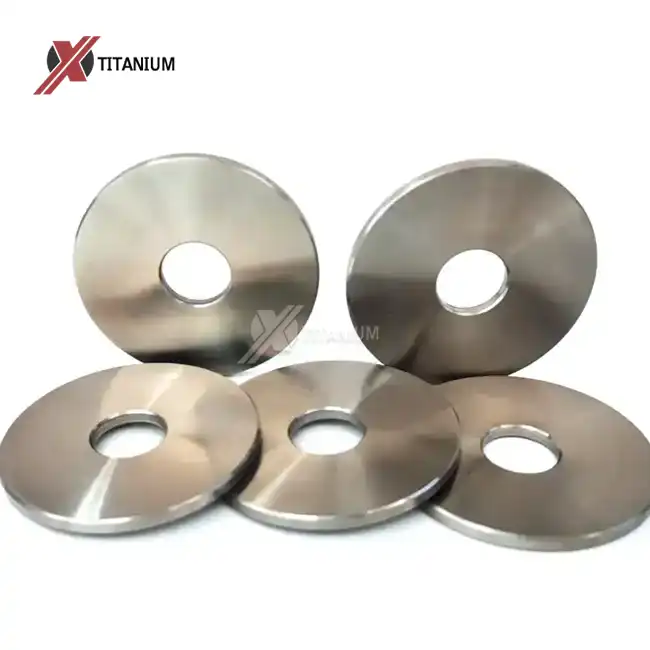
Understanding Ti-6Al-4V Titanium Flat Washers in Aerospace
Metallurgical Composition and Mechanical Properties
Ti-6Al-4V is an alpha-beta titanium metal with about 6% aluminum and 4% vanadium. Its microstructure is a good mix of strength and flexibility. The aluminum part stabilizes the alpha phase and makes it more resistant to rust. The vanadium part stabilizes the beta phase and makes it easier to forge and respond better to heat treatment. This mix gives tensile strengths of up to 130 ksi when annealed and up to 150 ksi when heat-treated. It also keeps stretch values around 10-15%, which stops brittle failure modes.
Aerospace washers made from this metal usually meet the requirements set by AMS 4928. This makes sure that the mechanical qualities are the same from one production batch to the next. The density of the material is 4.43 g/cm³, which is much lower than stainless steel's 8.0 g/cm³. This means that it can be used to make airplane structures lighter, since every pound affects fuel use and carrying capability. The modulus of elasticity is about 16.5 Msi, which is stiff enough to spread loads and flexible enough to account for differences in temperature expansion between the united materials.
Temperature and Corrosion Performance in Aeronautical Environments
During flight, aircraft parts such as Ti-6Al-4V Titanium Flat Washers are exposed to wide ranges of temperatures, from very cold conditions at high altitudes to high temperatures close to the engines. With creep resistance up to 400°C and embrittlement resistance down to -200°C, Ti-6Al-4V keeps its structural integrity across this range. The alloy creates a protective oxide layer that grows back when it is scratched. This keeps the alloy from rusting, even in salty sea settings that are common during coastal operations.
Aviation repair records show that titanium fastening gear always lasts longer than steel options in places where rust is likely to happen. If titanium parts are used, places like wing connection points, landing gear assemblies, and fuselage sections close to toilets that tend to get wet don't break down much after decades of use. This makes the airplane last longer, which means it doesn't need to be inspected as often and doesn't need to be replaced too soon, which would lower its availability and raise its lifecycle costs.
Compliance with Aerospace Standards and Certification Requirements
Specifications for buying aircraft bolts include a number of standards that work together to check the source of materials, their mechanical performance, and the controls used during production. Aerospace Material Specifications (AMS) rules say what chemicals can be used and how they must be processed. ASTM B348 rules say how to test titanium bar stock, which is used to make washers, and what its limits should be for size. Quality management systems need to show that they are in line with AS9100, which is an extension of ISO 9001 that applies specifically to aerospace and requires strict paperwork and process approval.
Each output lot comes with material certifications that include mill test papers that show the results of chemical analysis, mechanical tests, and heat treatment. These papers set up the chain of custody from the suppliers of raw materials to the final machining processes. This makes it possible to fully track down problems in the field. Aerospace OEMs usually make sellers keep their approved vendor status by auditing them on a regular basis to make sure they keep following the rules for quality systems and manufacturing processes.
Comparative Analysis: Ti-6Al-4V Titanium Washers vs Other Materials
Performance Advantages Over Stainless Steel and Aluminum Alternatives
When buying teams look at fastening gear, grades of stainless steel like 316 or A286 often come up as cheaper options than titanium. While steel washers are strong enough and don't cost as much, they are too heavy for use in aircraft uses. A comparison test shows that Grade 5 titanium screws are 45% lighter than similar steel parts and are also more resistant to rust. Aluminum alloys save about the same amount of weight, but they aren't strong enough or able to handle high temperatures for high-stress aircraft parts.
For aircraft uses, the most important performance measure is the strength-to-weight ratio. Specific strength of Ti-6Al-4V is about 30% higher than that of high-strength steel alloys and almost twice as high as that of aerospace-grade aluminum. Because of this benefit, engineers can make washers smaller while keeping their load capacity. This makes it possible to reduce the weight of airplane structures. The material's fatigue strength under cyclic loading conditions is much better than that of steel and aluminum. This means that parts will last longer in installations that are prone to shaking.
Galvanic corrosion is especially hard to deal with when joining metals that are not the same in aircraft systems. Modern airframes are mostly made of carbon fiber reinforced polymer (CFRP) materials. When there is moisture present, the electrical potential changes between CFRP and metal fasteners form corrosion cells. Titanium is in the galvanic series, which means it can be used with carbon fiber materials. On the other hand, aluminum washers make these surfaces corrode faster, and steel parts need isolation processes that make them more complicated and heavier.
Lifecycle Cost Analysis for Aerospace Procurement
At first glance, titanium washers appear to be three to five times more expensive than stainless steel versions. This can be shocking for procurement managers who are used to looking at unit prices. Lifecycle cost modeling shows a different picture when you look at how much fuel, labor, and new parts cost based on an airplane's weight over a 30-year service life. Every pound that commercial planes lose in weight saves them about $1,000 a year in fuel costs. This means that the higher starting cost of titanium is worth it, even for small parts like washers.
Increasing the time between maintenance tasks also saves money. Checking for corrosion and replacing fasteners are big upkeep costs, and the work costs are often higher than the costs of the parts. Titanium hardware lasts two to three times longer than steel options in corrosive settings, which means that it doesn't needs to be inspected as often or for as long. Titanium washers make it easier to standardize parts across airplane lines because the material has a wide range of uses, so a single part number can be used for many tasks that would normally need different versions made for each material.
For aerospace projects to work, timelines of decades are needed, and supply chain security is very important. Titanium producers to the aerospace industry keep their production skills and material certifications up to date for long periods of time. This makes sure that replacement parts are always available for airplanes that are still in use. The material's resistance to obsolescence, which is caused by qualities that don't change rather than changing manufacturing methods, gives aerospace makers who don't like taking risks the confidence to pay more for it.
How to Select and Use Ti-6Al-4V Titanium Flat Washers in Aerospace Projects?
Critical Specifications and Certification Verification
Specifications for purchases must include more than just simple math. Tolerances for inner diameter, outer diameter, and width have a direct effect on how load is distributed and how torque is applied to a unit. For aerospace uses, tolerances need to be tighter than for everyday use. For example, differences in width must be kept to ±0.005 inches and consistency in thickness must be kept to ±0.003 inches. Surface finish standards keep stress concentrations from happening, which could lead to wear cracks. For important uses, Ra values are usually limited to 125 microinches.
Material certifications need to be checked at more than one level. Suppliers must give test results on the materials that show that the chemical makeup is within the limits set by AMS 4928, that the mechanical qualities meet the minimum strength standards, and that each lot can be traced back to its source of raw materials. Heat treatment certifications show that the right steps were taken to get the microstructures that were wanted, and dimensional inspection records show that the parts fit within the limits set by the drawing. Aerospace buyers should make sure that the quality systems of suppliers are registered with AS9100 and check with important OEMs to see if the supplier is a recognized source, if needed.
Fake parts are always a threat in aircraft supply lines, so it's important to do your research on suppliers of Ti-6Al-4V Titanium Flat Washers. Manufacturers with a good reputation use anti-counterfeiting measures like laser-etched lot codes, tamper-evident packaging, and blockchain-based systems for tracking products. Purchasing teams should check with sellers on a regular basis to make sure that their manufacturing skills match their claimed qualifications. They should also look over the paperwork they send to see if there are any mistakes that could mean the certificates are fake.
Installation Best Practices and Torque Specifications
When titanium nuts are installed correctly, they will work as intended for the whole time they are in use. Because titanium has a lower amount of elasticity than steel, it is important to carefully control the force used for fastener assembly. When you over-torque, nuts can get embedded in softer base materials. This reduces the effective bearing area and causes stress to build up in certain places. Under-torquing lets the joint move, which speeds up the damage caused by tiredness. For torque specs, aircraft standards like the NASM1312 series should be used as a guide. These standards take into account the friction coefficients and thread engagement traits of different materials.
How you lubricate the threads affects the torque-preload relationships during fitting. Anti-seize products made for titanium usually have lubricants based on molybdenum disulfide or copper that stop galling and keep the friction coefficients constant. When used in high-temperature situations where thermal breakdown can happen, silver-based lubricants should not be used. To make sure that the load is evenly spread across multiple fastener designs, installation instructions should list the types of lube to use, how to apply them, and the order in which they should be applied.
How well the surfaces of matching parts are prepared affects how well the washer works. Surfaces of the substrate should be cleaned to get rid of any dirt or dust that might get in the way of load transfer or encourage cavity rust. When binding loads are applied to painted surfaces, extra care must be taken because soft coats can allow too much embedment. In aerospace assembly processes, surface preparation steps like solvent cleaning, abrasive pad treatment, and primer application boundaries are often listed to make sure that joints always behave the same way.
Customization Options for Specialized Aerospace Applications
Many aircraft uses can be met by standard catalog washers, but for more specific needs, custom designs are often needed. Engineers can ask for non-standard outer sizes to make thin-walled structures stronger or ask for thinner walls to lower the height of stacks in tight envelope installs. You can change the edge breaks and chamfers to keep the material from rolling over during high-torque installs. Certain friction or weather needs can be met by surface processes like passivation or dry film lubricant coats.
Different types of materials in the Ti-6Al-4V standard give you more ways to customize it. For cryogenic uses, ELI (Extra Low Interstitial) grades offer better ductility and crack toughness, while grades with more oxygen offer higher strength for high temperature service. When you choose between annealed and solution-treated conditions, you can change the mix between strength and ductility to fit the loading conditions of a particular application. To make sure sellers provide the right grades, procurement specs should make it clear what kinds of materials are needed.
When you work with approved suppliers, you can do joint engineering that makes part designs better. Titanium fastener makers with a lot of experience can suggest changes to the design that make it easier to machine, cut down on wait times, or improve performance. When suppliers are involved early on in specifying components, problems that might arise during production can be found before the final plans are made. This saves a lot of money on redesigns during the production ramp-up stages. Long-term relationships with capable providers give you a competitive edge because you can share technical knowledge and give priority to capacity sharing during disruptions in the supply chain.
Supplier and Brand Insights for Ti-6Al-4V Titanium Flat Washers
Evaluating Manufacturer Qualifications and Quality Systems
When buying aerospace products, suppliers need to be able to do more than just make things. Quality management systems need to show that they are registered with AS9100, which means they can handle cutting processes on titanium. Audit reports should show that risk-based thinking, configuration management processes, and steps to stop counterfeiting that aircraft buyers want have been put in place. Nadcap (National Aerospace and Defense Contractors Accreditation Program) certification for certain processes, such as heat treatment or non-destructive testing, adds to the proof of professional skills.
Manufacturers should keep equipment calibration systems that are linked to national standards and have written down calibration times and steps for what to do when something is out of range. For measuring sizes, coordinate measuring machines (CMM) must be able to be used, as well as spectrometers for figuring out what the material is made of and mechanical testing tools for making sure it is strong. To make sure sellers can meet delivery dates without lowering quality standards, a production capacity review should look at how many machine tools are available, how fast they can work, and how qualified the workers are.
Transparency in the supply chain makes risk management possible throughout the buying cycle. Qualified sellers keep records of where they get their raw materials and have lists of allowed vendors for titanium mill products and additional processes like heat treatment or surface finishing. Audits of Tier 2 and Tier 3 suppliers show that quality is important all along the supply chain. Business continuity plans that cover possible delays give customers faith in the long-term reliability of supplies. This is especially important for aerospace projects that last for many years.
Procurement Strategies for Consistent Supply and Cost Management
The procurement cycles in aerospace make it hard to handle supplies and build relationships with suppliers. Program standards often last for years, from the first samples to continuous delivery. This means that suppliers need to be able to keep quality high over long periods of time. Setting up framework deals with qualified providers helps with long-term program planning by ensuring stable prices and capacity. Blanket purchase orders with planned releases keep inventory costs in check while also making sure there is a steady supply of goods.
Minimum order numbers (MOQ) for titanium washers are based on how much it costs to buy the raw materials and set up the machine for the first time. Most of the time, suppliers set MOQs based on output lot sizes that make the best use of materials and machines. Buyers in the aerospace industry can get better MOQ terms by combining needs from different projects or agreeing to longer lead times that let suppliers group orders that are similar. Strategically placing inventory at supplier sites, which is also known as "vendor-managed inventory," cuts down on wait times and keeps customers from holding too much stock.
To handle lead times, you need to know how the whole manufacturing process works for Ti-6Al-4V Titanium Flat Washers, from getting the raw materials to delivering the finished product. Getting titanium bar stock from mills usually takes 12 to 16 weeks, plus the time needed for cutting, heat treatment, testing, and making certification documents. Rush orders cost more, but they may be necessary in cases of AOG (Aircraft On Ground) or to get back on track with a program's plan. When handled carefully, keeping a buffer store of long-lead parts lowers schedule risks without adding too much to the cost of carrying.
Case Studies: Successful Aerospace Supplier Partnerships
Through smart supplier consolidation efforts, major aircraft OEMs have cut quality escapes related to fasteners by 60%. Leading manufacturers no longer get their parts from dozens of distributors whose products are hard to track. Instead, they work with tier-one fastener experts who have direct ties with titanium mills and follow quality standards designed for aerospace applications. These relationships make it possible for people to work together to solve problems in the field and make it easier to make quick changes to engineering plans during aircraft development projects.
After standardizing on titanium fastening gear, regional aircraft companies with composite manufacturing facilities said that the cost of assembly labor dropped by 35%. The removal of corrosion-prevention treatments needed for steel fasteners, such as isolation plates and sealing applications, made installation easier and cut down on the time needed to touch each fastener. Maintenance teams saw fewer checks for corrosion and longer periods of time between replacing fasteners, which further lowered lifetime costs even though the original prices of the parts were higher.
In order to meet weight reduction goals for a commercial airplane program, old steel fastening gear was replaced with titanium alternatives in all secondary elements. The engineering team worked closely with fastener makers to find places where titanium's high strength-to-weight ratio made it possible to reduce the size of parts without lowering their load capacity. A thorough finite element analysis proved that titanium washers with smaller diameters offered enough bearing area while lowering weight by 30% compared to steel components. This joint engineering method made the whole fleet use less fuel, which could be measured.
Conclusion
Ti-6Al-4V Titanium Flat Washers are a smart material choice for aircraft uses where performance, dependability, and long-term value are more important than original cost. The alloy's unique mix of strength, resistance to corrosion, and low weight solves some of the most difficult problems in modern airplane design. It also helps meet environmental goals by lasting longer and being easier to recycle. For aerospace buying to go well, relationships with suppliers must be based on technical know-how, a mature quality system, and a shared goal to always getting better. Titanium fastening gear will continue to be an important part of making sure that airplane structures are safe, efficient, and long-lasting, even as aerospace technology moves toward more electric architectures, advanced composites, and tough working environments.
FAQ
Why are Ti-6Al-4V titanium washers preferred over steel in aerospace applications?
Aerospace engineers choose Ti-6Al-4V Titanium Flat Washers because they are 45% lighter than steel versions while still having better strength-to-weight ratios and resistance to rust. The substance can handle very low temperatures (below 0°C) and high temperatures (400°C) without breaking down. It also eliminates the risk of galvanic rust when joining carbon fiber composites and offers wear resistance that makes parts last longer.
How do I verify that titanium washers meet aerospace certification requirements?
Ask for material test results that show the chemical makeup meets the standards of AMS 4928, data on the mechanical properties that show the required strength and ductility, and lot traceability certificates that connect parts to approved raw material sources. Check to see if providers are still registered with the AS9100 quality system and have accepted vendor standing with major aircraft OEMs.
Can I source certified aerospace-grade titanium washers for small-batch prototyping?
Reliable aircraft fastener providers can make prototypes and keep up with full certification and traceability standards. Minimum order amounts depend on the supplier and the complexity of the part, but well-known makers usually offer sampling programs that let engineers test the product before committing to production.
Partner with Chuanglian for Certified Aerospace-Grade Ti-6Al-4V Solutions
The Baoji Chuanglian New Metal Material Co., Ltd. has been making titanium fasteners and accurate parts for aircraft, defense, and high-performance uses for more than ten years. Our quality control system is in line with AS9100 standards, which means that every titanium flat washer we make meets strict aerospace requirements. You can track the material from certified titanium mills all the way through the final review. We are in Baoji City, which is known as China's titanium production hub. We have a wide range of machining tools, such as CNC precise equipment and advanced testing facilities that check the accuracy of dimensions and material properties for important aerospace uses.
Our engineering team works together with sourcing professionals and design engineers to improve the specs of parts, suggest the best grades of materials, and give you technical documents that support your certification needs. We know how important it is to be able to deliver on time, so we keep strategic inventory spots that cut down on wait times for both prototype sampling and large production runs. Chuanglian gives your aerospace projects the quality, stability, and technical support they need, whether they're looking for suppliers for a new airframe program or a dependable titanium fastener maker for ongoing production. Get in touch with our aircraft sales team at info@cltifastener.com or djy6580@aliyun.com to talk about your needs and ask for clearance paperwork.
References
1. Boyer, R., Welsch, G., and Collings, E.W. (1994). Materials Properties Handbook: Titanium Alloys. ASM International, Materials Park, Ohio.
2. Donachie, M.J. (2000). Titanium: A Technical Guide, 2nd Edition. ASM International, Materials Park, Ohio.
3. Federal Aviation Administration (2019). Advisory Circular AC 43.13-1B: Acceptable Methods, Techniques, and Practices - Aircraft Inspection and Repair. U.S. Department of Transportation, Washington, D.C.
4. Lutjering, G. and Williams, J.C. (2007). Titanium, 2nd Edition: Engineering Materials and Processes. Springer-Verlag, Berlin Heidelberg.
5. SAE International (2021). Aerospace Material Specification AMS 4928: Titanium Alloy, Bars, Wire, Forgings, Rings, and Drawn Shapes 6Al-4V Annealed. Society of Automotive Engineers, Warrendale, Pennsylvania.
6. Veiga, C., Davim, J.P., and Loureiro, A.J.R. (2012). "Properties and Applications of Titanium Alloys: A Brief Review." Reviews on Advanced Materials Science, Volume 32, Issue 2, pp. 133-148.
Learn about our latest products and discounts through SMS or email